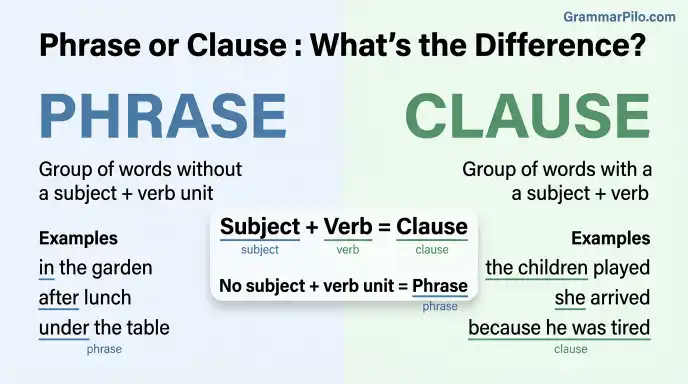
Have you ever wondered if a group of words is a phrase or clause? The key difference is simple: a phrase does not contain a complete subject-verb unit, while a clause contains a subject and a verb. Both phrases and clauses are important parts of English grammar, but they perform different jobs in a sentence.
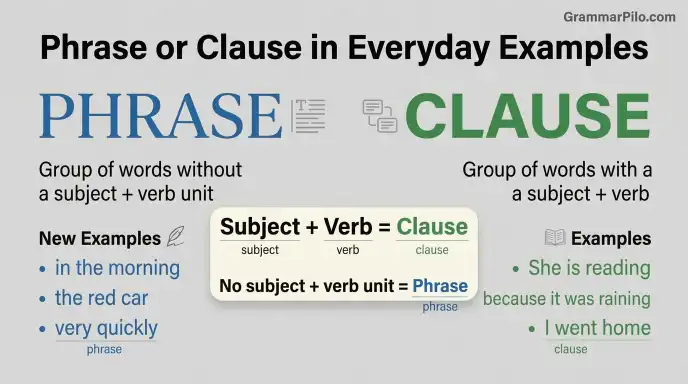
A phrase is a group of words that works together but does not contain a subject-verb unit. A clause is a group of words that contains a subject and a verb. For example, “in the morning” is a phrase, while “she arrived in the morning” is a clause. A clause can be independent or dependent.
For example, “under the table” is a phrase because it does not contain a subject and verb. “The cat slept” is a clause because it has the subject the cat and the verb slept.
This distinction becomes especially useful when you are learning sentence structure, identifying sentence fragments, using commas, or writing more clearly. Clauses can be independent or dependent, while phrases can function as nouns, adjectives, adverbs, and other parts of a sentence.
In this guide, you will learn the difference between a phrase and a clause, how to identify each one, when to use them, common mistakes, and plenty of everyday examples
Phrase or Clause : Quick Answer
Phrase: A group of words that functions together but does not contain a subject and verb working as a unit.
Clause: A group of words that contains a subject and a verb.
| Example | Type | Why? |
| in the garden | Phrase | No subject-verb unit |
| after the meeting | Phrase | No subject-verb unit |
| the children played | Clause | “children” = subject; “played” = verb |
| because she was tired | Clause | “she” = subject; “was” = verb |
| running down the street | Phrase | No stated subject |
| when the rain stopped | Clause | “rain” = subject; “stopped” = verb |
The easiest memory trick is:
Phrase = no subject-verb unit.
Clause = subject + verb.
However, remember that some clauses are dependent and cannot stand alone as complete sentences.
What Does Phrase or Clause Mean?
What Is a Phrase?
A phrase is a group of words that functions as a unit within a sentence. It does not contain a subject and finite verb working together as a clause.
Examples include:
- the old house
- in the morning
- very quickly
- after lunch
- with great care
- a beautiful garden
Consider this sentence:
The children played in the garden.
The words “in the garden” form a prepositional phrase. They give information about where the children played, but they do not contain a subject and verb.
Phrases can perform different grammatical functions. Common types include noun phrases, verb phrases, adjective phrases, adverb phrases, and prepositional phrases.
What Is a Clause?
A clause is a group of words containing a subject and a verb. Cambridge describes a clause as a basic unit of grammar and notes that a typical clause contains a subject and a verb phrase.
Examples include:
- She smiled.
- The dog barked.
- They went home.
- because he was late
- when the movie ended
Look at:
Because she was tired, she went to bed.
The words “she was tired” form a clause because she is the subject and was is the verb.
The clause begins with because, so it is dependent on the main clause for its complete meaning.
The Simplest Difference
The easiest way to distinguish the two is to look for a subject and verb.
Phrase:
after the class
There is no subject-verb combination.
Clause:
after the class ended
Here, the class is the subject and ended is the verb.
The Origin of Phrase and Clause
The words phrase and clause have different histories.
Origin of Phrase
The English word phrase dates to the 1520s. It came through Late Latin phrasis, meaning “diction,” and ultimately from Greek phrasis, meaning speech, expression, or a way of speaking. The Greek verb phrazein carried meanings related to telling, explaining, indicating, or expressing.
Over time, phrase developed into the modern grammatical term for a group of words functioning together within a sentence.
Today, we use the word in both grammar and everyday language. For example:
“That is a common phrase.”
In grammar:
“Under the bridge” is a prepositional phrase.
Origin of Clause
The English word clause dates to around the 1200s. It came from Old French clause, which was connected to Medieval Latin clausa, meaning a conclusion or closing. Its grammatical meaning developed in English around the 1300s.
The word also developed a legal meaning referring to a particular condition or section of a legal document.
Today, clause has two especially common meanings:
- A grammatical unit containing a subject and verb.
- A section or condition in a legal document.
For example:
The sentence contains two clauses.
But:
The contract includes a payment clause.
These are different uses of the same word.
British English vs American English
There is no major spelling difference between “phrase” and “clause” in British and American English. Both varieties use the same spellings and the same basic grammatical distinction.
| Feature | British English | American English |
| Phrase | phrase | phrase |
| Clause | clause | clause |
| Spelling difference | None | None |
| Basic meaning of phrase | Group of words functioning together | Group of words functioning together |
| Basic meaning of clause | Group of words containing a subject and verb | Group of words containing a subject and verb |
| Independent clause | Used | Used |
| Dependent clause | Used | Used |
| Grammar rule | Essentially the same | Essentially the same |
For example:
British English:
She left after the meeting ended.
American English:
She left after the meeting ended.
The distinction between the phrase and clause is the same in both varieties.
Differences between British and American English can appear elsewhere in vocabulary, spelling, punctuation, and style, but phrase and clause themselves are not competing British/American spellings.
Which Version Should You Use?
If you are deciding between phrase and clause, your choice depends on the grammatical structure you are describing—not on your country or variety of English.
For US English
Use phrase when the word group does not contain a subject-verb unit.
Use clause when it contains a subject and verb.
in the office: phrase
she works in the office: clause
For UK English
The same distinction applies.
after lunch: phrase
after lunch ended: clause
For Canada and Australia
Canadian and Australian English follow essentially the same grammatical distinction.
For International English
For ESL learners and international readers, the simplest rule is:
Look for the subject and verb.
If the group has a subject and verb, it is generally a clause. If it does not, it may be a phrase.
For Academic Writing
Understanding clauses helps you create more varied sentence structures.
Compare:
The students studied hard.
with:
The students studied hard because the exam was approaching.
The second sentence uses a dependent clause to explain why the students studied.
For Business Writing
Phrases are useful for concise information, while clauses allow you to express complete relationships between ideas.
After the meeting: phrase
After the meeting ended: clause
Both can be useful depending on what you want to communicate.
Common Mistakes With Phrase or Clause
Mistake 1: Thinking Every Group of Words Is a Clause
Not every group of words is a clause.
Incorrect idea:
“under the old bridge” is a clause.
Correct:
“under the old bridge” is a phrase.
It does not contain a subject and verb.
Memory tip:
No subject + verb unit? Think phrase.
Mistake 2: Thinking Every Clause Is a Complete Sentence
A clause can be dependent.
For example:
because she was tired
This contains a subject (she) and a verb (was), so it is a clause. But it does not express a complete thought by itself.
Correct:
She went home because she was tired.
Here, “because she was tired” is a dependent clause.
Mistake 3: Confusing a Verb Phrase With a Clause
A verb phrase can contain several verbs without forming a complete clause by itself.
For example:
has been working
This is a verb phrase.
But:
She has been working
is a clause because it contains the subject she along with the verb phrase has been working.
Mistake 4: Calling a Phrase a Sentence
A phrase usually cannot function as a complete sentence.
For example:
After the meeting.
This is a phrase, not a complete sentence.
You could write:
We went home after the meeting.
Now the sentence contains a complete clause.
Mistake 5: Forgetting That Clauses Can Be Dependent
A dependent clause has a subject and verb but cannot normally stand alone as a complete sentence.
Example:
Although he was tired
This is a dependent clause.
Complete it with a main clause:
Although he was tired, he continued working.
Phrase or Clause in Everyday Examples
In Emails
Phrase:
After the meeting
Clause:
After the meeting ended, I will send the report.
The clause gives the sentence a subject and verb.
In Business Writing
Phrase:
Before the deadline
Clause:
Before the deadline arrives, we need to finish the project.
The second example uses a dependent clause.
In News Headlines
News headlines often use shortened structures, so they may not always look like ordinary complete sentences.
For example:
After the storm
This is a phrase.
A complete sentence could be:
After the storm ended, residents returned home.
In Blogs
Writers use both phrases and clauses to control sentence length and rhythm.
During the summer, many people travel.
“During the summer” is a phrase.
When summer arrives, many people travel.
“When summer arrives” is a clause.
In Social Media
Short phrases are common:
On my way home
A beautiful evening
These are phrases rather than complete clauses.
In Academic Writing
Clauses are especially important when explaining relationships between ideas.
Students learn more effectively when they practice regularly.
The part “when they practice regularly” is a dependent clause.
In Daily Conversation
People frequently use phrases as conversational responses:
“After lunch.”
“At the office.”
“In a few minutes.”
These expressions can communicate meaning even though they are not complete sentences.
Google Trends & Modern Usage
The terms phrase and clause remain common grammar terms in modern English-learning materials. They are especially relevant to students learning sentence structure, punctuation, writing, and English as a second language.
There is no need to treat phrase and clause as spelling alternatives. They are two different grammatical concepts.
Search interest can vary over time depending on school terms, exams, English-learning trends, and educational content.
Because search-volume numbers can change and third-party trend estimates may differ, specific numerical figures should not be presented without a current, verifiable data source.
For GrammarPilo readers, the most useful takeaway is not which term is more popular. It is knowing how to identify each one correctly.
Quick Comparison Table: Clause vs. Phrase
| Feature | Phrase | Clause |
| Basic definition | Group of words functioning together | Group of words containing a subject and verb |
| Subject + verb | Not as a complete unit | Yes |
| Can be part of a sentence? | Yes | Yes |
| Can be a complete sentence? | No, generally | Independent clauses can |
| Main types | Noun, verb, adjective, adverb, prepositional | Independent, dependent, relative, subordinate, etc. |
| Example | in the garden | the children played |
| Another example | after lunch | after lunch ended |
| Main purpose | Adds or groups information | Expresses a grammatical relationship or idea |
Easy Test
Ask yourself:
Does this group of words contain a subject and a verb?
If no, it is likely a phrase.
If yes, it is a clause.
For example:
in the house → Phrase
she is in the house → Clause
after the movie → Phrase
after the movie ended → Clause
This simple test works well for many basic grammar questions.
Key Takeaways
- A phrase is a group of words that functions together.
- A clause contains a subject and a verb.
- “In the morning” is a phrase.
- “She arrived in the morning” is a clause.
- An independent clause can stand alone as a sentence.
- A dependent clause cannot normally stand alone.
- A verb phrase is not necessarily a complete clause.
- “Phrase” and “clause” have the same spelling in British and American English.
- The terms describe different grammatical structures, not alternative spellings.
- The easiest test is to look for a subject + verb combination.
FAQs About Clause and Phrase
Is a phrase the same as a clause?
No. A phrase and a clause are different grammatical structures. A phrase is a group of words functioning together without a subject-verb unit. A clause contains a subject and a verb. For example, “in the house” is a phrase, while “she is in the house” is a clause.
What is an easy way to identify a clause?
Look for a subject and a verb. If the group of words contains both, it is likely a clause. For example, “the dog barked” contains the subject “the dog” and the verb “barked,” so it is a clause.
Can a phrase be a sentence?
A phrase is not normally a complete sentence because it does not contain a complete subject-verb structure. However, phrases can sometimes be used as sentence-like expressions in conversation, headlines, or informal writing. For example, “After lunch” can be a conversational response even though it is not a complete sentence.
Can a clause be a sentence?
Yes. An independent clause can stand alone as a complete sentence. For example, “The children laughed” is both a clause and a complete sentence. A dependent clause, however, cannot normally stand alone because it depends on another clause to complete its meaning.
What is a phrase example?
Examples of phrases include “under the table,” “after lunch,” “the tall building,” and “very quickly.” These groups of words work together in a sentence but do not contain a subject and verb functioning together as a clause.
What is a clause example?
Examples include “she smiled,” “the children played,” and “because he was tired.” Each contains a subject and verb. The first two can function as independent clauses, while “because he was tired” is a dependent clause.
Is “after the meeting” a phrase or clause?
“After the meeting” is a phrase. It does not contain a subject and verb. If you change it to “after the meeting ended,” it becomes a clause because “the meeting” is the subject and “ended” is the verb.
Is “because I was tired” a phrase or clause?
“Because I was tired” is a dependent clause. It contains the subject “I” and the verb “was.” The word “because” makes the clause dependent on another part of the sentence.
What is the difference between an independent and dependent clause?
An independent clause can stand alone as a complete sentence, while a dependent clause cannot normally stand alone. For example, “I went home” is independent. “Because I was tired” is dependent. Together, they form a complete sentence: “I went home because I was tired.”
Do British and American English use phrase and clause differently?
The basic grammatical distinction is the same in British and American English. Both use “phrase” for groups of words functioning together and “clause” for structures containing a subject and verb. There is no British-versus-American spelling choice between these two terms.
Conclusion
Understanding the difference between a phrase or clause makes English grammar much easier. The basic rule is simple: a phrase does not contain a subject-verb unit, while a clause does.
For example, “in the garden” is a phrase because it does not contain a subject and verb. “The children played in the garden” is a clause because it contains the subject the children and the verb played.
Clauses can be independent or dependent. An independent clause can stand alone as a sentence, while a dependent clause needs another clause to complete the thought. Phrases, meanwhile, can work as nouns, adjectives, adverbs, prepositional expressions, and other parts of a sentence.
The distinction is the same in British and American English. So when you are unsure, do not focus on spelling or pronunciation. Instead, look for the subject and verb. If you find both working together, you are looking at a clause. If you do not, you are probably looking at a phrase.
Once you learn this simple test, identifying phrases and clauses becomes much easier in everyday writing, academic work, emails, and conversations.
Explore more Articles:

I’m Sloane Mercer, a U.S.-based English language writer focused on grammar, spelling, vocabulary, and everyday English usage. Through GrammarPilo, I provide clear and practical explanations to help readers choose the right words and communicate with confidence.



3 thoughts on “Phrase or Clause: What’s the Difference?”