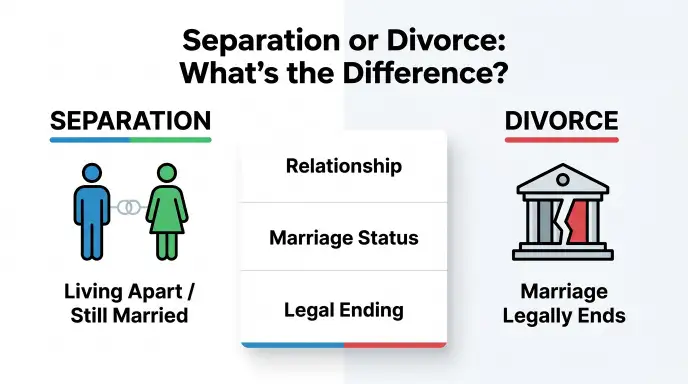
Separation means living apart while still married, whereas divorce legally ends the marriage.
When people search “separation or divorce,” they are usually asking whether the two words mean the same thing. They do not.
Separation generally means that spouses live apart or stop living as a couple, while divorce is the official legal process that ends a marriage.
The confusion is understandable because separation can happen before divorce, and the two words often appear together in conversations about relationships, family law, finances, and children.
A couple may separate without divorcing, while another couple may separate and later decide to end the marriage legally.
This guide explains separation vs. divorce in simple English. You will learn what each word means, how the terms are used, the difference between legal separation and divorce, common mistakes, regional considerations, and examples you can use in everyday writing.
Separation or Divorce: What Is the Difference?
Separation means that two spouses live apart or stop living together as a couple. Divorce means that a marriage is officially ended through a legal process. A couple can be separated while still legally married, but divorce ends the marriage itself.
In simple terms:
- Separation = living apart or ending the relationship as a couple
- Divorce = legally ending the marriage
- Legal separation = a formal arrangement in which spouses remain married
- Divorce does not mean simply living apart
For example:
“They are separated but have not filed for divorce.”
This means they are living apart or no longer functioning as a couple, but their marriage has not necessarily been legally ended.
“They decided to get a divorce.”
This means they chose to begin or complete the legal process of ending their marriage.
The exact legal effects of separation vary by jurisdiction, so legal questions should be checked against the laws where the couple lives.
Separation or Divorce: Quick Answer
If you need the short answer, use separation when you mean that spouses have stopped living together or are no longer together as a couple. Use divorce when you mean the official legal ending of a marriage.
Examples
- “They are considering a separation.”
The couple may live apart while deciding what to do about their marriage. - “They are getting a divorce.”
They are ending their marriage through an official legal process. - “After two years of separation, they decided to divorce.”
The sentence uses both words correctly because the couple first lived apart and later ended the marriage legally.
What Does Separation or Divorce Mean?
What Does “Separation” Mean?
Separation is a broad word. It can mean the state of being apart, but when discussing marriage, it often refers to spouses stopping their life together as a couple. Cambridge specifically describes separation as an arrangement, often legal, in which married people stop living together as a couple.
For example:
- “The couple announced their separation.”
- “They have been separated for six months.”
- “They are considering a trial separation.”
A separation does not automatically mean that a marriage has legally ended.
What Does “Divorce” Mean?
Divorce is more specific. It refers to the official or legal process of ending a marriage. Cambridge defines divorce as an official or legal process used to end a marriage.
Examples include:
- “They filed for divorce.”
- “She is getting a divorce.”
- “Their marriage ended in divorce.”
The word divorce can also be used as a verb:
“They decided to divorce.”
Or:
“She divorced her husband.”
Cambridge notes that divorce can function as both a noun and a verb when referring to the legal ending of a marriage.
The Origin of Separation or Divorce
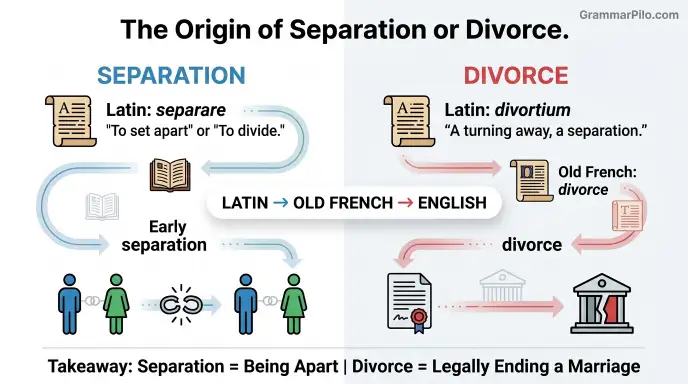
The two words have different histories.
Separation comes from the Latin separare, meaning “to set apart” or “to divide.” English developed the word from forms associated with the Latin root through Old French and Middle English.
Divorce comes through Old French divorce and ultimately from Latin divortium, related to the idea of turning away or separating. The word became associated specifically with the legal dissolution of marriage.
This history helps explain an important distinction that still exists today. Separation has a broad meaning of being apart, while divorce developed a more specific connection with ending a marriage.
The modern meanings are much more important for everyday writing than their historical roots.
British English vs American English
There is no major spelling difference between separation and divorce in British and American English. Both varieties use the same words and spellings.
The main differences are related to legal systems, pronunciation, and local terminology, rather than spelling.
| Term | British English | American English | Example |
| Separation | separation | separation | “They announced their separation.” |
| Legal separation | legal separation / judicial separation in relevant contexts | legal separation | “They remain legally married.” |
| Divorce | divorce | divorce | “They filed for divorce.” |
| Separated | separated | separated | “They have been separated for a year.” |
| Divorced | divorced | divorced | “They are officially divorced.” |
In England and Wales, for example, a legal separation can allow a couple to live separately without ending their marriage. GOV.UK explains that legal separation allows spouses to separate without divorcing or officially ending their civil partnership.
In the United States, the meaning and legal consequences of legal separation can vary by state. Cornell’s Legal Information Institute notes that a legally separated couple remains legally married, with the specific consequences depending on the jurisdiction.
So, when writing for a general English-speaking audience, separation and divorce are safe and standard terms. For legal writing, use the terminology required by the relevant jurisdiction.
Which Version Should You Use?
The choice depends on what you mean, not simply where you live.
United States
Use separation when discussing spouses who live apart or have separated but remain married.
Use divorce when discussing the legal ending of the marriage.
Because family law differs from state to state, avoid making broad legal claims without checking the applicable state law.
United Kingdom
Use separation for living apart or ending a relationship as a couple without necessarily ending the marriage.
Use divorce for the official process that ends the marriage.
In England and Wales, GOV.UK distinguishes legal separation from divorce and explains that a legal separation does not end the marriage.
Canada
The same basic English distinction applies:
- separation = spouses live apart or stop living together as a couple
- divorce = legal ending of the marriage
Canadian legal procedures can vary by situation, so legal content should use current Canadian government or provincial sources.
Australia
The everyday English distinction is also straightforward. Separation describes the relationship status or period of living apart, while divorce refers to the legal ending of the marriage.
International Writing
For international readers, use the simplest wording:
“They separated but have not divorced.”
This sentence makes the distinction clear without depending on a specific country’s legal terminology.
Academic Writing
In academic writing, define the terms if they are central to your topic.
For example:
“In this study, separation refers to living apart while divorce refers to the legal dissolution of marriage.”
This avoids ambiguity.
Business Writing
In professional writing, use neutral and respectful language:
“The employee is currently separated from their spouse.”
Avoid unnecessary personal details unless they are relevant to the subject.
Common Mistakes
Mistake 1: Treating Separation and Divorce as Exact Synonyms
Incorrect:
“They are separated, so their marriage has legally ended.”
Correct:
“They are separated, but their marriage may still be legally intact.”
Why?
Separation does not automatically mean divorce.
Memory tip:
Separated = apart. Divorced = marriage legally ended.
Mistake 2: Using “Divorce” for Any Relationship Breakup
Incorrect:
“My boyfriend and I are getting a divorce.”
Correct:
“My boyfriend and I are breaking up.”
Why?
Divorce specifically relates to marriage.
Mistake 3: Assuming Separation Always Leads to Divorce
Incorrect assumption:
“Every separation ends in divorce.”
Better:
“Some separations lead to divorce, while others do not.”
A couple may separate temporarily, reconcile, remain separated, or later divorce.
Mistake 4: Confusing “Separated” With “Divorced”
Incorrect:
“She is divorced, but they still live as a married couple.”
Better:
“They are separated but not yet divorced.”
The second sentence clearly distinguishes the relationship situation from the legal status.
Everyday Examples
In Emails
“Please let me know if the change in your marital status affects the information on your application.”
For sensitive subjects, professional emails should use neutral language.
In Business Writing
“The employee reported that they are separated from their spouse.”
This is more neutral than using unnecessary personal details.
In News Headlines
Celebrity Couple Announces Separation
This indicates that the couple has announced that they are no longer together as a couple. It does not necessarily mean that they are legally divorced.
In Blogs
“Separation can be a difficult period because couples may still need to make decisions about housing, finances, and children.”
On Social Media
“After several years together, they announced their separation.”
This is a common way to describe a relationship ending without stating that a divorce has occurred.
In Academic Writing
“The researchers examined the effects of parental separation and divorce on family relationships.”
Here, using both terms can be useful because they describe related but distinct circumstances.
In Daily Conversation
“Are they divorced?”
“No. They are separated.”
This is one of the clearest examples of the difference.
Google Trends & Modern Usage
Search interest around “separation or divorce” is understandable because people often encounter the two terms together. They appear in discussions about relationships, family law, children, finances, housing, and major life changes.
However, there is no need to treat separation and divorce as competing spellings or interchangeable grammar choices. They are different words with overlapping subject matter.
Search behavior can also be influenced by legal questions. Someone searching for “separation vs divorce” may want to know whether they can remain married while living apart, while someone searching for “separation before divorce” may be asking about a possible stage in ending a marriage.
Exact legal meanings and procedures depend on location. For example, GOV.UK explicitly distinguishes legal separation from divorce, while Cornell’s Legal Information Institute explains that legal separation in the United States leaves the spouses legally married.
For language learners, the easiest rule remains:
Separation describes being apart. Divorce describes legally ending a marriage.
Quick Comparison Table
| Version | Meaning | Correct? | Region | Example |
| Separation | Living apart or being apart as a couple | Yes | International | “They announced their separation.” |
| Legal separation | Formal separation while remaining married | Yes | Depends on jurisdiction | “They obtained a legal separation.” |
| Divorce | Official legal ending of a marriage | Yes | International | “They filed for divorce.” |
| Separated | Describes people who are no longer living together as a couple | Yes | International | “They are separated.” |
| Divorced | Describes people whose marriage has legally ended | Yes | International | “They are divorced.” |
Separation vs Divorce at a Glance
| Question | Separation | Divorce |
| Does the couple live apart? | Often | Usually, but not the defining feature |
| Does it end the marriage? | Not necessarily | Yes |
| Can the couple reconcile? | Yes | They would need to remarry to become married again |
| Is it always a legal process? | No | Yes, where divorce is legally recognized |
| Can the couple remain married? | Yes | No |
| Best simple definition | Being apart | Legally ending a marriage |
Key Takeaways
- Separation and divorce do not mean exactly the same thing.
- Separation generally means that spouses live apart or stop living together as a couple.
- Divorce is the official or legal process of ending a marriage.
- A couple can be separated without being divorced.
- Legal separation allows spouses to remain legally married in jurisdictions that recognize it.
- The legal effects of separation vary by country, state, or other jurisdiction.
- Use separation when the focus is on being apart.
- Use divorce when the focus is on legally ending the marriage.
Frequently Asked Questions
Q1. Is separation the same as divorce?
No. Separation and divorce are related but different. Separation generally means that spouses live apart or have stopped living together as a couple. Divorce is the official legal process that ends a marriage. A couple can therefore be separated while still legally married.
Q2. Which is better, separation or divorce?
Neither word is inherently “better.” They describe different situations. Separation may describe a period of living apart without ending the marriage, while divorce describes legally ending the marriage. The appropriate term depends on what has happened and, for legal matters, the laws that apply to the couple.
Q3. Can you be separated but not divorced?
Yes. This is one of the most important differences between the terms. A married couple can live separately or stop functioning as a couple while remaining legally married. Some jurisdictions also recognize a formal legal separation that provides legal arrangements without ending the marriage.
Q3. Does separation automatically lead to divorce?
No. Separation does not automatically mean that a couple will divorce. Some couples reconcile, while others remain separated without divorcing. Others eventually begin a divorce process. The words describe different stages or situations rather than a guaranteed sequence.
Q4. What does “separated but not divorced” mean?
It usually means that the spouses are no longer living together as a couple but their marriage has not been legally ended. Depending on the jurisdiction, they may have informal arrangements or a formal legal separation. The phrase is useful when someone wants to distinguish relationship status from legal marital status.
Q5. Should I say “separated” or “divorced”?
Use separated when the people have separated but are still married. Use divorced when the marriage has officially ended. For example, “They are separated” and “They are divorced” communicate different situations.
Q6. Is separation a legal term?
It can be. In everyday English, separation simply means being apart. Some legal systems also recognize legal separation, which can create formal arrangements while the couple remains married. The exact meaning and legal consequences depend on the jurisdiction.
Q7. Can a separated couple get back together?
Yes. Separation does not necessarily mean that the marriage has ended permanently. A couple may separate for a period and later reconcile. This is one reason why separated should not automatically be replaced with divorced.
Q8. Can you divorce without being separated first?
The answer depends on the laws and procedures of the relevant jurisdiction. Separation is not simply another word for divorce, and not every legal system treats a period of separation in the same way. For a legal question, check the current rules where the divorce will take place.
Q9. What is the easiest way to remember separation vs divorce?
Remember this simple rule: separation means being apart, while divorce means legally ending a marriage. If the couple is no longer together but remains married, “separated” is usually the appropriate everyday term. If the marriage has legally ended, “divorced” is the appropriate term.
Conclusion
The difference between separation or divorce is mainly about what has happened to the relationship and the marriage legally. Separation generally means that spouses are living apart or have stopped living together as a couple. Divorce, on the other hand, is the official legal process that ends a marriage.
The easiest way to remember the difference is to focus on the marriage itself. If the spouses are apart but remain married, they can be described as separated. If their marriage has been legally ended, they are divorced.
The distinction matters in everyday English, journalism, academic writing, and legal discussions. It also matters because the legal meaning of separation can vary between jurisdictions.
For example, England and Wales recognize legal separation without divorce, while U.S. legal separation rules depend on state law.
Remember: separation means being apart; divorce means legally ending the marriage.
Commonly Confused English Words

I’m Claire Morgan, the author behind Grammarpilo.com, where I write about English grammar, sentence structure, punctuation, and everyday language. My goal is to make grammar simple, clear, and practical, helping readers understand the rules and apply them with confidence in real-world writing.






2 thoughts on “Separation or Divorce: What’s the Difference?”