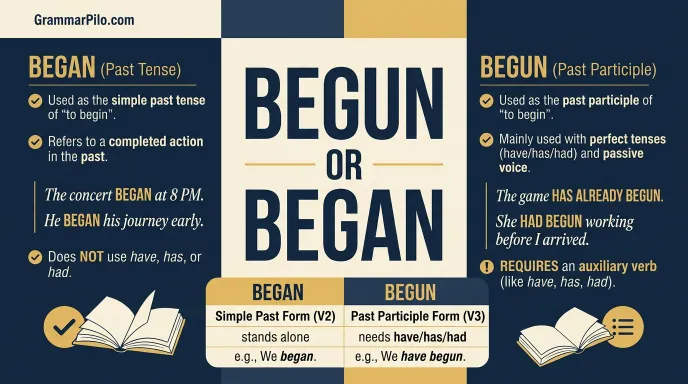
Began is the simple past form of begin, while begun is the past participle and normally needs a helping verb such as have, has, or had. Both began and begun are correct, but they serve different grammatical purposes.
People often search for begun or began because the verb begin is irregular. Its three main forms are begin, began, and begun, which can be confusing for English learners, writers, and anyone checking a sentence.
Unlike a regular verb such as walk, which changes to walked, the verb begin changes its vowel in the past forms.
For example, we say “The movie began at seven”, but “The movie has begun.” We do not normally say “The movie begun at seven” because begun is not the simple past form.
Understanding the difference is useful in everyday English because began describes a completed past action, while begun works as a past participle in perfect and passive constructions.
Once you learn the pattern begin → began → begun, choosing the correct form becomes much easier.
Began or Begun: Quick Answer
Began is the simple past form of begin.
Example: The meeting began at nine o’clock.
Begun is the past participle of begin.
Example: The meeting has begun.
The basic verb pattern is:
Begin → began → begun
| Verb form | Grammatical role | Example |
| begin | Present/base form | We begin work at nine. |
| began | Simple past | We began work at nine. |
| begun | Past participle | We have begun work. |
| beginning | ing form | We are beginning work. |
The easiest rule is:
Simple past → began
Past participle → begun
For example:
The class began at eight.
The class has begun.
A common mistake is using begun by itself as the simple past.
Incorrect: The movie begun at seven.
Correct: The movie began at seven.
Definition and Meaning of Begun and Began
What does “begin” mean?
Begin means to start something or to start happening. It can describe an activity, event, process, period, or action.
Examples:
- The lesson will begin soon.
- The movie begins at six.
- We need to begin the project.
- The rain began suddenly.
The verb can be used with an object or without one.
With an object:
She began the lesson.
Without an object:
The lesson began at noon.
What does “began” mean?
Began means that something started in the past. It is the simple past form of begin.
Examples:
- The concert began at eight.
- She began writing a letter.
- They began the project last month.
- The rain began after sunset.
The sentence usually refers to a specific past event or a completed starting point.
What does “begun” mean?
Begun is the past participle of begin.
It normally appears with a helping verb.
Examples:
- The concert has begun.
- She has begun writing.
- They had begun the project.
- The work had already begun.
The most common patterns are:
has + begun
have + begun
had + begun
Begun does not normally stand alone
One of the most important rules is that begun normally needs an auxiliary verb when it functions as the past participle.
Incorrect: She begun the project yesterday.
Correct: She began the project yesterday.
Correct: She has begun the project.
This difference explains most searches for begun or began.
Different meanings of begin
The verb begin can describe several kinds of starting actions.
It can mean starting an activity:
She began studying English.
It can mean starting an event:
The meeting began at ten.
It can mean starting a process:
The repair work began last week.
It can describe the first stage of something:
The story begins in a small village.
The Origin of Began and Begun
Where does “begin” come from?
The verb begin has a long history in English. Oxford traces it to Old English beginnan, a Germanic word related to Dutch and German forms. The verb has remained part of English for many centuries.
Modern English preserves the older irregular pattern:
begin → began → begun
This pattern is similar to other irregular verbs in which the vowel changes across different forms.
For example:
sing → sang → sung
ring → rang → rung
swim → swam → swum
begin → began → begun
These patterns can help learners understand why began and begun look so different even though they come from the same verb.
Why does the spelling change?
The difference comes from the historical development of English irregular verbs. The past tense and past participle developed different vowel patterns rather than simply adding ed.
That is why we do not write:
begin → begined
Instead, standard English uses:
begin → began → begun
The forms also have different pronunciations.
Begin: /bɪˈɡɪn/
Began: /bɪˈɡæn/
Begun: /bɪˈɡʌn/
The vowel changes make the three forms easier to distinguish when spoken, but they can make spelling more difficult for learners.
The historical pattern still matters today
Although English has changed greatly over time, begin, began, and begun remain standard forms in modern English.
Learning the three forms together is more useful than trying to memorize began and begun separately.
British English vs American English Spelling
There is no major spelling difference between British English and American English for began and begun.
Both varieties use:
begin → began → begun
The grammatical functions are also the same.
| English variety | Simple past | Past participle | Example |
| British English | began | begun | The show has begun. |
| American English | began | begun | The show has begun. |
| Canadian English | began | begun | The show has begun. |
| Australian English | began | begun | The show has begun. |
| International English | began | begun | The show has begun. |
British English examples
The meeting began at nine.
The meeting has begun.
American English examples
The meeting began at nine.
The meeting has begun.
The difference is therefore not about British spelling versus American spelling. It is about verb form and grammar.
Do not change “began” to “begun” because of English variety
Some learners may think that begun is a British form and began is an American form.
That is incorrect.
Both forms are standard in British and American English. The correct choice depends on the grammatical structure of the sentence.
Which Spelling Should You Use?
For American English
Use began when you are describing a simple past action.
Example: The meeting began at noon.
Use begun as a past participle.
Example: The meeting has begun.
For British English
The same rule applies.
Example: The film began at seven.
Example: The film has begun.
For Commonwealth English
The forms remain the same in countries such as Canada, Australia, and New Zealand.
Begin → began → begun
For international English
The safest approach is to learn the grammatical pattern instead of associating each form with a particular country.
Use:
began = simple past
begun = past participle
This rule works across major varieties of standard English.
A simple memory trick
Think of the three forms as a sequence:
Begin today.
Began yesterday.
Has begun already.
This gives you a simple time based reminder.
Present: I begin.
Past: I began.
Perfect: I have begun.
Common Mistakes with Begun or Began
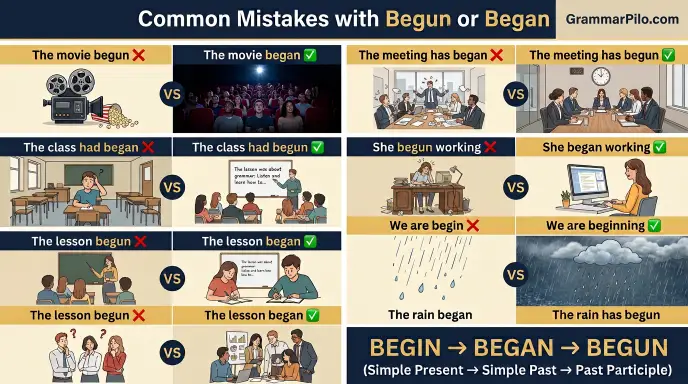
Mistake 1: Using “begun” as the simple past
Incorrect: The movie begun at eight.
Correct: The movie began at eight.
The simple past form is began.
Mistake 2: Using “began” after “has”
Incorrect: The meeting has began.
Correct: The meeting has begun.
After has, use the past participle begun.
Mistake 3: Using “began” after “had”
Incorrect: The class had began before I arrived.
Correct: The class had begun before I arrived.
The structure is:
had + past participle
Therefore:
had begun
Mistake 4: Using “begun” without a helping verb
Incorrect: She begun working last week.
Correct: She began working last week.
Or:
Correct: She has begun working on the project.
Mistake 5: Writing “begined”
Incorrect: The lesson begined at nine.
Correct: The lesson began at nine.
Begin is an irregular verb, so it does not form its past tense by adding ed.
Mistake 6: Confusing “begin” with “beginning”
Incorrect: We are begin the meeting.
Correct: We are beginning the meeting.
After am, is, and are in a continuous construction, use beginning.
Mistake 7: Confusing “began” and “begun” because they both describe past events
Both forms can relate to the past, but they have different grammatical roles.
Began: The rain began yesterday.
Begun: The rain has begun.
The first uses the simple past. The second uses the past participle with has.
Began vs. Begun in Everyday Examples
In Emails
Example: The meeting began at 10 a.m.
This is a simple past statement.
Example: The meeting has begun, so please join as soon as possible.
Here, begun follows has.
In News Writing
Example: The investigation began last year.
Example: The investigation has begun in several regions.
News writing uses both forms depending on the time structure.
In Social Media
Example: The concert began a few minutes ago!
Example: The show has begun! Get here soon.
Both forms can sound natural in informal posts.
In Formal Writing
Example: The study began in January.
Example: The research team has begun collecting data.
The choice depends on the tense rather than the level of formality.
In Everyday Conversation
Example:
When did the movie begin?
Example: It began about ten minutes ago.
Example: Has the movie begun yet?
These three questions and answers clearly show the difference between the forms.
In Academic Writing
Example: The experiment began after the equipment was prepared.
Example: Researchers have begun to examine the results.
Both forms are common in academic contexts.
Begun or Began: Google Trends & Usage Data
Google Trends can be useful for observing search interest in begun or began, but search popularity does not determine grammatical correctness.
Search behavior can vary by country, language learning needs, time period, and search context. Someone searching for begun or began may be checking a grammar exercise, writing an email, completing schoolwork, or trying to understand an irregular verb.
For that reason, a Trends comparison should be treated as information about search interest, not as a grammar rule.
Search interest can vary by country
Searches for begun or began may be more common in places where English is learned as a second or additional language. Students often search for irregular verb forms when studying English grammar.
Search behavior can also differ between native English speaking countries and international English learning markets.
However, search volume alone cannot tell us which form is correct. Grammar references consistently identify began as the simple past form and begun as the past participle.
Context matters more than popularity
Consider these examples:
The game began at six.
The game has begun.
The forms are not competing spelling choices in these sentences. They have different grammatical functions.
A search for begun or began therefore often reflects uncertainty about verb tense rather than a genuine spelling variation.
For language usage, dictionary and grammar references are more useful than search frequency when deciding which form belongs in a sentence.
Begun vs. Began: Comparison Table
| Feature | Began | Begun |
| Base verb | begin | begin |
| Simple past | Yes | No |
| Past participle | No | Yes |
| Used alone as simple past | Yes | No |
| Used after have | No | Yes |
| Used after has | No | Yes |
| Used after had | No | Yes |
| Example | She began working. | She has begun working. |
| Pronunciation | /bɪˈɡæn/ | /bɪˈɡʌn/ |
The three main forms
Begin: I begin work at nine.
Began: I began work at nine yesterday.
Begun: I have begun work on the project.
A quick sentence test
If your sentence contains yesterday, last week, last year, ago, or another clear simple past structure, began may be the correct form.
Example: The project began last month.
If your sentence contains has, have, or had, use begun.
Example: The project has begun.
Example: The project had begun before the announcement.
Frequently Asked Questions About Begun or Began
1. Is “began” correct?
Yes. Began is the simple past form of begin.
Example: The meeting began at nine.
2. Is “begun” correct?
Yes. Begun is the past participle of begin.
Example: The meeting has begun.
3. Is it “began” or “begun” yesterday?
Use began.
Correct: The class began yesterday.
Incorrect: The class begun yesterday.
4. Should I say “has began” or “has begun”?
Use has begun.
Correct: The show has begun.
The word after has should be the past participle.
5. What is the past tense of “begin”?
The simple past is began.
Begin → began
Example: She began reading the book yesterday.
6. What is the past participle of “begin”?
The past participle is begun.
Begin → begun
Example: She has begun reading the book.
7. Can I say “had begun”?
Yes.
Example: The meeting had begun before we arrived.
Had begun is the past perfect form.
8. Is “begined” a word?
No, begined is not the standard past form of begin.
The correct forms are:
begin → began → begun
Final Thoughts on Begun or Began
The difference between begun or began is mainly a difference in grammatical form. Began is the simple past form of begin, while begun is the past participle. The most useful pattern to remember is begin → began → begun.
Use began when you describe something that started in the past:
The movie began at seven.
Use begun after have, has, or had:
The movie has begun.
The movie had begun before we arrived.
The same distinction applies in British English, American English, and other major varieties of standard English. There is no national spelling rule that makes began British and begun American.
The most common error is using begun as a simple past verb. Another frequent mistake is writing has began instead of has begun. Remembering the three forms together can prevent both errors.
When you are unsure, check the structure of the sentence. If you need the simple past, choose began. If you need the past participle, choose begun. This simple rule covers most everyday uses.
Read Next

I’m Sloane Mercer, a U.S.-based English language writer focused on grammar, spelling, vocabulary, and everyday English usage. Through GrammarPilo, I provide clear and practical explanations to help readers choose the right words and communicate with confidence.