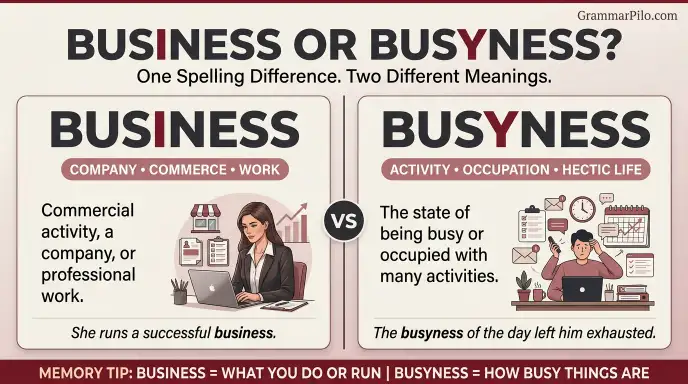
Business and busyness are both correct English words, but they have different meanings and uses.
Business usually refers to a company, commercial activity, professional affairs, or work that needs attention.
Busyness, on the other hand, means the state of being busy or occupied with activities. Although the words look similar and share the same root, they are not interchangeable.
For example, “She started a small business” refers to a company or commercial activity. In contrast, “The busyness of the office made it difficult to concentrate” describes an environment filled with activity.
The difference may seem small, but choosing the wrong word can make a sentence confusing or change its intended meaning.
Many writers find business or busyness difficult because both words relate to the idea of being occupied. However, their grammatical roles and everyday uses are different.
Business is a common noun used in professional, financial, and personal contexts, while busyness is an abstract noun that describes a condition or quality.
In this guide, you will learn the meanings, origins, spelling rules, and grammatical differences between business and busyness.
You will also discover common mistakes, practical examples, and a simple way to remember which word to use in emails, school assignments, articles, and everyday conversations.
Quick Answer: Business or Busyness?
Business is the correct word for a company, trade, commercial activity, professional affairs, or matters that require attention. Busyness describes the state of being busy or occupied.
| Word | Meaning | Example |
| Business | A company, trade, or professional activity | She owns a successful business. |
| Busyness | The state of being busy or occupied | The busyness of the office was overwhelming. |
Remember this simple rule:
- Business = company, commerce, or professional affairs.
- Busyness = the condition of being busy.
Both words are standard English. The right choice depends on what you want to describe.
Definition and Meaning of Business and Busyness
Although business and busyness are related, they have distinct meanings. Understanding how each word works makes it easier to use them correctly.
What Does Business Mean?
Business is a noun with several common meanings. It can refer to an organization that sells goods or services, the activity of buying and selling, professional work, or a matter that needs attention.
Examples of business:
- My sister owns a clothing business.
- He studied business management at university.
- We discussed the business proposal during the meeting.
- I have some important business to finish today.
- The restaurant’s business increased during the holiday season.
In the first example, business means a company. In the second, it refers to a field of study. And in the fourth, it means work or matters requiring attention.
The word also appears in common expressions such as business partner, business meeting, business hours, and mind your own business.
What Does Busyness Mean?
Busyness is an abstract noun that describes the state or quality of being busy. It refers to having many activities, responsibilities, tasks, or demands competing for attention.
Examples of busyness:
- The busyness of the shopping district increased before the holidays.
- She struggled with the busyness of her daily routine.
- Despite the busyness of the office, he found time to help.
- The busyness of city life can feel exhausting.
- I needed a quiet weekend after weeks of constant busyness.
In these examples, busyness describes a condition rather than a company or commercial activity.
Although the word is correct, it is less common than business. Depending on the sentence, alternatives such as activity, hectic schedule, workload, or busy atmosphere may sound more natural.
Are Business and Busyness Interchangeable?
No. The words have different meanings, so replacing one with the other can change the message.
Business: The business is growing quickly.
This sentence means that a company or commercial activity is expanding.
Busyness: The busyness is growing quickly.
This sentence is possible in a specific context, but it sounds incomplete or unnatural without more information about the increasing activity.
Business: I have business to discuss with you.
This means the speaker has a matter or topic to discuss.
Busyness: I have busyness to discuss with you.
This is generally unnatural because busyness describes a condition rather than a particular matter of business.
The surrounding context helps determine which word fits the sentence.
Origin of Business and Busyness
The spelling differences become easier to understand when you look at how these words developed.
Where Does Business Come From?
Business developed from the word busy, which historically referred to being occupied or engaged in activity. The noun eventually came to describe a person’s occupation, affairs, trade, or commercial activity.
Its spelling is unusual because it does not simply follow the modern pronunciation of busy. The word developed historically, and its conventional spelling became established over time.
Today, business can refer to a company, an industry, professional work, a transaction, or a matter requiring attention.
Examples of modern usage:
- She wants to expand her business.
- The business meeting starts at noon.
- The government introduced new business regulations.
- He has personal business to attend to.
Where Does Busyness Come From?
Busyness is formed from the adjective busy and the noun forming suffix -ness. The suffix is commonly added to adjectives to describe a state, condition, or quality.
For example:
- Happy becomes happiness.
- Kind becomes kindness.
- Dark becomes darkness.
- Busy becomes busyness.
The spelling change from busy to busyness involves replacing the final y with i before adding -ness.
Busy + ness = busyness
The resulting word means the state or quality of being busy.
Why Are the Words Spelled So Differently?
The two words have different histories and formation patterns. Business is an established word with a conventional spelling, while busyness follows a recognizable pattern for forming abstract nouns.
Although both are connected to busy, the spelling of business should be learned as a standard form rather than recreated from the adjective.
Correct forms:
- Busy → busyness
- Business → businesses, when referring to more than one company or commercial activity
Avoid confusing the plural businesses with busyness. They may look similar, but they serve different grammatical purposes.
British English vs. American English Spelling
Business and busyness have the same standard spellings in British English and American English. Neither word changes spelling simply because you are writing for a British or American audience.
Are Business and Busyness Different in the UK and US?
No. Both words are spelled identically in the two varieties of English.
| Feature | American English | British English |
| Company or commercial activity | Business | Business |
| State of being busy | Busyness | Busyness |
| Plural of business | Businesses | Businesses |
| Common adjective | Busy | Busy |
| Noun meaning the condition of being busy | Busyness | Busyness |
American English example: The busyness of the city makes commuting difficult.
British English example: The busyness of the city makes commuting difficult.
Both sentences are grammatically correct. However, some writers may prefer a more familiar alternative, such as the busy atmosphere of the city.
Does Pronunciation Affect the Spelling?
Pronunciation can contribute to confusion because the two words are visually similar and both are related to busy. Nevertheless, their meanings and spelling patterns remain distinct.
When writing, focus on the intended meaning rather than trying to spell the word from its sound.
- Use business for companies, commerce, professional affairs, and matters.
- Use busyness for the condition of being busy.
Which Spelling Should You Use?
The best way to choose between business and busyness is to identify what the sentence is describing.
Use Business for Companies and Commercial Activities
Choose business when discussing a company, trade, work, transactions, or professional matters.
Examples:
- My parents own a family business.
- She wants to start an online business.
- The business meeting lasted two hours.
- Our business partner approved the proposal.
- He has some important business to complete.
In these examples, business refers to an organization, professional activity, or matter that needs attention.
Use Busyness for the State of Being Busy
Choose busyness when describing the condition of having many things to do or being surrounded by activity.
Examples:
- The busyness of the holiday season can be stressful.
- I enjoy the busyness of a lively market.
- His constant busyness left little time for relaxation.
- The busyness of the workplace made it difficult to focus.
In some situations, busyness may sound abstract or slightly formal. If a simpler phrase makes your meaning clearer, use it.
For example:
Original: The busyness of the office distracted me.
Alternative: The busy office environment distracted me.
Both communicate a similar idea, but the second may sound more natural to some readers.
A Simple Trick to Remember the Difference
Think about the words company and busy.
If you can replace the word with company, commercial activity, or professional affairs, use business.
If you can replace it with the state of being busy, use busyness.
Example 1: She runs a successful business.
You can say, “She runs a successful company.” Therefore, business is correct.
Example 2: The busyness of the city surprised me.
You can say, “The constant activity of the city surprised me.” Therefore, busyness fits the intended meaning.
Common Mistakes With Busyness and Business
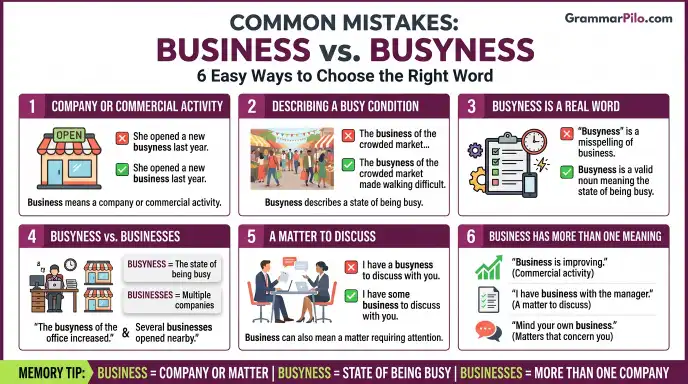
The following mistakes occur when writers confuse the similar spellings or assume that both words have the same meaning.
Mistake 1: Using Busyness When You Mean a Company
Incorrect: She opened a new busyness last year.
Correct: She opened a new business last year.
The sentence refers to a company or commercial activity, so business is required.
Mistake 2: Using Business When You Mean a Busy Condition
Less suitable: The business of the crowded market made it difficult to walk.
Clearer: The busyness of the crowded market made it difficult to walk.
The second sentence describes the amount of activity in the market. Depending on the context, the crowded market was extremely busy may sound even more natural.
Mistake 3: Assuming Busyness Is Incorrect
Incorrect assumption: Busyness is a misspelling of business.
Correct explanation: Busyness is a legitimate noun meaning the state of being busy.
It is less common than business, but it is a valid word.
Mistake 4: Confusing Busyness With Businesses
These words differ in meaning and grammatical function.
Busyness: The condition of being busy.
Businesses: The plural form of business, referring to multiple companies or commercial activities.
Examples:
- The busyness of the office increased before the deadline.
- Several businesses opened along the new road.
Mistake 5: Writing Busyness as Busyness Without Understanding Its Meaning
The spelling busyness is correct, but it should be used only when describing a condition or quality of being busy.
Awkward: I have a busyness to discuss with you.
More natural: I have some business to discuss with you.
The second sentence refers to a matter that needs discussion.
Mistake 6: Assuming Business Always Means a Company
Business has several meanings. It can refer to commercial activity, professional affairs, work, or a matter requiring attention.
Examples:
- Business is improving this quarter. (Commercial activity)
- I have business with the manager. (A matter to discuss)
- Mind your own business. (Matters that concern you)
Understanding the context prevents confusion.
Busyness or Business in Everyday Examples
These examples show how each word can be used in common situations.
In School
Business: She is studying business administration.
Business: The students prepared a presentation about small businesses.
Busyness: The busyness of the school library increased before exams.
In Emails
Business: I am writing to discuss our upcoming business partnership.
Business: Please let me know if you have any business related questions.
Busyness: I apologize for the delayed reply because of the busyness of the past few days.
The last sentence is grammatically possible, but “I apologize for the delayed reply because I have been very busy” sounds more natural in most professional emails.
In the Workplace
Business: The business is expanding into new markets.
Business: We have important business to discuss at tomorrow’s meeting.
Busyness: The busyness of the office made it difficult to finish the report.
In Everyday Conversation
Business: What kind of business does your family run?
Business: I have some personal business to take care of.
Busyness: I need a break from the busyness of everyday life.
In News and Articles
Business: Local businesses are preparing for the holiday shopping season.
Business: The report examines changes in international business.
Busyness: The busyness of the city center increased during the festival.
In Social Media
Business: I am excited to launch my new business!
Business: Supporting small businesses helps local communities.
Busyness: Taking a quiet walk helps me escape the busyness of daily life.
These examples illustrate the central distinction: business often refers to work or commercial affairs, while busyness describes the state of being occupied.
Business vs. Busyness: Google Trends and Modern Usage
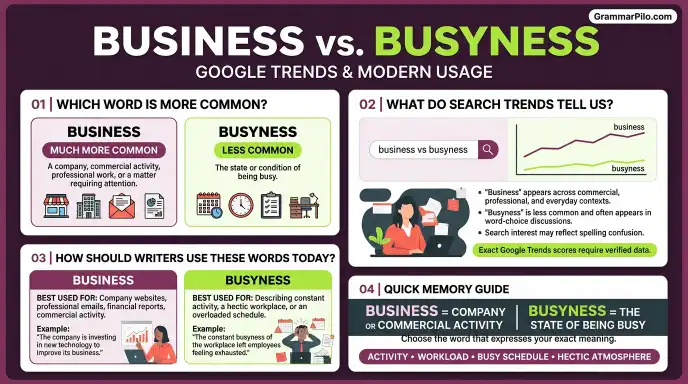
People sometimes search for business or busyness because the words look similar and share a connection to the adjective busy. Their everyday frequency and contexts, however, are quite different.
Which Word Is More Common?
Business is much more common in general English. It appears frequently in news articles, workplace communication, finance, education, commerce, and everyday conversations.
Busyness is less common and is usually used when a writer specifically wants to describe a state of being occupied or surrounded by activity. Some writers prefer alternatives such as activity, workload, a busy schedule, or a hectic atmosphere.
What Do Search Trends Tell Us?
Search interest in these words can reflect spelling uncertainty, writing questions, or the need to distinguish between a company and a busy condition.
However, exact Google Trends scores, search volumes, and changes over time need to be checked using current data. Without a verified data source, it would be misleading to provide precise numerical comparisons.
How Should Writers Use These Words Today?
Modern writers should choose the word that makes their meaning clear.
Use business for company websites, professional correspondence, commercial articles, financial reports, and discussions about work or personal affairs.
Use busyness when the condition of being busy is central to the message. In casual writing, consider alternatives if they communicate the idea more naturally.
Business example: The company is investing in new technology to improve its business.
Busyness example: The constant busyness of the workplace left employees feeling exhausted.
Both words are useful when applied to the correct context.
Busyness vs. Business: Side by Side Comparison
| Feature | Business | Busyness |
| Main meaning | Company, commerce, work, or professional affairs | State or condition of being busy |
| Part of speech | Noun | Noun |
| Common context | Workplaces, companies, finance, professional matters | Activity, hectic schedules, crowded environments |
| Formation | Established historical spelling | Busy + -ness |
| Plural form | Businesses | Busyness is generally uncountable |
| American spelling | Business | Busyness |
| British spelling | Business | Busyness |
| Example | The business hired more staff. | The busyness of the office was distracting. |
The main difference is meaning: business often refers to commercial or professional matters, while busyness refers to a condition of being occupied.
Frequently Asked Questions
1. Is Business or Busyness Correct?
Both words are correct, but they have different meanings. Business refers to a company, commercial activity, work, or professional affairs. Busyness means the state of being busy or occupied.
2. Is Busyness a Real Word?
Yes. Busyness is a standard English noun formed from busy and the suffix –ness. It describes the state or quality of being busy, although it is less common than business.
3. Why Is Business Spelled Differently From Busyness?
The words have different formation histories. Business has an established conventional spelling, while busyness is formed by changing the final y in busy to i before adding –ness.
4. What Is the Difference Between Business and Businesses?
Business is the singular form commonly used for a company or commercial activity. Businesses is its plural form, referring to multiple companies or commercial activities.
Example: The business is growing, and several other businesses are expanding too.
5. Can I Use Busyness in a Professional Email?
Yes, but it can sound abstract or less natural than a direct alternative. For example, “I apologize for the delay because of my busyness” is understandable, but “I apologize for the delay because I have been very busy” sounds more natural.
6. Are Business and Busyness Different in British and American English?
No. Both words have the same standard spelling and basic meanings in British and American English. Regional spelling differences do not apply to this pair.
7. How Can I Remember Business vs. Busyness?
Associate business with a company, work, or professional matters. Associate busyness with the condition of being busy. If you mean a company, choose business. If you mean a hectic or occupied state, choose busyness.
Conclusion: Choose Business or Busyness With Confidence
The difference between business or busyness becomes clear when you focus on what each word describes.
Business refers to a company, commercial activity, professional work, or a matter that needs attention. Busyness describes the condition of being busy, occupied, or surrounded by activity.
Although the words look similar, they are not interchangeable. You might start a successful business, discuss business with a colleague, or support local businesses.
However, you might also feel overwhelmed by the busyness of city life or struggle with the busyness of a demanding schedule.
Remember the spelling and meaning together. Business is the established spelling for companies and professional affairs, while busyness is formed from busy plus -ness. Both words are correct in standard British and American English.
When you are unsure which word to choose, ask yourself what the sentence describes. If it refers to a company or professional matter, use business. If it refers to the state of being occupied, use busyness.
With this simple distinction, you can avoid common mistakes and write more clearly in emails, articles, school assignments, and everyday conversations.
Discover More Articles

I’m Claire Morgan, the author behind Grammarpilo.com, where I write about English grammar, sentence structure, punctuation, and everyday language. My goal is to make grammar simple, clear, and practical, helping readers understand the rules and apply them with confidence in real-world writing.








2 thoughts on “Business or Busyness: Spelling Difference That Changes Meaning”