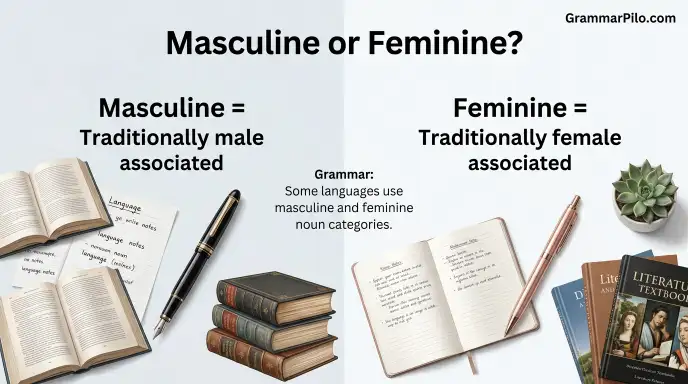
Masculine and feminine are both correct words, but they are used in different contexts. The word masculine describes qualities traditionally associated with men or, in grammar, a category associated with male gender.
Feminine describes qualities traditionally associated with women or, in grammar, a category associated with female gender.
The confusion around masculine or feminine often comes from the fact that the two words are opposites in many contexts.
They can describe appearance, style, language, grammar, and traditional characteristics. However, they are not always interchangeable with male and female.For example, we normally use male and female to refer to the sex of humans and animals.
We use masculine and feminine when discussing qualities traditionally associated with men or women, as well as certain grammatical categories in languages that have grammatical gender.
English also has an important difference from languages such as French, Spanish, German, and Italian. Most English nouns do not have grammatical gender. Instead, English mainly uses pronouns and possessive determiners such as he, she, his, and her to show gender.
Masculine or Feminine: Quick Answer
Masculine: Describes qualities traditionally associated with men, or a grammatical category that is not feminine or neuter in languages with grammatical gender.
Feminine: Describes qualities traditionally associated with women, or a grammatical category that is not masculine or neuter in languages with grammatical gender.
Simple rule: Use masculine for traditionally male associated qualities and feminine for traditionally female associated qualities. In grammar, the meaning depends on the language being discussed.
Definition and Meaning of Masculine or Feminine
What Does Masculine Mean?
Masculine is an adjective that commonly describes characteristics traditionally considered typical of men.
For example:
Example: He has a deep, masculine voice.
Example: The room has a strong, masculine design.
Cambridge defines masculine as having characteristics traditionally thought to be typical of or suitable for men. The word also has a specific grammatical meaning in languages that divide nouns into masculine, feminine, and sometimes neuter categories.
In grammar, a noun may be called masculine because it belongs to a grammatical class associated with masculine agreement patterns.
For example, French has masculine and feminine nouns:
Example: Le soleil is masculine in French.
The grammatical category does not necessarily mean that the physical object is biologically male. It is a feature of the language’s grammatical system.
What Does Feminine Mean?
Feminine is an adjective that describes characteristics traditionally considered typical of women.
For example:
Example: She chose a feminine floral dress.
Example: The room has a soft and feminine style.
Cambridge defines feminine as having characteristics traditionally thought to be typical of or suitable for women. It also uses the word for grammatical categories in languages where nouns can be masculine, feminine, or neuter.
Masculine and Feminine in Grammar
The terms become especially important when discussing languages with grammatical gender.
Some languages classify nouns as masculine or feminine. Others also have a neuter category.
Example: French has masculine and feminine grammatical categories.
Example: German has masculine, feminine, and neuter categories.
English works differently. Most English nouns do not have grammatical gender.
The Origin of Masculine and Feminine
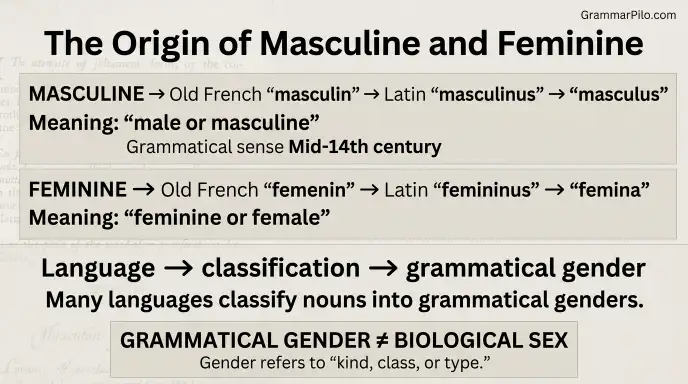
The Origin of Masculine
The word masculine entered English in the Middle English period.
Etymonline traces it to Old French masculin, from Latin masculinus, meaning male or masculine. The Latin word is related to masculus, meaning male or masculine.
The grammatical sense appeared early in English. Etymonline dates the sense meaning “belonging to the male grammatical gender” to the mid 14th century.
The broader meaning connected with qualities traditionally associated with men developed later.
The Origin of Feminine
Feminine has a similarly old history.
Etymonline traces it to Old French femenin, from Latin femininus, meaning feminine or female. The Latin form comes from femina, meaning woman or female.
Like masculine, the word has long been used in grammatical contexts as well as in descriptions of people and qualities.
Why Did These Words Become Grammar Terms?
The terms masculine and feminine were adopted into grammatical descriptions because many languages classify nouns into grammatical genders.
The word gender itself comes from Old French and Latin roots connected with kind, class, or type. Its grammatical meaning developed from the idea of classifying words into grammatical groups.
This is why grammatical gender does not always correspond directly to biological sex.
British English vs American English Spelling
There is no spelling difference between American and British English for these words.
| Word | British English | American English |
| Masculine | Masculine | Masculine |
| Feminine | Feminine | Feminine |
| Masculinity | Masculinity | Masculinity |
| Femininity | Femininity | Femininity |
| Masculine gender | Correct | Correct |
| Feminine gender | Correct | Correct |
The spelling remains the same in both major varieties of English.
The pronunciation can vary slightly by speaker or region, but there is no British American spelling change such as those seen with words like colour/color or organise/organize.
Which Word Should You Use?
Choosing between masculine and feminine depends on the meaning you want.
Use Masculine for Traditionally Male Associated Qualities
Use masculine when describing something traditionally associated with men.
Example: The designer created a masculine style using darker colors and simple lines.
The word describes a perceived style or quality, not necessarily the biological sex of a person.
Use Feminine for Traditionally Female Associated Qualities
Use feminine when describing something traditionally associated with women.
Example: The room has a light and feminine appearance.
Again, this describes a style or quality rather than simply identifying someone’s biological sex.
Use Male and Female for Sex
Male and female are generally the better terms when referring directly to the sex of humans or animals.
Cambridge explains that male and female are used to refer to the sex of humans and animals, while masculine and feminine are used for qualities traditionally associated with men or women.
Example: The veterinarian identified the animal as female.
Example: The veterinarian described the animal as having feminine features.
These sentences communicate different ideas.
Use Masculine and Feminine for Grammatical Gender
When discussing languages that have grammatical gender, masculine and feminine are the appropriate terms.
Example: The French noun is masculine.
Example: The Spanish noun is feminine.
Common Mistakes with Feminine or Masculine
Mistake 1: Treating Masculine and Male as Exact Synonyms
Incorrect: The scientist said the animal was masculine.
Better: The scientist said the animal was male.
When discussing biological sex, male is normally the appropriate term.
Mistake 2: Treating Feminine and Female as Exact Synonyms
Incorrect: The veterinarian recorded the animal as feminine.
Better: The veterinarian recorded the animal as female.
Female identifies sex, while feminine generally describes qualities or grammatical categories.
Mistake 3: Assuming Every English Noun Has a Gender
English does not normally classify ordinary nouns as masculine or feminine.
For example, table, house, car, and book do not normally have grammatical gender in English.
Languages such as French and Spanish have grammatical gender systems, but English generally does not.
Mistake 4: Assuming Grammatical Gender Means Biological Sex
A noun can be grammatically masculine or feminine without representing a male or female living thing.
This is an important distinction when learning another language.
Mistake 5: Assuming Masculine Always Means “For Men”
The word can also describe grammatical categories.
Example: The French word is grammatically masculine.
That sentence does not mean the object itself is male. It refers to the noun’s grammatical classification.
Feminine and Masculine in Everyday Examples
In Emails
Masculine Example: The client prefers a more masculine design for the office.
Feminine Example: The client requested a softer, more feminine design for the reception area.
In News Writing
Masculine Example: The article discussed traditionally masculine styles in men’s fashion.
Feminine Example: The report examined changing ideas about feminine fashion.
In Social Media
Masculine Example: This jacket has a classic masculine look.
Feminine Example: I love the feminine details on this dress.
In Formal Writing
Masculine Example: The study examines cultural ideas surrounding masculine identity.
Feminine Example: The study discusses historical representations of feminine identity.
In Language Learning
Masculine Example: The French noun uses the masculine article.
Feminine Example: The Spanish noun belongs to the feminine grammatical category.
Feminine Vs. Masculine in Grammar
One of the most important points about masculine vs. feminine is that grammatical gender differs from biological sex.
Some languages use grammatical gender to determine which articles, adjectives, pronouns, or other forms accompany a noun.
For example, a language may require different forms for a masculine noun and a feminine noun.
English generally does not work this way for ordinary nouns. Cambridge notes that English does not commonly mark nouns according to gender. Instead, gender is mainly shown through pronouns and possessive determiners in relevant contexts.
| Feature | Masculine | Feminine |
| General meaning | Traditionally male associated | Traditionally female associated |
| Grammar | Masculine grammatical category | Feminine grammatical category |
| Opposite | Feminine | Masculine |
| Used for style | Yes | Yes |
| Used for grammatical gender | Yes | Yes |
| British spelling | Masculine | Feminine |
| American spelling | Masculine | Feminine |
Masculine or Feminine: Male vs. Female
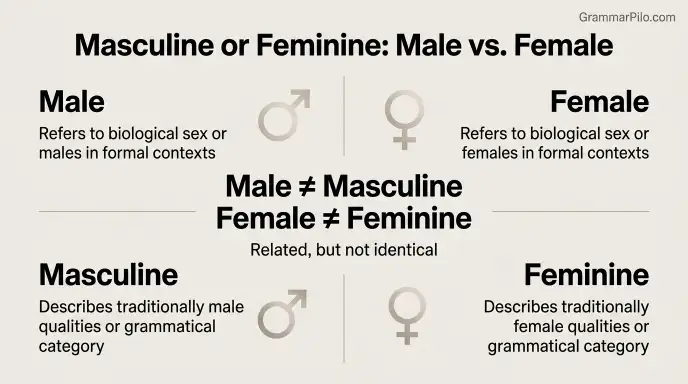
A useful distinction is:
Male: Refers primarily to biological sex or to males in formal contexts.
Female: Refers primarily to biological sex or to females in formal contexts.
Masculine: Describes qualities traditionally associated with men or a grammatical category.
Feminine: Describes qualities traditionally associated with women or a grammatical category.
Cambridge makes this distinction directly in its grammar guidance.
This means male and masculine are related but not identical, just as female and feminine are related but not identical.
Masculine or Feminine: Google Trends & Usage Data
Google Trends can be useful for comparing search interest in masculine or feminine, but it should not be treated as a dictionary or a direct measure of word frequency.
Search interest can vary depending on the country, time period, language learning interest, fashion topics, cultural discussions, and grammar related searches.
For a meaningful comparison, Google Trends should be checked using the same location, time range, and search type for both terms. Exact numerical values should not be presented without a current Trends check.
Dictionary evidence provides a clearer linguistic distinction: masculine and feminine are both established English words, and both have general descriptive meanings as well as grammatical meanings.
Masculine and Feminine: Related Word Forms
The two words also have related noun forms.
Masculinity
Masculinity means the quality or state of being masculine.
Example: The book examines changing ideas about masculinity.
Femininity
Femininity means the quality or state of being feminine.
Example: The article discusses traditional ideas about femininity.
These nouns are formed from the adjectives masculine and feminine.
Key Takeaways
- Masculine and feminine are both correct English words.
- Masculine generally describes qualities traditionally associated with men.
- Feminine generally describes qualities traditionally associated with women.
- Both words can describe grammatical categories in languages that have grammatical gender.
- Male and female are normally used when referring to the sex of humans and animals.
- English does not commonly assign grammatical gender to ordinary nouns.
- British and American English use the same spellings.
- Grammatical gender does not always correspond to biological sex.
- Masculinity and femininity are the related noun forms.
- The simplest distinction is masculine = traditionally male associated; feminine = traditionally female associated.
Frequently Asked Questions
1. What is the difference between masculine and feminine?
Answer: Masculine describes qualities traditionally associated with men, while feminine describes qualities traditionally associated with women. Both words can also describe grammatical categories in some languages.
2. Is masculine the opposite of feminine?
Answer: Yes. In common English usage, masculine and feminine are contrasting terms.
3. Is masculine the same as male?
Answer: No. Male primarily refers to sex, while masculine generally refers to qualities traditionally associated with men or to a grammatical category.
4. Is feminine the same as female?
Answer: No. Female primarily refers to sex, while feminine describes qualities traditionally associated with women or a grammatical category.
5. Does English have masculine and feminine nouns?
Answer: English does not commonly mark ordinary nouns as masculine or feminine. English mainly shows gender through pronouns and possessive determiners in relevant contexts.
6. What does masculine mean in grammar?
Answer: In grammar, masculine refers to a grammatical category used by languages that classify nouns or related forms as masculine.
7. What does feminine mean in grammar?
Answer: In grammar, feminine refers to a grammatical category used by languages that classify nouns or related forms as feminine.
8. Are masculine and feminine spelled differently in British and American English?
Answer: No. Both varieties use the same spellings: masculine and feminine.
9. What is the noun form of masculine?
Answer: The common noun form is masculinity.
10. What is the noun form of feminine?
Answer: The common noun form is femininity.
Conclusion
The difference between masculine or feminine is mainly a matter of meaning and context. Both words are correct, and neither spelling is a mistake.
Masculine generally describes qualities traditionally associated with men, while feminine describes qualities traditionally associated with women. Both can also describe grammatical categories in languages that use grammatical gender.
It is also important to separate these words from male and female. When talking about the sex of humans or animals, male and female are normally the more direct terms.
When describing traditionally male associated or female associated qualities, masculine and feminine are appropriate.
Grammar creates another important distinction. Languages such as French, Spanish, and German use grammatical gender systems, while English generally does not assign masculine or feminine gender to ordinary nouns.
The easiest rule to remember is simple: masculine relates to traditionally male associated qualities or grammatical categories, while feminine relates to traditionally female associated qualities or grammatical categories.
See Related Posts

I’m Sloane Mercer, a U.S.-based English language writer focused on grammar, spelling, vocabulary, and everyday English usage. Through GrammarPilo, I provide clear and practical explanations to help readers choose the right words and communicate with confidence.








2 thoughts on “Masculine or Feminine: Understanding the Difference in English”