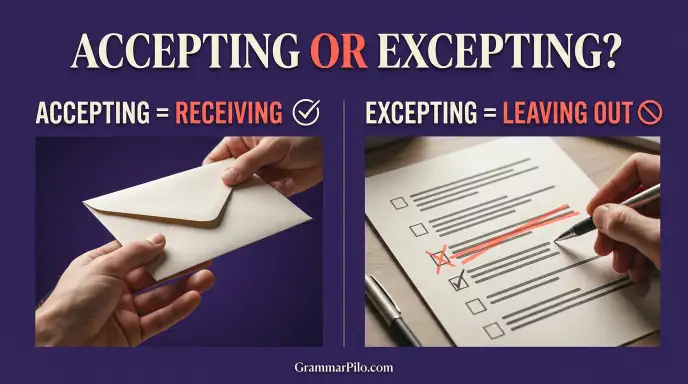
Accepting means receiving, agreeing to, or welcoming something, while excepting means excluding something or someone from a group or rule. Both words are correct English words, but they have different meanings and uses. Choosing the right word depends on what you want to say.
For example, a teacher may be accepting late assignments, meaning the teacher is willing to receive them. However, the teacher may be excepting certain students from a classroom rule, meaning those students are excluded from that rule.
The confusion between accepting or excepting often occurs because the words look and sound similar.
Both contain the letters cept, but their meanings are different. One relates to receiving or agreeing, while the other relates to leaving something out.
If you have searched for accepting or excepting, excepting or accepting, or accepting vs. excepting, this guide will help you understand the difference. You will learn their definitions, origins, grammatical roles, common mistakes, and everyday uses.
By the end, you will know which word fits your sentence in emails, schoolwork, business communication, and daily conversation.
Accepting or Excepting: Quick Answer
Accepting means receiving, agreeing to, or welcoming something. Excepting means excluding someone or something from a group or general statement.
| Word | Meaning | Example |
| Accepting | Receiving or agreeing to something | She is accepting the job offer. |
| Excepting | Excluding something or someone | Excepting the final chapter, I enjoyed the entire book. |
Quick memory trick: Accepting means saying yes or receiving something. Excepting means leaving something out.
What Does Accepting Mean?
Accepting is the -ing form of the verb accept. It means receiving something willingly, agreeing to an offer, recognizing a situation, or allowing something to happen.
People use accepting in everyday conversations, professional communication, relationships, education, and many other situations.
Accepting an Offer
When someone agrees to an offer, invitation, job, or proposal, they are accepting it.
Examples:
- She is accepting a new job offer.
- We are accepting invitations for the event.
- He thanked the company for accepting his application.
- They are accepting the proposal from the client.
In these examples, accepting describes agreeing to receive or take something.
Accepting a Situation
The word can also describe recognizing a fact or situation instead of denying it.
Examples:
- He is accepting the results of the competition.
- She is accepting the changes in her life.
- Accepting responsibility is an important step.
- They are slowly accepting the new circumstances.
Accepting Payments or Applications
Businesses often use accepting when they receive payments, orders, applications, or customers.
Examples:
- The store is accepting online payments.
- Our company is accepting applications for the position.
- The restaurant is accepting reservations.
- The school is accepting new students.
Accepting in a Sentence
Here are additional examples that show how the word works:
- Thank you for accepting my invitation.
- She is accepting feedback from her manager.
- The organization is accepting donations.
- He has trouble accepting criticism.
- Accepting help can make a difficult task easier.
In every example, accepting relates to receiving, agreeing, or acknowledging something.
What Does Excepting Mean?
Excepting is the -ing form of the verb except. It means excluding someone or something from a group, rule, statement, or general situation.
The word is less common in everyday conversation than accepting. People often use excluding, except for, or with the exception of instead.
Excepting Someone From a Rule
Use excepting when a person or group is excluded from a rule or general statement.
Examples:
- Excepting new employees, everyone must attend the meeting.
- The policy applies to all departments, excepting the research team.
- Excepting a few special cases, the rule applies to everyone.
These examples identify people or groups that are left out.
Excepting Something From a Group
The word can also describe leaving an item out of a collection or general statement.
Examples:
- Excepting the final chapter, I enjoyed the entire book.
- The museum is open every day, excepting public holidays.
- Excepting two minor errors, the report was accurate.
In everyday English, these sentences may sound more natural with except for or excluding.
For example:
- Except for the final chapter, I enjoyed the entire book.
- The museum is open every day except on public holidays.
- Excluding two minor errors, the report was accurate.
Excepting in Formal Writing
Excepting can appear in formal or legal language when a writer needs to identify exclusions.
Examples:
- The agreement covers all employees, excepting those listed in Appendix B.
- All items are included, excepting damaged products.
- The policy applies to every branch, excepting the temporary location.
Use the word only when it communicates the intended exclusion clearly.
The Origin of Accepting and Excepting
Although the two words look similar, they developed from different verbs with different meanings.
The Origin of Accepting
Accepting comes from accept, which entered English through Old French and ultimately comes from Latin accipere, meaning to receive or take.
The Latin word combines elements associated with taking and receiving. This history reflects the modern meaning of accept: to receive something, agree to an offer, or acknowledge a situation.
Examples include accepting a gift, accepting an invitation, or accepting responsibility.
The Origin of Excepting
Excepting comes from except, which traces back to Latin excipere, meaning to take out or exclude.
The word developed a meaning connected with leaving something outside a group or general rule. That is why excepting relates to exclusion rather than agreement or receipt.
Examples include excepting certain items from a list or excepting a group from a policy.
Why Their Meanings Are Different
The two words share similar letters, but their roots help explain their difference.
- Accepting: receiving, agreeing, or acknowledging.
- Excepting: excluding or leaving out.
Understanding these meanings is more useful than memorizing the spelling alone.
British English vs. American English: Excepting or Accepting
There is no standard British-American spelling difference between accepting and excepting. Both words are spelled the same way in American English, British English, Canadian English, and Australian English.
The difference is based on meaning, not geography.
| English variety | Correct word for receiving or agreeing | Correct word for excluding |
| American English | Accepting | Excepting |
| British English | Accepting | Excepting |
| Canadian English | Accepting | Excepting |
| Australian English | Accepting | Excepting |
| International English | Accepting | Excepting |
For example, an American writer would say, “We are accepting applications.” A British writer would use the same spelling.
Likewise, both writers could use excepting to describe excluding certain items, although excluding or except for may sound more natural in many contexts.
Which Word Should You Use?
Choose accepting when you mean receiving something, agreeing to something, or recognizing a situation.
Choose excepting when you mean excluding something or someone from a group or general statement.
Use Accepting When You Mean Receiving
Correct examples:
- The company is accepting applications.
- She is accepting the award.
- We appreciate you accepting our invitation.
- He is accepting responsibility for the mistake.
Use Excepting When You Mean Excluding
Correct examples:
- Excepting one item, the entire order was correct.
- The rule applies to everyone, excepting temporary staff.
- Excepting the final page, the document is complete.
In natural modern English, you can often improve the last examples by using excluding or except for.
Compare the Words in Similar Sentences
Accepting: The school is accepting applications from international students.
Excepting: The school has invited all students, excepting those who registered too late.
The first sentence describes receiving applications. The second describes excluding a group.
Common Mistakes With Excepting and Accepting
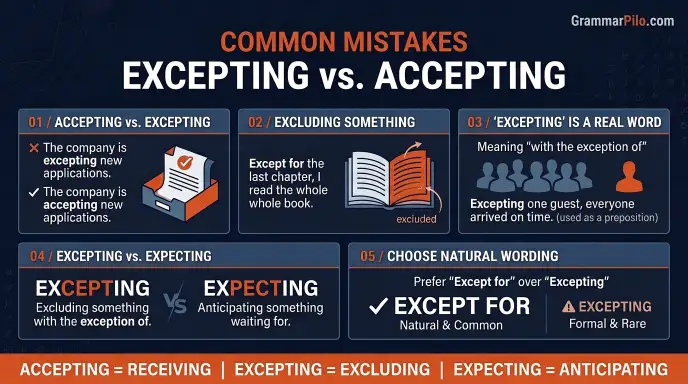
Mistake 1: Using Excepting When You Mean Accepting
Incorrect for the intended meaning: The company is excepting new applications.
Correct: The company is accepting new applications.
If the company is willing to receive applications, accepting is the correct word.
Mistake 2: Using Accepting When You Mean Excluding
Incorrect for the intended meaning: Accepting the last chapter, I enjoyed the entire book.
Correct: Except for the last chapter, I enjoyed the entire book.
The sentence describes leaving one chapter out of the positive assessment, so except for is the appropriate expression.
Mistake 3: Assuming Excepting Is Always Wrong
Excepting is a valid English word. It is not simply a misspelling of accepting. It is less common, but it can be used to mean excluding.
Mistake 4: Confusing Excepting With Expecting
Excepting and expecting are different words, too.
- Excepting: excluding something.
- Expecting: believing something will happen or anticipating an event.
Examples:
- Excepting one guest, everyone arrived on time.
- We are expecting one more guest.
Mistake 5: Using Excepting When a Simpler Phrase Is Better
Although excepting is correct in suitable contexts, it can sound stiff or unnatural in everyday writing.
Instead of:
“Excepting the broken items, the shipment was complete.”
You could write:
“Except for the broken items, the shipment was complete.”
Clear, natural wording is often the best choice.
Accepting and Excepting in Everyday Examples
The following examples show how the words work in different situations.
In School
Accepting: The teacher is accepting late assignments until Friday.
Excepting: All students must submit the assignment, excepting those who received an approved extension.
In Emails
Accepting: Thank you for accepting my invitation to the meeting.
Excepting: The office will be closed every weekday, excepting public holidays when special arrangements apply.
A more natural alternative is: “The office will be closed on weekdays except for public holidays when special arrangements apply.” Adjust the sentence to match the intended schedule.
In Business
Accepting: Our company is accepting orders for the new product.
Excepting: The policy applies to all customers, excepting those covered by a separate agreement.
In Everyday Conversation
Accepting: She is accepting the fact that plans have changed.
Excepting: Everyone enjoyed the trip, excepting my brother, who felt unwell.
A more conversational version of the second sentence is: “Everyone enjoyed the trip except my brother, who felt unwell.”
In Formal Writing
Accepting: The committee is accepting written submissions from all interested parties.
Excepting: The agreement applies to all departments, excepting those specifically listed in the appendix.
In Social Media
Accepting: We are accepting questions for our next live session.
Excepting: All entries are eligible for the prize, excepting duplicate submissions.
These examples show why context matters. The spelling alone does not determine which word belongs in a sentence.
Accepting vs. Excepting: Quick Comparison Table
| Feature | Accepting | Excepting |
| Root verb | Accept | Except |
| Main meaning | Receiving or agreeing | Excluding or leaving out |
| Common use | Offers, invitations, payments, responsibility | Exceptions, rules, groups, conditions |
| Related word | Acceptance | Exception |
| Common alternative | Receiving, agreeing to | Excluding, except for |
| Example | She is accepting the offer. | Excepting one item, the order was complete. |
| Correct English word? | Yes | Yes |
The essential difference is simple: accepting brings something in, while excepting leaves something out.
Excepting vs. Accepting: Modern Usage
Accepting is common in modern English. It appears in workplace messages, application forms, customer service notices, everyday conversations, and personal writing.
Common phrases include:
- Accepting applications
- Accepting payments
- Accepting an invitation
- Accepting responsibility
- Accepting feedback
Excepting is less common in everyday communication. Writers may use it in formal statements, policies, and descriptions of exclusions. In many cases, however, except for, excluding, or apart from is more natural.
Examples:
- “Except for one mistake, the report was accurate.”
- “All employees are included, excluding temporary contractors.”
- “Everyone attended except Maria.”
These alternatives can make a sentence easier to understand without changing its meaning.
Key Takeaways
- Accepting means receiving, agreeing to, or acknowledging something.
- Excepting means excluding something or someone.
- Both words are correct English words.
- Accepting comes from the verb accept.
- Excepting comes from the verb except.
- Neither word is a regional spelling alternative.
- Accepting is more common in everyday communication.
- Excepting is less common and may sound formal.
- In many sentences, excluding or except for is a clearer alternative to excepting.
- Remember the simple rule: accepting means including or receiving; excepting means leaving out.
Frequently Asked Questions
1. Is accepting or excepting correct?
Both words are correct, but they have different meanings. Accepting means receiving or agreeing to something.
Excepting means excluding someone or something from a group or general statement. Choose the word that matches your intended meaning.
2. What is the difference between accepting and excepting?
Accepting describes receiving, agreeing to, or acknowledging something. Excepting describes excluding something or someone.
For example, a company can be accepting applications, while a rule can apply to everyone excepting a particular group.
3. Is excepting a real word?
Yes. Excepting is the -ing form of the verb except. It means excluding or leaving out. Although it is less common than excluding or except for, it is a valid English word.
4. How do I use accepting in a sentence?
Use accepting when someone receives something, agrees to an offer, or acknowledges a situation.
For example, “The school is accepting applications,” or “She is accepting responsibility for the mistake.”
5. How do I use excepting in a sentence?
Use excepting when describing an exclusion. For example, “Excepting one special case, the policy applies to everyone.” In everyday writing, “Except for one special case” often sounds more natural.
6. Is accepting the opposite of excepting?
They express different ideas, but they are not exact opposites in every context. Accepting means receiving or agreeing, while excepting means excluding.
Their similar spelling can cause confusion, but their meanings and grammatical uses are different.
7. What is the difference between excepting and expecting?
Excepting means excluding something. Expecting means anticipating something or believing it will happen.
For example, “Excepting one guest, everyone arrived” describes an exclusion, while “We are expecting a guest” describes anticipation.
8. Is excepting commonly used in American and British English?
Yes, both varieties recognize the word excepting, but it is less common in everyday speech than except for or excluding.
American and British writers use accepting with the same spelling when referring to receiving or agreeing to something.
9. Can I use excepting instead of excluding?
Sometimes. Both words can communicate the idea of leaving something out, but excluding is often clearer and more natural.
For example, “Excluding damaged items, the shipment was complete” is a straightforward alternative to “Excepting damaged items, the shipment was complete.”
10. What is the easiest way to remember accepting and excepting?
Remember this simple distinction: accepting means receiving; excepting means excluding. You accept an invitation, a gift, or responsibility. You except something when you leave it out of a general statement or group.
Conclusion
Accepting and excepting are both correct English words, but they express different ideas. Accepting means receiving something, agreeing to an offer, or acknowledging a situation. Excepting means excluding someone or something from a group, rule, or general statement.
The easiest way to remember the difference is to focus on the action. If you are receiving an invitation, accepting a job, or accepting responsibility, use accepting.
If you are describing something left out of a group or rule, excepting may fit, although excluding or except for often sounds more natural.
These words have the same spelling in British and American English, so the choice does not depend on your audience’s location. It depends on the meaning of your sentence.
For school assignments, business emails, reports, and everyday conversations, choose the word that communicates your point clearly.
Keep this rule in mind: accepting means receiving or agreeing, while excepting means leaving something out.
Explore Related Difference
- Analyzes or Analyses: Easy Rule That Helps You Choose Correctly
- Embed or Imbed: Which Spelling Is Correct in Modern English?
- Insite or Insight: Don’t Confuse These Two Words

I’m Sloane Mercer, a U.S.-based English language writer focused on grammar, spelling, vocabulary, and everyday English usage. Through GrammarPilo, I provide clear and practical explanations to help readers choose the right words and communicate with confidence.








3 thoughts on “Accepting or Excepting: One Letter Changes the Meaning”