Wave and waive are both correct English words, but they have completely different meanings.
Wave usually refers to a movement of the hand, a moving swell of water, or a pattern that rises and falls. Waive means to voluntarily give up a right, claim, requirement, or fee. Although the two words sound alike, you cannot use them interchangeably.
For example, you wave to a friend when you see them across the street, but you waive an entrance fee when you agree not to charge it.
Understanding this difference helps you avoid mistakes in emails, school assignments, business documents, and everyday conversations.
The confusion often occurs because both words are pronounced the same way in standard English.
Their spellings differ by just one letter, making it easy to type the wrong word without noticing. However, remembering their main purposes makes the distinction simple.
In this guide, you will learn what wave and waive mean, how to use them correctly, common mistakes to avoid, and practical examples that make the difference easy to remember.
Quick Answer: Wave vs. Waive
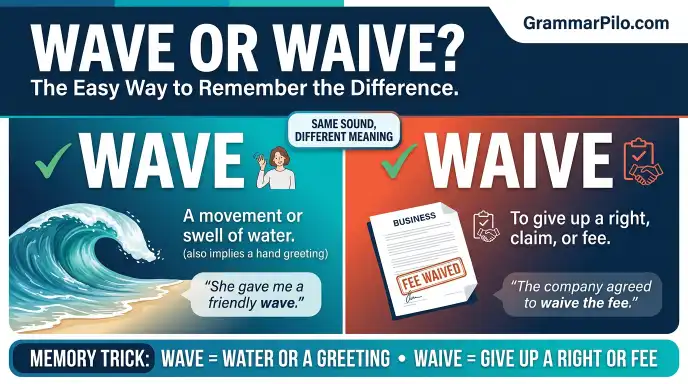
Wave is a noun or verb referring to a moving swell, a hand gesture, or a movement that rises and falls.
Waive is a verb meaning to voluntarily give up a right, claim, fee, or requirement.
| Word | Meaning | Example |
| Wave | A hand gesture or moving swell | She gave me a friendly wave. |
| Waive | To give up a right or requirement | The company agreed to waive the fee. |
Memory trick: You wave with your hand, but you waive a fee or right.
What Does Wave Mean?
The word wave has several meanings depending on the context. It can function as both a noun and a verb.
Wave as a Noun
As a noun, wave can describe a movement of water, a gesture made with the hand, or a sudden increase in something.
Examples include:
- A large wave crashed against the shore.
- She gave her neighbor a friendly wave.
- A wave of excitement spread through the crowd.
- The city experienced a new wave of visitors.
In each sentence, wave refers to a movement, gesture, or surge.
Wave as a Verb
As a verb, wave means to move your hand or another object back and forth, often to greet someone, attract attention, or signal something.
Examples:
- Please wave when you see me.
- The teacher waved to the students.
- He waved a flag during the parade.
- She waved goodbye as the train departed.
The word can also describe something that curves or moves in a flowing pattern.
Example: The tall grass waved gently in the wind.
What Does Waive Mean?
Waive is a verb that means to voluntarily give up, relinquish, or choose not to enforce a right, claim, fee, or requirement.
It is commonly used in legal, financial, educational, and professional contexts.
Waive a Fee
When a person or organization waives a fee, they agree not to charge it.
Examples:
- The bank agreed to waive the late payment fee.
- The hotel waived the cancellation charge.
- Students may qualify to have their application fees waived.
Waive a Right or Requirement
The word can also refer to voluntarily giving up a right or choosing not to insist on a particular condition.
Examples:
- The defendant chose to waive the right to a jury trial.
- The employee agreed to waive the notice requirement.
- The organization decided to waive its usual eligibility rule.
Waiving a right or requirement can have legal or financial consequences, so the exact meaning depends on the circumstances.
Important: Waive does not mean to move your hand or greet someone. It describes giving something up or choosing not to require it.
The Main Difference Between Waive and Wave
The simplest difference is that wave describes a movement or gesture, while waive describes voluntarily giving something up.
| Feature | Wave | Waive |
| Part of speech | Noun and verb | Verb |
| Main meaning | A gesture, swell, or flowing movement | To give up a right, fee, or requirement |
| Common contexts | Greetings, oceans, signals, trends | Contracts, fees, rules, rights |
| Example | He gave a wave. | They waived the fee. |
| Can it describe a greeting? | Yes | No |
| Can it describe giving up a fee? | No | Yes |
Compare these sentences:
- She waved to the receptionist.
She greeted the receptionist with her hand. - She waived the registration fee.
She agreed not to charge the registration fee.
The difference is not about grammar or regional spelling. It is about meaning.
Is Wave or Waive Correct in American and British English?
Both wave and waive are standard English words in American and British English. Neither is an alternative spelling of the other.
| English variety | Correct word for a hand gesture | Correct word for giving up a fee |
| American English | Wave | Waive |
| British English | Wave | Waive |
| Australian English | Wave | Waive |
| Canadian English | Wave | Waive |
| International English | Wave | Waive |
There is no American-versus-British spelling difference in this pair. The appropriate word depends on what you want to communicate.
Why the Words Are Confusing
The words are homophones in standard English, meaning they are pronounced alike but have different spellings and meanings.
Because they sound the same, relying on pronunciation alone will not help you select the correct spelling. Instead, consider the sentence’s meaning.
- If someone is greeting, signaling, or moving something, use wave.
- If someone is giving up a right, fee, or requirement, use waive.
Common Mistakes When Using Wave and Waive
Mixing up these words can change the meaning of a sentence, especially in professional or legal writing.
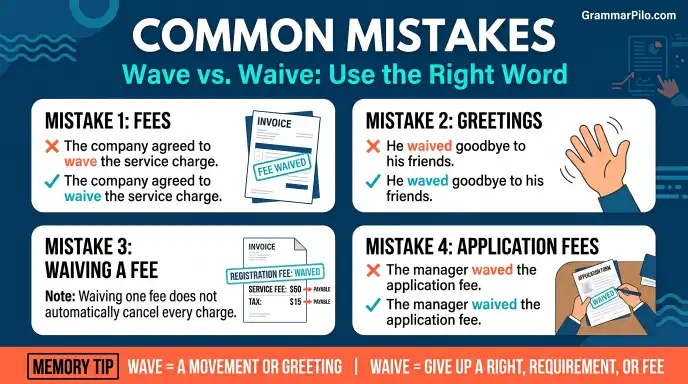
Mistake 1: Using Wave for a Fee
Incorrect: The company agreed to wave the service charge.
Correct: The company agreed to waive the service charge.
The sentence refers to removing a charge, so waive is the correct word.
Mistake 2: Using Waive for a Greeting
Incorrect: He waived goodbye to his friends.
Correct: He waved goodbye to his friends.
The sentence describes a hand gesture, so wave is correct.
Mistake 3: Confusing Waive With Remove
Waive often means choosing not to require or collect something, but it does not automatically mean that an existing obligation disappears in every circumstance.
For example, a company may waive a particular fee while other charges remain payable. In legal or contractual situations, the scope of a waiver depends on the relevant terms and circumstances.
Mistake 4: Assuming the Words Are Interchangeable
Incorrect: The manager waved the application fee.
Correct: The manager waived the application fee.
The manager is choosing not to charge the fee, not making a gesture with it.
Tip: Read the sentence and ask yourself what action is taking place. A physical movement usually points to wave; giving up or not enforcing something points to waive.
Wave and Waive in Everyday Examples
The following examples show how both words work in common situations.
In School
Wave: The student waved to her teacher in the hallway.
Waive: The college agreed to waive the application fee for eligible students.
Wave: The science teacher explained how a sound wave travels.
Waive: The student asked the school to waive the late registration penalty.
In Emails and Workplace Communication
Wave: I saw you across the office, but I did not have time to wave.
Waive: Could you please confirm if the company can waive the additional service fee?
Wave: The supervisor waved for the team to come closer.
Waive: Management decided to waive the requirement for this particular project.
In Everyday Conversation
Wave: Please wave when you arrive at the entrance.
Waive: Can the hotel waive the cancellation fee?
Wave: The children waved at the passing bus.
Waive: The customer requested that the bank waive the overdraft charge.
In News and Media
Wave: A new wave of heavy rain is expected to reach the region.
Waive: The airline agreed to waive certain change fees for affected passengers.
Wave: Fans waved flags as the team entered the stadium.
Waive: Officials decided to waive the usual deadline under special circumstances.
In Formal Writing
Wave: The report examines how a wave travels through different materials.
Waive: The agreement allows the parties to waive specific contractual requirements under stated conditions.
Wave: The candidate waved to supporters after the speech.
Waive: The organization may waive the membership fee at its discretion.
Waive or Wave: A Quick Comparison Table
Use this table as a quick reference when choosing between the two words.
| If you mean… | Use | Example |
| Greeting someone with your hand | Wave | I waved to my cousin. |
| A swell of water | Wave | A wave reached the beach. |
| A movement or signal | Wave | She waved the driver forward. |
| A sudden increase or surge | Wave | A wave of complaints followed. |
| Giving up a fee | Waive | They waived the delivery fee. |
| Giving up a right | Waive | He chose to waive his right to appeal. |
| Not enforcing a rule | Waive | The school waived the deadline. |
| Choosing not to collect a charge | Waive | The landlord waived the late fee. |
Waive vs. Wave: Google Trends and Modern Usage
Both words appear in modern English, but they are used in different contexts.
Wave has a broad range of everyday meanings. It appears in conversations about greetings, oceans, science, music, weather, and social trends. For that reason, it is common in casual speech as well as academic writing.
Waive is more specialized. It frequently appears in discussions about fees, contracts, legal rights, insurance, applications, and policies. People often encounter it when dealing with financial services or official documents.
Although both words sound alike, their surrounding words usually reveal the intended meaning. Phrases such as “wave goodbye,” “ocean wave,” and “wave of support” use wave. Phrases such as “waive the fee,” “waive the requirement,” and “waive the right” use waive.
Easy Tricks to Remember Wave and Waive
If you regularly confuse wave and waive, use these simple memory aids.
Trick 1: Wave With Your Hand
Remember the familiar action of waving hello or goodbye.
Wave = hand movement.
Example: She waved at the driver.
Trick 2: Waive a Fee
Associate waive with fees, rights, and requirements.
Waive = give something up or choose not to require it.
Example: The bank waived the annual fee.
Trick 3: Look for the Object
Pay attention to the word that follows the verb.
- Wave your hand.
- Wave a flag.
- Waive a fee.
- Waive a requirement.
- Waive a right.
This is not an absolute grammar rule, but it is a useful way to identify the intended meaning.
Trick 4: Replace the Word
Try replacing the word with a synonym.
If “greeted with a hand gesture” or “moved back and forth” makes sense, choose wave.
If “gave up,” “relinquished,” or “chose not to enforce” makes sense, choose waive.
Frequently Asked Questions
1. What is the difference between wave and waive?
Wave refers to a gesture, movement, swell, or surge. Waive means to voluntarily give up a right, fee, claim, or requirement.
2. Is it wave a fee or waive a fee?
The correct expression is waive a fee. It means to choose not to charge or collect the fee.
3. Is it wave goodbye or waive goodbye?
The correct expression is wave goodbye because it describes a hand gesture used when leaving or saying farewell.
4. Are wave and waive pronounced the same?
Yes. They are homophones in standard English, so their pronunciation is the same even though their spellings and meanings differ.
5. Is waive a real word?
Yes. Waive is a standard English verb used in legal, financial, educational, and everyday professional contexts.
6. Can wave be used as a noun and a verb?
Yes. Wave can be a noun, as in “a large wave,” or a verb, as in “wave to a friend.”
7. Can waive be used as a noun?
No. Waive is a verb. Its related noun is waiver, which refers to the act of giving something up or a document or statement recording that decision.
Example: The participant signed a liability waiver.
8. Is wave or waive correct in British English?
Both words are correct in British English, just as they are in American English. Wave describes a gesture or movement, while waive means to give something up.
9. What does it mean to waive your rights?
It means voluntarily giving up or relinquishing certain rights. The consequences depend on the specific right, applicable law, and circumstances.
10. How can I remember wave vs. waive?
Remember that you wave with your hand but waive a fee or right. This simple distinction works in most everyday situations.
Conclusion: Wave or Waive?
The difference between wave and waive becomes easy to remember once you connect each word to its main meaning.
Wave refers to a hand gesture, a movement of water, or a surge in something. Waive means to voluntarily give up a right, fee, claim, or requirement.
For example, you wave to a friend across the street, but you ask a company to waive an extra charge. Both spellings are correct in American and British English, so regional spelling rules do not determine which word to use.
When you are unsure, look at the action described in the sentence. If it involves greeting, signaling, or movement, wave is usually the right choice. If it involves giving something up or choosing not to enforce a condition, use waive.
The easiest rule to remember is simple: wave with your hand, waive a fee or right. Keep this distinction in mind, and you will be able to use both words accurately in everyday conversations, professional emails, and formal writing.
See More Related Articles

I’m Claire Morgan, the author behind Grammarpilo.com, where I write about English grammar, sentence structure, punctuation, and everyday language. My goal is to make grammar simple, clear, and practical, helping readers understand the rules and apply them with confidence in real-world writing.





3 thoughts on “Wave or Waive: The Easy Way to Remember the Difference”