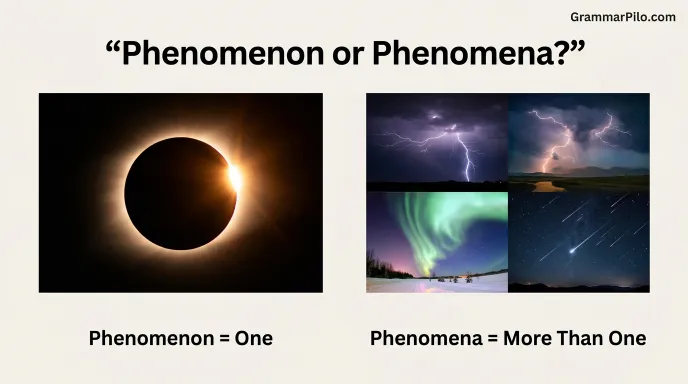
Phenomenon is the singular form, while phenomena is the plural form. Use phenomenon when you are talking about one event, fact, occurrence, or unusual thing, and use phenomena when you are talking about more than one.
Cambridge Dictionary lists phenomena as the plural of phenomenon, and Collins gives the same singular to plural relationship.
The confusion around phenomenon or phenomena comes from the unusual plural ending. Most English nouns form their plurals by adding s or es, such as book/books or box/boxes.
Phenomenon, however, comes from Greek through Latin, so it keeps a classical plural form: phenomena. Cambridge includes phenomenon → phenomena among nouns with special Latin and Greek plural forms.
This distinction is especially important in academic, scientific, formal, and professional writing. You may see sentences such as “This is a natural phenomenon” and “These are natural phenomena.” The words are closely related, but they cannot normally be exchanged.
In this guide, you will learn the difference between phenomenon and phenomena, their meanings, pronunciation, origins, British and American usage, common mistakes, everyday examples, and an easy way to remember which form to use.
Phenomenon or Phenomena: Quick Answer
Phenomenon: The singular form, used for one event, occurrence, fact, experience, or unusual thing.
Phenomena: The plural form, used for two or more events, occurrences, facts, experiences, or unusual things.
Simple rule: One phenomenon, two or more phenomena.
Example: A solar eclipse is a natural phenomenon.
Example: Solar eclipses and lunar eclipses are natural phenomena.
Definition and Meaning of Phenomena or Phenomenon
What Does Phenomenon Mean?
A phenomenon is something that exists, happens, or can be experienced or observed. The word is often used for something unusual, interesting, important, or noticeable.
Cambridge defines it as something that exists and can be experienced, particularly something unusual or interesting.
The word can be used in many areas, including science, nature, psychology, society, culture, and everyday conversation.
For Example:
- Gravity is a natural phenomenon.
- The sudden increase in online shopping became a social phenomenon.
- The northern lights are a spectacular natural phenomenon.
The word can also describe a person or thing that is exceptionally unusual or successful.
Example: The young musician became a global phenomenon.
Cambridge recognizes this additional meaning for a person or thing that is especially unusual or successful.
What Does Phenomena Mean?
Phenomena is the plural form of phenomenon.
Use it when you are referring to multiple events, occurrences, experiences, or observable facts.
For Example:
- Scientists studied several natural phenomena.
- The researchers recorded unusual weather phenomena.
- Psychological phenomena can be difficult to explain.
Cambridge and Collins both identify phenomena as the plural of phenomenon.
Phenomenon and Phenomena Have the Same Basic Meaning
The main difference is number.
Phenomenon = one
Phenomena = more than one
The meaning of the word does not fundamentally change. The grammatical number changes.
Why Is the Plural of Phenomenon Phenomena?
The unusual plural comes from the word’s Greek origin.
English has borrowed many words from Greek and Latin. Some of these words retain traditional plural forms.
For example:
| Singular | Plural |
| phenomenon | phenomena |
| criterion | criteria |
| analysis | analyses |
| crisis | crises |
| hypothesis | hypotheses |
Cambridge lists phenomenon → phenomena as one example of a noun with a special plural form.
This is why phenomenons is generally not the normal plural form when you mean multiple observable events or occurrences.
The Origin of Phenomenon and Phenomena
The Origin of Phenomenon
The word phenomenon entered English in the 16th century.
Etymonline dates the English noun to the 1570s and traces it through Late Latin phaenomenon to Greek phainomenon, meaning “that which appears or is seen.” It ultimately comes from a Greek verb meaning “to appear” or “to show.”
The original connection to something that appears or can be observed helps explain the modern meaning.
Over time, phenomenon developed several uses.
It could describe:
- something directly observed
- an event or occurrence
- something experienced
- an unusual event
- an extraordinary person or thing
- a philosophical object of perception
The meaning “extraordinary occurrence” developed later, with Etymonline dating that sense to the 18th century.
The Origin of Phenomena
Phenomena comes from the classical plural of phenomenon.
Etymonline identifies phenomena as the classical plural form and notes that it has sometimes been incorrectly used as a singular.
The ending a is part of a traditional Greek and Latin plural pattern.
That is why the correct standard pair is:
Singular: phenomenon
Plural: phenomena
British English vs American English Spelling
There is no British versus American spelling difference between phenomenon and phenomena.
Both forms are used in British and American English.
| Form | British English | American English |
| Singular | phenomenon | phenomenon |
| Plural | phenomena | phenomena |
| One event | phenomenon | phenomenon |
| Multiple events | phenomena | phenomena |
The pronunciation can differ somewhat between British and American English, but the spelling remains the same. Cambridge provides separate British and American pronunciations for both the singular and plural forms.
An American Usage Note
Cambridge’s American dictionary also records phenomenons in some specialized senses, particularly when referring to a special or extraordinary person or thing.
However, for general formal writing about multiple observable events or occurrences, phenomena is the established plural form.
Which Form Should You Use?
The easiest way to choose between phenomenon or phenomena is to count the things you are describing.
Use Phenomenon for One
Choose phenomenon when there is only one event, occurrence, or observable fact.
For Example:
The eclipse was a remarkable phenomenon.
Climate change is a complex phenomenon.
The sudden trend became a cultural phenomenon.
Use Phenomena for More Than One
Choose phenomena when you are discussing multiple events or occurrences.
Examples:
Scientists studied several natural phenomena.
These psychological phenomena require further research.
The researchers observed unusual atmospheric phenomena.
Use the Verb Correctly
The singular form takes a singular verb.
Correct: This phenomenon is difficult to explain.
The plural form takes a plural verb.
Correct: These phenomena are difficult to explain.
This follows the standard relationship between singular and plural nouns and their verbs. Cambridge’s grammar guidance explains that singular nouns take singular verbs while plural nouns take plural verbs.
Common Mistakes with Phenomena and Phenomenon Phenomena
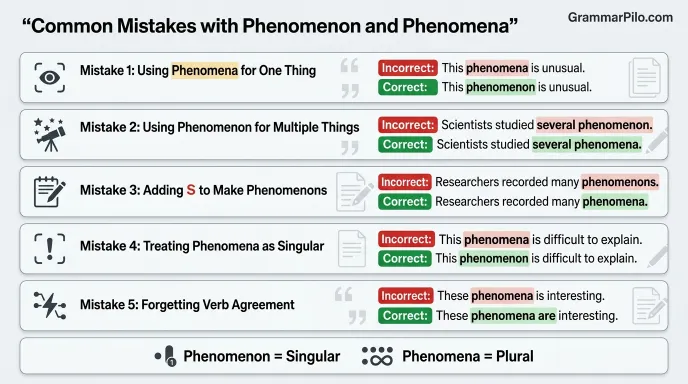
Mistake 1: Using Phenomena for One Thing
Incorrect: This phenomena is unusual.
Correct: This phenomenon is unusual.
The word phenomena is plural, so it should not normally be used with a singular subject such as “this.”
Mistake 2: Using Phenomenon for Multiple Things
Incorrect: Scientists studied several phenomenon.
Correct: Scientists studied several phenomena.
The word several indicates more than one, so the plural phenomena is needed.
Mistake 3: Adding S to Make Phenomenons
Incorrect: Researchers recorded many phenomenons.
Better: Researchers recorded many phenomena.
For the standard plural of phenomenon, use phenomena. Collins and Cambridge identify this as the standard plural relationship.
Mistake 4: Treating Phenomena as Singular
Incorrect: This phenomena is difficult to explain.
Correct: This phenomenon is difficult to explain.
Phenomena can look unusual because of its classical ending, but it is plural.
Mistake 5: Forgetting the Verb Agreement
Incorrect: These phenomena is interesting.
Correct: These phenomena are interesting.
The plural noun phenomena normally requires a plural verb.
Phenomenon or Phenomena in Everyday Examples
In Emails
Example: This unusual phenomenon has affected several departments.
Example: The research team is studying several related phenomena.
In News Writing
Example: Experts described the sudden increase as a social phenomenon.
Example: Scientists are investigating several unusual weather phenomena.
In Social Media
Example: The northern lights were an amazing natural phenomenon.
Example: It is fascinating to learn about strange natural phenomena.
In Formal Writing
Example: The study examines the phenomenon of language change.
Example: The researchers analyzed several psychological phenomena.
In Academic Writing
Example: The phenomenon has been observed in several experiments.
Example: These phenomena require further investigation.
In Science Writing
Example: Lightning is a naturally occurring phenomenon.
Example: Scientists continue to study atmospheric phenomena.
Phenomenon vs. Phenomena in Sentences
Seeing the two forms side by side makes the difference easier to understand.
| Singular | Plural |
| This phenomenon is unusual. | These phenomena are unusual. |
| The phenomenon was observed yesterday. | The phenomena were observed yesterday. |
| A natural phenomenon occurred. | Several natural phenomena occurred. |
| This social phenomenon is interesting. | These social phenomena are interesting. |
| One phenomenon was recorded. | Several phenomena were recorded. |
Notice how the demonstrative and verb also change:
This + phenomenon + is
These + phenomena + are
That pattern is a useful shortcut when checking your sentence.
Phenomenon or Phenomena: Pronunciation
The pronunciation of the two forms is different.
Phenomenon
British English is commonly pronounced approximately:
fuh NOM uh nun
American English is commonly pronounced approximately:
fuh NAH muh nahn
Cambridge gives separate British and American pronunciations for the word.
Phenomena
The plural phenomena is commonly pronounced approximately:
fuh NOM uh nuh in British English
fuh NAH muh nuh in American English
Cambridge lists these plural pronunciations alongside the singular form.
Phenomenon vs. Phenomena in Different Fields
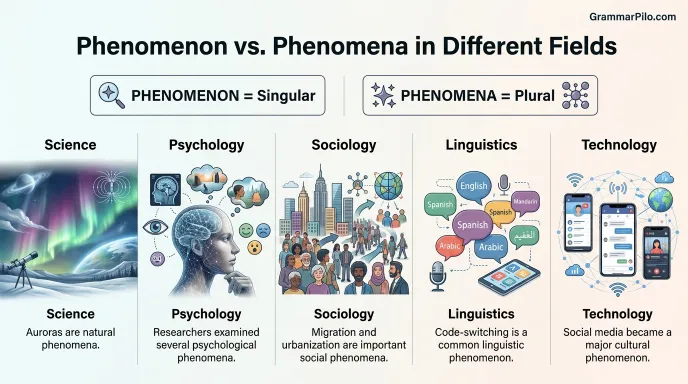
The words are especially common in fields that study observable events or patterns.
Science
Scientists may study physical, chemical, biological, or astronomical phenomena.
Auroras are natural phenomena caused by interactions between charged particles and Earth’s atmosphere.
Psychology
Psychologists may discuss psychological phenomena such as memory, perception, or group behavior.
The researchers examined several psychological phenomena.
Sociology
Sociologists often study social phenomena.
Migration and urbanization are important social phenomena.
Linguistics
Language change can also be described as a linguistic phenomenon.
Code-switching is a common linguistic phenomenon in multilingual communities.
Technology
New developments in technology can sometimes become cultural or social phenomena.
The rapid growth of social media became a major cultural phenomenon.
Phenomenon or Phenomena: Google Trends & Usage Data
Google Trends measures relative search interest rather than the total number of times a word appears in books, articles, or conversations.
For phenomenon or phenomena, searches may come from students, writers, researchers, and English learners trying to determine the correct singular or plural form.
The important grammatical distinction is clear in major dictionaries: phenomenon is singular, while phenomena is its standard plural.
Search interest can also vary by country and time period. A reliable comparison should therefore specify the location, date range, and search category instead of presenting one unsupported worldwide figure.
For normal edited English, the safest rule remains simple:
One = phenomenon
More than one = phenomena
Phenomenon and Phenomena: Side by Side Comparison
| Feature | Phenomenon | Phenomena |
| Number | Singular | Plural |
| Meaning | One event or occurrence | Multiple events or occurrences |
| Example | A natural phenomenon | Natural phenomena |
| Determiner | this, that, a, one | these, those, several, many |
| Verb | is, was | are, were |
| Origin | Greek through Latin | Classical plural of phenomenon |
| British spelling | phenomenon | phenomena |
| American spelling | phenomenon | phenomena |
| Pronunciation | Singular pronunciation | Plural pronunciation |
| Standard formal use | Yes | Yes |
How to Remember Phenomena vs. Phenomenon
Use the one versus many trick.
Phenomenon = one
Phenomena = many
You can also remember the pattern by comparing it with criterion and criteria.
One criterion → several criteria
One phenomenon → several phenomena
The ending a often signals the classical plural in these words.
Related Words from Phenomenon
The word phenomenon is part of a larger word family.
Phenomenal
Phenomenal is an adjective meaning extraordinary, remarkable, or related to a phenomenon. Collins records both senses.
Example: She made phenomenal progress.
Phenomenology
Phenomenology is a philosophical approach concerned with experience and consciousness.
Phenomenologically
This is the adverbial form related to phenomenology.
These related forms are useful, but they do not change the basic singular plural rule.
Key Takeaways
- Phenomenon is singular.
- Phenomena is plural.
- Use phenomenon for one event, occurrence, experience, or unusual thing.
- Use phenomena for two or more.
- Phenomena is the standard plural in general formal English.
- Phenomenons is not the normal plural for multiple observable events.
- The words come from Greek through Latin.
- British and American English use the same spellings.
- A singular sentence normally uses is or was.
- A plural sentence normally uses are or were.
- The easiest rule is one phenomenon, many phenomena.
Frequently Asked Questions About Phenomenon or Phenomena
1. Is phenomenon singular or plural?
Answer: Phenomenon is singular. It refers to one event, occurrence, experience, or unusual thing.
2. Is phenomena singular or plural?
Answer: Phenomena is plural. It refers to more than one phenomenon. Cambridge and Collins both identify it as the plural of phenomenon.
3. What is the plural of phenomenon?
Answer: The standard plural is phenomena.
Example: One phenomenon, several phenomena.
4. Can I say phenomenons?
Answer: In general formal writing, use phenomena for the plural of phenomenon. Some American dictionary entries record phenomenons in limited senses involving an extraordinary person or thing, but it is not the usual plural for observable events or occurrences.
5. Is phenomenon or phenomena correct?
Answer: Both are correct, but they have different grammatical numbers. Phenomenon is singular, and phenomena is plural.
6. Should I say this phenomenon or this phenomena?
Answer: Say this phenomenon because “this” normally refers to one thing.
Correct: This phenomenon is unusual.
7. Should I say these phenomenon or these phenomena?
Answer: Say these phenomena because “these” refers to more than one thing.
Correct: These phenomena are unusual.
8. Why does phenomenon become phenomena?
Answer: Phenomenon comes from Greek through Latin, and phenomena preserves its classical plural form. The a ending comes from a traditional Greek and Latin plural pattern.
9. Is phenomenon spelled differently in British and American English?
Answer: No. The spelling is phenomenon in both British and American English. The plural is phenomena in both varieties.
10. What is an easy way to remember phenomenon and phenomena?
Answer: Remember one phenomenon, many phenomena. If you can replace the noun with “one,” use phenomenon. If you mean “several” or “many,” use phenomena.
Conclusion
The difference between phenomenon or phenomena is mainly a matter of grammatical number. Phenomenon is the singular form, while phenomena is the standard plural form. A single unusual event, observable fact, experience, or occurrence is a phenomenon. Two or more are phenomena.
The unusual plural comes from the word’s Greek and Latin history. Unlike most English nouns that simply add s, phenomenon keeps the classical plural phenomena. This makes it similar to other words such as criterion and criteria or analysis and analyses.
The same spellings are used in British and American English. The most important point is to match the noun with the correct number and verb.
Use phenomenon for one and phenomena for more than one.
If you remember just one sentence, make it this: One phenomenon, many phenomena.
See More Difference
- Lettuce or Cabbage: What Is the Real Difference?
- Lettuce or Cabbage: What Is the Real Difference?
- Masculine or Feminine: Understanding the Difference in English

I’m Claire Morgan, the author behind Grammarpilo.com, where I write about English grammar, sentence structure, punctuation, and everyday language. My goal is to make grammar simple, clear, and practical, helping readers understand the rules and apply them with confidence in real-world writing.








2 thoughts on “Phenomenon or Phenomena: Master the Singular and Plural Forms”