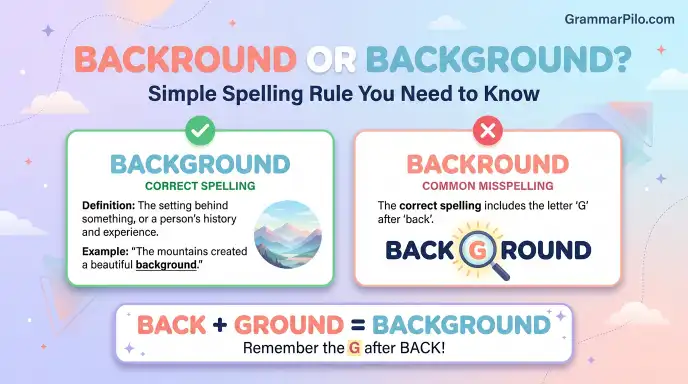
Background is the correct spelling, while backround is a common misspelling. The word background can refer to the area behind a main subject, a person’s education or experience, or the circumstances that help explain an event.
It is widely used in photography, graphic design, education, business, writing, and everyday conversation.
For example, you might say, “The photo looks better with a blue background.” In this sentence, background refers to the area behind the main subject. You could also write, “She has a background in computer science,” to describe her education or experience.
The confusion between backround and background usually happens because people accidentally leave out the letter g after back.
Although the incorrect version may look familiar, it is not an accepted alternative spelling in standard English.
In this guide, you will learn why background is correct, explore its different meanings, understand its spelling and origin, and see how to use it in everyday situations.
You will also discover common mistakes, practical examples, frequently asked questions, and an easy trick to remember the correct spelling.
Backround or Background: Quick Answer
Background is correct. Backround is incorrect.
The word background is a compound word formed from back and ground. It can describe something behind a main subject or the information and circumstances surrounding a person, event, or situation.
Examples:
- The designer chose a white background.
- She has a professional background in marketing.
- The teacher explained the historical background of the story.
- The mountains formed a beautiful background for the photograph.
Incorrect examples:
- The designer chose a white backround.
- She has a professional backround in marketing.
- The teacher explained the historical backround.
In every example, the correct spelling includes the letter g between back and round.
The Easiest Way to Remember the Spelling
Think of the word as two separate words joined together.
Back + ground = Background
The spelling retains the complete word ground. If you remember that background contains both back and ground, you are less likely to leave out the letter g.
| Word | Correct? | Explanation |
| Back | Yes | The rear part or side of something |
| Ground | Yes | The surface of the earth or a base |
| Background | Yes | The area behind something or contextual information |
| Backround | No | A common misspelling |
| Backgrounds | Yes | The plural form of background |
The simple rule is to write background, with the full spelling of both parts.
Definition and Meaning of Background and Backround
What Does Background Mean?
Background is a noun with several related meanings. It can describe the area behind the main subject in a picture, a person’s education or experience, or the circumstances that help explain an event.
The intended meaning depends on the context.
1. Background in Images and Photography
In photography, art, and graphic design, the background is the part of an image that appears behind the main subject.
Examples:
- The portrait has a plain white background.
- The photographer blurred the background to highlight the model.
- Add a darker background to make the text easier to read.
- The mountains create a dramatic background.
This meaning is especially common when discussing website graphics, product photographs, advertisements, and social media designs.
2. Background as Education or Experience
The word can also describe a person’s education, training, work history, or personal experience.
Examples:
- She has a background in English literature.
- His technical background helped him solve the problem.
- The company is looking for someone with a strong sales background.
- My educational background prepared me for this position.
In these examples, background refers to knowledge or experience that a person has gained over time.
3. Background as Historical or Supporting Information
A background can be the information needed to understand a person, event, decision, or situation.
Examples:
- The article provides the historical background of the conflict.
- We need more background information before making a decision.
- The teacher explained the background of the novel.
- Understanding the political background helps explain the event.
This meaning is common in research, journalism, education, and professional writing.
4. Background as Something Less Noticeable
The word can describe sounds, activities, or details that remain behind the main focus.
Examples:
- Soft music played in the background.
- I heard a conversation in the background of the recording.
- The office was busy, but the background noise was manageable.
- She continued working in the background while the team presented its results.
The phrase in the background often suggests that something is present but is not the main focus.
What Does Backround Mean?
Backround is a misspelling of background. It is not the standard spelling of the word in English.
For example:
Incorrect: The image has a colorful backround.
Correct: The image has a colorful background.
Incorrect: He has a backround in finance.
Correct: He has a background in finance.
The error occurs when the letter g is omitted from the word. Whenever you mean the area behind something, a person’s experience, or contextual information, use background.
The Origin of Backround and Background
Where Does Background Come From?
The word background is a compound formed from the words back and ground. Both elements have long histories in English.
Back can refer to the rear part of something, while ground can refer to the earth, a surface, or a foundation. Together, the words developed the meaning of a surface or area behind something.
Over time, the meaning expanded beyond physical spaces. The word came to describe a person’s history, professional experience, the circumstances behind an event, and less prominent sounds or activities.
Today, background is used in many fields, including art, photography, computing, education, science, business, and communication.
How the Word Developed Its Modern Meaning
The main meanings of background are closely connected.
- Physical meaning: The area behind the main subject.
- Personal meaning: A person’s education, history, or experience.
- Informational meaning: Facts that help explain a situation.
- Sound or activity meaning: Something present but not in the foreground.
For example, a photographer may change an image’s background, while a hiring manager may ask about an applicant’s professional background. The two uses differ, but both describe something that supports or surrounds the main focus.
Why Do People Write Backround?
The misspelling usually happens because the word is pronounced quickly and the spelling of its two parts is overlooked. Some writers remember the sound of background but fail to retain the complete spelling of ground.
Another reason is typing speed. When people write quickly, they may accidentally omit a letter without noticing.
The best solution is to break the word into its two parts.
Back + ground = Background
This method makes the missing g easier to remember.
British English vs American English Spelling
There is no spelling difference between British English and American English for background. Both varieties use the same spelling.
| Feature | American English | British English |
| Correct spelling | Background | Background |
| Incorrect spelling | Backround | Backround |
| Plural form | Backgrounds | Backgrounds |
| Related phrase | Background information | Background information |
| Common expression | In the background | In the background |
American English Examples
- The designer selected a dark background for the website.
- She has a strong educational background.
- The report provides useful background information.
British English Examples
- The designer selected a dark background for the website.
- She has a strong educational background.
- The report provides useful background information.
The spelling remains identical in both varieties. You do not need to change the word for an American or British audience.
Some English words have regional spelling differences, such as color and colour or center and centre. However, background is spelled the same way in both American and British English.
Which Spelling Should You Use?
Always use background in standard English writing.
Use Background for Images
Examples:
- Choose a simple background for your presentation.
- The product stands out against the black background.
- The designer changed the background color.
- The photographer removed the original background.
Use Background for Education and Work
Examples:
- She has a background in teaching.
- The employer asked about my professional background.
- His academic background includes computer science.
- We need a candidate with a technical background.
Use Background for Events and Situations
Examples:
- The article explains the historical background.
- The report provides background information.
- Researchers studied the social background of the issue.
- I need more background before I can understand the decision.
Use Background in Everyday Expressions
Examples:
- Music was playing in the background.
- The conversation continued in the background.
- She prefers working in the background.
- The building appeared in the background of the photograph.
Use Backgrounds for More Than One
The plural form is backgrounds.
Examples:
- The designer created three different backgrounds.
- The candidates have different educational backgrounds.
- The photographer tested several colorful backgrounds.
Do not write backrounds. The plural form keeps the complete spelling of background and adds -s.
Common Mistakes With Background or Backround
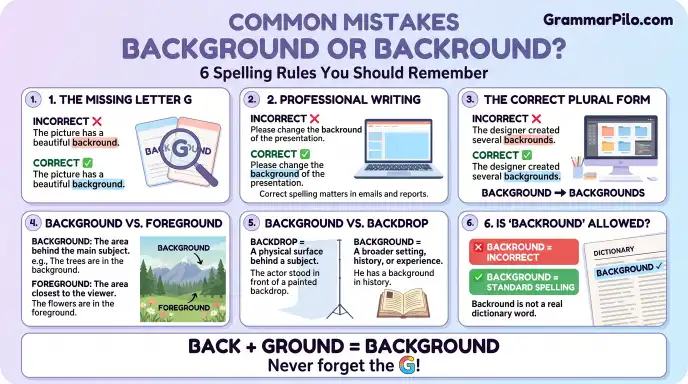
Mistake 1: Leaving Out the Letter G
Incorrect: The picture has a beautiful backround.
Correct: The picture has a beautiful background.
The word contains back followed by ground. Keep the g when joining the two parts.
Mistake 2: Using Backround in Professional Writing
Incorrect: Please change the backround of the company presentation.
Correct: Please change the background of the company presentation.
Spelling accuracy is important in presentations, reports, emails, and published content.
Mistake 3: Misspelling the Plural Form
Incorrect: The designer created several backrounds.
Correct: The designer created several backgrounds.
The plural is formed by adding -s to the correctly spelled word.
Mistake 4: Confusing Background With Foreground
Background refers to the area behind the main subject, while foreground refers to the area closest to the viewer or the most prominent front part of a scene.
Examples:
- The trees are in the background.
- The flowers are in the foreground.
These words describe different parts of a scene, so they should not be used interchangeably.
Mistake 5: Confusing Background With Backdrop
A backdrop is often a surface or setting placed behind a subject, especially for a photograph, performance, or event. Background has a broader range of meanings, including personal experience and historical context.
Examples:
- The actor stood in front of a painted backdrop.
- The article explains the historical background of the event.
Although these words can overlap in visual contexts, they are not interchangeable in every sentence.
Mistake 6: Assuming Backround Is an Alternative Spelling
Incorrect: Both background and backround are acceptable.
Correct: Background is the standard spelling.
Unlike certain words that have accepted British and American forms, backround is not a recognized regional alternative.
Background or Backround in Everyday Examples
The following examples show how to use the correct spelling in different situations.
In School
Background: The teacher explained the historical background of the story.
Background: Students researched the author’s educational background.
Incorrect: The teacher explained the historical backround.
In Emails
Background: Could you provide some background information about the project?
Background: I have a background in customer service.
Incorrect: Could you provide some backround information?
In Business
Background: The manager reviewed the candidate’s professional background.
Background: We need more background information before approving the proposal.
Incorrect: The manager reviewed the candidate’s professional backround.
In Graphic Design
Background: Use a light background to improve readability.
Background: The logo looks clearer against a plain background.
Incorrect: Use a light backround for the design.
In Photography
Background: The photographer blurred the background to emphasize the subject.
Background: The mountains appeared in the background of the picture.
Incorrect: The mountains appeared in the backround.
In Everyday Conversation
Background: I could hear music playing in the background.
Background: She has a background in computer programming.
Incorrect: I could hear music playing in the backround.
Across these situations, the same rule applies: write background with the complete spelling of back and ground.
Backround vs. Background: Google Trends and Modern Usage
People search for backround or background when checking the spelling of the word for writing, design work, education, or everyday communication. The two forms look similar, but only background is the accepted standard spelling.
Related search phrases include:
- backround or background
- background spelling
- correct spelling of background
- background meaning
- background definition
- background information meaning
- background image
- background color spelling
The correct word appears in many contexts. Designers use it when discussing image backgrounds, employers use it when discussing professional experience, and writers use it when explaining the context of an event.
Which Spelling Is Standard?
| Word or phrase | Standard usage |
| Background | Correct |
| Backround | Misspelling |
| Backgrounds | Correct plural |
| Background information | Correct |
| Background image | Correct |
| In the background | Correct |
| Backround image | Incorrect |
Exact search volumes and changing Google Trends figures require current data. Without verified live figures, specific search counts or percentages should not be presented as facts.
For practical writing, the distinction is simple: background is correct, and backround should be corrected.
Background vs. Backround: Side by Side Comparison
| Feature | Background | Backround |
| Correct spelling | Yes | No |
| Standard English word | Yes | No |
| Refers to the area behind a subject | Yes | No |
| Describes personal experience | Yes | No |
| Describes contextual information | Yes | No |
| Used in American English | Yes | No |
| Used in British English | Yes | No |
| Correct plural | Backgrounds | Incorrectly written as backrounds |
| Example | The image has a blue background. | The image has a blue backround. |
| Recommended for formal writing | Yes | No |
Key takeaway: Always use background. The incorrect spelling backround leaves out the letter g from ground.
FAQs About Backround or Background
1. Is it backround or background?
Background is correct. Backround is a misspelling. For example, write, “The photograph has a beautiful background.”
2. Why is background spelled with a G?
The word is formed from back and ground. The letter g belongs to the word ground, so it remains in the compound word background.
3. What does background mean?
Background can mean the area behind a main subject, a person’s education or experience, or information that helps explain an event or situation.
4. Is background correct in British English?
Yes. Background is the standard spelling in both British and American English. There is no regional spelling difference.
5. What is the plural of background?
The plural is backgrounds.
Example: The designer created several backgrounds for the website.
6. What is the difference between background and foreground?
The background is the area behind the main subject, while the foreground is the area closest to the viewer or the most prominent front part of a scene.
Example: The trees are in the background, and the flowers are in the foreground.
7. How can I remember the correct spelling of background?
Break the word into two parts: back + ground = background. Remember to keep the g at the beginning of ground. This simple trick helps prevent the common misspelling backround.
Conclusion: Backround or Background?
When choosing between backround or background, always use background. It is the correct standard English spelling and can describe the area behind an image’s main subject, a person’s education or experience, or the information needed to understand a situation.
The spelling is the same in American and British English. You should write phrases such as background image, professional background, historical background, and background information with the complete word.
The easiest way to remember it is to divide the word into its two parts: back and ground. Since ground begins with the letter g, that letter must remain when the words are combined. The plural form is backgrounds, not backrounds.
If you are preparing a school assignment, designing a website, editing a photograph, writing a business email, or creating online content, the correct spelling makes your writing clearer and more professional.
Final rule: Write background, never backround.
Curious About More Differences?
- Uncurable or Incurable: A Quick Guide to Correct Word
- Loses or Looses: The Simple Trick to Remember the Difference
- Turmeric or Tumeric: The Correct Spelling Might Surprise You

I’m Sloane Mercer, a U.S.-based English language writer focused on grammar, spelling, vocabulary, and everyday English usage. Through GrammarPilo, I provide clear and practical explanations to help readers choose the right words and communicate with confidence.