
Formal and informal are both correct English words, but they describe different styles of communication.
Formal language is used in professional, academic, official, and serious situations, while informal language is common in everyday conversations with friends, family, and people you know well.
Understanding the difference helps you choose words, expressions, and sentence structures that fit your audience and purpose.
For example, you might write, “I would appreciate your assistance” in a professional email, but say, “Can you help me out?” when speaking with a friend. Both sentences communicate a similar message, yet their tone and level of formality are different.
The choice between formal or informal language is not simply about using difficult or easy words. It also involves politeness, contractions, greetings, sentence structure, and how closely you know the person receiving your message.
In this guide, you will learn what formal and informal mean, how they differ, when to use each style, and how to change your writing to suit different situations. You will also find practical examples, common mistakes, and simple tips for choosing the right tone.
Quick Answer: Formal vs. Informal
Formal language is appropriate for professional, academic, official, or other situations that require a respectful and structured tone.
Informal language is more relaxed and conversational, making it suitable for everyday communication with friends, family, and familiar people.
| Feature | Formal | Informal |
| Tone | Professional and respectful | Relaxed and conversational |
| Vocabulary | More precise and conventional | Everyday and familiar |
| Contractions | Often limited in traditional formal writing | Common |
| Common settings | Reports, applications, business letters | Text messages, casual chats |
| Example | I would like to request your assistance. | Can you help me out? |
Easy memory trick: Formal is for official situations; informal is for familiar conversations.
What Does Formal Mean?
The word formal describes something that follows established rules, conventions, or expectations. In communication, it refers to a style that is professional, respectful, structured, and appropriate for official or serious situations.
Formal language is often used when communicating with people you do not know well, addressing an authority figure, or presenting information in an academic or professional setting.
Formal Language in Writing
It is usually prioritizes clarity, accuracy, politeness, and a well-organized structure.
Examples include:
- I am writing to inquire about the available position.
- Please find the requested documents attached.
- We would appreciate your response at your earliest convenience.
- The findings indicate a significant improvement in performance.
These sentences are suitable for professional emails, reports, applications, and official correspondence.
Formal Language in Speaking
Formal language is also used in speeches, interviews, meetings, presentations, and official events.
Examples:
- Good morning. Thank you for attending today’s meeting.
- I would like to present the results of our research.
- Could you please clarify the final point?
- We appreciate your time and consideration.
Formal communication does not have to sound complicated. The goal is to express ideas clearly while respecting the situation and audience.
What Does Informal Mean?
The word informal describes something relaxed, casual, or free from strict formal conventions. Informal language is commonly used in everyday conversations and friendly communication.
It often includes familiar expressions, contractions, shorter sentences, and a more personal tone.
Informal Language in Writing
Informal writing is common in text messages, personal emails, social media posts, and conversations with friends.
Examples include:
- Hey, how are you doing?
- Just checking if you got my message.
- Thanks for sending that over!
- I’ll see you later.
These expressions sound natural in casual situations because they resemble ordinary conversation.
Informal Language in Speaking
People often use informal language when chatting with friends, family members, classmates, or close colleagues.
Examples:
- What’s up?
- I’ll be there in a minute.
- That sounds great!
- Can you give me a hand?
Informal language is not incorrect English. It simply suits situations where a relaxed and familiar tone is appropriate.
The Main Difference Between Formal and Informal
The main difference between informal and formal language is the tone and level of formality used to communicate a message.
Formal communication tends to be more structured and professional. Informal communication tends to be more relaxed, direct, and conversational.
| Feature | Formal Language | Informal Language |
| Purpose | Official or professional communication | Everyday communication |
| Tone | Respectful and measured | Friendly and relaxed |
| Greetings | Dear Mr. Smith, Good morning | Hi, Hey, Hello |
| Requests | Could you please assist me? | Can you help me? |
| Thanks | I appreciate your assistance. | Thanks a lot! |
| Apologies | I apologize for the inconvenience. | Sorry about that. |
| Vocabulary | Please inform me of your decision. | Let me know what you decide. |
| Sentence style | Often complete and carefully structured | May be shorter and more conversational |
| Contractions | May be limited, depending on the style guide | Frequently used |
| Common use | Reports, applications, official letters | Chats, texts, friendly emails |
Compare these examples:
- Formal: I would be grateful if you could send me the information.
- Informal: Could you send me the info?
Both sentences request information, but the first sounds more formal, while the second is more casual.
Informal vs. Formal in Different Situations
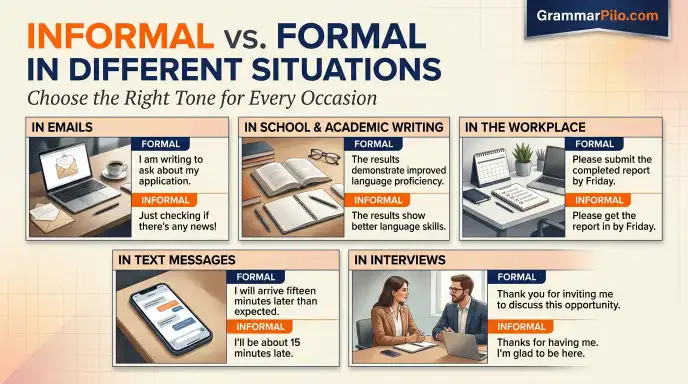
The right style depends on the purpose of your message, your audience, and the setting.
In Emails
Formal emails are appropriate for job applications, clients, supervisors, and official requests.
Formal example: Dear Ms. Taylor, I am writing to ask about the status of my application.
Informal example: Hi Taylor, just checking to see if there’s any news about my application.
Use a formal opening when contacting someone for the first time in a professional context. A more relaxed style may be appropriate once a friendly working relationship has developed.
In School and Academic Writing
Formal language is generally expected in essays, research papers, academic reports, and written examinations.
Formal example: The results demonstrate that regular practice can improve language proficiency.
Informal example: The results show that practicing regularly can help you get better at a language.
The informal sentence is understandable, but the formal version may fit an academic assignment better.
In the Workplace
Formal language is useful for official announcements, reports, proposals, and communications with clients.
Formal example: Please submit the completed report by Friday afternoon.
Informal example: Please get the report in by Friday.
The appropriate choice depends on the company’s culture and the relationship between the people communicating.
In Text Messages
Informal language is common when messaging friends and relatives.
Formal example: I will arrive approximately fifteen minutes later than expected.
Informal example: I’ll be about 15 minutes late.
The informal version is shorter and sounds more natural in an ordinary text message.
In Interviews
Job interviews generally call for polite, professional language, although you do not need to sound overly stiff.
Formal example: Thank you for inviting me to discuss this opportunity.
Informal example: Thanks for having me. I’m glad to be here.
Both can be appropriate depending on the interviewer’s tone and the organization. The second is conversational but still respectful.
Common Mistakes When Using Formal and Informal Language
Choosing the wrong tone can make a message sound too casual, unnecessarily stiff, or inappropriate for its audience.
Mistake 1: Using Slang in an Official Email
Too informal: Hey, send me the stuff ASAP.
More formal: Could you please send me the documents as soon as possible?
Slang may be fine with friends, but a clear and polite request is usually better for official communication.
Mistake 2: Making Every Sentence Sound Overly Formal
Overly stiff: I wish to express my sincere gratitude for your kind provision of assistance.
Natural and professional: Thank you for your help.
Formal writing should be clear and appropriate, not unnecessarily complicated.
Mistake 3: Assuming Contractions Are Always Incorrect
Contractions such as I’m, we’re, can’t, and it’s are common in informal writing. Some traditional academic or official styles limit contractions, but many professional settings accept them.
Formal alternative: I cannot attend the meeting.
Informal alternative: I can’t make the meeting.
Follow the expectations of your audience or the relevant style guide.
Mistake 4: Confusing Informal With Disrespectful
Informal language is not automatically rude. A friendly message can still be polite.
Informal but polite: Hi, could you send me the file when you get a chance?
Too abrupt for many professional settings: Send the file now.
The issue is not simply formality. It is also how respectfully the message treats the reader.
Mistake 5: Using Casual Expressions in Academic Writing
Expressions such as “a lot of stuff,” “kids,” or “kind of” may be suitable in conversation but less precise in an academic paper.
Informal: A lot of kids had trouble with the test.
More formal: Many students experienced difficulty with the test.
The formal version is more specific and suitable for academic discussion.
Formal and Informal Examples in Everyday English
The following examples show how the same idea can be expressed in different styles.
Greetings
Formal: Good morning. How are you today?
Informal: Hey! How’s it going?
Making a Request
Formal: Could you please provide me with a copy of the document?
Informal: Can you send me the document?
Saying Thank You
Formal: I sincerely appreciate your assistance.
Informal: Thanks so much for helping!
Apologizing
Formal: I apologize for the delay in responding.
Informal: Sorry I took so long to reply.
Inviting Someone
Formal: I would like to invite you to attend the event.
Informal: Do you want to come to the event?
Sharing an Opinion
Formal: In my opinion, the proposed solution would be effective.
Informal: I think that idea would work well.
Giving Information
Formal: Please be advised that the office will remain closed on Monday.
Informal: Just letting you know that the office is closed on Monday.
Ending a Message
Formal: Kind regards,
Informal: See you soon!
How to Change Informal Language Into Formal Language
You can make informal language more formal by adjusting vocabulary, sentence structure, greetings, and tone.
| Informal expression | More formal alternative |
| Hey | Hello or Dear [Name] |
| Thanks a lot | Thank you for your assistance |
| I wanna ask | I would like to ask |
| Can you help me out? | Could you please assist me? |
| Let me know | Please inform me |
| Sorry about that | I apologize for the inconvenience |
| ASAP | As soon as possible |
| A bunch of people | A large number of people |
| Kids | Children or students, depending on context |
| Get back to me | Please respond at your convenience |
These are useful alternatives, not strict replacements for every situation. The best wording depends on the meaning you want to convey.
Simple Steps for Making Writing More Formal
- Replace slang with clear, standard vocabulary.
- Use polite requests instead of direct commands when appropriate.
- Organize your message into complete, clear sentences.
- Choose a greeting and closing that fit the relationship.
- Remove unnecessary abbreviations and overly casual expressions.
- Keep the message natural instead of adding complicated words just to sound professional.
Is Informal or Formal the Same in American and British English?
The distinction between formal and informal language is broadly the same in American and British English. Both varieties use formal styles for many professional and official situations and informal styles for everyday communication.
However, some expressions, greetings, and conventions differ by region.
| Situation | American English example | British English example |
| Casual greeting | Hi, how are you? | Hi, how are you? |
| Formal request | Could you please send the information? | Could you please send the information? |
| Informal thanks | Thanks a lot! | Thanks a lot! |
| Formal closing | Sincerely, | Yours sincerely, or Kind regards, depending on context |
| Casual invitation | Do you want to come along? | Do you fancy coming along? |
The last example illustrates a common British informal expression, but usage varies by speaker and region. American and British English also share many formal expressions.
Important: Informal and formal are styles of communication, not competing spelling systems. The difference is mainly about context, audience, and tone.
Formal or Informal: Google Trends and Modern Usage
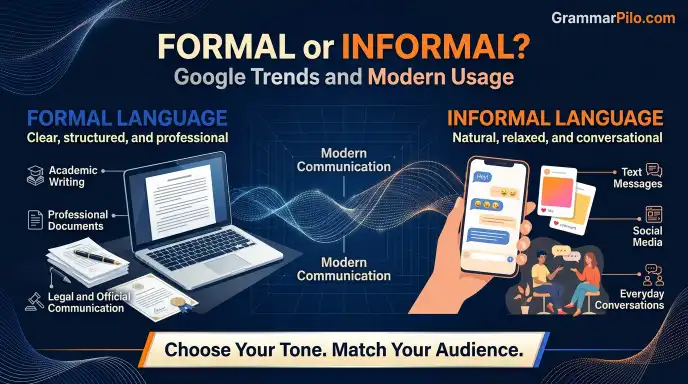
Formal and informal language are both important in modern communication. Their usage depends heavily on the context rather than one being universally better than the other.
Formal language remains common in academic writing, workplace documents, government communication, professional applications, and legal contexts.
Informal language is widely used in text messages, social media, personal conversations, and friendly workplace exchanges.
Digital communication has also made the boundary more flexible. A professional email may use contractions and a friendly greeting, while an informal message may still require careful wording if the subject is sensitive.
The most effective communicators can move between the two styles without losing clarity or respect.
Easy Ways to Remember Formal and Informal
Use these simple reminders to choose the right communication style.
Trick 1: Think About the Situation
Formal = official or professional.
Examples include job applications, academic essays, and business proposals.
Informal = relaxed or familiar.
Examples include conversations with friends, family texts, and casual chats.
Trick 2: Think About Your Audience
Ask yourself who will receive the message.
If you are writing to a professor, client, or official organization, a formal or professionally polite style may be appropriate. If you are texting a close friend, an informal style will usually sound more natural.
Trick 3: Read the Message Aloud
If your writing sounds like a relaxed conversation, it may be informal. If it sounds carefully structured and professional, it may be formal.
This is only a general guide. Professional writing can still sound warm, and casual communication can still be clear and respectful.
Trick 4: Match the Tone to the Purpose
A request for financial information may need a more formal tone than a message inviting a friend to lunch. Choose the style that makes the message appropriate, clear, and easy to understand.
Frequently Asked Questions
1. What is the difference between formal and informal?
Formal language is generally professional, structured, and appropriate for official situations. Informal language is relaxed and conversational, making it suitable for familiar people and everyday communication.
2. Is formal or informal correct English?
Both are correct. Formal and informal describe different communication styles. The appropriate choice depends on the audience, purpose, and situation.
3. What is an example of formal language?
“I would appreciate it if you could provide the requested information” is an example of formal language because it uses a polite, professional structure.
4. What is an example of informal language?
“Can you send me the info?” is an example of informal language because it uses a direct, conversational expression.
5. Is informal language unprofessional?
Not necessarily. Informal language can be perfectly appropriate in friendly workplace conversations, team chats, and relationships where a relaxed tone is expected. Problems arise when the style does not suit the situation.
6. Can I use contractions in formal writing?
Yes, depending on the style guide and context. Traditional academic writing may discourage contractions, while many modern professional documents allow them. Follow the requirements of your assignment or organization.
7. Is formal language always better?
No. Formal language is useful in official settings, but informal language can be more natural and effective in personal conversations. The best style is the one that fits the situation.
8. How do I make an informal sentence formal?
Replace slang with standard vocabulary, use a polite structure, and make the message clear and complete. For example, change “Hey, send me the file” to “Hello, could you please send me the file?”
9. What is the difference between formal and informal emails?
Formal emails usually include a suitable greeting, a clear purpose, polite wording, and a professional closing. Informal emails are more conversational and may use contractions, familiar greetings, and shorter sentences.
10. Are formal and informal the same in British and American English?
The basic distinction is the same in both varieties. Some phrases and email conventions differ, but formal language remains appropriate for official situations and informal language for relaxed communication.
Conclusion: Choosing Between Formal and Informal
Understanding formal and informal language helps you communicate effectively in different situations. Formal language is generally appropriate for academic assignments, professional emails, applications, reports, and official communication.
Informal language works well in everyday conversations, personal messages, and relaxed interactions with familiar people.
Neither style is automatically better than the other. What matters is choosing the tone that suits your audience and purpose. A formal message can show professionalism and respect, while an informal message can make communication feel friendly and natural.
When deciding between formal or informal wording, consider who will read or hear your message, what you want to achieve, and how the situation is likely to be interpreted.
You can also adjust your style as a relationship develops. For example, a conversation that begins formally with a new colleague may become more relaxed over time.
The key lesson is simple: use formal language when the situation calls for professionalism, and informal language when a relaxed, familiar tone is appropriate.
With practice, you can move naturally between both styles and make your English clearer, more effective, and more appropriate in every setting.
See More Related Articles

I’m Sloane Mercer, a U.S.-based English language writer focused on grammar, spelling, vocabulary, and everyday English usage. Through GrammarPilo, I provide clear and practical explanations to help readers choose the right words and communicate with confidence.





3 thoughts on “Formal or Informal: Learn the Difference & Choose the Right Style”