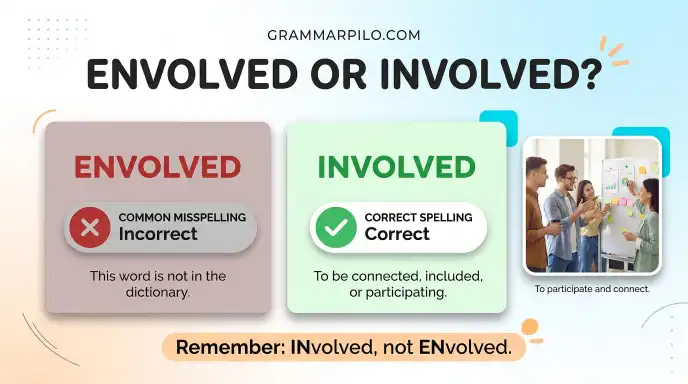
Involved is the correct spelling when you mean participating in something, being connected to a situation, or taking part in an activity. Envolved is generally a misspelling of involved in standard English. The two forms look similar, but only involved is appropriate for these common meanings.
The confusion between envolved or involved often happens because English spelling can be difficult to predict from pronunciation alone. People may remember the sound of a word but mix up its first few letters when writing it. In this case, the correct word begins with in-, not en-.
You will commonly see involved in school assignments, workplace emails, personal conversations, news reports, and formal documents. It can describe a person participating in a project, someone connected to an event, or a process that requires several steps.
If you searched for involved or envolved, envolved vs. involved, or involved and envolved, this guide explains the correct spelling, meaning, origin, grammar, common mistakes, and everyday uses. You will also learn a simple trick to remember the correct form and avoid this spelling error in future writing.
Envolved or Involved: Quick Answer
Involved is the correct standard English spelling. Envolved is generally an incorrect spelling when intended to mean involved.
| Word | Status | Meaning |
| Involved | Correct | Participating, connected, engaged, or complicated |
| Envolved | Generally incorrect for this meaning | Usually an attempted spelling of involved |
Examples:
- Correct: She is involved in the school project.
- Incorrect: She is envolved in the school project.
Remember: Write involved with in at the beginning.
What Does Involved Mean?
Involved is the past tense and past participle of the verb involve. It can also function as an adjective. Its meaning depends on the context, but it commonly describes participation, connection, engagement, or complexity.
1. Involved Means Participating
When someone takes part in an activity, project, event, or organization, that person is involved.
Examples:
- She is involved in the school debate team.
- Several students were involved in the science project.
- My brother is involved in community service.
- The manager is actively involved in the planning process.
In each example, involved shows that someone is participating in an activity.
2. Involved Means Connected to a Situation
The word can also describe someone who has a connection to an event, problem, decision, or investigation.
Examples:
- The police interviewed everyone involved in the incident.
- Three companies were involved in the agreement.
- The people involved in the dispute met yesterday.
- She was involved in the decision to change the schedule.
Here, the word describes a connection to a particular situation.
3. Involved Means Complicated
Sometimes, involved describes something that has many details, steps, or parts.
Examples:
- The instructions are too involved for beginners.
- Preparing the report was an involved process.
- The repair requires an involved procedure.
- We discussed an involved legal matter.
In these sentences, involved means complex or complicated rather than simply participating.
4. Involved in Personal Relationships
The word may also describe a person’s relationship or emotional connection with another person.
Examples:
- They have been involved for several months.
- He does not want to become involved in their argument.
- She was emotionally involved in the situation.
The context helps readers understand the specific kind of involvement.
What Does Envolved Mean?
Envolved is not the standard English spelling of involved. In ordinary writing, people who use envolved usually intend to write involved.
For example:
- Incorrect: The team was envolved in the competition.
- Correct: The team was involved in the competition.
The intended meaning is participation, so involved is the correct word.
Why Does Envolved Appear?
There are several possible reasons for this spelling mistake.
1. Confusion about the first letters: Writers may remember the ending correctly but replace in- with en-.
2. Writing from memory: Someone who has heard the word often but has not studied its spelling may write a form that looks reasonable.
3. Typing mistakes: Fast typing, autocorrect, or proofreading errors can allow the incorrect form to remain in a sentence.
4. Repeated online exposure: Seeing an incorrect form in informal posts can make it appear familiar, even when it is not standard spelling.
For ordinary English writing, use involved.
The Origin of Involved
The word involved comes from the verb involve, which entered English through French and ultimately traces back to Latin involvere, meaning to roll or wrap in.
Over time, the meaning developed to include the idea of being connected with, engaged in, or entangled in something. This helps explain why involved can describe participation in an activity as well as a complicated situation.
The word is now widely used in everyday and formal English.
Examples include:
- She was involved in the research.
- The case is more involved than it first appeared.
- Everyone involved received a copy of the report.
The spelling involved reflects the established English form of the word. The spelling envolved does not serve as a standard alternative for these meanings.
British English vs. American English: Involved or Envolved
There is no standard British-American spelling difference between involved and envolved. American English and British English both use involved.
| English variety | Correct spelling | Incorrect form for the intended meaning |
| American English | Involved | envolved |
| British English | Involved | envolved |
| Canadian English | Involved | envolved |
| Australian English | Involved | envolved |
| International English | Involved | envolved |
The correct form does not change based on the country or audience.
For example:
- American English: She is involved in the project.
- British English: She is involved in the project.
Both sentences use the same spelling.
Which Spelling Should You Use?
Use involved in schoolwork, business communication, emails, essays, reports, articles, and everyday conversation.
Avoid envolved when you intend to express participation, connection, engagement, or complexity.
In School Assignments
Correct: All students involved in the experiment must submit a report.
Incorrect: All students envolved in the experiment must submit a report.
In Business Emails
Correct: Please contact everyone involved in the project.
Incorrect: Please contact everyone envolved in the project.
In News Writing
Correct: Investigators questioned the people involved in the incident.
Incorrect: Investigators questioned the people envolved in the incident.
In Everyday Conversation
Correct: I do not want to get involved in their argument.
Incorrect: I do not want to get envolved in their argument.
The rule is simple: use involved whenever you mean being connected to, participating in, or engaged with something.
Common Mistakes With Envolved and Involved
Mistake 1: Replacing In- With En-
Incorrect: She is envolved in the charity event.
Correct: She is involved in the charity event.
The correct word starts with the letters in.
Mistake 2: Assuming Envolved Is a British Spelling
Some writers may think envolved is an alternative used in British English.
It is not the standard British spelling of involved. Both British and American writers use involved.
Mistake 3: Confusing Involved With Evolved
The words involved and evolved are both correct, but they have different meanings.
- Involved: Participating in something or connected to it.
- Evolved: Developed or changed gradually over time.
Examples:
- She was involved in the project.
- The project evolved over several months.
This is an important distinction because evolved is a real word, while envolved is generally a misspelling when intended to mean involved.
Mistake 4: Forgetting the Correct First Syllable
Writers sometimes focus on the ending of a word and overlook the beginning.
To avoid this error, remember the phrase:
Involved in the activity.
The word involved begins with the same letters as in in the phrase in the activity.
Mistake 5: Failing to Proofread
A spelling checker may catch envolved, but automated tools can miss some mistakes or fail to explain why a form is wrong.
Read your sentence again and check if you mean participation, connection, or complexity. If you do, involved is the correct form.
Involved or Envolved in Everyday Examples
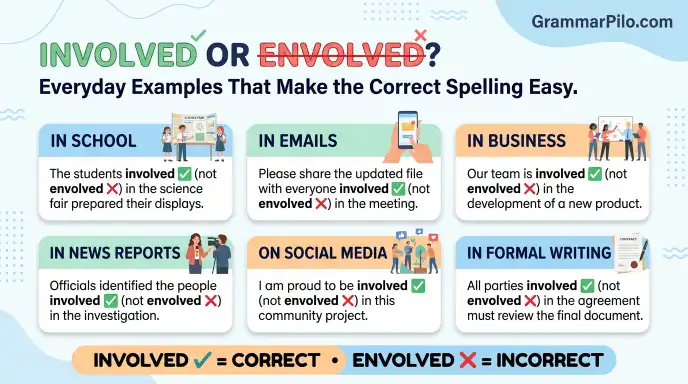
The following examples show how to use the correct word in common situations.
In School
Correct: The students involved in the science fair prepared their displays.
Incorrect: The students envolved in the science fair prepared their displays.
In Emails
Correct: Please share the updated file with everyone involved in the meeting.
Incorrect: Please share the updated file with everyone envolved in the meeting.
In Business
Correct: Our team is involved in the development of a new product.
Incorrect: Our team is envolved in the development of a new product.
In News Reports
Correct: Officials identified the people involved in the investigation.
Incorrect: Officials identified the people envolved in the investigation.
In Social Media
Correct: I am proud to be involved in this community project.
Incorrect: I am proud to be envolved in this community project.
In Formal Writing
Correct: All parties involved in the agreement must review the final document.
Incorrect: All parties envolved in the agreement must review the final document.
These examples show that involved remains the correct form across different writing styles and situations.
Involved vs. Evolved: Do Not Confuse These Words
Although envolved is generally a spelling mistake for involved, the correctly spelled word evolved has a separate meaning.
| Word | Meaning | Example |
| Involved | Participating or connected | She was involved in the campaign. |
| Evolved | Developed or changed over time | The campaign evolved into a larger movement. |
| Envolved | Generally a misspelling of involved | Use involved instead. |
The difference becomes clear when you focus on the action.
If someone takes part in something, use involved.
If something develops or changes gradually, use evolved.
Envolved or Involved: Google Trends and Modern Usage
Involved is the standard form used in contemporary English writing. It appears frequently in workplace communication, academic writing, news reports, personal conversations, and online content.
The form envolved may appear in searches, informal messages, or user generated content because of spelling errors. However, its appearance online does not make it a standard alternative.
A useful way to understand the usage difference is to examine the context:
- Involved in a project: Participating in the project.
- Involved in a discussion: Taking part in the discussion.
- An involved process: A complicated process.
- Evolved over time: Developed or changed gradually.
Exact search volume figures and Google Trends comparisons should be checked directly before publication. Without verified trend data, it is better not to claim a specific search volume or percentage difference.
For polished content, the safest choice is involved.
Quick Comparison Table: Involved vs. Envolved
| Feature | Involved | Envolved |
| Standard English spelling | Yes | No, for the intended meaning |
| Means participating | Yes | No |
| Means connected to a situation | Yes | No |
| Can mean complicated | Yes | No |
| Used in American English | Yes | Not as the standard form |
| Used in British English | Yes | Not as the standard form |
| Recommended in formal writing | Yes | No |
| Correct choice for ordinary usage | Yes | No |
Final rule: When you mean participating, connected, engaged, or complicated, write involved.
Key Takeaways
- Involved is the correct standard spelling.
- Envolved is generally a misspelling when used in place of involved.
- Involved is the past tense and past participle of involve.
- It can describe participation, connection, engagement, or complexity.
- American and British English use the same spelling.
- Evolved is a different correct word meaning developed or changed over time.
- Remember the opening letters: INvolved, not ENvolved.
Frequently Asked Questions
1. Is involved or envolved correct?
Involved is the correct standard spelling when you mean participating in something, being connected to a situation, or describing a complicated process. Envolved is generally a misspelling of involved.
2. What does involved mean?
Involved can mean participating in an activity, connected to an event, engaged in a situation, or complicated. For example, “She is involved in the project” means she takes part in it.
3. Is envolved a real English word?
Envolved is not the standard spelling for the common meanings of involved. In ordinary English writing, it should be corrected to involved when the intended meaning is participation, connection, or complexity.
4. Why do people spell involved as envolved?
People may confuse the opening letters, type quickly, or spell the word from memory. The forms look similar, but standard English uses involved.
5. Is involved spelled differently in British English?
No. Involved is the standard spelling in both British and American English. There is no regional spelling rule that changes it to envolved.
6. What is the difference between involved and evolved?
Involved means participating or connected to something. Evolved means developed or changed gradually over time. For example, a person can be involved in a project while the project evolves.
7. How do you use involved in a sentence?
You can write, “She was involved in the school event,” or “Everyone involved in the project attended the meeting.” In both examples, the word describes participation or connection.
8. What is the easiest way to remember involved?
Remember the beginning of the word: INvolved. You can connect it with the phrase “in the activity.” If someone participates in an activity, they are involved in it.
9. Can involved describe something complicated?
Yes. Involved can be an adjective meaning complex or complicated. For example, “The application process is involved” means the process has many details or steps.
10. Should I use involved in formal writing?
Yes. Involved is appropriate in formal and informal English. Use it in school assignments, business emails, reports, articles, and professional documents. Avoid envolved when you mean involved.
Conclusion
Involved is the correct spelling, while envolved is generally a spelling mistake in standard English. The word involved has several useful meanings. It can describe someone participating in an activity, a person connected to a situation, or a process that contains many details.
The confusion often comes from mixing up the first two letters. However, the spelling remains the same in American English, British English, and other major varieties of English.
Remember that involved and evolved are different words. Someone who is involved in a project participates in it, while a project that has evolved has developed or changed over time.
When writing an email, school assignment, business report, or article, use involved whenever you mean participation, connection, or complexity. A simple memory trick is to focus on the first two letters: IN, not EN.
Once you remember this small spelling detail, choosing the correct form becomes much easier.
See More

I’m Claire Morgan, the author behind Grammarpilo.com, where I write about English grammar, sentence structure, punctuation, and everyday language. My goal is to make grammar simple, clear, and practical, helping readers understand the rules and apply them with confidence in real-world writing.






1 thought on “Envolved or Involved: The Spelling Mistake You Should Avoid”