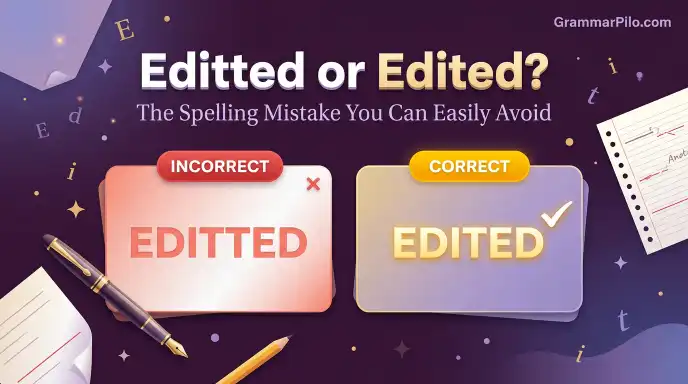
Edited is the correct spelling, while editted is a common misspelling. The word edited is the past tense and past participle of the verb edit.
It means to review, correct, improve, or change written, audio, or video content. The spelling editted incorrectly doubles the final letter t.
Many people search for editted or edited because English verbs follow different spelling rules when endings such as -ed and -ing are added. Some verbs double their final consonant, while others do not.
Understanding this difference helps you avoid mistakes in school assignments, business emails, website articles, and everyday messages.
For example, you should write, “She edited the report before sending it to her manager.” You should not write, “She editted the report.”
The same rule applies to many forms of the verb. The correct words are edit, edits, edited, and editing. The spelling editted is not standard English.
In this guide, you will learn why edited is correct, how the word is formed, how to use it in different sentences, and how to avoid similar spelling errors.
You will also find examples, a comparison table, frequently asked questions, and a simple rule to remember.
Editted or Edited: Quick Answer
Edited is correct. Editted is incorrect in standard English.
The word edited is the past tense and past participle of edit. It describes something that someone reviewed, corrected, revised, or changed.
Examples:
- She edited her essay before submitting it.
- The writer edited the article for clarity.
- We have edited the video.
- He edited the document yesterday.
Incorrect examples:
- She editted her essay.
- The writer editted the article.
- We have editted the video.
In each incorrect example, the final letter t has been doubled unnecessarily.
The easiest rule to remember
Edit + ed = edited, not editted.
The correct spelling keeps one t from the base word and adds the ending -ed.
| Form | Correct spelling |
| Base verb | Edit |
| Third person singular | Edits |
| Past tense | Edited |
| Past participle | Edited |
| Present participle | Editing |
| Incorrect form | Editted |
Remember this pattern whenever you write about correcting, revising, or improving something.
Definition and Meaning of Edited or Editted
What Does Edited Mean?
Edited is the past tense and past participle of edit. It means that someone has reviewed, changed, corrected, or improved a piece of content.
Editing can involve fixing spelling mistakes, improving grammar, removing unnecessary words, rearranging information, or making a video more effective.
The word is commonly used in writing, publishing, education, business, film, photography, and digital content creation.
1. Edited as the Past Tense
Use edited when an editing action happened in the past.
Examples:
- I edited my homework last night.
- She edited the email before sending it.
- The journalist edited the news report.
- They edited the video after filming.
Each sentence describes an action that has already happened.
2. Edited as a Past Participle
The past participle edited can be used with helping verbs such as has, have, and had.
Examples:
- I have edited the document.
- She has edited three chapters.
- They had edited the recording before the meeting.
- The article was edited by an experienced writer.
In these sentences, edited works with another verb to express tense or voice.
3. Edited as an Adjective
The word edited can also describe something that has been revised or changed.
Examples:
- Please read the edited version.
- The edited video is shorter than the original.
- She submitted an edited copy of the report.
Here, edited describes a noun rather than acting as the main verb.
What Does Editted Mean?
Editted is a misspelling of edited. It is not the standard past tense or past participle of edit.
For example:
Incorrect: The teacher editted my essay.
Correct: The teacher edited my essay.
Incorrect: I have editted the document.
Correct: I have edited the document.
The mistake usually happens because writers assume the final consonant must be doubled before adding -ed. However, that rule does not apply to every verb.
The Origin of Edited or Editted
The Origin of Edit
The word edit entered English in the late eighteenth century. It developed from the language of preparing and publishing written works, with connections to the Latin word editus, meaning published or brought forth.
Over time, edit became a general verb for preparing written material for publication. Its meaning later expanded to include revising photographs, audio recordings, videos, and digital content.
Today, editing can involve many tasks:
- Correcting spelling and grammar
- Improving sentence structure
- Removing repeated information
- Checking facts
- Revising a book or article
- Cutting and arranging video footage
- Changing audio recordings
How Edited Is Formed
The word edited is formed by adding the past tense ending -ed to the verb edit.
Edit + ed = edited
The final t is not doubled.
The same base word appears in several common forms:
- Edit
- Edits
- Edited
- Editing
- Editor
- Editing process
Each form follows its own grammatical pattern, but none requires the spelling editted.
Why Do People Write Editted?
English has many verbs that double their final consonant when adding an ending.
For example:
- Stop → stopped
- Plan → planned
- Admit → admitted
- Prefer → preferred
Because these words double their final consonants, writers may assume that edit should follow the same pattern.
However, English spelling rules depend on the structure and stress pattern of a word. In edit, the final syllable is not stressed, so the final t is not doubled when adding -ed or -ing.
That is why the correct forms are edited and editing, not editted and editting.
British English vs American English Spelling
There is no spelling difference between British English and American English for edited. Both varieties use the same spelling.
| Word form | American English | British English |
| Base verb | Edit | Edit |
| Present tense | Edits | Edits |
| Past tense | Edited | Edited |
| Past participle | Edited | Edited |
| Present participle | Editing | Editing |
| Incorrect form | Editted | Editted |
American English Examples
- She edited the article before publication.
- He is editing the video.
- The writer has edited the final draft.
British English Examples
- She edited the article before publication.
- He is editing the video.
- The writer has edited the final draft.
The spelling remains the same in both varieties. Writers do not need to choose between American and British spellings for this word.
Some other English words do have regional spelling differences, such as color and colour or organize and organise. However, edited is identical in American and British English.
Which Spelling Should You Use?
Always use edited when you need the past tense or past participle of edit.
Use Edited for Completed Actions
Examples:
- I edited the report yesterday.
- She edited her college application.
- The team edited the presentation before the meeting.
Use Edited With Helping Verbs
Examples:
- I have edited the file.
- He had edited the document earlier.
- The article was edited by a professional.
Use Edited to Describe Content
Examples:
- The edited version is ready.
- Please check the edited photograph.
- We watched the edited recording.
Use Editing for an Ongoing Action
If the action is happening now, use editing.
Examples:
- She is editing the article.
- They are editing the film.
- I am editing my assignment.
Do not write editting.
Use Edit for the Base Form
Examples:
- I need to edit this document.
- Please edit the final paragraph.
- We will edit the recording tomorrow.
The easiest approach is to remember the complete pattern:
Edit → Edits → Edited → Editing
This pattern covers the most common forms you will need in everyday writing.
Common Mistakes With Editted or Edited
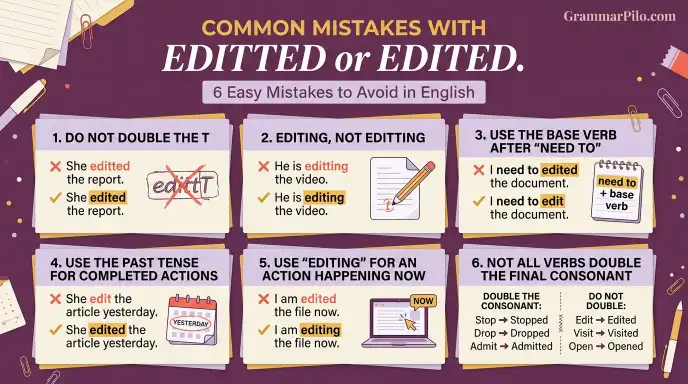
Mistake 1: Doubling the Final T
Incorrect: She editted the report.
Correct: She edited the report.
The verb edit does not double its final t before adding -ed.
Mistake 2: Writing Editting Instead of Editing
Incorrect: He is editting the video.
Correct: He is editing the video.
The same spelling principle applies when adding -ing. The correct form contains one t followed by ing.
Mistake 3: Using Edited Instead of Edit
Incorrect: I need to edited the document.
Correct: I need to edit the document.
After the verb need to, use the base form of the verb.
Mistake 4: Using Edit Instead of Edited
Incorrect: She edit the article yesterday.
Correct: She edited the article yesterday.
The sentence describes a completed past action, so the past tense form is required.
Mistake 5: Confusing Edited With Editing
Incorrect: I am edited the file now.
Correct: I am editing the file now.
Use editing after am when describing an action that is happening now.
Mistake 6: Assuming All Verbs Follow the Same Doubling Rule
Some verbs double the final consonant before adding -ed:
- Stop → stopped
- Drop → dropped
- Admit → admitted
Others do not:
- Edit → edited
- Visit → visited
- Open → opened
- Offer → offered
The correct spelling depends on the word’s structure and stress pattern. Do not double a final consonant automatically.
Edited or Editted in Everyday Examples
The following examples show how to use edited correctly in different situations.
In School
Correct: The student edited the essay before submitting it.
Correct: The teacher has edited the instructions to make them clearer.
Incorrect: The student editted the essay.
In Emails
Correct: I edited the email to make it more professional.
Correct: Please review the edited version before sending it.
Incorrect: I editted the email this morning.
In Business
Correct: Our team edited the presentation before meeting the client.
Correct: The manager has edited the report.
Incorrect: The manager editted the report.
In Blogging and Website Content
Correct: The writer edited the article to improve readability.
Correct: I am editing the blog post before publication.
Incorrect: The writer is editting the article.
In Video Production
Correct: They edited the video to remove unnecessary scenes.
Correct: The edited version is ready for review.
Incorrect: They editted the video last night.
In Social Media
Correct: I edited my caption to fix a spelling mistake.
Correct: She has edited her post.
Incorrect: I editted my caption.
In Everyday Conversation
Correct: I edited the message before sending it.
Correct: He is editing his photos.
Incorrect: He is editting his photos.
Across all these situations, the same spelling rule applies. Use edited for the past tense and past participle, and use editing for the ongoing action.
Editted vs. Edited: Google Trends and Usage Data
People search for editted or edited because the two spellings look similar and the extra t seems reasonable to many English learners. The confusion is understandable, especially for people familiar with words such as stopped, planned, and admitted.
Common related search phrases include:
- editted or edited
- edited spelling
- is editted a word
- how to spell edited
- editted meaning
- editing or editting
- edit past tense
- past tense of edit
- edited definition
These searches reflect a spelling question rather than a difference in meaning. Unlike some word pairs, editted is not an alternative regional spelling. Edited is the standard form in both American and British English.
Which Spelling Is Correct?
| Search phrase | Correct answer |
| Editted or edited | Edited |
| Editing or editting | Editing |
| Edit or edited | Depends on grammar |
| Edited or editing | Depends on the time and meaning |
| Edited or edit | Depends on sentence structure |
Exact search-volume figures and changing search-interest patterns require current keyword research or Google Trends data.
Without verified live figures, it would be misleading to assign search counts or claim that one spelling has a particular percentage of search interest.
For writers and learners, the most useful takeaway is straightforward: edited is the standard spelling, and editted should be corrected during proofreading.
Edited vs. Editted: Side-by-Side Comparison
| Feature | Edited | Editted |
| Correct spelling | Yes | No |
| Standard English word form | Yes | No |
| Past tense of edit | Yes | No |
| Past participle of edit | Yes | No |
| Used in American English | Yes | No |
| Used in British English | Yes | No |
| Example | She edited the report. | She editted the report. |
| Recommended for publication | Yes | No |
Key takeaway: Edited is always the correct standard spelling when you mean the past tense or past participle of edit.
FAQs About Editted or Edited
1. Is it editted or edited?
Edited is correct. Editted is a common misspelling. For example, write “She edited the article,” not “She editted the article.”
2. Why is edited spelled with one T?
The verb edit does not double its final t when adding -ed. The correct spelling is edit + ed = edited. The final syllable is not stressed, so the usual consonant-doubling pattern does not apply.
3. Is editted ever correct?
No. Editted is not the standard spelling of the past tense or past participle of edit. Use edited in formal writing, schoolwork, emails, and online content.
4. Is it editing or editting?
Editing is correct. The word edit keeps one t when the ending -ing is added. Do not write editting.
5. Is edited correct in British English?
Yes. Edited is correct in both British and American English. There is no regional spelling difference for this word.
6. What is the past tense of edit?
The past tense of edit is edited.
Example: She edited the report yesterday.
The past participle is also edited, as in “She has edited the report.”
7. How can I remember the spelling of edited?
Remember this pattern: Edit, edits, edited, editing. The word keeps one t in every form. If you remember that edit does not double its final consonant, you can avoid both editted and editting.
Conclusion: Editted or Edited?
When choosing between editted or edited, always use edited. It is the correct past tense and past participle of the verb edit, which means to review, correct, revise, or improve content. The spelling editted is a common error caused by doubling the final t unnecessarily.
The rule is the same in American and British English. You should write “She edited the report,” “I have edited the article,” and “The video was edited yesterday.” When describing an action in progress, use editing, as in “She is editing the document.”
Although English has many verbs that double their final consonants before adding endings, edit does not follow that pattern. Its correct forms are edit, edits, edited, and editing.
If you are writing a school assignment, professional email, blog post, or social media caption, using the correct spelling makes your writing clearer and more polished.
Remember the simple rule: edit becomes edited, never editted. With this pattern in mind, you can avoid the mistake and use the word confidently.
See More

I’m Claire Morgan, the author behind Grammarpilo.com, where I write about English grammar, sentence structure, punctuation, and everyday language. My goal is to make grammar simple, clear, and practical, helping readers understand the rules and apply them with confidence in real-world writing.