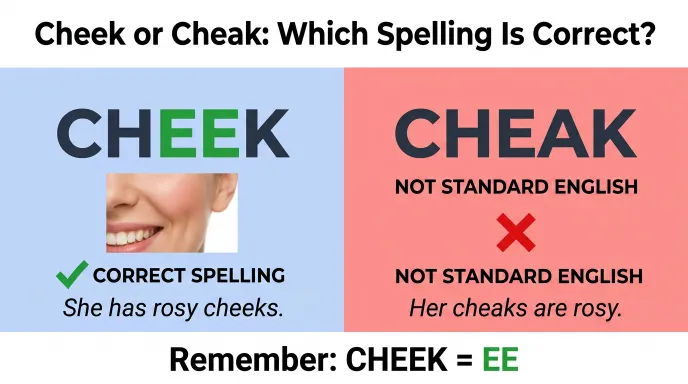
Have you ever wondered if the correct spelling is cheek or cheak? These two words look similar, but only one is the standard English spelling. Cheek is correct, while cheak is a common spelling mistake.
The word cheek refers to either side of your face below the eyes. It can also describe rude or bold behavior, especially in British English.
Many people confuse these spellings because they sound alike. The long “ee” sound in cheek may lead some writers to use “ea” instead of “ee.” However, English spelling does not always follow pronunciation rules.
Understanding this small difference can help you avoid spelling errors in school assignments, emails, blogs, and professional writing.
This guide explains the meaning of cheek, its origin, British and American spelling, common mistakes, and practical examples. You will also learn why cheak is not the standard spelling and how to remember the correct form easily.
Cheek or Cheak: The Correct Spelling Explained
Cheek is the correct spelling in standard English. It refers to the soft part of the face below the eye or can describe bold, disrespectful behavior. Cheak is not a standard English spelling of this word. For example, write “She has rosy cheeks,” not “She has rosy cheaks.”
Cheek or Cheak: Quick Answer
The correct spelling is cheek, with two letter E’s.
Cheak is incorrect when you mean the facial part or the behavior described by the word cheek.
Here is the simple comparison:
| Word | Correct? | Meaning |
| Cheek | Yes | The side of the face or bold behavior |
| Cheak | No | Nonstandard spelling of cheek |
Correct Examples
- She has beautiful rosy cheeks.
- He kissed his mother on the cheek.
- It was a bit of cheek to ask for more money.
- The child had a small mark on her cheek.
Incorrect Examples
- She has rosy cheaks.
- He kissed her on the cheak.
- That was a lot of cheak.
The correct spelling remains cheek in American, British, Canadian, and Australian English.
What Does Cheek Mean?
Cheek is a noun with several meanings. Its most common meaning refers to the soft area on either side of the face, below the eyes and between the nose and ears.
However, the word has other meanings in everyday English.
1. Cheek as a Part of the Face
A cheek is one of the two fleshy sides of your face.
Examples:
- The baby has soft, round cheeks.
- Tears rolled down her cheek.
- He felt a warm kiss on his cheek.
- Her cheeks turned red when she felt embarrassed.
The plural form is cheeks.
2. Cheek as Rude or Bold Behavior
In British English, cheek can describe behavior or speech that seems rude, disrespectful, or too bold.
Examples:
- He had the cheek to interrupt the teacher.
- What a cheek! You should have asked first.
- She got into trouble for showing cheek to her parents.
In American English, similar meanings are often expressed through words such as nerve, audacity, or impudence.
3. Cheek as an Informal Word for Buttocks
In informal English, cheeks can also refer to the two sides of a person’s bottom.
Example:
The child fell and landed on his cheeks.
This meaning is informal and depends on context.
4. Cheek in Common Expressions
The word also appears in several everyday expressions.
| Expression | Meaning | Example |
| Turn the other cheek | Avoid responding aggressively to an insult | She decided to turn the other cheek. |
| Tongue in cheek | Saying something jokingly or without complete seriousness | His comment was tongue in cheek. |
| Cheek to cheek | Very close together, especially while dancing | They danced cheek to cheek. |
| What a cheek! | An expression of surprise at someone’s boldness | What a cheek to ask for a free ticket! |
These expressions use the correct spelling cheek, never cheak.
The Origin of Cheek
The word cheek has a long history in English. It comes from Old English forms such as cēace and cēce, which referred to the jaw or jawbone.
Historical sources connect it with related West Germanic words, including Dutch kaak. Over time, its meaning became more closely associated with the fleshy sides of the face.
The word later developed additional meanings.
Around the 17th century, cheek began to refer informally to the buttocks. By the 19th century, it was also used to describe bold or disrespectful behavior.
This figurative meaning is still common in British English today.
Why Is Cheek Spelled With EE?
The spelling cheek developed through the historical forms of the word. Modern English kept the double E spelling.
The letters E and A can sometimes represent similar sounds in English words, which may cause confusion. However, that does not make cheak an accepted alternative spelling.
For example:
- Cheek
- Seek
- Week
- Peek
- Creek
These words use EE to represent the long E sound.
Remembering this spelling pattern can help you recognize the correct form.
British English vs American English Spelling
There is no spelling difference between British and American English for this word.
Both varieties use cheek as the correct spelling.
| British English | American English | Example |
| Cheek | Cheek | She has a mark on her cheek. |
| Cheeks | Cheeks | His cheeks turned red. |
| Cheeky | Cheeky | That was a cheeky remark. |
| Cheeked | Cheeked | The informal verb was cheeked. |
| Cheaking | Not standard | Incorrect spelling |
| Cheaking | Not standard | Incorrect spelling |
The word cheeky is also used in both varieties, but it is especially common in British everyday speech.
For example:
British English:
That was a cheeky thing to say!
American English:
That was a cheeky thing to say!
American speakers may also use bold, sassy, or smart alecky, depending on the situation.
Is Cheak a British or American Spelling?
No. Cheak is not an accepted regional spelling of cheek in standard British or American English.
The spelling remains the same across major English varieties.
Which Spelling Should You Use?
The answer is simple. Use cheek in every standard English context.
United States
American English uses cheek.
Example:
The little girl had a small dimple on her cheek.
United Kingdom
British English also uses cheek.
Example:
He had the cheek to complain after arriving late.
Canada
Canadian English follows the same spelling.
Example:
She rested her cheek against the window.
Australia
Australian English also uses cheek.
Example:
The child had rosy cheeks after playing outside.
International Writing
For international readers, always choose cheek.
It is widely recognized and understood.
Academic Writing
In academic writing, use cheek when discussing facial anatomy, human appearance, or language.
Example:
The subject showed visible redness across both cheeks.
Business Writing
The word may appear in informal communication or expressions.
Example:
His cheeky response surprised everyone in the meeting.
For formal business writing, words such as boldness or disrespect may be more suitable when describing behavior.
Common Mistakes With Cheek or Cheak
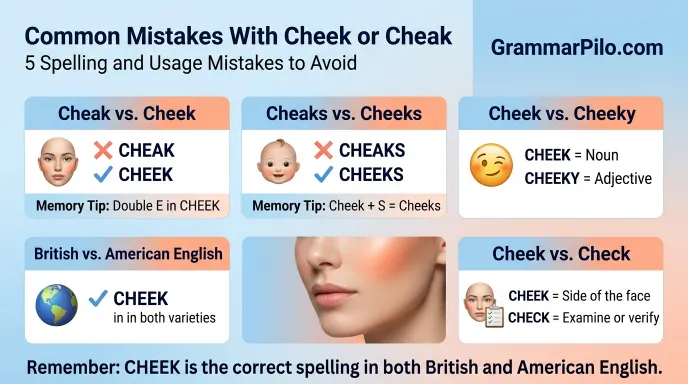
Mistake 1: Using Cheak Instead of Cheek
Incorrect: She has a small scar on her cheak.
Correct: She has a small scar on her cheek.
Explanation: The correct spelling uses two E’s. The spelling cheak is not standard English.
Memory tip: Remember the double E in cheek.
Mistake 2: Writing Cheaks Instead of Cheeks
Incorrect: The baby’s cheaks are very soft.
Correct: The baby’s cheeks are very soft.
Explanation: The plural of cheek is formed by adding S.
Memory tip: Cheek + S = cheeks.
Mistake 3: Confusing Cheek With Cheeky
Incorrect: She gave him a cheek look.
Better: She gave him a cheeky look.
Explanation: Cheek is usually a noun, while cheeky is an adjective describing someone or something bold, playful, or slightly disrespectful.
Memory tip: Use cheeky when describing a person, expression, or action.
Mistake 4: Assuming Cheak Is a Regional Variant
Incorrect claim: Cheak is the British spelling, while cheek is American.
Correct understanding: Both British and American English use cheek.
Explanation: This is not a regional spelling difference. It is simply a common spelling error.
Memory tip: The correct spelling stays the same everywhere.
Mistake 5: Confusing Cheek With Check
Incorrect: She touched her check.
Correct: She touched her cheek.
Explanation: Cheek refers to the side of the face. Check can mean to examine, verify, or control something.
Memory tip: Cheek has the long E sound, while check has the short E sound.
Cheek or Cheak in Everyday Examples
The following examples show how to use cheek naturally in different writing situations.
Emails
Example 1:
Please let me know if you notice any swelling on your cheek after the treatment.
Example 2:
I noticed a small red mark on my cheek this morning.
Business Writing
Example 1:
The employee made a cheeky comment during the meeting.
Example 2:
His response showed considerable cheek, given the circumstances.
News Headlines
Example 1:
Local Student Receives Award for Creative Cheek Art
Example 2:
Actor’s Cheeky Response Becomes a Talking Point
Blogs
Example 1:
Natural skincare products can help keep your cheeks soft and moisturized.
Example 2:
A little blush can add color to your cheeks and brighten your appearance.
Social Media
Example 1:
Rosy cheeks and a happy smile make the perfect winter look!
Example 2:
That was such a cheeky reply!
Academic Writing
Example 1:
The researcher observed a visible change in the color of the participant’s cheeks.
Example 2:
The facial examination included observations of the cheeks, jaw, and chin.
Daily Conversation
Example 1:
Why is your cheek red?
Example 2:
The baby has such cute cheeks!
Example 3:
You have some cheek asking me to do that!
These examples show that cheek can describe a body part, an expression, or bold behavior.
Google Trends & Modern Usage
People search for cheek or cheak because the two spellings look and sound similar. The confusion often comes from the difference between English pronunciation and spelling.
Some writers hear the long E sound and assume that cheak might be an alternative spelling. However, standard dictionaries recognize cheek, not cheak, for the usual meanings discussed in this article.
Common search phrases include:
- Cheek and cheak
- Cheak or cheek
- Cheak vs. cheek
- Is cheak a word?
- Correct spelling of cheek
- Cheek meaning
- Cheeks or cheaks
- How do you spell cheek?
- Cheek spelling in English
- Cheek pronunciation
Regional Popularity
The spelling cheek is used in American, British, Canadian, and Australian English.
There is no established regional spelling difference between cheek and cheak.
Modern Usage
The word cheek remains common in everyday English.
It appears in discussions about facial features, skincare, beauty, emotions, health, and personal behavior.
The expression cheeky is also widely used in informal conversations and social media.
Why People Search This Keyword
Most searches for this comparison come from spelling uncertainty.
People may see the word in a message, school assignment, article, or online discussion and want to confirm the correct spelling.
Exact Google Trends figures depend on the selected country and date range. Without a specific dataset, it would be misleading to claim exact search volumes or popularity percentages.
Quick Comparison Table: Cheek vs. Cheak
| Version | Meaning | Correct? | Region | Example |
| Cheek | Side of the face | Yes | All English varieties | She kissed his cheek. |
| Cheeks | Plural form of cheek | Yes | All English varieties | Her cheeks were rosy. |
| Cheek | Bold or disrespectful behavior | Yes | Especially common in UK usage | What a cheek! |
| Cheeky | Bold, playful, or slightly rude | Yes | British and other English varieties | That was a cheeky joke. |
| Cheak | Intended misspelling of cheek | No | Not standard | Incorrect: My cheak hurts. |
| Cheaks | Intended plural misspelling | No | Not standard | Incorrect: Her cheaks are red. |
Key Takeaways
- Cheek is the correct spelling in standard English.
- Cheak is a spelling mistake when referring to the face or bold behavior.
- A cheek is the soft area below the eye on either side of the face.
- The plural form of cheek is cheeks.
- Cheek can also mean bold or disrespectful behavior.
- British and American English use the same spelling.
- Cheeky is an adjective related to the noun cheek.
- The easiest memory trick is to remember the double E in cheek.
FAQs About Cheak and Cheek
1. Is it cheek or cheak?
Cheek is the correct spelling in standard English. It refers to the side of the face below the eye and can also describe bold or disrespectful behavior. Cheak is not a standard alternative spelling. For example, write “She has rosy cheeks,” not “She has rosy cheaks.”
2. Is cheak a real English word?
Cheak is not a standard English spelling of cheek. It may appear as a typo, a name, or a nonstandard form in particular contexts, but it should not replace cheek in ordinary English writing. If you mean the side of the face, the correct spelling is always cheek.
3. What does cheek mean?
Cheek usually means either of the two soft areas on the face below the eyes. It can also describe bold or disrespectful behavior, especially in British English. In informal speech, cheeks may refer to the two sides of the bottom. The intended meaning depends on the sentence.
4. Is cheek British or American English?
Cheek is used in both British and American English. There is no spelling difference between these varieties. However, the informal meaning of cheek as bold or disrespectful behavior is especially common in British English. Both varieties also use expressions such as cheeky and turn the other cheek.
5. What is the plural of cheek?
The plural of cheek is cheeks. Simply add the letter S to the singular form. For example, “The baby has soft cheeks” is correct. The spelling cheaks is incorrect because the original word keeps its double E when it becomes plural.
6. How do you spell cheek correctly?
The correct spelling is C-H-E-E-K. It contains two E’s followed by K. A helpful way to remember it is to connect it with words such as week, seek, and peek, which also use double E to represent the long E sound.
7. What is the difference between cheek and cheeky?
Cheek is mainly a noun that refers to a facial feature or bold behavior. Cheeky is an adjective used to describe someone or something that is playful, bold, or slightly disrespectful.
For example, “He has a round cheek” describes a facial feature, while “He made a cheeky comment” describes behavior.
8. Is it cheek or cheeks?
Both are correct, but they have different grammatical uses. Cheek is singular and refers to one side of the face. Cheeks is plural and refers to both sides or more than one cheek. For example, “She touched her cheek” is singular, while “Her cheeks were red” is plural.
9. Is cheek a noun or a verb?
Cheek is commonly used as a noun. It can refer to a part of the face or bold behavior. It can also function as an informal verb in British English, meaning to speak rudely to someone. For example, “Don’t cheek your teacher” uses cheek as a verb.
10. What is the difference between cheek and check?
Cheek refers to the side of the face or bold behavior. Check means to examine, verify, or inspect something. Although the words look similar, their vowel sounds and meanings differ. For example, “My cheek hurts” is correct for facial pain, while “Check the answer” means verify it.
Conclusion
The difference between cheek or cheak is simple once you remember the correct spelling. Cheek is the standard English word, while cheak is a common spelling mistake. The correct word refers to the soft area below the eyes and can also describe bold or disrespectful behavior.
The spelling does not change between American and British English. Writers in the United States, United Kingdom, Canada, Australia, and other English speaking regions all use cheek.
Remember that the plural form is cheeks, while cheeky is an adjective used to describe playful or bold behavior. These related forms also keep the double E spelling.
If you are writing an email, school assignment, blog post, or professional document, always choose cheek instead of cheak.
The easiest rule to remember is this: A cheek has two E’s, and the correct spelling never changes.
Avoid This Mistake
- Tried or Tryed: Which Spelling Should You Use?
- Beserk or Berserk: The Correct Spelling and How to Use It
- Spiky or Spikey: Which Form Is Correct?

I’m Claire Morgan, the author behind Grammarpilo.com, where I write about English grammar, sentence structure, punctuation, and everyday language. My goal is to make grammar simple, clear, and practical, helping readers understand the rules and apply them with confidence in real-world writing.






2 thoughts on “Cheek or Cheak: Never Make This Common Mistake Again”