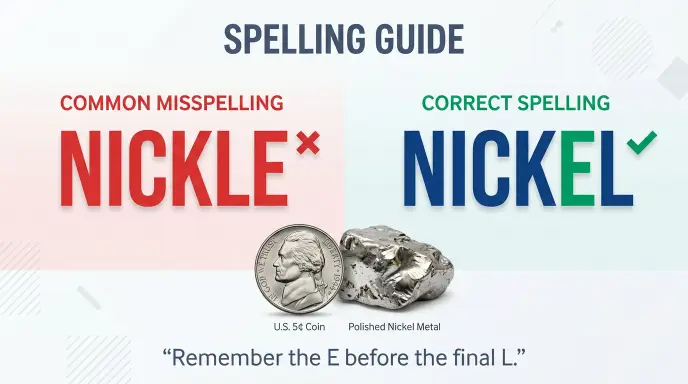
Have you ever written nickle when you meant nickel? The correct spelling of the common English word for the metal and the five cent U.S. coin is nickel, with an e before the final l.
Nickle is usually a misspelling of nickel, although it may appear as a surname or other proper name.This spelling confusion is easy to understand because the two forms look almost identical and may sound similar in everyday speech.
If you are writing about coins, chemistry, metal products, or everyday money, choosing the right spelling helps your writing look clear and accurate.
Nickel has several meanings. It is a chemical element used in many alloys, a silvery metal found in everyday products, and the name of a five cent coin in the United States. The word also appears in phrases such as nickel allergy, nickel plating, and not worth a nickel.
In this guide, you will learn the difference between nickle or nickel, explore the word’s origin, review American and British usage, and see practical examples for school, work, and everyday conversation.
Nickle or Nickel: Quick Answer
Nickel is the correct standard spelling for the chemical element, the metal, and the five cent U.S. coin. Nickle is generally a misspelling when used with these meanings. For example, write “I found a nickel in my pocket” and “Nickel is used in some metal alloys.” Remember the extra e in nickel.
If you are deciding between nickle or nickel, choose nickel for ordinary English writing.
The spelling nickel is used in several common contexts.
- Money: A nickel is a five cent coin in the United States.
- Chemistry: Nickel is a chemical element with the symbol Ni.
- Materials: Nickel is used in stainless steel and other metal alloys.
- Manufacturing: Nickel may be used in plating and protective coatings.
- Everyday expressions: “Not worth a nickel” means not worth much.
Examples of correct usage:
- She paid with a nickel and four pennies.
- The manufacturer uses nickel in some metal alloys.
- He found a nickel under the sofa.
In these examples, nickle would be incorrect because the intended word is the metal or coin.
What Does Nickel Mean?
Nickel is a noun with several related but distinct meanings. Its exact meaning depends on the sentence.
Nickel as a Chemical Element
Nickel is a metallic chemical element with the symbol Ni and atomic number 28. It is known for its silvery appearance and its use in alloys.
Nickel is used in products such as stainless steel, certain batteries, metal coatings, and industrial equipment. Its properties make it useful in manufacturing, although exposure to nickel can cause skin reactions in some people.
Examples:
- Nickel is used to make some stainless steel products.
- The laboratory measured the nickel content of the sample.
- Some people develop skin irritation from nickel in jewelry.
Nickel as a Coin
In the United States, a nickel is a coin worth five cents, or one twentieth of a dollar.
Examples:
- I found a nickel beside the vending machine.
- The child saved every nickel in a glass jar.
- The item costs less than a dollar and can be paid for with coins.
The U.S. five cent coin is commonly called a nickel, even though the coin is not made entirely of nickel.
Nickel in Everyday Expressions
The word also appears in common expressions.
- Not worth a nickel: Worth very little or nothing.
- Nickel and dime: To charge or handle small amounts of money, often in a way that feels unfair or overly detailed.
- Nickel plated: Covered with a layer of nickel.
Example: The customer complained that the company kept nickel and diming him with extra charges.
These expressions use the correct spelling nickel, never nickle when the standard word is intended.
What Does Nickle Mean?
Nickle is generally not the standard spelling of the common noun nickel. If you are writing about a metal, a U.S. coin, or a nickel based material, use nickel.
However, Nickle can occur as a surname or another proper name. In that case, its spelling depends on the person or organization being named.
Nickle as a Name
A name should be spelled according to the individual’s or organization’s established spelling.
Examples:
- Ms. Nickle attended the meeting.
- The document was sent to the Nickle family.
- The author used the surname Nickle on the book cover.
Here, Nickle is a proper noun. It is not being used to name the chemical element or coin.
When Nickle Is Incorrect
Use nickel in the following sentences.
Incorrect: The store gave me a nickle in change.
Correct: The store gave me a nickel in change.
Incorrect: This alloy contains nickle.
Correct: This alloy contains nickel.
Incorrect: The necklace may contain nickle.
Correct: The necklace may contain nickel.
The standard spelling includes the letter e before the final l.
The Origin of Nickel
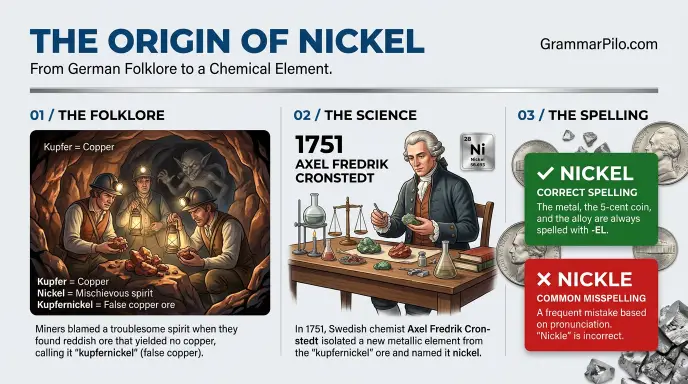
The history of nickel helps explain why its spelling differs from nickle.
Where the Word Nickel Comes From
The English word nickel developed from the German word Kupfernickel, a historical name associated with an ore that miners had difficulty working with. The German term combined Kupfer, meaning copper, with Nickel, a name associated with a mischievous or troublesome spirit in German folklore.
Miners used the term for an ore that looked as though it might contain copper but did not yield the expected metal. The name later became associated with the element itself.
How Nickel Became a Chemical Name
Nickel was identified as a distinct chemical element in the eighteenth century. Swedish chemist Axel Fredrik Cronstedt is credited with identifying it in 1751.
As scientific terminology developed, nickel became the established English spelling for the element. The same spelling is used for the metal and the U.S. five cent coin.
Why Nickle Is Confusing
The words nickle and nickel differ by only one letter. Because the final sound does not always make the spelling obvious, writers may leave out the e by mistake.
The standard spelling, however, remains nickel. The existence of Nickle as a surname does not make it an accepted alternative spelling of the chemical element.
British English vs. American English
The spelling of nickel is the same in standard British and American English. Neither variety normally uses nickle for the metal or coin.
| British English | American English | Example |
| Nickel | Nickel | Nickel is used in some metal alloys. |
| Nickel plating | Nickel plating | The component has a nickel plated finish. |
| Nickel allergy | Nickel allergy | Some people have a nickel allergy. |
| Nickel coin | Nickel coin | The collector examined the nickel coin. |
| Nickle | Nickle, generally incorrect for the common noun | The standard spelling is nickel. |
Is Nickel a Five-Cent Coin in Britain?
No. In the United States, nickel commonly refers to a five cent coin. The United Kingdom does not use a nickel as the name of its standard five pence coin.
British English still uses nickel when referring to the chemical element, the metal, and products containing it.
Which Spelling Should You Use?
Use nickel in the United States, United Kingdom, Canada, Australia, and international English when referring to the metal or element.
For U.S. money, nickel also means the five cent coin. In other countries, the word may refer only to the metal or appear in a technical or historical context.
In academic writing, use nickel for the chemical element and its compounds. And in business writing, use the same spelling for products, materials, and manufacturing processes.
Common Mistakes With Nickel or Nickle
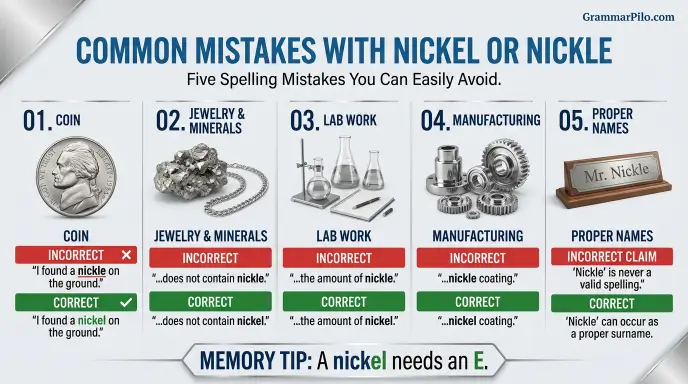
The most common mistake is leaving out the e in nickel. The following examples show how to correct the error.
Mistake 1: Misspelling the Coin Name
Incorrect: I found a nickle in my jacket pocket.
Correct: I found a nickel in my jacket pocket.
Explanation: The U.S. five cent coin is spelled nickel.
Mistake 2: Misspelling the Chemical Element
Incorrect: Nickel free jewelry does not contain nickle.
Correct: Nickel free jewelry does not contain nickel.
Explanation: The name of the chemical element is nickel, including the letter e before the final l.
Mistake 3: Using Nickle in a Science Report
Incorrect: The sample contains a small amount of nickle.
Correct: The sample contains a small amount of nickel.
Explanation: Scientific writing uses the established element name nickel.
Mistake 4: Misspelling Nickel Plating
Incorrect: The manufacturer applied a nickle coating.
Correct: The manufacturer applied a nickel coating.
Explanation: Nickel plating is the standard term for applying a nickel layer to a material.
Mistake 5: Assuming Nickle Can Never Be Correct
Incorrect claim: Nickle is never a valid spelling in any context.
Correct explanation: Nickle can occur as a surname or another proper name, but it is not the standard spelling for the metal or coin.
A Simple Memory Tip
Remember this sentence.
“A nickel needs an E.”
The extra e appears before the final l. When you write about a coin, a chemical element, or a metal coating, check that the word is spelled nickel.
Nickel and Nickle in Everyday Examples
The following examples show how to use nickel correctly across common writing situations.
In Emails
Nickel: Please confirm if the component contains nickel.
Nickel: I found a nickel in the office vending area.
In Business Writing
Nickel: The company manufactures nickel plated components.
Nickel: The finance team recorded the coin collection’s value.
In News Headlines
Nickel: Researchers Study Nickel Use in Battery Materials
Nickel: Rare Nickel Coin Attracts Attention From Collectors
These are illustrative headline examples, not claims about specific current news events.
In Blogs
Nickel: How to Recognize a Nickel Allergy
Nickel: Why Is the U.S. Five Cent Coin Called a Nickel?
In Social Media
Nickel: Found a nickel on my morning walk!
Nickel: Does your favorite jewelry contain nickel?
In Academic Writing
Nickel: Nickel is a metallic element with the chemical symbol Ni.
Nickel: The study examined the nickel content of the sample.
In Daily Conversation
Nickel: Do you have a nickel for the parking meter?
Nickel: This metal part may contain nickel.
In all these examples, nickle would be a spelling error unless it was intentionally used as a proper name.
Nickel vs. Nickle: Google Trends and Modern Usage
Nickel is the established spelling in dictionaries, scientific writing, manufacturing, coin collecting, and everyday English. Its meaning can vary by topic, which is one reason people search for it.
Common search interests may include:
- The difference between nickle and nickel.
- The meaning and pronunciation of nickel.
- The value of a U.S. five cent coin.
- Nickel in stainless steel, batteries, and other materials.
- Nickel allergies and jewelry.
- Nickel plating and industrial uses.
The spelling nickle is generally searched because people are unsure if the final letters should be written as -el or -le. Another possible reason is that Nickle appears as a personal name.
No verified, current Google Trends figures are included here, so exact search volumes, percentages, or regional rankings should not be assumed. A reliable comparison would require checking both search terms over the same period and region.
For practical writing, the distinction is clear. Use nickel for the chemical element, the metal, and the U.S. five cent coin. Use Nickle only when the spelling is part of a proper name or another specific title.
Nickle vs. Nickel: Quick Comparison Table
| Version | Meaning | Correct? | Region | Example |
| Nickel | Chemical element | Yes | International | Nickel is represented by Ni. |
| Nickel | U.S. five cent coin | Yes | United States | She found a nickel in her purse. |
| Nickel | Metal coating or material | Yes | International | The part has a nickel finish. |
| Nickle | Intended as the common metal name | No | General English | Write nickel instead. |
| Nickle | Personal name or surname | Yes, when intended | Depends on the person | Mr. Nickle joined the meeting. |
Key Takeaways
- Nickel is the correct standard spelling for the metal, chemical element, and U.S. five cent coin.
- Nickle is generally a misspelling when used as the common noun.
- The chemical symbol for nickel is Ni, and its atomic number is 28.
- A U.S. nickel is worth five cents.
- The spelling nickel is the same in American and British English.
- Nickle can be correct when used as a personal name or another proper noun.
- Remember the spelling with the phrase “A nickel needs an E.”
Frequently Asked Questions
1. Is it spelled nickle or nickel?
Nickel is the correct spelling for the metal, chemical element, and U.S. five cent coin. Nickle is generally a spelling mistake in these contexts. The main exception is when Nickle is intentionally used as a surname or another proper name.
2. Why do people spell nickel as nickle?
People may write nickle because the two forms look similar and the correct spelling is not always obvious from pronunciation. The standard spelling includes an e before the final l. A simple way to remember it is “A nickel needs an E.”
3. What does nickel mean?
Nickel is a metallic chemical element with the symbol Ni and atomic number 28. It is used in alloys, coatings, and various manufactured products. In the United States, nickel also refers to the five cent coin.
4. Is nickle ever a correct word?
Nickle can be correct as a personal name or surname. However, it is not the standard spelling for the metal, chemical element, or U.S. five cent coin. Always consider the intended meaning before correcting a proper name.
5. Is nickel spelled differently in British and American English?
No. Both British and American English use nickel for the chemical element and metal. In the United States, the word also commonly names the five cent coin. The spelling remains the same in both varieties.
6. How much is a nickel worth?
A U.S. nickel is worth five cents, or one twentieth of a dollar. Its collectible value may be higher or lower than its face value depending on factors such as rarity, condition, and collector demand.
7. What is the chemical symbol for nickel?
The chemical symbol for nickel is Ni, and its atomic number is 28. Nickel is a metallic element used in many alloys and industrial applications. In scientific writing, its name is always spelled nickel.
8. What is nickel plating?
Nickel plating is a process in which a layer of nickel is applied to the surface of another material. It can be used to improve appearance, surface properties, or resistance to wear and corrosion, depending on the application.
9. Is nickel a metal?
Yes. Nickel is a metallic chemical element with a silvery appearance. It is used in stainless steel, alloys, coatings, batteries, and other applications. The correct spelling is nickel, not nickle.
10. How can I remember the difference between nickle and nickel?
Remember the phrase “A nickel needs an E.” The correct spelling is nickel, with an e before the final l. If you are writing about a coin or the chemical element, use nickel. Use Nickle only when it is the intended proper name.
Conclusion: Nickle or Nickel?
The correct spelling for the common English word is nickel. It refers to a chemical element, a silvery metal used in many products, and the five cent coin in the United States. The spelling nickle is generally incorrect when used for any of these meanings.
The confusion is understandable because the words differ by only one letter. However, standard English consistently uses nickel in scientific, financial, manufacturing, and everyday contexts. The same spelling is used in American and British English.
When writing a school assignment, a business report, or a casual message, remember to include the e before the final l. If you are discussing a person’s surname, follow the correct spelling of that name instead.
A quick spelling check can help you avoid this small but noticeable error. Keep the simple memory tip in mind, and you will be able to choose the right word with confidence.
Remember, a nickel needs an E.
More Related Articles To Explore

I’m Claire Morgan, the author behind Grammarpilo.com, where I write about English grammar, sentence structure, punctuation, and everyday language. My goal is to make grammar simple, clear, and practical, helping readers understand the rules and apply them with confidence in real-world writing.