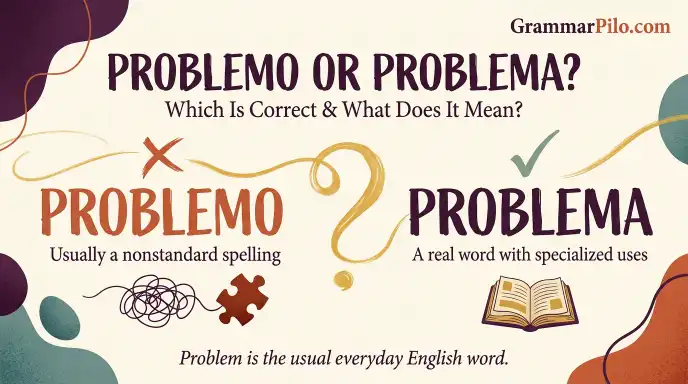
Problema is the correct spelling of the Spanish word for “problem,” while problemo is generally a nonstandard or humorous form in English.
The right choice depends on the language and context in which you are writing. In Spanish, problema is a standard noun meaning a problem, difficulty, or issue. In English, the ordinary word is problem, not problema or problemo.
The confusion between problemo and problema often comes from casual expressions such as “No problemo,” which people sometimes use humorously to mean “No problem.”
Although this expression is recognizable in informal English, it is not standard Spanish and should not be used in formal writing.
Understanding the difference helps you choose the right word in conversations, school assignments, social media posts, and multilingual writing.
This guide explains the meanings of problemo and problema, their language origins, common mistakes, and examples that show when each form may appear.
Quick Answer: Problemo or Problema?
Problema is the standard Spanish spelling. It means “problem” or “difficulty.” In English, use problem for the ordinary English word.
Problemo is not the standard Spanish spelling. It may appear in humorous English expressions, especially “No problemo,” which informally means “No problem.”
Examples:
- Spanish: Tenemos un problema. (We have a problem.)
- English: We have a problem.
- Informal English expression: No problemo! (No problem!)
What Does Problema Mean?
Problema is a Spanish noun meaning a problem, issue, difficulty, or matter that needs a solution. It can describe anything from a small everyday inconvenience to a serious challenge.
1. Problema in Spanish
In Spanish, problema is a standard word used in everyday conversations, education, business, and formal writing.
Examples:
- Tenemos un problema. (We have a problem.)
- El problema es muy difícil. (The problem is very difficult.)
- Necesito resolver este problema. (I need to solve this problem.)
- Hay un problema con el teléfono. (There is a problem with the phone.)
In these examples, problema refers to an issue that needs attention or resolution.
2. Problema in School and Education
Students and teachers frequently use problema when discussing exercises, questions, and challenges.
Examples:
- El estudiante resolvió el problema de matemáticas. (The student solved the math problem.)
- Este problema tiene dos soluciones. (This problem has two solutions.)
- La profesora explicó el problema a la clase. (The teacher explained the problem to the class.)
3. Problema in Work and Business
The word is also common in professional settings.
Examples:
- Tenemos un problema con el pedido. (We have a problem with the order.)
- La empresa busca una solución al problema. (The company is looking for a solution to the problem.)
- El problema afecta al equipo. (The problem affects the team.)
4. Is Problema Masculine or Feminine in Spanish?
Although problema ends in the letter a, it is grammatically masculine in Spanish.
Therefore, the correct expressions are:
- El problema (the problem)
- Un problema (a problem)
- Este problema (this problem)
In standard Spanish, do not write la problema when referring to the ordinary noun meaning “problem.”
This is an important point for Spanish learners because many Spanish nouns ending in -a are feminine, but problema is one of several common exceptions.
What Does Problemo Mean?
Problemo is not the standard Spanish word for “problem.” The correct Spanish word is problema.
However, problemo appears in informal English, particularly in the playful expression “No problemo.” Speakers use this phrase to mean “No problem,” “That’s fine,” or “Don’t worry about it.”
Examples:
- “Can you help me carry this?” “No problemo!”
- “Sorry I’m late.” “No problemo!”
- “Thanks for fixing the computer.” “No problemo!”
The expression is informal and often humorous. It may sound playful, exaggerated, or deliberately casual.
Is Problemo a Real Word?
You may encounter problemo in jokes, dialogue, online posts, and informal speech. Its use in such contexts does not make it the standard Spanish noun.
For ordinary Spanish, use problema. For ordinary English, use problem. If you choose “No problemo,” understand that you are using a playful expression rather than standard Spanish.
Problemo vs. Problema: The Main Difference
The main difference is how the words are used and whether they follow standard spelling in the language concerned.
| Feature | Problema | Problemo |
| Standard Spanish word for “problem” | Yes | No |
| Ordinary English noun | No, use problem | No |
| Common informal English use | Occasionally as a borrowed Spanish word | “No problemo” |
| Formal Spanish writing | Correct | Avoid |
| Meaning in the expression “No problemo” | Not applicable | Informally means “No problem” |
| Example | Tenemos un problema. | No problemo! |
The key point: Use problema when writing in Spanish and problem when writing in ordinary English. Reserve problemo for informal or humorous expressions.
Problema vs. Problemo: Origin and Language History
The Spanish word problema comes through Latin from Greek problēma, a word associated with something put forward, a question, or a matter to be addressed. Related forms exist in several European languages.
For example:
| Language | Word for “problem” |
| English | Problem |
| Spanish | Problema |
| Italian | Problema |
| Portuguese | Problema |
| French | Problème |
| German | Problem |
The exact spelling and pronunciation vary by language. Spanish and Italian use problema, while French adds a grave accent to the final e.
The form problemo is associated in English with informal, playful expressions such as “No problemo.” It resembles Spanish and other Romance-language words but is not the standard Spanish spelling of the noun.
British English vs. American English: Problemo or Problema
There is no meaningful British-American spelling difference in the ordinary English word: both varieties use problem.
When writing in Spanish, both British and American writers should use problema.
| Context | British English | American English |
| Ordinary English noun | Problem | Problem |
| Spanish noun | Problema | Problema |
| Humorous informal expression | No problemo | No problemo |
| Formal Spanish spelling | Problema | Problema |
Examples:
British English: We have a problem with the schedule.
American English: We have a problem with the schedule.
Spanish: Tenemos un problema con el horario.
The humorous phrase “No problemo” can be understood in either English variety, but it is informal rather than a standard alternative in professional writing.
Which Word Should You Use?
The correct word depends on the language and the tone of your message.
Use Problema When Writing in Spanish
Choose problema for Spanish conversations, essays, emails, business documents, and school assignments.
Examples:
- Tengo un problema. (I have a problem.)
- ¿Cuál es el problema? (What is the problem?)
- El problema no es complicado. (The problem is not complicated.)
Use Problem When Writing in English
In standard English, problem is the ordinary noun.
Examples:
- I have a problem with my laptop.
- We need to solve this problem.
- The problem was easier than expected.
Use No Problemo for Informal Humor
You can use “No problemo” in a friendly conversation when you want to sound playful or relaxed.
Examples:
- “Could you send me the file?” “No problemo!”
- “Thanks for your help.” “No problemo!”
- “Sorry for the confusion.” “No problemo!”
Avoid the phrase in formal academic papers, professional reports, and serious business correspondence unless the informal tone is intentional.
Common Mistakes When Using Problemo and Problema
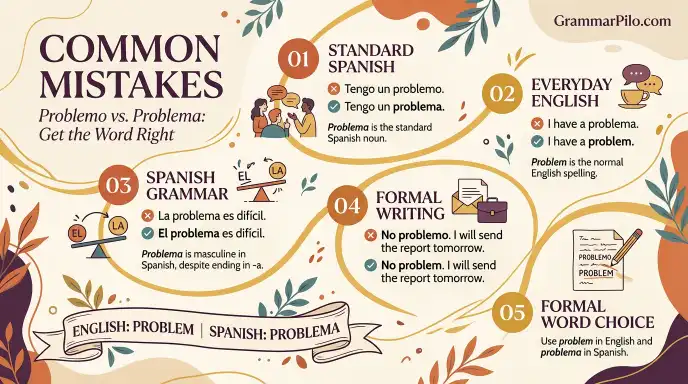
Mistake 1: Using Problemo as Standard Spanish
Incorrect: Tengo un problemo.
Correct: Tengo un problema.
The standard Spanish noun is problema.
Mistake 2: Using Problema as the Ordinary English Noun
Unnatural in standard English: I have a problema.
Correct: I have a problem.
Although English speakers may occasionally borrow foreign words for humor or style, problem is the normal English spelling.
Mistake 3: Assuming Problema Is Feminine Because It Ends in A
Incorrect: La problema es difícil.
Correct: El problema es difícil.
In Spanish, problema is masculine despite ending in -a.
Mistake 4: Using No Problemo in Formal Writing
Too informal for most professional contexts: No problemo. I will send the report tomorrow.
More professional: No problem. I will send the report tomorrow.
Also professional: Certainly. I will send the report tomorrow.
Mistake 5: Treating Problemo as a Formal Synonym for Problem
Problemo may be understood in casual English, but it is not the standard word to use in formal writing. Use problem in English and problema in Spanish.
Problemo or Problema in Everyday Examples
In School
Spanish: El problema de matemáticas es fácil.
English: The math problem is easy.
Informal English: No problemo! I can help you with the homework.
In Emails
Standard English: There is a problem with the attached document.
Spanish: Hay un problema con el documento adjunto.
Informal message: No problemo. I’ll send the corrected file.
For professional emails, No problem or Certainly is usually more appropriate than No problemo.
In Everyday Conversation
Spanish: ¿Tienes algún problema?
English: Do you have a problem?
Informal English: No problemo, I’ll take care of it.
In Social Media
- “No problemo! Happy to help.”
- “We found a solution to the problem.”
- “Tenemos un problema con la conexión.” (We have a problem with the connection.)
These examples show that the appropriate form depends on the language and level of formality.
Problema vs. Problem vs. Problemo: Quick Comparison
| Word | Language or context | Meaning |
| Problem | Standard English | A difficulty or issue |
| Problema | Standard Spanish | A difficulty or issue |
| Problema | Standard Italian and Portuguese | A difficulty or issue |
| Problemo | Informal English expression | A playful form, especially in “No problemo” |
| Problème | Standard French | A difficulty or issue |
Quick reminder: English uses problem, Spanish uses problema, and “No problemo” is a playful informal expression.
Problemo or Problema: Google Trends and Modern Usage
People may search for “problemo or problema” because they have encountered the expression “No problemo” in conversation, television, films, social media, or online messages.
The extra o makes the phrase sound playful, which can lead learners to wonder if it is the standard spelling.
In standard Spanish, problema is the accepted word. In standard English, the ordinary word is problem. The expression “No problemo” is recognizable as informal English, but it should not be treated as the standard Spanish phrase.
Google Trends can help compare interest in the spellings across different regions and periods. However, no specific search volume figures are presented here. Search popularity alone cannot establish whether a word is grammatically standard.
For language accuracy, use reputable Spanish and English dictionaries and pay attention to the language in which you are writing.
Frequently Asked Questions
1. Is it problemo or problema?
Problema is the standard Spanish spelling for “problem.” In ordinary English, use problem. Problemo is generally used in informal or humorous expressions such as “No problemo.”
2. Is problemo a Spanish word?
Problemo is not the standard Spanish noun for “problem.” The correct word is problema. You may see problemo in playful expressions used by English speakers.
3. What does no problemo mean?
“No problemo” is an informal, humorous way of saying “No problem.” It can mean that something is fine, easy to handle, or not an inconvenience.
4. Is no problemo grammatically correct?
It is recognizable as an informal English expression, but it is not standard Spanish. In formal English writing, “No problem,” “Certainly,” or “You’re welcome” may be more appropriate depending on the situation.
5. Why is problema masculine in Spanish?
Problema is one of several Spanish nouns ending in -a that are masculine because of their historical origins. Therefore, standard Spanish uses el problema and un problema.
6. How do you say problem in Spanish?
The Spanish word is problema.
Example: Tengo un problema. This means “I have a problem.”
7. Is problema correct in English?
In ordinary English, problem is the standard noun. Problema may appear as a foreign-language word, a stylistic choice, or a reference to Spanish, but it is not the usual English spelling.
8. Is problemo formal or informal?
Problemo is informal and often humorous, particularly in the phrase “No problemo.” It is not recommended for formal reports, academic writing, or standard Spanish.
9. Do British and American English use different spellings?
No. Both British and American English use problem for the ordinary English noun. The Spanish word is problema in both contexts.
10. What is the easiest way to remember the difference?
Remember three simple forms: problem for English, problema for Spanish, and No problemo for playful informal English.
Conclusion: Problemo or Problema?
The choice between problemo and problema depends on the language and context. Problema is the standard Spanish word meaning “problem,” while problem is the ordinary English noun. Problemo is best understood as an informal, humorous form, especially in the expression “No problemo.”
When writing in Spanish, use el problema or un problema. Remember that the word is masculine even though it ends in -a. When writing in English, use problem in school assignments, business emails, articles, and other formal or general contexts.
You can still use “No problemo” with friends or in playful social media messages if it suits the tone. Just do not confuse the expression with standard Spanish spelling.
Final answer: Use problema in Spanish, problem in English, and reserve problemo for informal humor. Understanding this distinction will help you communicate more naturally and avoid spelling mistakes.
Explore Here!
- Supplies or Supplys: The Right Spelling & Meaning Revealed
- Loses or Looses: The Simple Trick to Remember the Difference
- Uncurable or Incurable: A Quick Guide to Correct Word

I’m Claire Morgan, the author behind Grammarpilo.com, where I write about English grammar, sentence structure, punctuation, and everyday language. My goal is to make grammar simple, clear, and practical, helping readers understand the rules and apply them with confidence in real-world writing.






3 thoughts on “Problemo or Problema: Which Is Correct & What Does It Mean?”