
Wack and whack are both used in English, but they have different meanings and uses. Whack is the standard word for hitting something with a sharp or forceful blow, while wack is informal slang that often means bad, strange, disappointing, or uncool. The right choice depends on what you want to say.
For example, “He gave the ball a whack” describes a forceful hit. In contrast, “That movie was wack” means the speaker thought the movie was bad or unimpressive.
Both spellings appear in modern English, so it would be incorrect to treat wack as a misspelling in every situation.
The confusion comes from their similar pronunciation and related histories. Whack has been used for striking or hitting since the early eighteenth century.
Wack developed as slang and became associated with something strange, foolish, or poor in quality. Both forms can also appear in informal expressions and popular culture.
This guide explains wack or whack, including their meanings, origins, British and American usage, common mistakes, and everyday examples. You will also learn the difference between wack and whack, whack vs. wack, and the expressions out of whack and take a whack at something.
Wack or Whack: Quick Answer
Use whack when you mean a hit, a forceful strike, or an attempt at doing something. Use wack when you mean something is bad, strange, or uncool in informal slang.
- Whack: To hit something forcefully, or the act of hitting.
- Wack: Informal slang meaning bad, strange, foolish, or unimpressive.
- Whacked: Hit forcefully, or informally, extremely tired.
- Wacky: Strange, eccentric, or amusingly unusual.
- Out of whack: Not working correctly or not in the proper balance.
- Take a whack at something: Make an attempt at doing something.
Examples:
- The player gave the ball a whack.
- That new phone is wack, according to my brother.
- My sleep schedule is completely out of whack.
- I’ll take a whack at solving the puzzle.
The easiest rule is to remember that whack is the usual spelling for a hit, while wack is a recognized slang spelling.
Definition and Meaning of Whack or Wack
What Does Whack Mean?
Whack is commonly used as both a verb and a noun.
As a verb, it means to hit something or someone with a sharp, forceful movement. As a noun, it refers to the hit itself. The word can also appear in informal expressions with other meanings.
Examples of whack as a verb:
- He whacked the ball across the field.
- She whacked the dust off the old rug.
- The child whacked the drum with a wooden stick.
- He accidentally whacked his elbow against the door.
Examples of whack as a noun:
- The hammer struck the nail with one hard whack.
- She gave the ball a whack with her racket.
- The branch fell after one strong whack with the axe.
Whack is also used in expressions that do not refer to a physical hit. For example, take a whack at something means to try doing it, while out of whack describes something that is not working properly or is out of balance.
What Does Wack Mean?
Wack is an informal slang adjective, especially associated with American English. It commonly means bad, disappointing, strange, or uncool. Cambridge Dictionary identifies it as US slang for something that is not good or is strange.
Examples of wack:
- That movie was wack.
- The service at the restaurant was wack.
- He thought the new rule was wack.
- The party felt wack because hardly anyone attended.
Wack is usually casual. It can appear in conversations, text messages, music, social media posts, and informal reviews. It is generally not the best choice for a formal report or professional email.
Are Wack and Whack Interchangeable?
Not in every sentence. Although the words sound alike, the intended meaning determines the spelling.
| Word | Main meaning | Example |
| Whack | A forceful hit | He gave the drum a whack. |
| Whack | To hit forcefully | She whacked the ball. |
| Wack | Bad or unimpressive, in slang | That song is wack. |
| Wack | Strange or uncool, in slang | That idea sounds wack. |
| Whacked | Hit or, informally, very tired | I was whacked after work. |
| Wacky | Strange or eccentric | It was a wacky costume. |
One important detail is that slang usage can overlap. Some speakers use whack for something bad or strange as well. However, wack is a common spelling for the slang adjective, while whack remains the standard spelling for the hit related meanings.
The Origin of Wack and Whack
Where Did Whack Come From?
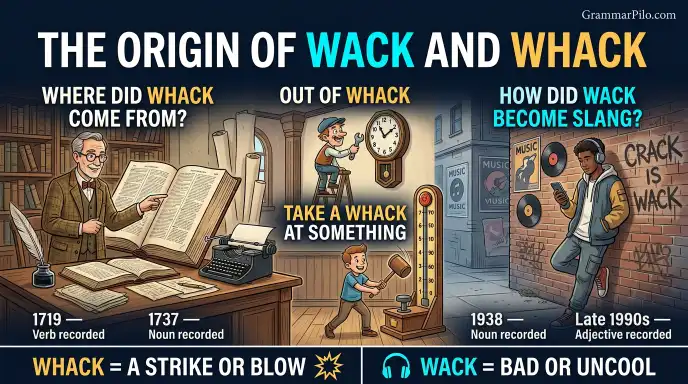
Whack emerged in English as a colloquial word for striking sharply or delivering a heavy blow. Etymonline records the verb from 1719 and the noun meaning a forceful stroke from 1737. Its origin is thought to be imitative, meaning the word may echo the sound of a blow.
Over time, whack developed several figurative meanings. The expression out of whack appeared in the nineteenth century and came to describe something that was not functioning properly or was out of balance.
The phrase take a whack at something also developed to mean trying or attempting something.
How Did Wack Become Slang?
Wack developed as a slang form associated with a foolish or strange person and later with something poor in quality. Etymonline records the noun meaning a obsessed person from 1938 and the adjective meaning worthless from the late 1990s. The related word wacky appeared earlier.
The expression “crack is wack” helped popularize the slang spelling in the 1980s. In contemporary informal English, wack is often used to criticize music, clothing, entertainment, behavior, or an idea.
The two spellings have overlapping histories, but modern usage gives writers a practical distinction. Use whack for a physical strike and established expressions such as out of whack. Use wack for the slang adjective when describing something as bad or uncool.
British English vs American English Spelling
The spelling whack is used in both British and American English for the act of hitting and related meanings. Wack is recognized as slang, particularly in American English.
The word whack also has some regional expressions. In British English, it can informally mean to put something somewhere quickly, as in “Whack the bag in the corner.”
In British usage, full whack can mean the full price or amount. Cambridge Dictionary records these informal uses.
| Feature | British English | American English |
| Standard spelling for a hit | Whack | Whack |
| Slang meaning bad or strange | Wack may be understood | Wack is especially associated with US slang |
| Out of whack | Informal expression | Informal expression |
| Take a whack at something | Understood | Common informal expression |
| Formal writing | Prefer clearer alternatives when needed | Prefer clearer alternatives when needed |
Writing tip: For international readers, use whack for a hit and explain wack if the slang meaning might be unfamiliar.
Which Spelling Should You Use?
Use Whack When You Mean a Hit
Choose whack when describing a forceful strike or the sound or action of hitting something.
Examples:
- The batter gave the ball a powerful whack.
- He whacked the table with his hand.
- One whack was enough to knock the loose piece off.
- She heard a loud whack from the next room.
Use Wack for Informal Slang
Choose wack when you want to describe something as bad, strange, disappointing, or uncool in casual speech.
Examples:
- That game was wack.
- The new design looks wack.
- I think the ending was wack.
- His excuse sounded wack to everyone.
Because wack is slang, its tone may sound too casual or judgmental in formal situations. In professional writing, words such as poor, unusual, unconvincing, or disappointing may communicate the intended meaning more clearly.
Use Out of Whack for Something That Is Not Right
The expression out of whack means that something is not working correctly, is out of balance, or seems wrong.
Examples:
- My sleep schedule is out of whack.
- The bike’s gears are out of whack.
- The figures in the report seem to be out of whack.
- My budget got out of whack after the unexpected expense.
Do not replace whack with wack in this established expression.
Common Mistakes With Whack and Wack
Mistake 1: Using Wack for Every Meaning of Whack
Incorrect for the intended meaning: He gave the ball a wack.
Correct: He gave the ball a whack.
When the sentence describes a hit, whack is the standard spelling.
Mistake 2: Assuming Wack Is Always a Misspelling
Incorrect assumption: Wack is never a real English word.
Correct explanation: Wack is a recognized informal slang word that can mean bad, strange, or uncool.
For example, “That movie was wack” uses the slang spelling intentionally.
Mistake 3: Confusing Wack With Wacky
Wack and wacky are related in usage, but they do not function in exactly the same way.
Wack: That outfit is wack.
Wacky: That outfit has a wacky design.
Wacky usually means strange, eccentric, or amusingly unusual. Wack is often more critical and can mean bad or unimpressive.
Mistake 4: Replacing Whack in Out of Whack
Incorrect: My computer is out of wack.
Correct: My computer is out of whack.
The established expression uses whack.
Mistake 5: Using Slang in Formal Writing
Too informal: The new policy is wack.
More formal: The new policy is unreasonable.
Wack can be effective in dialogue, casual posts, or informal reviews, but a more precise adjective is usually better in academic or professional writing.
Wack or Whack in Everyday Examples
In School
Whack: The student gave the piñata a whack during the school celebration.
Wack: The student said the movie’s ending was wack.
Whacked: I was completely whacked after finishing the long assignment.
In Emails and Workplace Communication
Whack: He gave the broken machine a light whack before checking the instructions.
Wack: The team described the outdated design as wack during an informal conversation.
Out of whack: The figures in the spreadsheet appear to be out of whack.
For professional emails, avoid wack unless you are quoting someone or intentionally using a casual tone.
In Social Media and Text Messages
Wack: That update is wack.
Whack: I heard a loud whack when the ball hit the fence.
Take a whack at: I’ll take a whack at fixing the problem tonight.
In Sports and Games
Whack: The golfer gave the ball a strong whack.
Whacked: The player whacked the ball over the net.
Wack: The fan called the referee’s decision wack in a casual post.
These examples show how context determines the correct word.
Wack vs. Whack: Google Trends and Modern Usage

Wack vs. whack is a useful comparison because the words sound alike but have different common meanings. Cambridge Dictionary identifies wack as US slang for something bad or strange, while whack is used for hitting, a forceful blow, and several informal expressions.
Wack is often found in casual conversations, online comments, music related discussions, and informal criticism. Whack appears in everyday descriptions of hitting, as well as expressions such as out of whack and take a whack at something.
What About Search Trends?
Search interest may change over time and vary by region. Without checking a specific Google Trends comparison, it would be misleading to claim exact search volumes or percentages for wack and whack.
To explore current interest, compare the two terms in Google Trends and select your target country and time period. Remember that Trends measures relative search interest rather than providing a complete count of all searches.
For writing, the more important question is meaning. If you mean a hit, use whack. If you mean bad or uncool in informal slang, wack is a recognized option.
Wack and Whack: Side by Side Comparison
| Feature | Wack | Whack |
| Main use | Informal slang adjective | Verb and noun |
| Common meaning | Bad, strange, or uncool | A forceful hit |
| Example | That song is wack. | He gave the ball a whack. |
| Formality | Very informal | Informal in many uses, but standard vocabulary |
| Common expression | Wack job | Out of whack |
| Past form | Not normally used as a verb in this sense | Whacked |
| Regional note | Particularly associated with US slang | Used in British and American English |
Easy Memory Trick
Remember the H in whack as a reminder of a hard hit.
- Whack: A hit or the act of hitting.
- Wack: Slang for bad, strange, or uncool.
- Whacked: Hit or, informally, very tired.
- Out of whack: Not working properly or not balanced.
This simple distinction will help you choose the right spelling in most everyday situations.
Key Takeaways
- Whack is the standard word for a forceful hit and the act of hitting.
- Wack is recognized informal slang meaning bad, strange, or uncool.
- Both words are pronounced alike in many accents.
- Out of whack means not functioning correctly or being out of balance.
- Take a whack at something means to attempt it.
- Wacky means strange, eccentric, or amusingly unusual.
- Wack is especially associated with American slang.
- In formal writing, choose a precise alternative to wack when the casual tone is unsuitable.
Frequently Asked Questions
1. Is wack or whack correct?
Both are correct in their usual contexts. Whack means a forceful hit, while wack is informal slang for something bad, strange, or uncool.
2. Is wack a real word?
Yes. Cambridge Dictionary recognizes wack as US slang meaning not good or strange. It is informal and should be used in contexts where slang is appropriate.
3. What does whack mean?
Whack can mean to hit someone or something forcefully. As a noun, it can describe the hit itself. It also appears in expressions such as out of whack and take a whack at something.
4. What does wack mean in slang?
Wack usually means bad, disappointing, strange, or uncool. For example, “That movie was wack” means the speaker did not like the movie.
5. Does whack mean bad?
Whack can also be used informally to describe something as bad or strange. However, the spelling wack is commonly associated with that slang adjective, while whack is the standard spelling for a hit.
6. What does out of whack mean?
Out of whack means that something is not working properly, is out of balance, or seems wrong. For example, “My sleep schedule is out of whack.”
7. What does take a whack at something mean?
It means to try or attempt something. For example, “I’ll take a whack at the puzzle” means “I’ll try to solve the puzzle.”
8. Is wack or whack used in British English?
Whack is used in both British and American English. Wack is particularly associated with American slang, although slang can spread across English speaking regions.
9. What is the difference between wack and wacky?
Wack usually means bad, strange, or uncool in slang. Wacky means strange, eccentric, or amusingly unusual. For example, “That idea is wack” sounds critical, while “That is a wacky idea” can sound playful.
10. How can I remember wack vs. whack?
Remember the H in whack as a reminder of a hard hit. Use wack for the informal slang meaning bad, strange, or uncool.
Conclusion
The difference between wack or whack depends on meaning and context. Whack is the standard spelling for a forceful hit, the act of hitting, and expressions such as out of whack and take a whack at something. Wack is a recognized slang word that commonly means bad, strange, disappointing, or uncool.
Both words appear in modern English, so neither spelling should be treated as universally wrong. Instead, focus on the sentence you want to write. If someone hits a ball, the correct phrase is “give the ball a whack.” If someone dislikes a song and calls it wack, the slang spelling is appropriate.
For school assignments, formal reports, and professional emails, use whack for the standard hit related meanings and choose more precise words such as poor or unreasonable instead of slang when needed. In casual conversations, texts, and social media posts, wack can express a strong negative opinion.
Once you remember that whack means a hit and wack is informal slang for something bad or strange, choosing the right word becomes much easier.
More Differences To Explore

I’m Claire Morgan, the author behind Grammarpilo.com, where I write about English grammar, sentence structure, punctuation, and everyday language. My goal is to make grammar simple, clear, and practical, helping readers understand the rules and apply them with confidence in real-world writing.





1 thought on “Wack or Whack: One Letter Changes the Meaning of These Words”