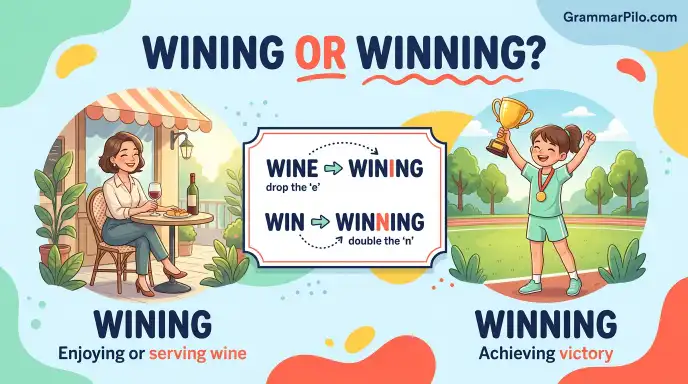
Wining and winning are both correct English words, but they have completely different meanings. Winning means succeeding in a competition, achieving victory, or getting the result you want, while wining refers to drinking wine, especially as part of a social occasion.
The difference comes down to one extra letter, but using the wrong form can change the meaning of your sentence.
For example, you might write, “Our team is winning the championship,” to describe a team that is ahead or succeeding. However, “They spent the evening wining and dining” describes people enjoying wine and food together.
The confusion between wining or winning often occurs because both words come from different verbs and follow different spelling patterns. Winning is formed from win, while wining comes from wine.
Understanding this distinction makes it easier to choose the right spelling in emails, school assignments, social media posts, and everyday conversations.
In this guide, you will learn the definitions, origins, grammatical forms, and practical uses of wining and winning. You will also discover common spelling mistakes, compare the two words in real life examples, and learn a simple trick to remember which form belongs in your sentence.
Quick Answer: Wining or Winning?
Winning is the correct choice when you mean succeeding, gaining victory, or coming out ahead. Wining is correct when you mean drinking wine.
| Word | Meaning | Example |
| Winning | Succeeding or achieving victory | Our team is winning the game. |
| Wining | Drinking or enjoying wine | They were wining and dining at a restaurant. |
Remember this simple rule:
- Winning = win + ning: succeeding or gaining victory.
- Wining = wine + ing: drinking or enjoying wine.
Both spellings are legitimate English words. The correct choice depends on what you want to express.
Definition and Meaning of Wining and Winning
Although wining and winning look almost identical, they come from different base words and serve different purposes in a sentence.
What Does Winning Mean?
Winning is the present participle of the verb win. It can describe succeeding in a competition, defeating an opponent, obtaining a desired result, or gaining an advantage.
The word can also function as an adjective to describe something successful, appealing, or likely to produce a favorable result.
Examples of winning:
- Our school team is winning the basketball tournament.
- She kept practicing because she was determined to keep winning.
- The candidate delivered a winning speech.
- Their winning strategy helped the company attract more customers.
- Winning the scholarship changed his life.
In each example, winning relates to success, achievement, or a favorable outcome.
What Does Wining Mean?
Wining is the present participle of the verb wine. As a verb, wine means to drink or enjoy wine, particularly in a social setting.
The word frequently appears in the expression wining and dining, which describes entertaining someone with food and drink, often in a restaurant or another social setting.
Examples of wining:
- They spent the evening wining and dining with their business partners.
- The guests were wining and talking late into the night.
- The couple enjoyed wining and dining at a countryside restaurant.
- The article described the tradition of wining during formal celebrations.
Although wining is less common than winning in everyday writing, it is a valid word when used with the appropriate meaning.
Is Wining a Misspelling of Winning?
No. Wining is not automatically a spelling mistake. It is a legitimate form of the verb wine.
However, if you are talking about a sports team, a competition, a prize, or an achievement, wining is usually incorrect because the intended word is winning.
Incorrect for success: Our team is wining the match.
Correct for success: Our team is winning the match.
Correct for drinking wine: They were wining and dining with friends.
The surrounding sentence determines which word is appropriate.
Origin of Wining and Winning
Understanding where these words come from makes their spelling differences easier to remember.
Where Does Winning Come From?
Winning comes from the verb win, an old English word with Germanic roots associated with striving, laboring, or gaining something. Over time, the word developed its modern meaning of achieving victory or obtaining a desired result.
The spelling follows a familiar English pattern. When the verb win takes the ending -ing, the final consonant is doubled.
Win + ing = winning
This spelling pattern also appears in other English words.
- Run becomes running.
- Sit becomes sitting.
- Swim becomes swimming.
- Begin becomes beginning.
In these words, the final consonant is doubled before adding -ing because of the verb’s spelling pattern.
Where Does Wining Come From?
Wining comes from the noun and verb wine. The word wine has a long history and entered English through earlier European language forms associated with the alcoholic drink.
When wine takes the ending -ing, the final silent e is dropped.
Wine − e + ing = wining
The same spelling pattern appears in other English words.
- Dine becomes dining.
- Shine becomes shining.
- Write becomes writing.
- Ride becomes riding.
The difference between wining and winning therefore reflects two separate spelling rules. The verb win doubles its final consonant, while wine drops its silent e.
British English vs. American English Spelling
Unlike word pairs that differ between British and American English, wining and winning follow the same spelling rules in both varieties.
Are Wining and Winning Spelled Differently in the UK and US?
No. Both words are spelled the same way in standard British English and American English.
| Usage | American English | British English |
| Achieving victory | Winning | Winning |
| Drinking wine | Wining | Wining |
| Past tense of win | Won | Won |
| Present participle of win | Winning | Winning |
| Present participle of wine | Wining | Wining |
The meanings also remain the same across both varieties.
American English example: The home team is winning the championship.
British English example: The home team is winning the championship.
American English example: They spent the evening wining and dining.
British English example: They spent the evening wining and dining.
Differences in pronunciation or local expressions do not change the standard spellings of these words.
Why Do People Confuse These Words?
The confusion usually comes from the similar appearance of the words and the difference of only one letter. Many writers recognize winning as a familiar word but may not realize that wining is also a valid form.
Another reason is that people often apply one spelling rule to every verb. English, however, uses different patterns depending on the base word.
The key is to identify the original verb first.
- If the verb is win, write winning.
- If the verb is wine, write wining.
Which Spelling Should You Use?
Choosing between wining and winning becomes easy once you identify the intended meaning.
Use Winning When You Mean Success
Choose winning when discussing victories, competitions, games, achievements, or successful approaches.
Examples:
- The team is winning by three points.
- Winning the contest gave her confidence.
- He has a winning personality.
- Their winning formula combines quality and consistency.
- The company is winning new customers through excellent service.
In each sentence, winning communicates success, achievement, or appeal.
Use Wining When You Mean Drinking Wine
Choose wining when discussing the act of drinking wine. In contemporary English, it is particularly familiar in the phrase wining and dining.
Examples:
- The guests were wining and dining at an elegant hotel.
- They enjoyed wining with friends after the celebration.
- The report discussed wining traditions at formal events.
Because wining is less common, readers may initially assume it is a typo if the context does not clearly involve wine.
A Simple Trick to Remember the Difference
Use the base word to determine the spelling.
Winning contains the idea of a win. If someone wins a race, earns a prize, or succeeds in a challenge, use winning.
Wining contains the word wine. If the sentence concerns drinking wine or the expression wining and dining, use wining.
Try this quick comparison:
- The players are winning the game.
- The guests are wining and dining.
If you can replace the word with succeeding, choose winning. If you can replace it with drinking wine, choose wining.
Common Mistakes With Wining and Winning
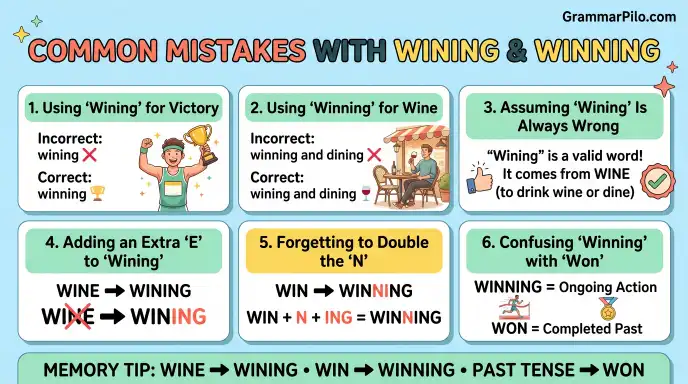
Even experienced writers can confuse words that look similar. These examples show how to avoid the most frequent errors.
Mistake 1: Writing Wining When You Mean Victory
Incorrect: Our team is wining the tournament.
Correct: Our team is winning the tournament.
The sentence describes success in a competition, so the correct form comes from win.
Mistake 2: Adding an Extra N to Wining
Incorrect for drinking wine: They spent the evening winning and dining.
Correct: They spent the evening wining and dining.
The expression refers to enjoying wine and food, not achieving victory.
Mistake 3: Assuming Wining Is Never Correct
Incorrect assumption: Wining is always a spelling error.
Correct explanation: Wining is the standard -ing form of the verb wine.
The word is less common, but it is appropriate when its meaning fits the context.
Mistake 4: Forgetting the Silent E Rule
The verb wine ends in a silent e. When adding -ing, remove that final e.
Correct: wine → wining
Do not write wineing in standard English.
Mistake 5: Applying the Wrong Verb Pattern
The verbs win and wine use different spelling changes.
Correct forms:
- Win → winning
- Wine → wining
The first doubles the final consonant. The second drops the silent e.
Mistake 6: Confusing Winning With Won
Winning and won are forms of the same verb, but they are used differently.
Winning: She is winning the race.
Won: She won the race yesterday.
Use winning for ongoing action or as an adjective. Use won for the simple past tense and the past participle.
Wining or Winning in Everyday Examples
Real-world examples make the difference easier to understand. Notice how the meaning changes with the context.
In School
Winning: Our class is winning the science competition.
Winning: Winning the spelling bee was her proudest achievement.
Wining: The literature lesson mentioned wining and dining in a historical setting.
In Emails
Winning: Congratulations on winning the award for outstanding performance.
Winning: Our team is winning more clients with its improved service.
Wining: Thank you for wining and dining our visiting partners during the conference.
The last sentence is grammatically possible, but entertaining our visiting partners over dinner may sound more natural in a formal business email.
In Sports
Winning: The players are winning because they communicate effectively.
Winning: The coach believes that winning requires patience and discipline.
Wining: The word wining would normally be unrelated to the outcome of a sports match unless the discussion specifically concerned wine.
In Social Media
Winning: Winning this match feels incredible!
Winning: Another milestone, another reason to keep winning.
Wining: Wining and dining with friends made the weekend unforgettable.
In Business
Winning: The company is winning customers by offering reliable support.
Winning: A winning strategy can help a business stand out in a competitive market.
Wining: The hosts were wining and dining their international guests.
In Everyday Conversation
Winning: Are we winning, or do we need to change our strategy?
Winning: She kept winning because she never stopped learning.
Wining: They were wining and dining at their favorite restaurant.
These examples demonstrate that both words are correct, but they belong in different contexts.
Wining vs. Winning: Google Trends and Modern Usage
People often search for wining or winning when they are unsure about the extra letter in winning. The two words look similar, but their meanings and everyday uses are quite different.
Which Word Is More Common?
Winning is much more widely used in general English. It appears in sports reporting, business writing, education, entertainment, personal development, and everyday conversations about success.
Wining is comparatively uncommon and usually appears in discussions about wine or in the expression wining and dining.
This difference in frequency helps explain why writers may assume that wining is a misspelling. In reality, its lower frequency does not make it incorrect.
What Do Search Trends Tell Us?
Search interest in spelling comparisons often reflects uncertainty about word forms, especially when one spelling is familiar and the other is less common.
For this pair, it is useful to distinguish between two questions:
- Spelling question: Which word should I use to describe success? The answer is winning.
- Meaning question: Is wining a real English word? Yes, when it refers to drinking wine.
Exact Google Trends figures, search volumes, and changes over time require a current, verified data check. Without those figures, it would be misleading to claim specific search numbers or percentage differences.
How Should Writers Use These Words Today?
Modern writers should choose the form that communicates their intended meaning clearly.
Use winning in articles about sports, competitions, achievement, business success, and personal goals. Use wining when discussing wine consumption or the phrase wining and dining.
For websites, educational materials, and professional writing, context is especially important because readers may interpret an unfamiliar spelling as an error. A clear sentence helps them understand the intended meaning immediately.
Wining and Winning: Side-by-Side Comparison
The following table summarizes the most important differences between the two words.
| Feature | Wining | Winning |
| Base verb | Wine | Win |
| Main meaning | Drinking or enjoying wine | Succeeding or achieving victory |
| Grammatical form | Present participle or gerund | Present participle or gerund; also an adjective |
| Spelling change | Drops the final silent e | Doubles the final n |
| Common expression | Wining and dining | Winning the game |
| Everyday frequency | Less common | Very common |
| American spelling | Wining | Winning |
| British spelling | Wining | Winning |
| Example | They were wining and dining. | They are winning the match. |
The main difference is meaning, not regional spelling. Both forms are standard English, and the intended message determines which one belongs in a sentence.
Frequently Asked Questions
1. Is Wining or Winning Correct?
Both are correct words, but they have different meanings. Winning refers to success or victory, while wining refers to drinking wine. Choose the spelling that matches your sentence.
2. Is Wining a Real Word?
Yes. Wining is the present participle of wine, meaning to drink or enjoy wine. It is commonly seen in the expression wining and dining.
3. Why Does Winning Have Two Ns?
The verb win doubles its final consonant before the ending -ing. Therefore, the correct form is winning, not wining, when referring to success.
4. Why Is Wining Spelled With One N?
Wining comes from wine. When the verb takes the ending -ing, the final silent e is removed. The result is wining, with one n.
5. Is Wining and Dining Correct?
Yes. Wining and dining is a standard expression that describes entertaining someone with food and wine, often in a social or business setting.
6. Are Wining and Winning Different in British and American English?
No. The spellings and meanings are the same in standard British and American English. Neither word has a different regional spelling in this pair.
7. How Can I Remember Wining vs. Winning?
Connect each word to its base verb. Winning comes from win and means succeeding. Wining comes from wine and relates to drinking wine. Remembering the base word will help you select the correct form.
Conclusion: Choose Wining or Winning With Confidence
The difference between wining or winning is simple once you understand the verbs behind the words. Winning is used for success, victory, and achievement, while wining describes drinking or enjoying wine. Although the two spellings differ by only one letter, they communicate very different ideas.
Remember the spelling rules: win becomes winning by doubling the final consonant, while wine becomes wining by dropping the silent e. Both forms are correct in standard English, and neither is inherently a misspelling.
When writing about a game, competition, award, or successful strategy, choose winning. When describing wine consumption or using the familiar expression wining and dining, choose wining. The surrounding context will usually make the intended meaning clear.
With this distinction in mind, you can avoid common spelling mistakes and write more confidently in school assignments, emails, articles, and everyday conversations. A simple way to remember the difference is this: winning is about victory, while wining is about wine.
Discover More Differences

I’m Sloane Mercer, a U.S.-based English language writer focused on grammar, spelling, vocabulary, and everyday English usage. Through GrammarPilo, I provide clear and practical explanations to help readers choose the right words and communicate with confidence.