
Incurable is the correct standard English spelling, while uncurable is a rare, nonstandard variant that is generally best avoided in modern writing.
The word incurable describes a disease, condition, or problem that cannot be cured or completely eliminated. For example, “The doctor explained that the disease was incurable” is a correctly written sentence.
The confusion between incurable and uncurable comes from the way English forms negative words. Both spellings may seem logical because the prefix un- often means “not,” while in- can also express negation.
However, English does not allow every prefix to be attached freely to every word. Established usage determines which form is standard.
Understanding the difference helps you write more clearly in school assignments, professional documents, articles, and everyday conversations.
This guide explains the meaning of incurable, why uncurable is generally avoided, how the word is used in American and British English, and which examples can help you remember the correct spelling.
Quick Answer: Uncurable or Incurable?
Incurable is the preferred standard spelling. It describes a disease, medical condition, or problem that cannot be cured. Although uncurable may occasionally appear as a rare variant, incurable is the established form used in standard modern English.
Correct: The condition was considered incurable.
Avoid in standard writing: The condition was considered uncurable.
Memory tip: Use incurable when you mean that something cannot be cured.
What Does Incurable Mean?
Incurable is an adjective meaning that something cannot be cured, healed completely, or remedied. It is most commonly used in medical contexts, but it can also describe persistent habits, problems, or personal characteristics in a figurative sense.
1. Incurable in Medical Contexts
The most common use of incurable relates to diseases or medical conditions for which no cure is available.
Examples:
- The patient was diagnosed with an incurable disease.
- Researchers continue to study treatments for previously incurable conditions.
- The specialist explained that the illness was considered incurable.
- An incurable condition may still be manageable with appropriate medical care.
Importantly, incurable does not necessarily mean that a condition cannot be treated or managed. Some incurable diseases can be controlled, and treatments may reduce symptoms or improve quality of life. The precise meaning depends on the medical condition and current medical knowledge.
2. Incurable in Everyday English
The word can also describe something persistent that seems impossible to change.
Examples:
- He is an incurable optimist who always expects the best.
- She has an incurable love of books.
- My brother is an incurable romantic.
- The character is portrayed as an incurable dreamer.
In these examples, incurable is figurative rather than a medical diagnosis. It emphasizes that a quality, interest, or habit is deeply rooted and unlikely to disappear.
3. Incurable as a Description of a Problem
Writers sometimes use incurable figuratively to describe a problem that appears impossible to resolve.
Examples:
- The novel portrays corruption as an incurable social problem.
- He jokingly described his procrastination as incurable.
- The story explores the consequences of an incurable obsession.
This usage can be expressive, but in formal or technical writing, choose a more precise description when a problem may actually be solvable.
What Does Uncurable Mean?
Uncurable is an uncommon spelling that some readers may understand as meaning “not curable.” However, incurable is the established standard form and is the better choice in contemporary formal and general writing.
The issue is not that the meaning of uncurable is impossible to understand. Rather, English vocabulary develops through established patterns of usage, and the conventional word for something that cannot be cured is incurable.
Examples of preferred usage:
- Preferred: The disease is incurable.
- Avoid: The disease is uncurable.
- Preferred: He is an incurable optimist.
- Avoid: He is an uncurable optimist.
If you are writing an academic paper, medical article, website post, email, or school assignment, choose incurable to follow standard usage.
Incurable vs. Uncurable: The Main Difference
The two spellings are often confused because both appear to communicate the idea of something that cannot be cured. In practice, incurable is the conventional form readers expect.
| Feature | Incurable | Uncurable |
| Standard modern usage | Established and preferred | Rare and generally avoided |
| Part of speech | Adjective | Intended as an adjective |
| Meaning intended | Unable to be cured | Intended to mean unable to be cured |
| Medical writing | Appropriate | Not recommended |
| Academic writing | Preferred | Avoid |
| Everyday writing | Preferred | Uncommon |
| Example | The condition is incurable. | The condition is uncurable. |
The key distinction: Use incurable for standard, natural English. Do not choose uncurable simply because un- is a familiar negative prefix.
Why Is Incurable the Correct Spelling?
English uses several prefixes to create words with negative meanings. These include un-, in-, im-, il-, and ir-. However, the choice of prefix depends on established vocabulary and word history, not just on a general spelling formula.
For example:
| Base word | Standard negative form |
| Curable | Incurable |
| Possible | Impossible |
| Legal | Illegal |
| Regular | Irregular |
| Happy | Unhappy |
| Certain | Uncertain |
| Accurate | Inaccurate |
Notice that un- works naturally with words such as happy and certain, but the standard negative form of curable is incurable.
The Role of Word History
The prefix in- comes from Latin and is used in many English words to express negation. The word incurable developed through established usage from forms associated with Latin incurabilis, meaning not curable.
Over time, incurable became the conventional English word for a condition or problem that cannot be cured. Although the spelling uncurable may look logical by analogy with words such as unhappy, that analogy does not make it the preferred standard form.
Remember: English spelling depends on convention and word history, so a prefix that works in one word may not be appropriate in another.
British English vs. American English: Incurable or Uncurable
There is no standard British-American spelling difference for this word. Both American English and British English use incurable.
| English variety | Preferred spelling | Avoid in standard writing |
| American English | Incurable | Uncurable |
| British English | Incurable | Uncurable |
| Canadian English | Incurable | Uncurable |
| Australian English | Incurable | Uncurable |
| International English | Incurable | Uncurable |
Examples:
American English: The doctor explained that the condition was incurable.
British English: The doctor explained that the condition was incurable.
The spelling remains the same in both sentences. Differences in pronunciation may occur among speakers, but the written form does not change.
Which Spelling Should You Use?
Choose incurable in nearly all standard writing situations. It is appropriate for medical information, academic assignments, professional communication, journalism, fiction, and general conversation.
In Medical Writing
Use incurable when describing a condition for which a cure is not available.
Example: The report discusses treatment options for an incurable disease.
Medical writers should be careful not to imply that an incurable condition is necessarily untreatable. Treatment may still control symptoms or slow progression.
In Academic Writing
Use incurable because it is the recognized form in standard English.
Example: The researcher examined the historical treatment of incurable illnesses.
In Everyday Conversation
Use incurable for both literal and figurative meanings.
Examples:
- My uncle is an incurable optimist.
- She is an incurable book lover.
- He has an incurable passion for music.
In Website Articles and Professional Content
Use incurable in headings, page titles, image text, and body content. Consistent standard spelling helps readers understand your writing and prevents avoidable editing mistakes.
Common Mistakes When Using Incurable
Writers can make several errors when choosing between incurable and uncurable or using the word in a sentence.
Mistake 1: Writing Uncurable in Formal Content
Incorrect or nonstandard: Scientists are studying an uncurable disease.
Preferred: Scientists are studying an incurable disease.
The second sentence uses the conventional spelling.
Mistake 2: Assuming Every Negative Word Uses Un-
The prefix un- appears in many English words, but it does not form the standard negative version of every adjective.
Examples:
- Happy → Unhappy
- Fair → Unfair
- Curable → Incurable
- Possible → Impossible
Learn the established form of each word rather than applying one prefix rule to everything.
Mistake 3: Confusing Incurable With Untreatable
These words do not mean exactly the same thing.
- Incurable: Cannot currently be cured completely.
- Untreatable: Cannot be treated, or no treatment is available or feasible in the relevant context.
A condition may be incurable but still treatable. For example, medical care may manage symptoms even when it cannot eliminate the underlying disease.
Mistake 4: Using Incurable Only for Diseases
The word is frequently used in medical contexts, but it also has figurative meanings.
Examples:
- She is an incurable optimist.
- He is an incurable romantic.
- The character has an incurable curiosity.
These examples describe persistent personal qualities rather than illnesses.
Mistake 5: Treating Incurable as a Medical Prediction Without Context
Calling a disease incurable is a serious claim. Medical knowledge can change as research develops, and the term depends on the specific disease and available treatments.
When writing health-related material, rely on trustworthy medical sources and avoid making individual diagnoses.
Incurable in Everyday Examples
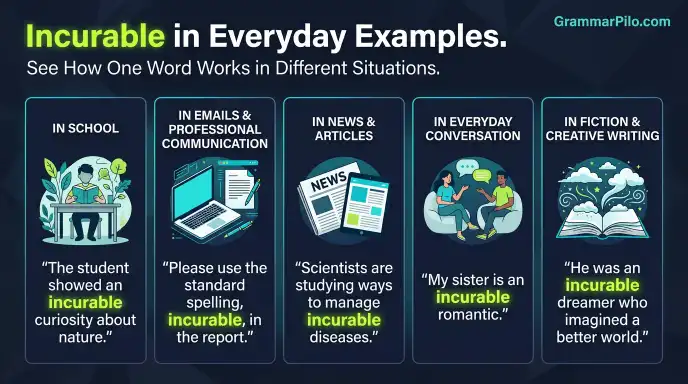
The following sentences show how to use incurable in different settings.
In School
- The class discussed the history of treatments for incurable diseases.
- The story features an incurable curiosity about the natural world.
- The student wrote an essay about an incurable problem in the novel.
In Emails and Professional Communication
- The article examines advances in care for people with incurable conditions.
- Please check that the report uses the standard spelling, incurable.
- The researcher reviewed the evidence before describing the condition as incurable.
News and Articles
- Scientists are investigating new ways to manage incurable diseases.
- The documentary follows families affected by incurable illnesses.
- The author describes the character as an incurable optimist.
In Everyday Conversation
- My sister is an incurable romantic.
- He is an incurable football fan.
- She has an incurable love of adventure.
- My friend is an incurable daydreamer.
In Fiction and Creative Writing
- The hero remained an incurable idealist despite repeated disappointments.
- The character’s incurable curiosity led her into trouble.
- He was an incurable dreamer who imagined a better world.
These examples demonstrate that incurable can be literal or figurative, depending on the context.
Incurable vs. Untreatable vs. Unhealable
These related words can overlap in meaning, but they are not always interchangeable.
| Word | Main meaning | Example |
| Incurable | Cannot be cured completely | The disease is incurable. |
| Untreatable | Cannot be treated in the relevant circumstances | The condition was considered untreatable with the available options. |
| Unhealable | Cannot be healed; less common in general usage | The story describes an unhealable wound. |
| Irreversible | Cannot be reversed or returned to an earlier state | The damage may be irreversible. |
| Chronic | Persists for a long time or recurs over time | She manages a chronic condition. |
Important: A chronic condition is not necessarily incurable, and an incurable condition is not necessarily untreatable. Choose the word that precisely describes the situation.
Incurable and Uncurable: Google Trends and Modern Usage
People may search for “uncurable or incurable” because both forms appear to follow understandable English word building patterns. The search reflects a spelling question, but search frequency alone does not determine which word is standard.
In contemporary general English, incurable is the established spelling. It is the appropriate form for dictionaries, formal documents, educational writing, and most published content. Uncurable is rare and generally best avoided when the intended meaning is “unable to be cured.”
Google Trends can be used to compare interest in these spellings by location and time period. However, no specific search volume figures are included here, and the number of searches should not be treated as a measure of grammatical correctness.
For a reliable spelling decision, consult established dictionaries and examine examples from reputable publications. These sources support the use of incurable as the conventional form.
Quick Comparison: Uncurable vs. Incurable
| Question | Answer |
| Which spelling is preferred? | Incurable |
| Is uncurable standard modern English? | It is rare and generally avoided. |
| What does incurable mean? | Unable to be cured completely |
| Is incurable used in British English? | Yes |
| Is incurable used in American English? | Yes |
| Can incurable describe a personality trait? | Yes, figuratively |
| Does incurable always mean untreatable? | No |
| What should you write in a formal article? | Incurable |
Frequently Asked Questions
1. Is it uncurable or incurable?
Incurable is the preferred standard spelling. It describes something that cannot be cured. Uncurable is rare and generally avoided in standard modern English.
2. Why is incurable spelled with in- instead of un-?
The spelling reflects established English vocabulary and word history. Although both in- and un- can express negation, they are not interchangeable in every word. The conventional form derived from Latin is incurable.
3. Is uncurable a real word?
Uncurable can occasionally be found as a rare variant, but it is not the standard form most writers should choose. Use incurable in formal, academic, medical, and everyday writing.
4. Does incurable mean there is no treatment?
No. Incurable means a condition cannot be cured completely. Treatment may still relieve symptoms, manage complications, or improve quality of life.
5. Is incurable correct in both American and British English?
Yes. American and British English use the same spelling, incurable. There is no standard regional spelling distinction.
6. Can incurable describe a person?
Yes, usually in a figurative sense. Phrases such as an incurable optimist or an incurable romantic describe someone whose personality or habits seem unlikely to change.
7. What is the opposite of incurable?
The most direct opposite is curable, meaning capable of being cured. Depending on the context, treatable may also be relevant, but it does not necessarily mean that a condition can be cured.
8. What is the difference between incurable and chronic?
Incurable means that a condition cannot be cured completely. Chronic describes a condition that persists over a long period or recurs. A chronic condition may be curable or incurable, depending on the disease.
9. Is incurable a noun or an adjective?
Incurable is an adjective. It describes a noun, as in “an incurable disease” or “an incurable optimist.” The noun form incurability refers to the state or quality of being incurable.
10. How can I remember the correct spelling?
Remember the established word incurable and connect it with curable. When describing something that cannot be cured, use incurable rather than forming a new spelling with un-.
Conclusion: Choose Incurable for Correct English
When comparing uncurable or incurable, the best choice for standard modern English is incurable. It is the established adjective for describing a disease, condition, or problem that cannot be cured completely.
Although uncurable may appear occasionally, it is rare and generally not recommended in formal or everyday writing.
The difference comes down to established English usage. Negative prefixes such as un- and in- can both express the idea of “not,” but they cannot be freely substituted for one another. That is why English uses unhappy but incurable.
Remember that incurable can describe medical conditions literally and personality traits figuratively. It also does not automatically mean that a condition cannot be treated or managed. Using the word precisely is especially important in medical and educational writing.
Final answer: Write incurable, not uncurable, when you want the conventional spelling. This simple choice will make your writing clearer, more natural, and consistent with standard English usage.
You Might Also Like
- Supplies or Supplys: The Right Spelling & Meaning Revealed
- Loses or Looses: The Simple Trick to Remember the Difference
- Turmeric or Tumeric: The Correct Spelling Might Surprise You

I’m Claire Morgan, the author behind Grammarpilo.com, where I write about English grammar, sentence structure, punctuation, and everyday language. My goal is to make grammar simple, clear, and practical, helping readers understand the rules and apply them with confidence in real-world writing.






3 thoughts on “Uncurable or Incurable: A Quick Guide to Correct Word”