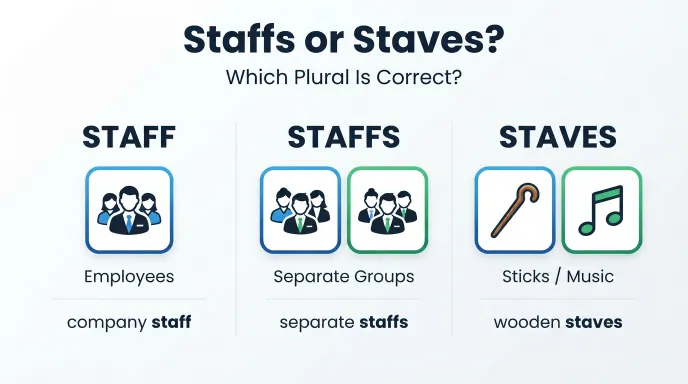
Staffs or staves? The correct plural depends on what you mean by staff. When staff means a group of employees, staff is normally the best choice, while staffs can be used for two or more separate groups of employees.
When staff means a stick, pole, or musical notation lines, staves is the traditional plural. The confusion happens because staffs and staves are both real words, but they do not always serve the same purpose.
A sentence such as “The company hired new staffs” is usually incorrect if you mean individual employees. In contrast, “The musicians played from several staves” uses the traditional plural for musical notation.
This distinction matters in workplace writing, academic work, music, history, and formal documents. It can also be confusing because English allows different plural patterns for the different meanings of staff.
This guide explains staffs or staves, shows when each form works, and gives practical examples you can use in everyday English.
Staffs or Staves: The Quick Answer
Use staff for employees in most everyday situations, staffs for separate groups of employees, and staves for sticks, poles, or musical notation.
For example:
- The hospital has 300 staff members. ✓
- The two senators have separate staffs. ✓
- The barrel was made from wooden staves. ✓
- The piano music was written on two staves. ✓
The easiest rule is:
- Staff = employees as a group
- Staffs = two or more separate employee groups
- Staves = sticks, poles, or musical notation lines
Staffs or Staves: What Is the Difference?
The answer becomes much easier when you separate the different meanings of staff.
Staff as Employees
When staff means the people who work for an organization, it is usually treated as a collective or group noun.
Examples:
The hotel has a large staff.
The staff are preparing for the event.
We need more staff during the holiday season.
In British English, staff can commonly be used with a plural verb and can also refer to individual employees in some constructions. North American English generally treats staff as singular when referring to the group.
Staffs for Separate Groups
Staffs is a legitimate plural when you are talking about more than one distinct group of employees.
For example:
The two candidates have different campaign staffs.
Here, staffs does not mean several individual workers. It means several separate groups of workers.
Oxford specifically notes that staffs is less frequent but can be used in both British and North American English to refer to more than one group of people.
Staves for Sticks or Poles
When staff means a long stick, pole, or rod, staves is the traditional plural.
The warriors carried wooden staves.
The old barrels were constructed from wooden staves.
Staves in Music
In traditional British terminology, stave is used for the five lines and four spaces on which musical notes are written. The plural is staves.
The piano score contains several staves.
In American English, staff is commonly used for this musical meaning, so staffs may appear in American music terminology. Cambridge lists staff as the US term and stave as the UK term for musical notation.
The Origin of Staffs and Staves
The history of these forms helps explain why English has two different plurals.
The noun staff has an Old English origin. Oxford traces the physical-stick sense to Old English stæf, with related forms in other Germanic languages.
Over time, staff developed several meanings. It could refer to a stick used for support, a symbol of authority, a group of workers, and later the lines used for writing music.
The plural staves comes from an older English plural pattern. It follows the same kind of historical vowel change found in other older English plurals.
For the physical object, this older plural has remained established:
one staff → several staves
English also developed staffs as a regular plural, particularly for the sense involving groups of employees.
That is why both forms exist today. They are not simply two spellings that can always be exchanged.
British English vs American English
The biggest regional difference appears in music terminology and the treatment of staff as a group noun.
| Meaning | British English | American English | Example |
| Employees as a group | staff | staff | The staff are helpful. |
| Separate employee groups | staffs | staffs | The candidates have different staffs. |
| Stick or pole | staves | staves | The guards carried staves. |
| Musical notation | stave / staves | staff / staffs or staff | The notes appear on a staff. |
Cambridge identifies stave as the UK musical term and staff as the US term. Oxford also distinguishes the employee sense from the physical-stick and musical senses.
There is another important point. Staffs is not normally the plural you should use simply because there are many employees.
Cambridge’s grammar guidance recommends staff, not staffs, for employees when referring to the workforce as a group.
So:
The company employs 500 staff. ✓
Not:
The company employs 500 staffs. ✗
But:
The two companies have separate staffs. ✓
The second sentence refers to two distinct groups.
Which Version Should You Use?
Your best choice depends on both meaning and regional style.
United States
For employees, use staff in most situations.
The school has 80 staff members.
For music, staff is the normal American term.
Write the notes on the musical staff.
Use staffs when you genuinely mean multiple separate employee groups.
United Kingdom
For employees, staff is the normal choice.
The hotel employs more than 100 staff.
For musical notation, stave and staves are traditional British forms.
The melody is written across two staves.
Canada
Canadian English can reflect both British and American conventions. In ordinary workplace writing, staff is the safest and most natural choice for employees.
For music, follow the terminology used by the publication, institution, or musical context.
Australia
In Australian English, staff is also the normal choice when referring to employees as a group. In specialized musical writing, terminology can vary by context and tradition.
International Writing
If your audience is international, choose the simplest form that removes ambiguity.
For employees, use:
staff members
For physical sticks, use:
staves
For music, use the terminology expected by your audience.
Academic Writing
Academic writing benefits from precision.
Instead of writing:
The university employs many staffs.
write:
The university employs many staff members.
If you mean different groups:
The research teams and their respective staffs participated in the project.
Business Writing
For most business documents, staff is the preferred choice for employees.
All staff must complete the training.
If you mean several organizations or departments with separate employee groups:
The regional offices and their respective staffs attended the meeting.
Common Mistakes With Staffs or Staves
Mistake 1: Using Staffs for Individual Employees
Incorrect:
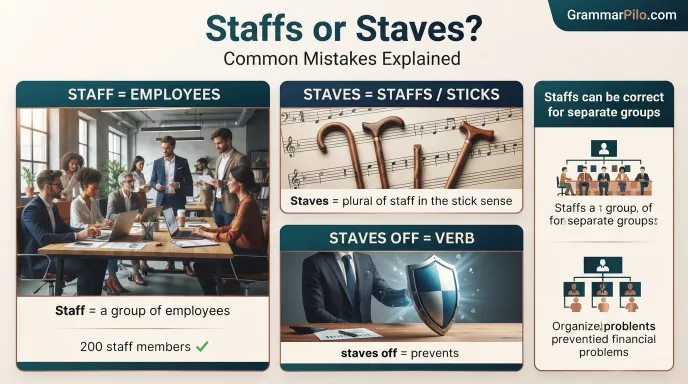
The company employs 200 staffs.
Correct:
The company employs 200 staff members.
Explanation: Staff already refers to the group of employees. Staffs is not normally used to mean individual employees.
Memory tip: Think staff = workers as a group.
Mistake 2: Assuming Staves Always Means Employees
Incorrect:
The hospital hired several staves.
Correct:
The hospital hired several staff members.
Explanation: Staves normally relates to the physical-stick sense of staff or to musical notation.
Mistake 3: Using Staves for Ordinary Workplace Groups
Incorrect:
The company’s staves attended the meeting.
Correct:
The company’s staff attended the meeting.
Explanation: Workplace employees are normally called staff, not staves.
Mistake 4: Using Staffs When You Mean Separate Groups
Sometimes writers avoid staffs because they have learned that staff is normally uncountable. But staffs can be correct when several distinct groups are involved.
The two senators hired separate staffs.
Here, each senator has a different group of employees.
Mistake 5: Confusing Staves With the Verb Staves
There is also a verb stave, as in:
The new policy staves off financial problems.
Here, staves is a verb form, not a plural noun.
Oxford lists stave as a verb meaning to prevent something bad from happening, especially in the expression stave off.
Staffs or Staves in Everyday Examples
Emails
All staff members must attend Friday’s meeting.
The two departments have separate staffs.
For a normal workplace email, staff is usually the right choice.
Business Writing
The company provides training for its staff.
The directors met with their respective staffs.
The first sentence refers to employees generally. The second identifies separate groups.
News Headlines
Hospital staff Prepare for Winter Surge
Candidates Announce New Campaign Staffs
News writing often favors short, clear wording. The exact choice depends on whether the writer means one workforce or multiple distinct groups.
Blogs
Good managers know how to support their staff.
Several political campaigns expanded their staffs before the election.
Social Media
Our staff worked incredibly hard this weekend.
This is the natural everyday form.
Academic Writing
The university’s staff participated in the survey.
The research teams and their staffs worked independently.
Academic writers should use staffs only when the distinction between separate groups matters.
Daily Conversation
The restaurant has friendly staff.
Both managers brought their own staffs.
In ordinary conversation, staff is much more common when talking about workers.
Staves vs. Staff: Google Trends & Modern Usage
Searches for staffs or staves usually come from a genuine grammar question: readers encounter both forms and want to know why the plural changes.
Modern English has not eliminated either form. Instead, their uses have become more specialized.
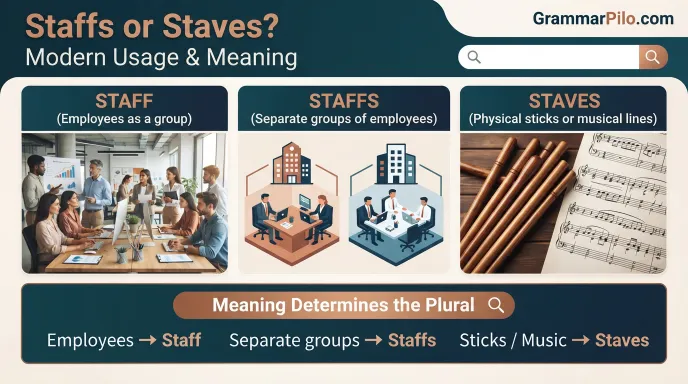
Staff remains the everyday word for employees. Cambridge describes staff as the group of people working for an organization and gives examples such as “over a hundred staff.”
Staffs has a narrower role when the writer needs to identify multiple groups of employees. Oxford describes this use as less frequent but valid in both British and North American English.
Staves remains established for physical staffs and in British musical terminology. Cambridge lists staves as the plural of staff and stave.
Exact search volume or Google Trends figures should not be assumed without checking current data.
The important usage pattern is clear from modern dictionaries: the meaning determines the plural you need.
Quick Comparison Table
| Version | Meaning | Correct? | Region | Example |
| staff | Employees as a group | Yes | All major varieties | The staff are meeting today. |
| staffs | Separate groups of employees | Yes | British & American English | The senators hired different staffs. |
| stave | One stick, pole, or musical line set | Yes | Mainly formal/specialized | He carried a stave. |
| staves | Multiple sticks or musical notation lines | Yes | International, especially traditional British usage | The barrels were made from wooden staves. |
| staff | Musical notation | Yes | Especially American English | The notes are on the musical staff. |
Key Takeaways
- Staff is the normal word for employees as a group.
- Staffs can correctly mean two or more separate groups of employees.
- Staves is the traditional plural of staff when it means a stick or pole.
- Staves is also the traditional British plural for musical notation.
- American English commonly uses staff for musical notation.
- Do not write staffs simply because you mean many employees.
- Staff members is a clear alternative when you mean individual workers.
- Always consider the meaning of staff before choosing the plural.
FAQs About Staffs or Staves
Is staffs a correct plural of staff?
Yes, staffs is a correct plural in some contexts. It is used mainly when referring to two or more separate groups of employees.
For example, “The two candidates have different staffs” is correct. However, staff is normally preferred when referring to employees generally.
Is staves the plural of staff?
Yes. Staves is the traditional plural of staff when staff means a stick, pole, or similar object. It is also used for musical notation, especially in British English. For example, “The barrels were made from wooden staves” is correct.
Should I say staff or staffs for employees?
Usually, say staff. For example, “The company has 500 staff members” is natural. Use staffs when you mean multiple separate groups, such as “The two senators have separate staffs.”
Is staves correct for employees?
No, not in normal modern workplace English. Staves refers to the plural of staff in the physical-stick sense and to musical notation. Employees are normally called staff or staff members.
Is staff or stave used for music?
Both can be correct depending on regional usage. Staff is commonly used in American English, while stave is traditionally used in British English. Their plurals are staffs and staves, respectively.
What is the plural of staff in British English?
It depends on the meaning. For employees, staff is normally used. For the physical object, staves is the traditional plural. In music, British English commonly uses stave, with staves as its plural.
What is the plural of staff in American English?
For employees, staff is normally used, while staffs can refer to multiple separate groups. For music, American English commonly uses staff, and staffs can occur as its plural.
Can I say “three staffs”?
Yes, if you mean three separate groups of employees. For example, “The three candidates each have their own staffs.” If you simply mean three employees or several employees, use staff members or another suitable expression.
Why does staff have two different plurals?
English developed different plural forms for different meanings of staff. The older plural staves survived for the stick and related senses, while the regular plural staffs developed for some uses, especially when distinguishing separate groups of employees. Modern usage now depends strongly on context.
Is “150 staffs” correct?
Usually, no. If you mean 150 employees, write 150 staff members or 150 staff, depending on the variety of English and sentence structure.
Staffs would suggest multiple distinct groups rather than 150 individual workers. Cambridge specifically recommends staff, not staffs, for the ordinary employee sense.
Conclusion
The choice between staffs or staves depends on what the word staff means in your sentence. When you are talking about employees, staff is normally the best choice.
You can use staffs when you need to describe two or more separate groups of employees, such as the staffs of different politicians or organizations.
When staff means a stick, pole, or similar object, the traditional plural is staves. In music, staves is also the established British term, while American English commonly uses staff for the five-line musical notation system.
The safest approach is not to memorize one plural and use it everywhere. Instead, identify the meaning first, then choose the form that fits that meaning and your audience.
Remember: staff for employees, staffs for separate employee groups, and staves for sticks or traditional musical notation.
See More Difference
- Colleague or Coworker: Meaning & When to Use Each
- Cutey or Cutie: The Correct Spelling and Meaning Explained
- Expertize or Expertise: Avoid This Common Spelling Mistake

I’m Sloane Mercer, a U.S.-based English language writer focused on grammar, spelling, vocabulary, and everyday English usage. Through GrammarPilo, I provide clear and practical explanations to help readers choose the right words and communicate with confidence.








3 thoughts on “Staffs or Staves: A Simple Guide to the Correct Usage”