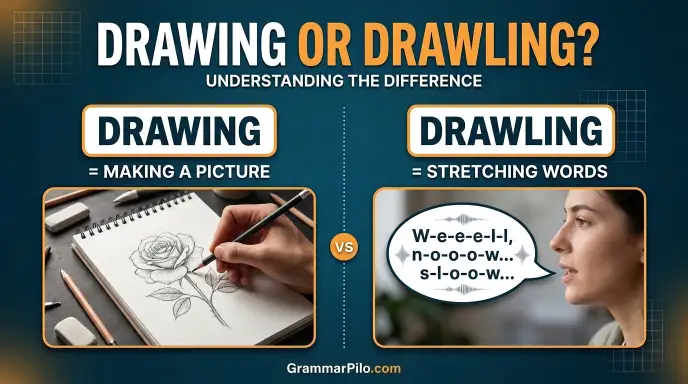
Drawing is the correct word when you mean making a picture, sketch, or diagram, while drawling means speaking slowly and stretching out vowel sounds. Both words are correct English words, but they have different meanings and uses
The confusion between drawling or drawing often comes from their similar spelling. Both words begin with drawl or draw, but the extra l changes the word and its meaning.
Someone who is drawing might be making a portrait, designing a building, or sketching a landscape. Someone who is drawling is speaking in a slow, stretched out way.
If you have searched for drawing or drawling, drawling vs. drawing, or drawling and drawing, the important thing is to choose the word that matches your intended meaning.
This guide explains both words, their origins, their grammatical uses, common mistakes, and practical examples to help you use them correctly in everyday English.
Drawling or Drawing: Quick Answer
Drawing refers to making pictures, sketches, or plans. Drawling refers to speaking slowly and lengthening vowel sounds. Both spellings are correct, but they are not interchangeable.
| Word | Meaning | Example |
| Drawing | Making a picture or the picture itself | She is drawing a flower. |
| Drawling | Speaking slowly with prolonged sounds | He was drawling his words. |
Quick rule: Use drawing for art and sketches. Use drawling for a slow, stretched out way of speaking.
What Does Drawing Mean?
Drawing is a noun and the -ing form of the verb draw. It can describe the activity of creating an image with a pencil, pen, charcoal, or another tool. It can also refer to the image itself.
People use drawing in art, education, architecture, engineering, design, and everyday communication.
Drawing as an Art Activity
Drawing often involves creating lines, shapes, and details to represent a person, object, place, or idea.
Examples include:
- My daughter enjoys drawing animals.
- He is drawing a picture of his house.
- The students practiced drawing circles and triangles.
- She spends an hour drawing every evening.
Drawing as a Picture
The word can also describe the finished image.
Examples include:
- The drawing of the mountain looks realistic.
- I found an old drawing in my notebook.
- Her drawing won first prize in the school competition.
- The architect showed us a detailed drawing of the new building.
Drawing in Technical and Professional Work
Drawing is not limited to art. Architects, engineers, designers, and builders use drawings to communicate plans and measurements.
Examples include:
- The engineer prepared a technical drawing.
- We reviewed the building drawings before construction.
- The designer created a drawing of the new product.
In all these examples, drawing relates to making or representing an image, plan, or design.
What Does Drawling Mean?
Drawling is the -ing form of the verb drawl. It means speaking slowly, often by stretching vowel sounds and making words last longer than usual.
A person may have a drawling voice because of their regional accent, speaking style, or deliberate way of talking. The word does not mean that someone is creating a picture.
Drawling as an Action
Use drawling when describing someone who is speaking in a slow, stretched out manner.
Examples include:
- He was drawling his answers during the interview.
- “Well, hello there,” she said, drawling the last word.
- The actor was drawling to imitate a character.
- My uncle was drawling so slowly that everyone noticed.
Drawling as a Description
The word can also describe a voice or manner of speaking.
Examples include:
- He spoke in a drawling voice.
- Her drawling accent made the sentence sound longer.
- The character had a relaxed, drawling way of speaking.
A drawling voice is not necessarily incorrect or unpleasant. The word simply describes a style of speech, although the context may suggest boredom, laziness, humor, or exaggeration.
The Origin of Drawling and Drawing
Although the words look similar, their meanings developed through different uses of the verb draw and the related verb drawl.
The Origin of Drawing
Drawing comes from the verb draw, which has a long history in English. Over time, draw developed many meanings, including pulling, producing lines, sketching, and creating pictures.
The -ing ending can form a noun describing an activity or a verb form describing an action in progress.
For example:
- She likes drawing portraits.
- He is drawing a map.
- The drawing shows the shape of the building.
The Origin of Drawling
Drawling comes from drawl, a verb meaning to speak slowly and lengthen vowel sounds. The verb is recorded in English from the late sixteenth century, with its earlier origin thought to be connected to Dutch or Low German dralen, meaning to linger or delay.
The connection with lingering helps explain the word’s meaning: a person who drawls makes speech sounds last longer than usual.
For example:
- He kept drawling instead of answering quickly.
- “I suppose so,” she said, drawling the words.
The origin of each word helps explain why their spellings and meanings differ.
British English vs. American English
There is no standard British American spelling difference between drawing and drawling. Both forms are used in American English, British English, and other varieties of English.
The choice depends on meaning, not location.
| English variety | Correct for making a picture | Correct for slow speech |
| American English | Drawing | Drawling |
| British English | Drawing | Drawling |
| Canadian English | Drawing | Drawling |
| Australian English | Drawing | Drawling |
| International English | Drawing | Drawling |
Do not choose one word because you are writing for a particular country. Choose it according to the action or idea you want to describe.
Which Word Should You Use?
Use drawing when the context involves art, pictures, sketches, diagrams, or plans. And use drawling when the context involves speaking slowly and stretching out sounds.
Use Drawing When You Mean Art
Correct examples:
- The child is drawing a cat.
- I enjoy drawing landscapes.
- The architect completed the drawing.
- Her drawing was displayed at the exhibition.
Use Drawling When You Mean Speech
Correct examples:
- The man was drawling his response.
- She answered in a slow, drawling voice.
- The actor practiced drawling to match the character.
- He was drawling every word for dramatic effect.
Compare the Words in Similar Sentences
Drawing: The student was drawing while the teacher explained the lesson.
Drawling: The student was drawling his words while reading the dialogue.
In the first sentence, the student is creating a picture. In the second, the student is speaking in a stretched out way.
Common Mistakes With Drawing and Drawling
Mistake 1: Using Drawling for Art
Incorrect: She is drawling a portrait of her friend.
Correct: She is drawing a portrait of her friend.
The sentence describes creating a portrait, so drawing is the right word.
Mistake 2: Using Drawing to Describe Slow Speech
Incorrect: He was drawing his words in a slow voice.
Correct: He was drawling his words in a slow voice.
The second sentence describes how he speaks, so drawling is appropriate.
Mistake 3: Assuming Drawling Is a Misspelling
Drawling is a real English word. It is not simply an incorrect version of drawing. It is the correct -ing form of drawl.
Mistake 4: Confusing the Verb and the Noun
Drawing can be a noun or a verb form.
- Noun: The drawing is beautiful.
- Verb form: She is drawing a flower.
Drawling generally describes the act of speaking in a drawl or acts as a description of speech.
- Verb form: He is drawling the sentence.
- Descriptive use: She has a drawling voice.
Mistake 5: Choosing a Word Based Only on Spelling
The words look alike, but their meanings are different. Instead of focusing only on the letters, ask what the sentence describes.
If it describes a picture, choose drawing. If it describes slow, stretched out speech, choose drawling.
Drawing or Drawling in Everyday Examples
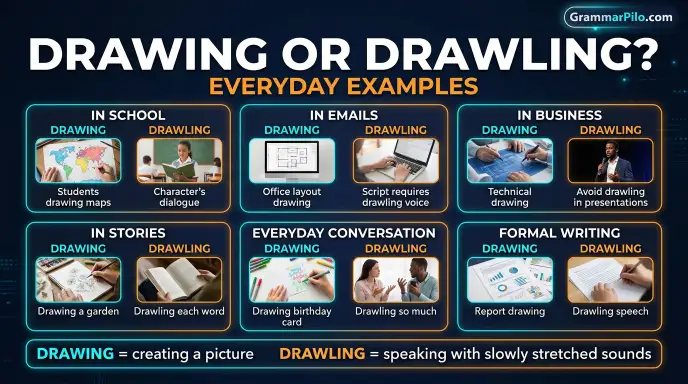
The following examples show how each word works in common situations.
In School
Drawing: The students are drawing maps of their country.
Drawling: One student was drawling the lines of a character’s dialogue during a reading exercise.
In Emails
Drawing: Please send me the drawing of the proposed office layout.
Drawling: The script requires the actor to speak in a drawling voice.
In Business
Drawing: The design team finished the technical drawing.
Drawling: The trainer asked the actor to avoid drawling during the presentation.
In Stories
Drawing: Mia sat by the window, drawing a picture of the garden.
Drawling: “Take your time,” he said, drawling each word.
In Everyday Conversation
Drawing: I’m drawing a birthday card for my sister.
Drawling: He was drawling so much that I thought he was joking.
In Formal Writing
Drawing: The report includes a drawing that illustrates the proposed design.
Drawling: The novelist described the character’s drawling speech to establish a distinctive voice.
These examples demonstrate that both words are correct when used in the right context.
Drawling vs. Drawing: Quick Comparison Table
| Feature | Drawing | Drawling |
| Root word | Draw | Drawl |
| Main meaning | Making a picture or the picture itself | Speaking slowly with prolonged sounds |
| Related activity | Art, sketching, design | Speaking, dialogue, performance |
| Can describe a picture? | Yes | No |
| Can describe a speaking style? | Not normally | Yes |
| Example | She is drawing a bird. | He is drawling his reply. |
| Correct English word? | Yes | Yes |
The main difference is meaning, not correctness. Both words are valid, but they serve different purposes.
How to Remember Drawing vs. Drawling
A simple memory trick can help you select the right word.
Drawing has to do with drawing pictures. Think of a pencil, paper, sketch, or painting plan.
Drawling has to do with a drawl. Think of someone stretching out words while speaking.
Remember these two associations:
- Drawing = picture
- Drawling = speech
You can also use this quick test: if the sentence makes sense with sketching, choose drawing. If it makes sense with speaking slowly, choose drawling.
For example:
- She is sketching a bird. Therefore, drawing is correct.
- He is speaking slowly and stretching the vowels. Therefore, drawling is correct.
Drawing or Drawling: Modern Usage
Both words appear in modern English, but they are used in different contexts.
Drawing is common in conversations about art, hobbies, education, architecture, design, and technical plans. It can refer to both the process of creating an image and the finished image itself.
Drawling appears more often in descriptions of speech, character dialogue, accents, and performances. Writers may use it to show how a character speaks or to create a particular impression.
The two words are not competing spellings of the same term. A spelling comparison should therefore focus on their meanings and grammatical roles rather than treating one as incorrect.
Key Takeaways
- Drawing is used for making pictures, sketches, diagrams, and plans.
- Drawling means speaking slowly while lengthening vowel sounds.
- Both words are correct English words.
- Drawing comes from the verb draw.
- Drawling comes from the verb drawl.
- Neither word is a British or American spelling alternative to the other.
- Use drawing for art and drawling for a style of speech.
- The easiest memory trick is drawing = picture and drawling = speech.
Frequently Asked Questions
1. Is drawing or drawling correct?
Both are correct English words, but they have different meanings. Drawing refers to making a picture or the picture itself. Drawling describes speaking slowly and stretching out vowel sounds.
2. What does drawling mean?
Drawling is the -ing form of drawl. It means speaking slowly, often by lengthening vowel sounds. For example, “He was drawling his response” means that he spoke in a slow, stretched out way.
3. What does drawing mean?
Drawing can refer to the activity of making pictures with tools such as pencils or pens. It can also mean the finished picture, sketch, or technical plan. For example, “Her drawing won the competition.”
4. Is drawling a real word?
Yes. Drawling is a valid English word, formed from the verb drawl. It is not a misspelling of drawing. It is used to describe slow, prolonged speech.
5. What is the difference between drawing and drawling?
The main difference is their meaning. Drawing relates to pictures, sketches, and designs. Drawling relates to speaking slowly and stretching sounds. The correct choice depends on the sentence.
6. Is drawing used the same way in British and American English?
Yes. Drawing has the same basic spelling and meaning in British and American English. Both varieties also use drawling for the slow, stretched out way of speaking.
7. Can drawling describe someone’s voice?
Yes. You can describe a voice as drawling when the speaker stretches vowel sounds and speaks slowly. For example, “The character had a drawling voice.”
8. How can I remember the difference between drawing and drawling?
Remember drawing = picture and drawling = speech. If someone is creating a sketch, use drawing. If someone is speaking slowly and stretching out words, use drawling.
Conclusion
Drawing and drawling are both correct words, but they are used in different situations. Drawing refers to creating a picture, sketch, diagram, or plan. Drawling describes a slow style of speech in which a speaker lengthens vowel sounds.
The easiest way to tell them apart is to focus on the action. If someone is using a pencil to create an image, the correct word is drawing. If someone is speaking slowly and stretching out words, the correct word is drawling.
Remember that drawling is not a spelling mistake. It comes from the verb drawl, while drawing comes from draw. Their similar appearance can cause confusion, but their meanings make the distinction clear.
For schoolwork, business writing, stories, emails, and everyday conversation, choose the word that matches your meaning. Keep the simple rule in mind: drawing means pictures, and drawling means stretched out speech.
Read More

I’m Sloane Mercer, a U.S.-based English language writer focused on grammar, spelling, vocabulary, and everyday English usage. Through GrammarPilo, I provide clear and practical explanations to help readers choose the right words and communicate with confidence.




2 thoughts on “Drawling or Drawing: Learn the Difference With Simple Examples”