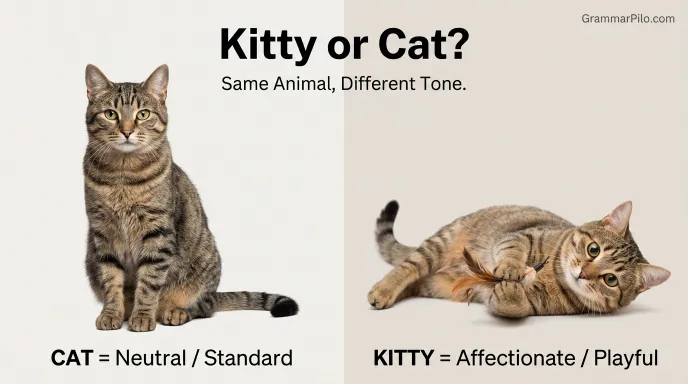
A cat is the standard word for the domesticated feline animal, while kitty is an informal, affectionate word often used for a cat, especially in friendly or child directed speech.
In most everyday situations, cat is the neutral and widely appropriate choice, while kitty sounds warmer, cuter, or more playful.
The confusion around kitty or cat is not really a spelling problem. Both words are correct, but they have different levels of formality and tone.
Cat is the ordinary name for the animal and works in formal writing, scientific contexts, news articles, conversations, and general descriptions. Kitty, on the other hand, is commonly used as a familiar or affectionate term.
For example, you might say, “My cat is sleeping on the sofa” in a normal conversation. If you are speaking affectionately to the animal, you might say, “Come here, kitty!”
The two words can sometimes refer to the same animal, but they are not always interchangeable in tone. Understanding cat vs. kitty can help you choose the word that best fits your audience and situation.
Kitty or Cat: Quick Answer
Cat: The standard, neutral word for a domesticated feline.
Kitty: An informal, affectionate, or child friendly word for a cat.
Simple rule: Use cat for neutral or formal writing. Use kitty when you want a friendly, affectionate, or playful tone.
Example: My cat is sleeping upstairs.
Example: Look at that cute kitty!
Definition and Meaning of Kitty or Cat
What Does Cat Mean?
A cat is a small domesticated carnivorous mammal belonging to the family Felidae. The domestic cat is commonly known as Felis catus.
In everyday English, cat is the normal word used to describe the animal.
Example: I adopted a cat from the shelter.
Example: Her cat likes to sleep near the window.
The word can also be used more broadly for members of the cat family, such as lions, tigers, and other felines, although compounds or more specific names are usually used to identify those animals.
The word cat can also have figurative meanings in English.
Example: He is a cool cat.
Here, cat refers to a person rather than an animal.
What Does Kitty Mean?
Kitty is an informal word for a cat. It is often used to express affection or friendliness.
Example: The kitty is sitting by the door.
Example: That little kitty has beautiful eyes.
The word is particularly common when talking to children or when addressing a pet in an affectionate way.
Example: Come here, kitty!
Because kitty is informal, it may sound less appropriate than cat in scientific, academic, or highly formal writing.
Kitty and Cat Can Refer to the Same Animal
A kitty can be a cat, but the words communicate slightly different tones.
Cat: Neutral and standard.
Kitty: Informal, affectionate, cute, or playful.
The difference is therefore mainly about usage and tone, rather than the animal itself.
Is a Kitty Always a Young Cat?
A common misunderstanding is that kitty always means a kitten.
That is not necessarily true.
Although people sometimes use kitty for a young cat, the word can also refer affectionately to an adult cat.
Example: Our old kitty likes sleeping on the couch.
Here, kitty refers to an adult cat.
The more specific word for a young cat is kitten.
Kitten: A young cat.
Kitty: An informal or affectionate term for a cat.
Therefore, kitty and kitten are not exact synonyms.
The Origin of Kitty and Cat
The Origin of Cat
The word cat has a long history in English and is related to words for the animal in several European and other languages.
Etymonline traces cat to Old English catte, from Proto Germanic kattuz. The word is also connected with Latin cattus and related forms in other languages.
The word entered English centuries ago and became the standard everyday term for the animal.
Over time, cat also developed numerous compounds and expressions.
Examples include:
- catfish
- catnap
- catlike
- catwalk
- copycat
- tomcat
- wildcat
The Origin of Kitty
Kitty developed as a familiar form associated with kitten and kit, and it became an affectionate term for a cat.
The word has long been used as a familiar name for cats and is especially associated with informal speech.
This development is similar to many English words that acquire affectionate or diminutive forms.
For example:
Dog → doggy
Cat → kitty
These forms can make speech sound friendlier or more affectionate.
British English vs American English Usage
There is no major spelling difference between kitty and cat in British and American English.
Both words are used in both varieties of English.
| Word | British English | American English |
| Cat | Standard | Standard |
| Kitty | Informal/affectionate | Informal/affectionate |
| Kitten | Standard | Standard |
| Cats | Standard plural | Standard plural |
| Kitties | Standard plural | Standard plural |
The main difference is context and tone, not spelling.
In both British and American English, cat is the normal neutral term.
Kitty can sound more affectionate, playful, or child friendly.
Which Word Should You Use?
The choice between kitty or cat depends mainly on the situation.
Use Cat for Neutral Writing
Choose cat when writing about the animal in a general, formal, or informative context.
For Example:
- The cat was examined by a veterinarian.
- Cats are popular household pets.
- The study examined the behavior of domestic cats.
In scientific and academic writing, cat is generally the more appropriate everyday term.
Use Kitty for Affectionate Speech
Choose kitty when speaking affectionately about a cat.
Example: Our kitty loves sleeping on the bed.
Example: What a beautiful kitty!
Use Kitty in Child Friendly Language
Parents and caregivers may use kitty when speaking with young children.
Example: Can you see the kitty?
Example: The kitty says meow.
The word can make the conversation sound softer and more playful.
Use Cat in Formal Situations
If you are writing a report, article, veterinary document, or academic paper, cat is normally the better choice.
Example: The cat showed signs of stress during the examination.
Rather than:
Less formal: The kitty showed signs of stress.
Common Mistakes with Kitty or Cat
Mistake 1: Thinking Kitty Is Always a Baby Cat
Incorrect assumption: A kitty must be a kitten.
Better: Kitty can refer affectionately to a cat of any age.
A young cat is specifically called a kitten.
Mistake 2: Using Kitty in Formal Writing
Less appropriate: The kitty was examined during the experiment.
Better: The cat was examined during the experiment.
The second sentence has a more neutral and professional tone.
Mistake 3: Assuming Cat Sounds Unfriendly
Some people think cat sounds cold compared with kitty.
That is not necessarily true.
Cat is simply the neutral name of the animal. You can use it affectionately depending on your tone.
Example: My cat is my best friend.
Mistake 4: Confusing Kitty With Kitten
Incorrect: The adult animal is a kitten.
Correct: The adult animal is a cat.
Correct: The adult animal can affectionately be called a kitty.
Kitty or Cat in Everyday Examples
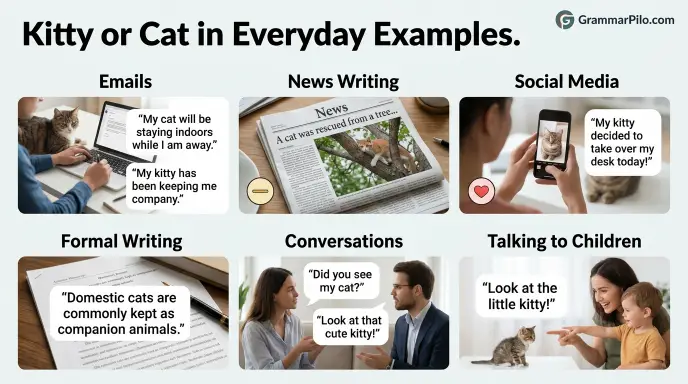
In Emails
Example: My cat will be staying indoors while I am away.
For a more personal message:
Example: My kitty has been keeping me company all week.
In News Writing
Example: A cat was rescued from a tree after becoming trapped overnight.
Cat is more appropriate because news writing generally uses neutral language.
In Social Media
Example: My kitty decided to take over my desk today!
The informal word works naturally in social media posts.
In Formal Writing
Example: Domestic cats are commonly kept as companion animals.
Cat is the natural choice for formal writing.
In Conversations
Example: Did you see my cat?
Example: Look at that cute kitty!
Both are natural, but the second sounds more affectionate.
When Talking to Children
Example: Look at the little kitty!
The affectionate form is especially common in child directed speech.
Kitty vs. Cat: Tone and Context
The biggest difference between kitty and cat is the feeling each word can communicate.
| Context | Better Choice | Reason |
| Scientific writing | Cat | Neutral and precise |
| Academic writing | Cat | Formal and standard |
| News article | Cat | Neutral |
| Everyday conversation | Cat or kitty | Depends on tone |
| Talking to a pet | Kitty | Affectionate |
| Talking to children | Kitty | Friendly and playful |
| Social media | Cat or kitty | Both work |
| Veterinary records | Cat | Professional |
| Pet names | Kitty | Warm and familiar |
The important point is that kitty is not a different animal. It is mainly a different way of referring to a cat.
Kitty or Cat: Google Trends & Usage Data
Google Trends measures relative search interest rather than the total number of times a word appears in English.
Search interest for kitty can be influenced by pet related searches, children’s content, names for cats, entertainment, and informal online language. Searches for cat are much broader because the word is the standard name of the animal and also appears in compounds and figurative expressions.
For kitty vs. cat, the search data should therefore be interpreted carefully. A higher search volume does not automatically indicate that one word is grammatically better than the other.
The more useful distinction is context:
Cat: Neutral and broadly appropriate.
Kitty: Informal and affectionate.
Current Google Trends numbers should be checked for a specific country, date range, and search category rather than presenting unsupported universal figures.
Kitty or Cat: Side by Side Comparison
| Feature | Kitty | Cat |
| Basic meaning | An informal term for a cat | The standard word for the animal |
| Formality | Informal | Neutral |
| Tone | Affectionate or playful | Neutral or affectionate depending on context |
| Refers to adult cats | Yes | Yes |
| Refers to kittens | Sometimes | Yes, but kitten is more specific |
| Scientific writing | Less suitable | Suitable |
| Academic writing | Less common | Standard |
| Children’s speech | Common | Common |
| Social media | Common | Common |
| British English | Used | Used |
| American English | Used | Used |
Kitty, Kitten, and Cat: What Is the Difference?
These three words are related but not identical.
Cat
Cat is the general and standard word.
Example: I have a cat.
Kitten
Kitten specifically means a young cat.
Example: The kitten is only eight weeks old.
Kitty
Kitty is an informal or affectionate term for a cat.
Example: Our kitty is sleeping on the sofa.
This gives you a simple three word rule:
Cat = general animal
Kitten = young cat
Kitty = affectionate cat
How to Remember Kitty vs. Cat
The easiest way to remember the difference is to focus on tone.
Cat = neutral
Kitty = cute or affectionate
If you are writing a formal sentence, cat is usually the safer choice.
If you are talking lovingly about your pet, kitty can sound natural and warm.
For example:
Formal: The cat was examined by a veterinarian.
Affectionate: My kitty is feeling much better today.
Both sentences can describe the same animal.
Key Takeaways
- Cat is the standard word for the domesticated feline animal.
- Kitty is an informal and affectionate term for a cat.
- A kitty does not have to be a young cat.
- Kitten specifically means a young cat.
- Cat is better for formal, academic, scientific, and professional writing.
- Kitty is common in affectionate, playful, and child friendly language.
- Both words are used in British and American English.
- The main difference is tone and context, not spelling.
- Kitty and cat can describe the same animal.
- The easiest rule is cat = neutral, kitty = affectionate.
Frequently Asked Questions About Kitty or Cat
1. Is kitty another word for cat?
Answer: Yes. Kitty is an informal and affectionate word commonly used for a cat.
2. Is a kitty a kitten?
Answer: Not necessarily. Kitty can refer to an adult cat, while kitten specifically refers to a young cat.
3. Is cat more formal than kitty?
Answer: Yes. Cat is the neutral standard word and is more appropriate for formal, academic, scientific, and professional writing.
4. Can I call an adult cat a kitty?
Answer: Yes. Kitty is commonly used affectionately for cats of different ages, including adult cats.
5. Is kitty a childish word?
Answer: Kitty can sound child friendly or playful, but adults also use it as an affectionate term for pets.
6. What is the difference between kitty and kitten?
Answer: Kitty is an informal term for a cat, while kitten specifically means a young cat.
7. Should I use cat or kitty in an academic paper?
Answer: Cat is generally the better choice because it is neutral and standard. Kitty is informal and may sound too casual for academic writing.
8. Is kitty used in British English?
Answer: Yes. Kitty is used in British English as an informal or affectionate term for a cat.
9. Is kitty used in American English?
Answer: Yes. American English also commonly uses kitty as an affectionate or informal term for a cat.
10. Which word should I use, kitty or cat?
Answer: Use cat for neutral or formal writing and kitty when you want an affectionate, friendly, or playful tone.
Conclusion
The difference between kitty or cat is mainly about tone and context. Cat is the standard, neutral word for the domesticated feline and works naturally in almost every type of English writing. It is the preferred choice for academic, scientific, professional, news, and formal contexts.
Kitty is an informal and affectionate term for a cat. It is especially common when people are talking to their pets, speaking with children, or describing a cat in a warm and playful way. Importantly, kitty does not necessarily mean a young cat. An adult cat can easily be called a kitty.
The word kitten is different because it specifically refers to a young cat. Keeping these three terms separate makes the distinction easy:
Cat = the standard general word.
Kitten = a young cat.
Kitty = an affectionate or informal cat.
So, when choosing between kitty vs. cat, consider your tone first. For neutral writing, choose cat. For friendly or affectionate language, kitty is perfectly natural.
Learn the Difference
- Phenomenon or Phenomena: Master the Singular and Plural Forms
- Lettuce or Cabbage: What Is the Real Difference?
- Masculine or Feminine: Understanding the Difference in English

I’m Sloane Mercer, a U.S.-based English language writer focused on grammar, spelling, vocabulary, and everyday English usage. Through GrammarPilo, I provide clear and practical explanations to help readers choose the right words and communicate with confidence.