Have you ever wondered whether to write expertize or expertise? Although these words look almost identical, they do not serve the same purpose in standard English.
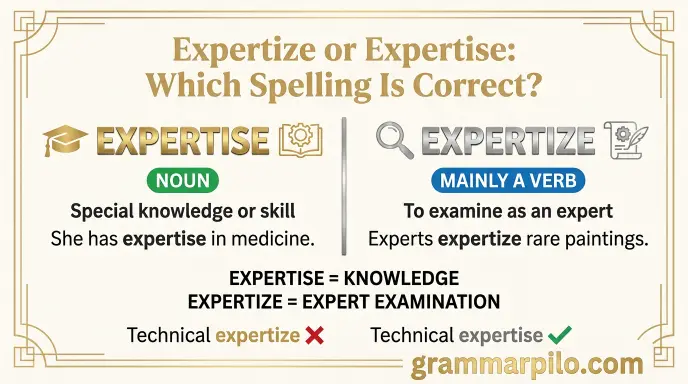
Expertise is the correct and widely accepted spelling of the noun that means special knowledge or skill. Expertize is mainly used as a verb, meaning to examine something as an expert or give an expert opinion about it.
This difference can confuse writers because both forms sound similar and share the same root. The confusion becomes greater when people see words such as professional expertise, technical expertise, and expertize a painting in different contexts.
Another important point is that the spelling difference is not simply a British versus American issue. Both American and British English use expertise as a noun. However, the verb expertize has specialized uses, while British English may also use expertise as a verb in certain contexts.
In this guide, you will learn the meaning, grammar, origin, regional usage, and practical examples of both forms. You will also discover which spelling to choose in academic, professional, and everyday writing.
Expertize or Expertise: Quick Answer
Expertise is the standard noun meaning special knowledge or skill in a particular field. Expertize is mainly a verb meaning to examine or assess something as an expert.
For example, “She has expertise in medicine” is correct, while “The specialist will expertize the painting” uses the verb. Use expertise for professional knowledge.
The difference between expertize and expertise depends on their grammatical roles.
- Expertise: A noun meaning specialized knowledge, skill, or ability.
- Expertize: Mainly a verb meaning to examine, assess, or give an expert opinion.
- Expertise: Used in both American and British English as a noun.
- Expertize: Commonly appears in specialized contexts involving expert examination or authentication.
Example 1: Expertise as a Noun
She has considerable expertise in computer programming.
Here, expertise refers to her knowledge and skills.
Example 2: Expertize as a Verb
The specialist was asked to expertize the rare painting.
Here, expertize means to examine the painting and provide an expert opinion.
Example 3: Professional Writing
The company needs someone with financial expertise.
This sentence uses the standard noun.
The easiest rule to remember is:
Expertise = Knowledge or skill
Expertize = To examine or assess as an expert
If you want to describe someone’s professional ability, use expertise.
What Does Expertize or Expertise Mean?
Although the two words share a connection with the word expert, their grammatical functions are different.
What Does Expertise Mean?
Expertise is a noun that refers to a high level of knowledge, skill, or experience in a particular subject.
It usually develops through education, training, practice, or professional experience.
Cambridge Dictionary defines expertise as a high level of knowledge or skill. It also identifies the word as a noun in both British and American English.
Examples:
- She has extensive expertise in digital marketing.
- His medical expertise helped the hospital.
- The project requires technical expertise.
- Our team brings years of professional expertise.
- I do not have enough expertise to solve this problem.
The word is usually uncountable.
For example:
Correct: She has valuable expertise.
Incorrect: She has many expertises.
However, the plural form expertises can appear in specialized contexts when referring to different areas or types of expert knowledge. In ordinary writing, the singular form is more natural.
What Does Expertize Mean?
Expertize is mainly a verb.
It means to examine, evaluate, or provide an expert opinion about something.
The word often appears in specialized contexts, particularly when assessing the authenticity, quality, or value of objects.
Examples:
- The specialist will expertize the antique painting.
- The dealer asked an expert to expertize the rare stamp.
- The museum hired a professional to expertize the historical object.
The verb can also appear in different forms:
| Verb form | Example |
| Base form | Expertize |
| Third person singular | Expertizes |
| Simple past | Expertized |
| Past participle | Expertized |
| Present participle | Expertizing |
For example:
The expert has expertized several rare collectibles.
Although this verb is legitimate, it is less common in everyday writing than the noun expertise.
Is Expertise Ever a Verb?
Yes. Some dictionaries recognize expertise as a verb, particularly in British English.
It can mean to examine something as an expert or provide an expert opinion.
However, this usage is specialized. For ordinary writing, readers are more likely to recognize expertise as a noun.
If you want to avoid confusion, use a clearer verb such as assess, examine, authenticate, or evaluate.
The Origin of Expertize and Expertise
The words expertize and expertise are connected to the word expert, but their histories and grammatical development differ.
The Origin of Expertise
The noun expertise entered English during the 19th century.
It comes from French expertise, which referred to an expert’s examination, assessment, or report.
The word developed into its modern English meaning of special knowledge, skill, or professional ability.
Over time, it became common in fields such as:
- Education
- Medicine
- Science
- Business
- Technology
- Law
- Engineering
Today, expressions such as professional expertise, technical expertise, and subject matter expertise are widely used.
The Origin of Expertize
Expertize developed from the word expert combined with the suffix -ize.
The suffix often forms verbs that describe an action or process.
Dictionary.com records the verb from the late 19th century, with the meaning of studying or investigating something as an expert.
Collins also recognizes its use for giving an expert opinion about the genuineness or value of an object.
This explains why expertize is mainly a verb rather than the usual spelling of the noun.
Why Are They Confused?
The confusion comes from their similar pronunciation and spelling.
Both words contain the same basic elements:
- Expert
- A similar ending
- A connection with specialized knowledge
However, their grammatical roles are different.
Expertise developed as the standard noun, while expertize became established mainly as a specialized verb.
This is why changing the final letters can change the meaning and function of the word.
British English vs American English
The distinction between expertize and expertise is more complicated than a simple regional spelling difference.
Both British and American English use expertise as a noun.
The verb expertize is used in North American English, especially in specialized contexts. British English may use expertise as a verb or use other verbs such as assess and authenticate.
The Government of Canada’s Language Portal explains that expertise is the noun, while expertize is most often spelled with a Z in North America when used as a verb. It also notes that British English favors the -ise ending for the verb.
| British English | American English | Example |
| Expertise (noun) | Expertise (noun) | She has professional expertise. |
| Expertise (verb, specialized) | Expertize (verb) | The specialist will assess the painting. |
| Expertised (verb form) | Expertized (verb form) | The object was expertized. |
| Expertising (verb form) | Expertizing (verb form) | He is expertizing the collection. |
| Professional expertise | Professional expertise | She has medical expertise. |
The table shows the general spelling preference for the specialized verb. Actual usage may vary by dictionary, industry, and publication.
American English
American English commonly uses expertise as a noun.
For the specialized verb, expertize is a recognized spelling.
Example:
The company hired a specialist to expertize the rare collection.
British English
British English uses expertise as the standard noun.
It may also use expertise as a verb in specialized contexts, although many writers prefer clearer alternatives.
Example:
The specialist was asked to expertise the painting.
The Important Difference
Do not assume that expertize is simply the American spelling of the noun expertise.
That would be misleading.
The noun is normally spelled expertise in both varieties.
Which Version Should You Use?
The correct choice depends on the meaning you want to express and the audience you are writing for.
United States
Use expertise when describing knowledge or professional skill.
She has extensive expertise in business management.
Use expertize only when you specifically mean to examine or assess something as an expert.
United Kingdom
Use expertise as the noun.
His expertise in engineering is widely recognized.
For the specialized verb, British English may use expertise, but alternatives such as examine, assess, and authenticate are often clearer.
Canada
Canadian English uses expertise as the noun.
The verb expertize is recognized in North American usage.
For general writing, choose the noun spelling expertise when discussing knowledge or skill.
Australia
Australian English uses expertise as the standard noun.
If you are describing professional knowledge, write:
The organization needs additional technical expertise.
For a specialist examining an object, assess or authenticate may be clearer than using the less common verb.
International Writing
For international readers, expertise is the safest choice when discussing knowledge, experience, or ability.
Avoid using expertize unless you specifically need the verb meaning.
Academic Writing
Academic writing normally uses expertise as a noun.
Example:
The researchers combined their expertise in biology and chemistry.
If you mean that an expert examined something, consider using evaluate, assess, or authenticate.
Business Writing
In professional documents, expertise is widely used.
Examples:
- Technical expertise
- Financial expertise
- Professional expertise
- Industry expertise
- Marketing expertise
These expressions sound natural in business communication.
Expertize or Expertise: Common Mistakes
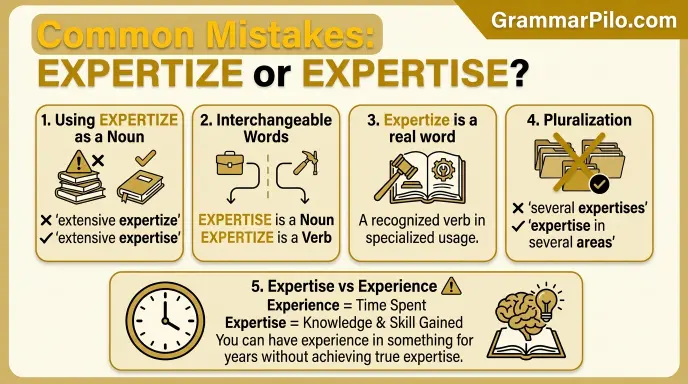
Mistake 1: Using Expertize as the Noun
Incorrect: Our company has extensive expertize in marketing.
Correct: Our company has extensive expertise in marketing.
Explanation: The standard noun referring to professional knowledge is expertise.
Memory Tip: If you are talking about someone’s skills or knowledge, use expertise.
Mistake 2: Treating Expertise and Expertize as Interchangeable
Incorrect: She has expertize in accounting.
Correct: She has expertise in accounting.
Explanation: The two forms have different grammatical functions in standard usage.
Memory Tip: Expertise describes what someone knows. Expertize describes an expert action.
Mistake 3: Assuming Expertize Is Always a Misspelling
Incorrect claim: Expertize is never a real English word.
Correct understanding: Expertize is a recognized verb in specialized usage.
Explanation: Dictionaries recognize expertize as a verb meaning to examine or provide an expert opinion.
Memory Tip: Do not reject a word without checking its grammatical role.
Mistake 4: Using Expertises in Ordinary Writing
Incorrect: The company needs several expertises.
Better: The company needs expertise in several areas.
Explanation: Expertise is usually an uncountable noun.
Memory Tip: Use areas of expertise when discussing different subjects.
Mistake 5: Confusing Expertise With Experience
Incorrect: She has ten years of expertise at the company.
Better: She has ten years of experience at the company and expertise in financial planning.
Explanation: Experience refers to time spent doing something. Expertise refers to a high level of knowledge or skill.
Memory Tip: Experience is gained over time. Expertise is developed through learning and practice.
Expertize or Expertise in Everyday Examples
Understanding these words becomes easier when you see them in real writing situations.
Emails
Correct:
We appreciate your expertise in financial planning.
Correct:
Could you recommend a specialist to assess the value of this painting?
The first sentence uses the noun. The second uses a clearer alternative to the specialized verb.
Business Writing
Our company combines technical expertise with practical experience.
The organization needs additional expertise in customer service.
Both sentences use expertise to describe professional knowledge.
News Headlines
Local Expert Shares Medical Expertise During Health Conference
Specialist Asked to Authenticate Rare Historical Painting
These examples show how the noun and a more familiar verb can be used naturally in news writing.
Blogs
Building expertise in digital marketing takes time, practice, and continuous learning.
A professional appraiser can assess the value of a rare collectible.
Social Media
Proud to share my expertise in graphic design with new learners!
Looking for an expert who can authenticate an old painting.
Academic Writing
The research team brought together expertise in psychology, education, and communication.
The study relied on the expertise of experienced researchers.
Daily Conversation
She has a lot of expertise in cooking.
I need someone with expertise in computer repair.
These are natural examples of expertise as a noun.
Google Trends & Modern Usage
People search for expertize or expertise because the two words look similar and are sometimes used in different grammatical roles.
The most common questions include:
- Expertize or expertise
- Expertise vs. expertize
- Is expertize a word?
- Is expertise spelled with an S or Z?
- Expertize meaning
- Expertise meaning
- Expertize as a verb
- Expertise as a noun
- Expertize or expertise in American English
- Expertize or expertise in British English
Modern English uses expertise much more broadly as a noun in professional, academic, and everyday communication.
The word appears frequently in expressions such as:
- Technical expertise
- Professional expertise
- Medical expertise
- Business expertise
- Financial expertise
- Subject matter expertise
Expertize has a narrower use. It is mainly associated with examining or assessing something as an expert.
The Government of Canada’s Language Portal specifically distinguishes the noun expertise from the North American verb expertize.
Exact Google Trends popularity depends on the selected country, time period, and search category. Without a specific dataset, it would be misleading to claim exact search volumes or regional percentages.
For modern writing, the practical recommendation is clear: use expertise when discussing knowledge or skill.
Quick Comparison Table
| Version | Meaning | Correct? | Region | Example |
| Expertise | Special knowledge or skill | Yes | US, UK, international | She has expertise in law. |
| Expertize | Examine as an expert | Yes, as a verb | Mainly North American usage | They will expertize the painting. |
| Expertise (verb) | Examine or give an expert opinion | Yes, specialized | Mainly British usage | The specialist will expertise the object. |
| Expertises | Plural noun in specialized contexts | Yes, but uncommon | Various | The report covers several areas of expertise. |
| Expertize (noun for skill) | Not the standard everyday noun | Avoid | Standard English | Use expertise instead. |
Key Takeaways
- Expertise is the standard noun meaning special knowledge or skill.
- Expertize is mainly a verb meaning to examine or assess something as an expert.
- Both American and British English use expertise as a noun.
- The specialized verb expertize is recognized in North American English.
- British English may use expertise as a verb.
- Expertise is usually an uncountable noun.
- Use areas of expertise when referring to different subjects.
- Do not confuse expertise with experience.
- For international writing, expertise is the natural choice when discussing professional knowledge.
- Use clearer verbs such as assess, examine, and authenticate when appropriate.
FAQs About Expertize or Expertise
1. Is it expertize or expertise?
Expertise is the standard noun meaning specialized knowledge or skill. Expertize is mainly a verb meaning to examine or give an expert opinion about something. For example, “She has expertise in medicine” is correct. “The specialist will expertize the painting” uses the verb.
2. Is expertize a real word?
Yes. Expertize is a recognized English verb. It means to examine, investigate, or assess something as an expert. It is often used in specialized contexts involving the authenticity or value of objects. However, it is not the usual spelling of the noun meaning professional knowledge.
3. Is expertise spelled with an S or Z?
The standard noun is always spelled expertise, with an S, in both American and British English. The spelling expertize, with a Z, is mainly used as a specialized verb in North American English. Therefore, use expertise when discussing someone’s knowledge or professional skills.
4. Is expertize American or British English?
Expertize is commonly recognized as a North American verb meaning to examine something as an expert. British English may use expertise as a verb instead. However, both British and American English use expertise as the standard noun for specialized knowledge or skill.
5. Can expertise be used as a verb?
Yes. Some dictionaries recognize expertise as a verb, especially in British English. It can mean to examine something or provide an expert opinion. However, this use is specialized. In everyday and professional writing, verbs such as assess, examine, and authenticate are often clearer.
6. What is the difference between expertise and experience?
Expertise means a high level of knowledge or skill in a subject. Experience means knowledge or ability gained through doing something over time. For example, someone may have ten years of work experience but still need to develop expertise in a specific field.
7. Is expertise a countable or uncountable noun?
Expertise is usually an uncountable noun. You can say “She has considerable expertise” or “He has expertise in engineering.” In ordinary writing, avoid saying “many expertises.” Instead, use “different areas of expertise” or “several areas of specialized knowledge.”
8. Is expertize correct in formal writing?
Expertize can be correct in formal writing when used as a verb with its specialized meaning. However, it is uncommon in general professional communication. If you mean to examine or assess something, evaluate, examine, or authenticate may communicate your meaning more clearly.
9. Is it technical expertise or technical expertize?
The correct standard expression is technical expertise. It refers to specialized knowledge or skills in a technical field. For example, “The project requires technical expertise.” Using technical expertize for this meaning is not standard everyday English.
10. What is the plural of expertise?
The word expertise is generally uncountable, so it does not normally need a plural form. When discussing multiple subjects, write “areas of expertise” or “different types of expertise.” Although expertises can occur in specialized contexts, it is uncommon in everyday writing.
Conclusion
The difference between expertize or expertise becomes clear when you understand their grammatical roles.
Expertise is the standard noun used to describe specialized knowledge, professional skills, or experience in a particular field. It is accepted in both American and British English. You can use it in expressions such as technical expertise, business expertise, and professional expertise.
Expertize, on the other hand, is mainly a verb. It refers to examining or assessing something as an expert. It is recognized in specialized North American usage, while British English may use expertise as a verb in similar contexts.
For everyday, academic, and business writing, the safest choice is expertise whenever you mean knowledge or skill. If you need to describe an expert examination, consider using clearer verbs such as assess, examine, or authenticate.
Remember this simple rule:
Expertise is what you know. Expertize is what an expert does.
Choose the correct form based on its meaning, and your writing will remain clear and professional.
Quick Grammar Tip
- Cutey or Cutie: The Correct Spelling and Meaning Explained
- Sword or Sord: The Correct Spelling, Meaning & Everyday Usage
- Cheek or Cheak: Never Make This Common Mistake Again

I’m Sloane Mercer, a U.S.-based English language writer focused on grammar, spelling, vocabulary, and everyday English usage. Through GrammarPilo, I provide clear and practical explanations to help readers choose the right words and communicate with confidence.





5 thoughts on “Expertize or Expertise: Avoid This Common Spelling Mistake”