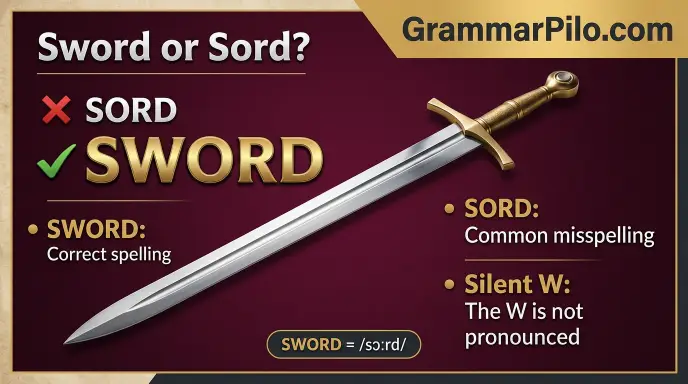
Sword is the correct spelling for the weapon with a long blade, while sord is a misspelling in standard English. The word sword has a silent “w,” which is why some people hear it as “sord” and may accidentally leave the letter out when writing.
This spelling confusion often happens because English pronunciation does not always match its written form. In sword, the “w” is not pronounced, but it must still appear in the spelling.
The word is used in history, literature, fantasy stories, games, and everyday expressions such as “sword fight” and “double edged sword.”
Understanding the difference between sword or sord can help you avoid spelling errors in school assignments, articles, messages, and professional writing.
This guide explains the correct spelling, meaning, origin, pronunciation, and usage of sword. It also includes common mistakes, practical examples, and answers to frequently asked questions.
Sword or Sord – Quick Answer
Sword is the correct spelling. Sord is not a standard spelling of the weapon’s name.
A sword is a weapon with a long blade, usually designed for cutting or thrusting.
Correct: The knight carried a sword into battle.
Incorrect: The knight carried a sord into battle.
The letter w in sword is silent, but it is still required in the written word.
Remember: The correct spelling is s w o r d, even though it sounds like “sord.”
Definition and Meaning of Sword
A sword is a weapon with a long metal blade and a handle. It may have one or two sharp edges and is traditionally used for cutting, thrusting, or fighting.
Swords have been used throughout history by soldiers, warriors, and people trained in swordsmanship. Today, they are also seen in museums, historical displays, films, books, and fantasy games.
What Does Sword Mean?
The word sword usually refers to a bladed weapon.
Examples:
- The museum displayed an ancient sword.
- The knight raised his sword during the battle.
- The character carried a silver sword in the fantasy story.
- The soldier learned how to handle a sword.
The word can also appear in figurative expressions.
Figurative Meaning of Sword
A sword does not always refer to a physical weapon. It can be used symbolically to describe danger, conflict, responsibility, or a difficult situation.
One common expression is a double edged sword. It describes something that has both advantages and disadvantages.
Example: Social media can be a double edged sword because it connects people but can also spread misinformation.
Another expression is the sword of Damocles, which refers to a constant threat or danger.
Example: The possibility of losing his job hung over him like the sword of Damocles.
Is Sword a Noun or a Verb?
Sword is mainly used as a noun. It names a weapon or appears in figurative expressions.
Example: The warrior held a sword.
The word is not commonly used as a standard verb in everyday English.
The Origin and History of Sword
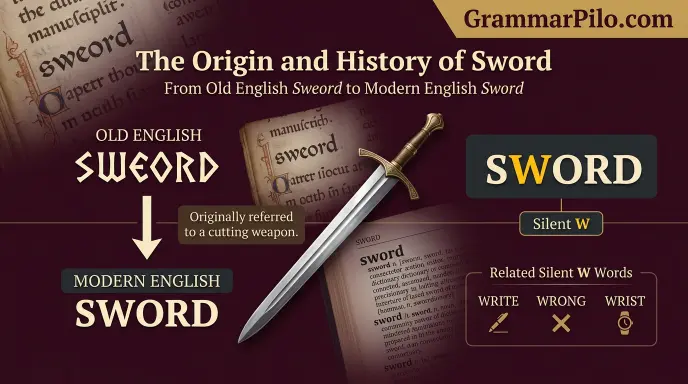
The word sword has a long history in the English language. It comes from Old English sweord, which referred to a cutting weapon. Related forms appeared in other Germanic languages.
Over time, the spelling developed into the modern form sword. The “w” became silent in pronunciation, but it remained part of the written word.
This is one reason why learners may confuse sword with sord. The spoken form does not clearly reveal the silent letter.
Why Is the W Silent in Sword?
English contains many words with silent letters. In sword, the “w” is not pronounced in modern standard English.
The same silent “w” appears in words such as:
- write
- wrong
- wrist
- answer
- two
However, the spelling rules are not identical for every word. It is best to learn sword as a word with a silent “w.”
How Did Sword Become a Common Word?
Swords were important tools and weapons in many historical societies. As a result, the word became common in historical records, literature, and storytelling.
Today, sword remains familiar because of its use in historical writing, fantasy fiction, films, and games.
British English vs American English Spelling
There is no spelling difference between British and American English for sword. Both varieties use the same spelling.
| Word | American English | British English | Status |
| Sword | Correct | Correct | Standard spelling |
| Sord | Incorrect | Incorrect | Misspelling |
Does Sword Have Different Spellings in Other English Varieties?
No. The standard spelling is sword in American, British, Canadian, Australian, and other major varieties of English.
American English: The soldier carried a sword.
British English: The soldier carried a sword.
The pronunciation may vary slightly by speaker or accent, but the spelling remains the same.
Which Spelling Should You Use?
Use sword whenever you are referring to the weapon or using the word in a figurative expression. This spelling is correct for all standard English audiences.
For American Readers
Use sword in schoolwork, articles, emails, stories, and everyday communication.
Example: The museum has a collection of medieval swords.
For British and Commonwealth Readers
The correct spelling is also sword in British English and other Commonwealth varieties.
Example: The knight drew his sword.
For International Readers
Choose sword for international writing. It is the recognized spelling across English varieties.
For Formal Writing
Use sword in formal writing when discussing weapons, history, literature, or symbolic expressions.
Example: The sword was an important weapon in several historical periods.
If you are writing about a figurative situation, make sure the meaning is clear.
Example: The new policy became a double edged sword for the organization.
Common Mistakes with Sword or Sord
Mistake 1: Leaving Out the Silent W
Some writers spell the word as sord because the “w” is not pronounced.
Incorrect: The king held a sord.
Correct: The king held a sword.
Remember that the silent “w” is part of the correct spelling.
Mistake 2: Spelling Sword the Way It Sounds
English spelling does not always follow pronunciation. Writing only the sounds you hear can lead to mistakes.
Incorrect: She bought a sord for the costume.
Correct: She bought a sword for the costume.
The correct spelling includes all five letters.
Mistake 3: Assuming Sord Is a British Variant
Sord is not an accepted British spelling of sword. Both American and British English use sword.
Correct in both varieties: The sword was made of steel.
Mistake 4: Misusing the Expression Double Edged Sword
A double edged sword is an expression for something that has both positive and negative effects.
Incorrect: The new schedule is a double edged sord.
Correct: The new schedule is a double edged sword.
The expression always uses the spelling sword.
Mistake 5: Confusing Sword With Other Similar Sounding Words
Some English words sound similar but have different meanings and spellings.
For example, sword and soared may sound similar in some accents, but they are not interchangeable.
- Sword: A bladed weapon.
- Soared: Rose high or increased quickly.
Example: The eagle soared above the castle where the knight carried a sword.
Sword in Everyday Examples
The best way to remember sword is to see it used in different writing situations.
In Emails
Example: Please include the sword display in the museum tour schedule.
This sentence uses sword to refer to a historical object.
In News Writing
Example: The museum has opened an exhibition featuring swords from different historical periods.
The word is used in a factual description.
In Social Media
Example: I finally finished my fantasy costume, complete with a wooden sword!
This is a casual use of the word.
In Formal Writing
Example: The sword played an important role in the military history of the region.
The sentence uses the word in a historical context.
In Literature
Example: The hero raised his sword and prepared to defend the kingdom.
Swords often appear in stories about battles, adventures, and fantasy worlds.
In Everyday Conversation
Example: That decision is a double edged sword because it saves time but increases costs.
Here, sword is part of a figurative expression rather than a reference to a real weapon.
Sword vs Sord – Side by Side Comparison
The main difference between sword and sord is that sword is the correct spelling, while sord is a misspelling.
| Feature | Sword | Sord |
| Spelling | S W O R D | S O R D |
| Standard English | Correct | Incorrect |
| Pronunciation | The “w” is silent | Often used to represent the sound |
| Meaning | A long bladed weapon; also used figuratively | No standard meaning as a spelling of the weapon |
| American English | Correct | Incorrect |
| British English | Correct | Incorrect |
| Example | The knight carried a sword. | The knight carried a sord. |
Sword or Sord: Which One Is Correct?
Sword is correct in every standard English variety. The letter “w” is silent, but it must remain in the spelling.
If you are unsure, remember the phrase a sword with a silent w.
Google Trends and Usage Data for Sword
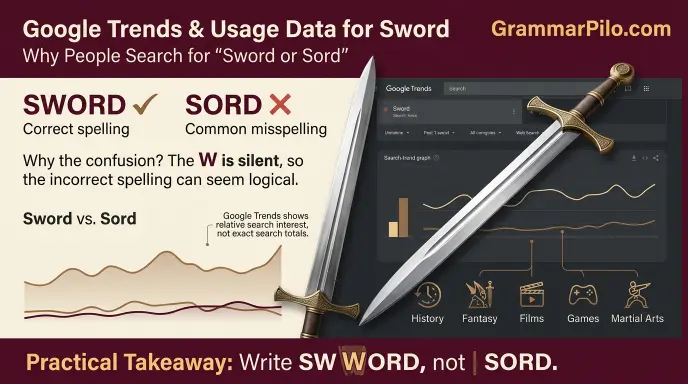
People may search for sword or sord because the word contains a silent letter. The spelling sord can seem logical to someone who writes the word based on how it sounds.
Search interest in sword may also come from several topics, including history, fantasy books, films, games, martial arts, and collecting. The word has uses beyond spelling questions, so general search interest does not show how many people are confused about its spelling.
Google Trends can compare search interest for sword and sord across selected locations and time periods. Its figures show relative interest rather than exact search totals. Search popularity also does not determine which spelling is correct.
For spelling guidance, use standard dictionaries and established English references. They recognize sword as the correct spelling of the weapon.
Practical takeaway: Write sword, not sord, even though the “w” is silent.
Frequently Asked Questions
1. Is it sword or sord?
Sword is the correct spelling. Sord is a misspelling when referring to the weapon.
2. Why is the W silent in sword?
The “w” is silent because of the word’s historical development and modern pronunciation. Although it is not spoken, it remains necessary in the spelling.
3. Is sord ever a correct spelling?
Sord is not the standard spelling of the weapon. Use sword in formal, academic, professional, and everyday English.
4. Is sword spelled the same in British and American English?
Yes. Both British and American English use sword. There is no regional spelling difference.
5. How do you pronounce sword?
Sword is commonly pronounced like “sord,” with the “w” silent. Pronunciation can vary slightly by accent.
6. What does double edged sword mean?
A double edged sword is something that has both positive and negative effects.
Example: Working from home can be a double edged sword because it offers flexibility but may also create distractions.
7. Is sword a noun or an adjective?
Sword is primarily a noun. It names a bladed weapon and can also appear in expressions such as “double edged sword.”
Conclusion: Keep the Silent W in Sword
When deciding between sword or sord, remember that sword is the only correct standard spelling for the weapon. The “w” is silent, which explains why people sometimes leave it out, but the letter must remain in written English.
The word sword refers to a long bladed weapon used historically for cutting or thrusting. It also appears in figurative expressions, such as “a double edged sword,” to describe something with both benefits and drawbacks.
There is no difference between British and American spelling. Writers in both varieties should use sword in school assignments, professional documents, articles, stories, and everyday messages.
A simple memory tip can help you avoid the mistake. Think of sword as a word with a silent “w,” just like other English words that contain letters we do not pronounce. Once you remember that detail, choosing sword over sord becomes much easier.
Also Check This Out!

I’m Sloane Mercer, a U.S.-based English language writer focused on grammar, spelling, vocabulary, and everyday English usage. Through GrammarPilo, I provide clear and practical explanations to help readers choose the right words and communicate with confidence.




1 thought on “Sword or Sord: The Correct Spelling, Meaning & Everyday Usage”