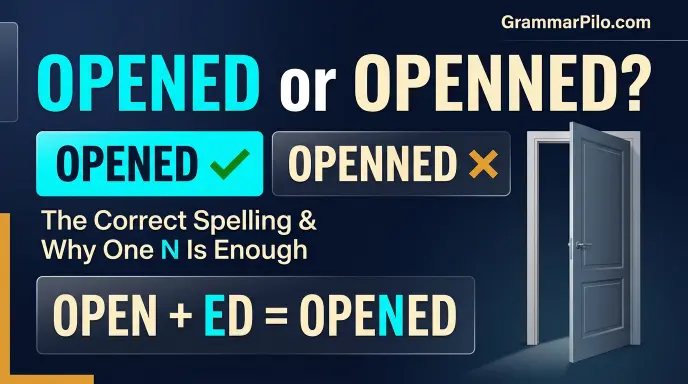
Opened is the correct spelling, while openned is a common spelling mistake. The verb open becomes opened when you add “-ed” to form its simple past tense or past participle. You do not double the final “n.”
This confusion often happens because English has a spelling rule that doubles the final consonant in some words before adding “-ed.”
For example, planned comes from plan, and stopped comes from stop. However, that rule does not apply to every verb ending in a consonant.
With open, the final syllable is not stressed. The correct form is therefore opened, not openned. You can use it to describe something that someone made accessible, a business that began operating, or an event that started.
This guide explains the difference between opened or openned, how the spelling rule works, and how to use opened in everyday and formal writing. It also includes examples, common mistakes, and answers to frequently asked questions.
Opened or Openned: Quick Answer
Opened is correct. Openned is incorrect in standard English.
The verb open forms its past tense and past participle by adding “ -ed”:
- Present: open
- Past: opened
- Past participle: opened
Correct: She opened the door.
Incorrect: She openned the door.
The word open already has one “n.” Do not add another one when forming opened.
Definition and Meaning of Opened
Opened is the simple past tense and past participle of the verb open. It describes the action of making something accessible, starting something, or allowing something to become available.
What Does Opened Mean?
The meaning of opened depends on the context.
It can mean that someone moved a door, lid, or container so that people could enter or see what was inside.
Example: He opened the window to let in fresh air.
It can also mean that a business or event began operating.
Example: The new restaurant opened last week.
In another context, opened may describe starting a discussion, account, or opportunity.
Example: The manager opened the meeting with a short announcement.
Is Opened a Verb?
Yes. Opened is a verb form.
It is used as the simple past tense and past participle of open.
Simple past: She opened the package yesterday.
Present perfect: She has opened the package.
Passive voice: The package was opened carefully.
In each sentence, opened is spelled with one “n.”
What Is the Difference Between Open and Opened?
Open is the base form of the verb and can also work as an adjective. Opened is the past tense and past participle of the verb.
| Word | Use | Example |
| Open | Base verb | Please open the window. |
| Open | Adjective | The store is open. |
| Opened | Simple past | The store opened yesterday. |
| Opened | Past participle | The store has opened. |
The Origin and History of Opened
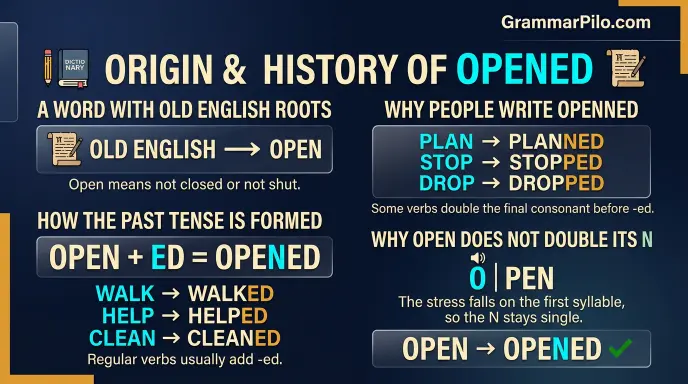
The word open has roots in Old English. It developed from an earlier form, open, meaning not closed or not shut. Related words appear in other Germanic languages.
The verb form opened follows a regular English pattern. Many regular verbs form their past tense and past participle by adding “ ed” to the base form.
For example:
- Walk → walked
- Help → helped
- Clean → cleaned
- Open → opened
The spelling remains straightforward because the final consonant in open is not doubled.
Why Do People Write Openned?
People may write openned because they know that some English verbs double their final consonant before adding “ ed.”
For example:
- Plan → planned
- Stop → stopped
- Drop → dropped
However, the doubling rule depends on the word’s spelling and stress pattern. It does not apply to open.
Why Is the N Not Doubled in Opened?
In many one syllable verbs that end in a single consonant preceded by a single vowel, the final consonant is doubled before adding “ ed.”
For example, stop becomes stopped.
For longer verbs, the final syllable usually needs to be stressed for this doubling pattern to apply. In open, the stress falls on the first syllable: O pen. The final syllable is not stressed, so the “n” is not doubled.
The correct form is opened.
British English vs American English Spelling
There is no spelling difference between British and American English for opened. Both varieties use the same form.
| Form | American English | British English | Status |
| Opened | Correct | Correct | Standard spelling |
| Openned | Incorrect | Incorrect | Misspelling |
Does Opened Have Different Spellings in Other English Varieties?
No. The standard spelling is opened in American, British, Canadian, Australian, and other major varieties of English.
American English: The shop opened at nine.
British English: The shop opened at nine.
The spelling remains the same. Some regions may prefer different words, such as “store” or “shop,” but that does not change the spelling of opened.
Which Spelling Should You Use?
Use opened in all standard English writing. It is correct for American, British, and international audiences.
For American Readers
Choose opened in emails, school assignments, reports, and everyday writing.
Example: The company opened a new office in Chicago.
For British and Commonwealth Readers
Use opened in British English and other Commonwealth varieties.
Example: The library opened its doors to visitors at ten.
For International Readers
Opened is the standard form and will be understood across English varieties.
For Formal Writing
Use opened when describing a completed action or a business, event, or facility that began operating.
Example: The research centre opened in 2024.
For clarity, make sure the sentence shows what was opened or what began operating.
Common Mistakes with Opened or Openned
Mistake 1: Doubling the N
A common mistake is adding an extra “n” before “-ed.”
Incorrect: The store openned early.
Correct: The store opened early.
The base word is open, so simply add “-ed.”
Mistake 2: Applying the Doubling Rule to Every Verb
Not all verbs double their final consonant before adding “-ed.”
Incorrect: We openned the box.
Correct: We opened the box.
Compare open → opened with stop → stopped. The spelling rules depend on the word’s structure and stress.
Mistake 3: Confusing Opened With Open
Open and opened have different grammatical uses.
Incorrect: The shop opened now.
Better: The shop is open now.
Correct for a past action: The shop opened yesterday.
Use open to describe the current state and opened to describe the past action.
Mistake 4: Using Openned in Formal Writing
Because openned is a spelling error, it should not appear in professional documents, academic work, or published content.
Incorrect: The application was openned by the staff.
Correct: The application was opened by the staff.
Mistake 5: Adding an Extra N in Related Forms
The same spelling principle applies to other forms of the verb.
- Opening, not openning
- Opens, not openns
- Opened, not openned
Remember that the base word is open, with one “n.”
Opened in Everyday Examples
Seeing opened in different contexts can help you understand its meaning and use.
In Emails
Example: I opened the document you sent and added my comments.
The sentence describes a completed action.
In News Writing
Example: The city opened a new public library in the downtown area.
Here, opened means the library began operating or became available to the public.
In Social Media
Example: I finally opened my birthday gifts!
This is a casual use of the past tense.
In Formal Writing
Example: The conference opened with a presentation from the research team.
The word describes how the event began.
In Business Writing
Example: The company opened a regional office to serve more customers.
The sentence explains that a new office began operating.
In Everyday Conversation
Example: I opened the fridge, but there was nothing to eat.
The word describes the action of opening something.
Opened vs Openned: Side by Side Comparison
The difference between opened and openned is spelling. Opened is the correct past tense and past participle of open. Openned is a misspelling.
| Feature | Opened | Openned |
| Spelling | O-P-E-N-E-D | O-P-E-N-N-E-D |
| Standard English | Correct | Incorrect |
| Base word | Open | Open |
| Grammar | Past tense and past participle | Not a standard form |
| American English | Correct | Incorrect |
| British English | Correct | Incorrect |
| Example | She opened the door. | She openned the door. |
Opened or Openned: Which One Is Correct?
Opened is correct because the verb open takes “-ed” without doubling the final “n.”
A useful memory tip is to remember the base word: open has one “n,” and opened keeps that same spelling.
Google Trends and Usage Data for Opened
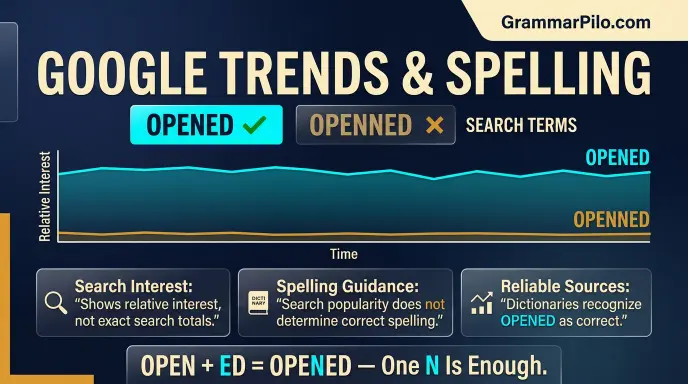
People may search for opened or openned because they are unsure when English verbs double their final consonants. Words such as planned and stopped may lead writers to assume that open follows the same pattern.
Search interest can also come from people checking grammar, spelling, or sentence structure. However, search popularity does not determine which spelling is correct.
Google Trends can compare interest in opened and openned across selected regions and time periods. Its data shows relative search interest, not exact search totals or a complete measure of spelling mistakes.
For reliable spelling guidance, standard dictionaries and grammar references are more useful than search volume. They recognize opened as the correct form.
Practical takeaway: Use opened in your writing. Do not double the “n.”
Frequently Asked Questions
1. Is it opened or openned?
Opened is correct. Openned is a spelling mistake. The past tense of open is formed by adding “ ed” without doubling the “n.”
2. Why is opened not spelled with two Ns?
The final syllable of open is not stressed. The consonant doubling rule does not apply, so the correct form is opened.
3. Is openned ever correct?
No. Openned is not a standard English spelling. Use opened in academic, professional, and everyday writing.
4. Is opened British or American English?
Opened is correct in both British and American English. There is no regional spelling difference.
5. What is the past tense of open?
The simple past tense of open is opened.
Example: I opened the door this morning.
6. What is the past participle of open?
The past participle is also opened.
Example: They have opened a new store.
It is also used in passive constructions.
Example: The store was opened last month.
7. Is it opening or openning?
Opening is correct. Openning is incorrect.
Example: The company is opening a new branch next month.
The word open keeps one “n” when adding “ ing.”
Conclusion: Use Opened, Not Openned
When choosing between opened or openned, always use opened. It is the correct simple past tense and past participle of the verb open. The spelling openned is a common mistake caused by applying the consonant doubling rule where it does not belong.
The key is to remember that open has one “n,” and that letter stays single when you add “ ed.” The correct forms are open, opens, opened, and opening.
There is no difference between British and American English spelling. Writers in both varieties use opened in schoolwork, professional documents, emails, articles, and everyday communication.
A simple memory tip can help: open + ed = opened. You do not need an extra “n.” Once you remember this pattern, you can avoid the mistake and use the correct form with confidence.
Discover More Articles

I’m Sloane Mercer, a U.S.-based English language writer focused on grammar, spelling, vocabulary, and everyday English usage. Through GrammarPilo, I provide clear and practical explanations to help readers choose the right words and communicate with confidence.








1 thought on “Opened or Openned: The Correct Spelling & Why One N Is Enough”