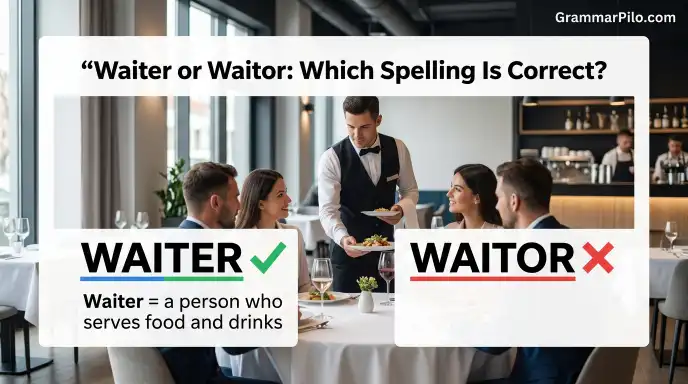
Have you ever wondered if “waiter” or “waitor” is the correct spelling? The correct word is waiter. Waitor is a misspelling and is not the standard English spelling.
A waiter is a person whose job is to serve food and drinks to customers, usually in a restaurant, café, or similar place. The word is spelled w-a-i-t-e-r, not w-a-i-t-o-r.
The confusion is understandable because English has many words that use the ending -or, such as actor, doctor, and professor. However, waiter follows a different spelling pattern and uses -er.
In this guide, we will explain the difference between waiter and waitor, look at the word’s meaning and origin, compare British and American English usage, and show you how to use waiter correctly in everyday writing and conversation.
Waiter or Waitor: Quick Answer
Waiter is the correct spelling. It means a person who serves food and drinks to customers in a restaurant or similar establishment. Waitor is an incorrect spelling and should not be used in standard English. If you are writing formally, use waiter.
| Word | Correct? | Meaning |
| Waiter | ✅ Yes | A person who serves customers food and drinks |
| Waitor | ❌ No | Misspelling of waiter |
Correct: The waiter brought us the menu.
Incorrect: The waitor brought us the menu.
So, if you are asking “waiter or waitor?”, always choose waiter.
What Does Waiter Mean?
A waiter is a person who serves customers in a restaurant, café, hotel, or other food-service setting.
A waiter may:
- Take customers’ orders
- Bring food and drinks
- Answer questions about the menu
- Provide customer service
- Clear tables
- Present the bill or check
For example:
The waiter took our order and brought our drinks.
The word waiter can also be used more broadly for a person whose job involves serving customers at a table.
What Does Waitor Mean?
Waitor is not the standard spelling of the word.
If you see waitor in a message, website, application, or other text, it is usually a spelling mistake. The correct form is waiter.
Therefore, there is no standard English meaning that you need to learn for waitor. It is simply an incorrect spelling when the intended word is waiter.
The Origin of Waiter
The word waiter comes from the verb wait, which historically had meanings connected with attending to or serving someone.
The suffix -er is commonly used in English to form nouns for people who perform an action or have a particular role. Examples include:
- teach → teacher
- work → worker
- drive → driver
- farm → farmer
- wait → waiter
This helps explain why the standard spelling is waiter, not waitor.
The spelling waitor may seem logical because English has many occupational words ending in -or, but English spelling does not always use one single rule for these endings.
British English vs American English
There is no spelling difference between American and British English for this word.
Both varieties use:
waiter
| English Variety | Correct Spelling |
| American English | waiter |
| British English | waiter |
| Canadian English | waiter |
| Australian English | waiter |
| International English | waiter |
The incorrect spelling waitor should be avoided in standard English regardless of the variety you are using.
Waiter vs. Waitor: Is There a Regional Difference?
No. Waiter is not an American-only spelling or a British-only spelling.
If you are writing an email, school assignment, article, résumé, menu, or business document, waiter is the appropriate spelling.
Which Version Should You Use?
Use waiter whenever you mean a person who serves food or drinks.
In American English
Use:
The waiter gave us the check.
In British English
Use:
The waiter brought our meals.
The spelling remains waiter in both cases.
In Academic Writing
Use waiter if the occupation is relevant to your topic.
For example:
The study examined the working conditions of restaurant waiters.
In Business Writing
Use waiter in professional communication:
We are hiring experienced waiters for our new restaurant.
In Everyday Conversation
You can also simply use waiter:
Let’s ask the waiter for another menu.
Common Mistakes With Waiter and Waitor
The biggest mistake is replacing the -er ending with -or.
| Incorrect | Correct | Explanation |
| The waitor brought the food. | The waiter brought the food. | Waitor is misspelled. |
| I asked the waitor for water. | I asked the waiter for water. | Use waiter for a restaurant server. |
| The waitor took our order. | The waiter took our order. | The standard spelling is waiter. |
| We thanked the waitor. | We thanked the waiter. | Waiter is the correct noun. |
Easy Memory Tip
Think:
wait + er = waiter
The person who waits on or serves customers is a waiter.
Remember the -er ending.
Waiter in Everyday Examples
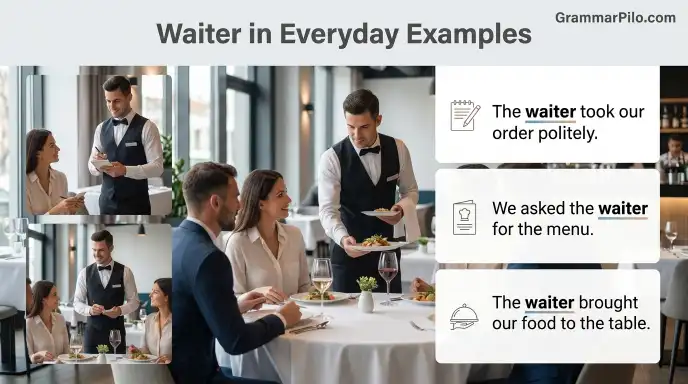
The word waiter is common in everyday English. Here are examples in different situations.
In a Restaurant
The waiter brought the menu as soon as we sat down.
Ordering Food
We asked the waiter what today’s special was.
Asking for the Bill
Could you ask the waiter for the bill?
In a Hotel Restaurant
The waiter served breakfast in the hotel dining room.
In an Email
I would like to recognize the waiter who provided excellent service during our dinner.
In a Review
Our waiter was friendly, professional, and very helpful.
In a News Article
The waiter received praise for helping a customer during an emergency.
In Social Media
Our waiter was amazing tonight!
In Academic Writing
The researchers interviewed restaurant waiters about their working conditions.
In Daily Conversation
The waiter just brought our drinks.
Waiter or Waitor: Quick Comparison Table
| Feature | Waiter | Waitor |
| Standard English | ✅ Yes | ❌ No |
| Correct spelling | ✅ | ❌ |
| Refers to a restaurant server | ✅ | ❌ |
| Used in American English | ✅ | ❌ |
| Used in British English | ✅ | ❌ |
| Suitable for formal writing | ✅ | ❌ |
| Common spelling mistake | No | Yes |
Why Do People Spell Waiter as Waitor?
The mistake usually happens because English contains many words ending in -or.
For example:
- actor
- instructor
- operator
- editor
- supervisor
Because of these familiar patterns, someone may assume that waitor is also correct.
However, the standard spelling is waiter.
English spelling often requires you to learn individual word forms rather than relying entirely on pronunciation or a single suffix rule.
Is Waiter a Noun or a Verb?
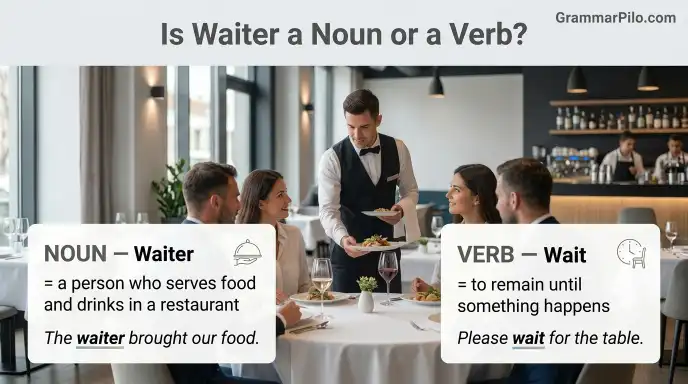
Waiter is a noun.
It names a person who serves customers.
For example:
The waiter brought our food.
The verb is wait, not waiter.
For example:
We waited for our food.
So:
- wait = verb
- waiter = noun
- waited = past tense of wait
- waiting = present participle/gerund of wait
Is “Waitor” Ever Correct?
In standard modern English, waitor is not the normal spelling for a restaurant server.
If you mean a person who serves food and drinks, use waiter.
Therefore:
❌ waitor
✅ waiter
If you encounter waitor somewhere, it may be a typo, a nonstandard spelling, or a proper name rather than the ordinary English occupation word.
Google Trends & Modern Usage
The spelling waiter is the established standard form in modern English. It appears widely in restaurant descriptions, job advertisements, menus, reviews, news writing, and everyday conversation.
Waitor, by contrast, is generally encountered as a spelling error rather than as a standard English word.
Search engines may still show the incorrect spelling because people often search for words they are unsure about. This does not make the spelling correct.
For professional, academic, or public-facing writing, always use waiter.
Key Takeaways
- Waiter is the correct spelling.
- Waitor is a misspelling in standard English.
- A waiter is a person who serves food and drinks to customers.
- The word is spelled with -er, not -or.
- American and British English both use waiter.
- Use waiter in formal and informal writing.
- A simple memory tip is wait + er = waiter.
- If you are unsure about waiter vs. waitor, choose waiter.
Frequently Asked Questions
Q1. Is waiter or waitor correct?
Waiter is correct. Waitor is a misspelling and is not the standard English form. Use waiter when referring to a person whose job is to serve food and drinks to customers in a restaurant, café, hotel, or similar establishment.
Q2. Is “waitor” a real word?
Waitor is not the standard spelling of the English word for a restaurant server. It is generally used as a misspelling of waiter. In standard English writing, use waiter.
Q3. Why is it waiter and not waitor?
The standard spelling uses the suffix -er: wait + er = waiter. English has many words ending in -or, which can make waitor look plausible, but the established spelling of this occupation is waiter.
Q4. Is waiter American or British?
Waiter is used in both American and British English. There is no spelling difference between the two varieties for this word. You can use waiter in American, British, Canadian, Australian, and other forms of standard English.
Q5. What is the plural of waiter?
The plural of waiter is waiters.
Example:
The restaurant employs ten waiters.
Q6. What is the female form of waiter?
Traditionally, waitress has been used for a female restaurant server. However, waiter can also be used as a gender-neutral occupational term in modern English, depending on the context.
Q7. How do you spell waiter correctly?
The correct spelling is waiter: W-A-I-T-E-R.
A useful memory trick is to remember wait + er = waiter.
Q8. Can I use waitor in formal writing?
No. If you mean a restaurant server, use waiter in formal writing. The spelling waitor is nonstandard and may be treated as a spelling error in an essay, article, résumé, email, or business document.
Q9. What is the difference between waiter and waitor?
There is no standard meaning difference between them. Waiter is the correct English word, while waitor is generally an incorrect spelling. Therefore, the important difference is correct versus incorrect spelling.
Q10. Is waiter spelled with “er” or “or”?
It is spelled with -er: waiter. The spelling waitor is incorrect when referring to a restaurant server.
Conclusion
When deciding between waiter or waitor, the answer is simple: waiter is the correct spelling, while waitor is a misspelling.
A waiter is a person who serves food and drinks to customers, especially in a restaurant, café, or hotel. The word is spelled with the -er ending, just as in other occupation words such as teacher and worker.
Although waitor may look reasonable because many English words end in -or, it is not the standard spelling of this occupation. Both American and British English use waiter, so you do not need to choose a regional variation.
If you are writing a school assignment, business email, restaurant review, job description, article, or everyday message, remember the simple rule:
Waiter = correct
Waitor = incorrect
So the next time you wonder “waiter vs. waitor?”, choose waiter with confidence.
Read More
- Alla or Aya: Which Spelling Is Correct?
- Phrase or Clause: What’s the Difference?
- Transitive or Intransitive: What’s the Difference?

I’m Claire Morgan, the author behind Grammarpilo.com, where I write about English grammar, sentence structure, punctuation, and everyday language. My goal is to make grammar simple, clear, and practical, helping readers understand the rules and apply them with confidence in real-world writing.




4 thoughts on “Waiter or Waitor: Which Spelling Is Correct?”