
Incidents and incidences are both correct English words, but they are used in different contexts. Incidents is the plural form of incident and refers to individual events, especially unusual, unexpected, or significant occurrences.
Incidences is the plural form of incidence and generally refers to the frequency, rate, or occurrence of something, particularly in statistics, medicine, research, and public health.
For example, a school might report three incidents of bullying during the week because it is describing specific events.
A research report might discuss the incidences of a particular condition across different populations, although incidence is more commonly used as a singular or uncountable style technical term in many such contexts.
The confusion happens because these words look almost identical and share related meanings.
Both can concern things that happen, but they emphasize different aspects. Incidents focuses on individual events, while incidences often focuses on occurrence or frequency.
In this GrammarPilo guide, you will learn the difference between incidents and incidences, understand their definitions and grammatical uses, explore practical examples, and discover how to choose the right word in academic, professional, and everyday writing.
Quick Answer: Incidents vs. Incidences
Incidents means specific events or occurrences, often unusual or noteworthy.
Incidences generally refers to occurrences or rates of occurrence, especially in technical, scientific, and statistical contexts.
| Word | Meaning | Example |
| Incidents | Individual events | The police investigated two incidents near the station. |
| Incidences | Occurrences or rates of occurrence | Researchers examined the incidences of the condition in different groups. |
Easy memory trick: Use incidents for events you can describe individually. Use incidences when discussing how often something occurs, especially in technical contexts.
What Does Incidents Mean?
Incidents is the plural form of the noun incident. An incident is an event or occurrence, particularly one that is unusual, unexpected, disruptive, or important enough to be noticed or reported.
The word does not always describe something negative. An incident can be minor, serious, accidental, or even amusing, depending on the context.
Incidents in Everyday English
In everyday communication, incidents commonly refers to separate events that happen at particular times or places.
Examples include:
- The school reported three incidents of vandalism.
- Several traffic incidents caused delays during rush hour.
- The manager discussed two incidents involving customer complaints.
- The concert continued despite a minor incident near the entrance.
Each example refers to one or more identifiable events.
Incidents in Professional and Official Writing
The word is frequently used in workplace reports, police statements, safety documents, news articles, and organizational records.
Examples:
- The company reviewed all workplace incidents reported during the month.
- Emergency services responded to several incidents in the area.
- The airline investigated the safety incidents.
- The supervisor documented the incidents before submitting the report.
In these situations, incidents refers to individual occurrences that can be recorded, reviewed, or investigated.
When Should You Use Incidents?
Use incidents when you mean specific events, particularly events that can be counted separately.
For example, if a teacher records four separate disruptions in a classroom, those are four incidents. If a news report describes several accidents at different intersections, it can refer to them as incidents.
What Does Incidences Mean?
Incidences is the plural form of incidence. The noun incidence can refer to the occurrence, frequency, or rate at which something happens. It is particularly common in scientific, medical, statistical, and analytical writing.
The exact meaning depends on the subject being discussed.
Incidences in Research and Statistics
In research, incidence often concerns how frequently an event, condition, or outcome occurs within a defined population or period.
Examples:
- The study compared the incidences of the condition across several regions.
- Researchers examined incidences of equipment failure in different facilities.
- The report discussed incidences of data loss during system updates.
These examples focus on occurrence across groups or circumstances rather than simply listing individual events.
Usage note: In medical and epidemiological writing, incidence is often used as a singular technical noun, especially when referring to a rate.
Writers commonly say “the incidence of the disease” rather than “the incidences of the disease.” The plural is appropriate when discussing distinct types, settings, or measurements of occurrence.
Incidences in Science and Medicine
The word incidence is particularly important in epidemiology, where it can refer to the occurrence of new cases in a population over a specified period.
Examples:
- The incidence of influenza increased during the winter.
- Researchers measured the incidence of new infections over six months.
- The study compared disease incidence among different age groups.
When discussing several distinct rates or categories, incidences may be appropriate, but the singular incidence is often more natural when referring to the general rate or occurrence of a condition.
When Should You Use Incidences?
Use incidences when you genuinely need the plural of incidence, such as when discussing multiple distinct occurrences, types, or measures of occurrence.
However, do not automatically replace incidents with incidences just because you are writing a formal or scientific sentence. The words are related, but they are not interchangeable.
The Main Difference Between Incidences and Incidents
The key difference is the focus of each word.
Incidents emphasizes individual events. Incidences emphasizes occurrences or, in appropriate technical contexts, multiple rates or patterns of occurrence.
| Feature | Incidents | Incidences |
| Singular form | Incident | Incidence |
| Main meaning | Individual events | Occurrence or frequency |
| Common contexts | Accidents, complaints, disruptions, investigations | Research, statistics, medicine, scientific analysis |
| Focus | What happened | How often or in what forms something occurs |
| Common phrase | Safety incidents | Incidence of disease |
| Example | The report listed five incidents. | The study compared several incidences across populations. |
Compare These Sentences
Incidents: The hospital recorded several incidents involving patient falls.
This sentence refers to separate events that occurred.
Incidence: The hospital studied the incidence of patient falls over a year.
This sentence focuses on how frequently patient falls occurred during the period.
Incidences: The researchers compared incidences across several distinct patient groups.
This can be appropriate if the researchers are comparing separate occurrences or measures. Depending on the intended meaning, however, “incidence rates across several patient groups” may be clearer and more precise.
Incidents vs. Incidences in American and British English
Both incidents and incidences are standard English words in American and British English. Their basic meanings are the same in both varieties.
| English variety | Individual events | Occurrence or frequency |
| American English | Incidents | Incidence; incidences when a plural is needed |
| British English | Incidents | Incidence; incidences when a plural is needed |
| Australian English | Incidents | Incidence; incidences when a plural is needed |
| Canadian English | Incidents | Incidence; incidences when a plural is needed |
| International English | Incidents | Incidence; incidences when a plural is needed |
There is no American versus British spelling difference between these words. The choice depends on the meaning you intend to communicate.
In both varieties, incidents is the natural choice when referring to multiple separate events. Incidence is commonly used when discussing the occurrence or rate of a condition or event.
Common Mistakes With Incidents and Incidences

These words are easy to confuse because they share a similar spelling and meaning. The following examples show how to avoid the most common errors.
Mistake 1: Using Incidences for Separate Accidents
Less suitable: The police investigated several incidences on the highway.
Better: The police investigated several incidents on the highway.
The sentence describes separate events, so incidents is the more natural choice.
Mistake 2: Using Incidents When Discussing a Rate
Less suitable: The study examined the incidents of diabetes in the population.
Better: The study examined the incidence of diabetes in the population.
When the focus is how frequently a condition occurs in a population, incidence is generally the more appropriate term.
Mistake 3: Assuming Incidences Is Always Incorrect
Incorrect claim: Incidences is never a proper English word.
Correct explanation: Incidences is a valid plural of incidence. It is appropriate when referring to multiple distinct occurrences, categories, or measures of occurrence.
The problem is not the word itself. It is using it where incidents or the singular incidence would be more accurate.
Mistake 4: Using Incidence and Incidents Interchangeably
Example A: The company documented four safety incidents.
This refers to four specific events.
Example B: The incidence of workplace injuries declined.
This refers to the occurrence or rate of workplace injuries.
The first sentence focuses on individual events, while the second focuses on a broader pattern.
Mistake 5: Making Technical Writing Less Precise
Less precise: The incidences of new infections increased.
Often clearer: The incidence of new infections increased.
If you are describing one overall rate or trend, the singular incidence is usually more natural. If you are comparing multiple rates, consider specifying “incidence rates” instead.
Incidents and Incidences in Everyday Examples
The following examples demonstrate how the words function in common writing situations.
In School
Incidents: The principal investigated two incidents of bullying.
Incidence: The school monitored the incidence of absenteeism throughout the year.
Incidents: Teachers reported several incidents of classroom disruption.
Incidences: The researchers compared incidences of absenteeism across different schools.
The last example is possible when referring to distinct occurrences or measurements, although “rates of absenteeism across different schools” may communicate the comparison more clearly.
In Emails and Workplace Communication
Incidents: Please submit a report describing the safety incidents from this week.
Incidence: The department is monitoring the incidence of equipment failure.
Incidents: The manager reviewed the incidents reported by customers.
Incidences: The analysis compares incidences of system downtime across separate facilities.
In News and Media
Incidents: Several incidents were reported during the public event.
Incidence: The report examined the incidence of road injuries over the past decade.
Incidents: Officials are investigating incidents of vandalism in the neighborhood.
Incidences: The researchers compared incidences of flooding across different regions.
Depending on the intended technical meaning, “flooding incidents” or “flood occurrence rates” may be more natural alternatives.
In Formal and Academic Writing
Incidents: The researchers documented all incidents that occurred during the experiment.
Incidence: The study measured the incidence of infection among participants.
Incidents: The final report summarized the reported incidents.
Incidences: The analysis compared several incidences recorded under different experimental conditions.
In academic writing, choose the term that accurately reflects the research design and the type of data being described.
Incidents or Incidences: A Quick Comparison Table
Use this table as a quick reference when deciding which word fits your sentence.
| Intended meaning | Best choice | Example |
| Separate accidents | Incidents | Several incidents occurred on the road. |
| Individual complaints | Incidents | The office reviewed three incidents. |
| Workplace safety events | Incidents | All incidents must be reported. |
| Overall occurrence of a disease | Incidence | The incidence of the disease declined. |
| Rate of new cases over time | Incidence | Researchers calculated the incidence rate. |
| Multiple distinct measures of occurrence | Incidences, if appropriate | The study compared incidences across defined groups. |
| Multiple unusual events | Incidents | The report described several incidents. |
| A general pattern of occurrence | Incidence | The incidence of errors remains low. |
Incidences vs. Incidents: Google Trends and Modern Usage
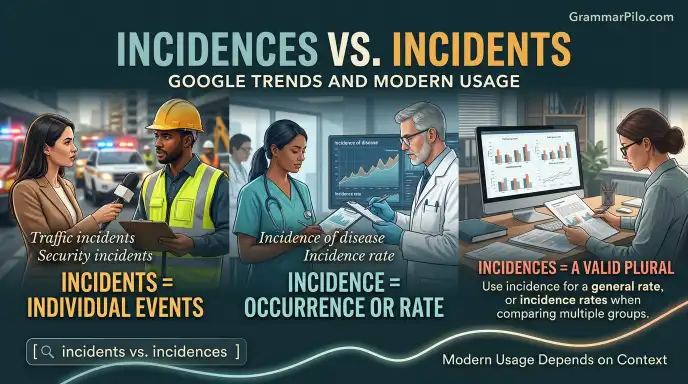
Both words appear in contemporary English, but their common contexts differ.
Incidents is widely used in everyday, professional, and news writing. It commonly appears in phrases such as “security incidents,” “traffic incidents,” “workplace incidents,” and “incidents reported.”
Incidence is more specialized and is frequently used in research, medicine, statistics, and public health. Common expressions include “incidence rate,” “incidence of disease,” and “incidence of injury.”
The plural incidences is valid, but it is less commonly needed in many ordinary sentences. Writers often use incidence for a general rate or incidence rates when comparing multiple groups.
Easy Tricks to Remember Incidents and Incidences
These simple memory aids can help you choose the right word.
Trick 1: Incidents Are Individual Events
Think of incidents as things that happened and can be listed separately.
Examples:
- Three traffic incidents.
- Two workplace incidents.
- Several security incidents.
Trick 2: Incidence Is About Occurrence
Think of incidence as how often something happens or the rate at which it occurs.
Examples:
- The incidence of infection.
- The incidence of workplace injuries.
- A lower incidence of errors.
Trick 3: Start With the Singular Word
Ask yourself if the singular form should be incident or incidence.
- One event is an incident; several are incidents.
- A measure of occurrence is an incidence; several distinct occurrences or measures may be incidences.
Trick 4: Choose Precision Over Complexity
Do not choose incidences simply because it sounds more scientific. In many technical sentences, the singular incidence or the phrase incidence rate is more precise.
Frequently Asked Questions
1. What is the difference between incidents and incidences?
Incidents refers to individual events, often unusual or significant. Incidences is the plural of incidence and generally refers to occurrences or multiple measures of occurrence, especially in technical contexts.
2. Is incidences a real word?
Yes. Incidences is the correct plural form of incidence. It is appropriate when referring to multiple distinct occurrences or measures, although the singular incidence is more common in many technical expressions.
3. Should I write incidences or incidents in a report?
Use incidents when reporting separate events, such as accidents, complaints, or safety problems.
Use incidence when discussing how frequently something occurs, and use incidences only when a plural form is appropriate to the intended meaning.
4. What is the plural of incident?
The plural of incident is incidents.
Example: The supervisor documented three incidents during the shift.
5. What is the plural of incidence?
The plural of incidence is incidences.
Example: The researchers compared incidences across several defined categories.
6. Is it incidence of disease or incidents of disease?
When discussing how frequently a disease occurs in a population, incidence of disease is generally the appropriate expression. Use incidents only if you are referring to individual events described as incidents.
7. Are incidents and incidences interchangeable?
No. Although their meanings are related, incidents usually refers to individual events, while incidence concerns occurrence or frequency. The correct choice depends on the context.
8. Is incidents or incidences correct in British English?
Both words are correct in British English and American English. Their basic meanings and spellings are the same in both varieties.
9. Is incidence the same as prevalence?
No. In epidemiology, incidence generally concerns new cases arising over a specified period, while prevalence concerns the total number or proportion of people who have a condition at a particular time or over a defined period. The precise measure depends on the study.
10. How can I remember incidents vs. incidences?
Remember that incidents are individual events, while incidence describes occurrence or frequency. When discussing one overall rate, the singular incidence is often the clearest choice.
Conclusion
The difference between incidences and incidents comes down to what you want to describe. Incidents is the plural of incident and refers to individual events, such as accidents, complaints, disruptions, or safety problems.
Incidences is the plural of incidence and can refer to multiple distinct occurrences or measures of occurrence, particularly in research and technical writing.
For example, a school might record several incidents of bullying, while a research report might examine the incidence of bullying across a population. The first expression focuses on separate events; the second focuses on how frequently the problem occurs.
Both words are correct in American and British English, so regional spelling does not determine the choice. The most important factor is accuracy. In many scientific and medical contexts, the singular incidence or the phrase incidence rate is more natural than incidences.
The easiest rule to remember is this: use incidents for individual events and incidence for occurrence or frequency. Use incidences when you genuinely need the plural of incidence, and your writing will be clearer, more precise, and more professional.
Explore More Related Articles

I’m Claire Morgan, the author behind Grammarpilo.com, where I write about English grammar, sentence structure, punctuation, and everyday language. My goal is to make grammar simple, clear, and practical, helping readers understand the rules and apply them with confidence in real-world writing.








4 thoughts on “Incidents or Incidences: The Meaning Difference Most Writers Miss”