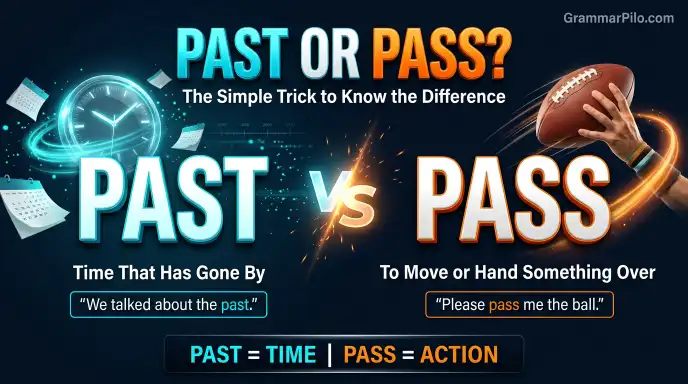
Past and pass are both correct English words, but they have different meanings and grammatical uses. Past can refer to an earlier time, something that has already happened, or a position beyond a particular point.
Pass can mean to move past something, succeed in a test, hand something to another person, or allow time to go by.
For example, you might walk past a store on your way home, but you pass the store while describing the action of moving beyond it. You can also talk about the past when discussing history or pass an exam when you achieve the required result.
The confusion between past and pass often happens because they sound similar in everyday speech. However, their meanings, spellings, and grammatical roles are different. Choosing the wrong word can make a sentence confusing or change its intended meaning.
In this GrammarPilo guide, you will learn the difference between past and pass, discover how each word works in sentences, explore common mistakes, and practice with examples from everyday conversation, school, work, and formal writing.
Quick Answer: Past vs. Pass
Past usually refers to an earlier time or a position beyond something. It can function as a noun, adjective, adverb, or preposition.
Pass is commonly used as a verb meaning to move beyond something, succeed in an examination, hand something over, or allow something to go by. It can also function as a noun.
| Word | Main meaning | Example |
| Past | An earlier time or beyond a point | We walked past the library. |
| Pass | To move, succeed, or hand something over | I hope I pass the exam. |
Easy memory trick: The past is behind you in time, while you pass something when you move beyond it.
What Does Past Mean?
The word past refers to a time before the present or a position beyond a particular point. Depending on how it is used, it can function as a noun, adjective, adverb, or preposition.
Past as a Noun
As a noun, past refers to a time that has already happened.
Examples:
- We should learn from the past.
- Her past was very different from her present life.
- The town has a fascinating past.
In these sentences, past refers to earlier experiences, events, or history.
Past as an Adjective
As an adjective, past describes something that happened previously or belongs to an earlier period.
Examples:
- We discussed our past experiences.
- The past president attended the ceremony.
- She has learned from past mistakes.
Here, past modifies a noun by indicating that something belongs to an earlier time.
Past as a Preposition
As a preposition, past can indicate movement beyond a person, place, or point.
Examples:
- She walked past the school.
- The bus drove past our house.
- We ran past the finish line.
In these examples, past describes a position or movement beyond a particular point.
Past as an Adverb
As an adverb, past can describe movement beyond a location or point.
Examples:
- The car went past.
- I watched the train go past.
- She walked straight past without noticing me.
The exact grammatical role depends on how the word functions within the sentence.
What Does Pass Mean?
It is most commonly a verb. It can describe movement, success, the transfer of something, or the progression of time. And it also has several meanings as a noun.
Pass as a Verb
The verb pass has many common uses.
1. To move beyond something
- The runner passed the other competitors.
- We passed several shops on the way home.
- A car passed us on the highway.
2. To succeed in a test or examination
- I studied hard to pass the exam.
- She passed her driving test.
3. To hand something to another person
- Please pass me the salt.
- She passed the ball to her teammate.
4. To allow time to go by
- The hours passed quickly.
- Several weeks passed before we received a reply.
- Time passes faster when you are enjoying yourself.
5. To approve or formally adopt something
- The legislature passed a new law.
- The committee passed the proposal.
Pass as a Noun
The word pass can also refer to permission, a ticket, a successful result, or a route through mountains.
Examples:
- She received a visitor’s pass.
- He earned a passing grade on the test.
- We bought a season pass for the park.
Its meaning depends on the context.
The Main Difference Between Past and Pass
The most important distinction is that past often refers to time or position, while pass usually describes an action or a result.
| Feature | Past | Pass |
| Main role | Noun, adjective, adverb, preposition | Primarily a verb; also a noun |
| Refers to earlier time | Yes | Not usually by itself |
| Describes movement beyond something | Yes, as a preposition or adverb | Yes, as a verb |
| Means to succeed in an exam | No | Yes |
| Means to hand something over | No | Yes |
| Example | We drove past the station. | We passed the station. |
| Time related example | Think about the past. | Time passes quickly. |
Compare Past and Pass in Similar Sentences
Past the school: We walked past the school.
This describes the school’s position relative to our movement.
Passed the school: We passed the school.
This describes the action of moving beyond the school.
Both sentences are correct, and their meanings are very similar. The grammatical difference is that past functions as a preposition in the first sentence, while passed is the past tense verb in the second.
Past your bedtime: It is past your bedtime.
This means the time is later than your bedtime.
Pass your bedtime: This is not the normal expression for saying that it is too late to go to bed. You would usually say, “It is past your bedtime.”
Pass the exam: She hopes to pass the exam.
This means she hopes to succeed.
Past the exam: The phrase may refer to a location or a point beyond the exam in a particular context, but it does not mean succeeding in an examination.
An Important Difference
Another common source of confusion is the difference between past and passed. Although they look and sound similar, they serve different grammatical purposes.
Passed is the past tense and past participle of the verb pass. Past is not the past tense of pass.
| Word | Use | Example |
| Past | Earlier time or beyond a point | We walked past the museum. |
| Pass | Present tense verb or base form | I want to pass the test. |
| Passed | Past tense or past participle form of pass | She passed the test yesterday. |
Compare these examples:
- Correct: He passed the ball to his friend.
- Correct: He walked past his friend.
- Incorrect: He past the ball to his friend.
- Incorrect: He walked passed his friend.
The last sentence is incorrect if the intended meaning is simply walking beyond the friend. In that construction, use past.
However, passed is correct when it is the verb describing the action.
Remember: If the sentence needs a verb meaning “moved,” “succeeded,” or “handed over,” pass or passed may be appropriate. If it means “beyond” or “an earlier time,” past is usually the correct choice.
Is Pass or Past Correct in American and British English?
Both past and pass are standard words in American English, British English, Australian English, and other varieties of English. Their spellings and basic meanings remain the same.
| English variety | Correct word for an earlier time | Correct verb for succeeding |
| American English | Past | Pass |
| British English | Past | Pass |
| Australian English | Past | Pass |
| Canadian English | Past | Pass |
| International English | Past | Pass |
There is no regional spelling difference between these words.
For example, both American and British writers use “the past decade” to refer to an earlier period and “pass the examination” to describe succeeding in an exam.
The correct choice depends on grammar and meaning, not location.
Common Mistakes
Because these words sound similar, it is easy to confuse them when writing quickly. The following mistakes show how to choose the correct word.
Mistake 1: Using Past Instead of Pass for an Exam
Incorrect: I hope I past my driving test.
Correct: I hope I pass my driving test.
Pass is the verb meaning to succeed in a test. Past cannot replace it.
Mistake 2: Using Passed Instead of Past for Movement
Incorrect: We walked passed the restaurant.
Correct: We walked past the restaurant.
Past is used here as a preposition meaning beyond the restaurant.
Mistake 3: Using Pass Instead of Past for Time
Incorrect: It is pass midnight.
Correct: It is past midnight.
Past means that the current time is later than midnight.
Mistake 4: Confusing Past With Passed
Incorrect: Many years past before they met again.
Correct: Many years passed before they met again.
Passed is the verb describing time going by.
Another correct sentence is “Many years in the past, they lived together,” where past refers to an earlier period.
Mistake 5: Using Past as a Verb
Incorrect: She past the ball to her teammate.
Correct: She passed the ball to her teammate.
The action of transferring the ball requires the verb passed.
Mistake 6: Assuming Past and Pass Are Interchangeable
Incorrect: Please past me the notebook.
Correct: Please pass me the notebook.
Pass means to hand something to someone. Past cannot perform that grammatical role.
Past and Pass in Everyday Examples
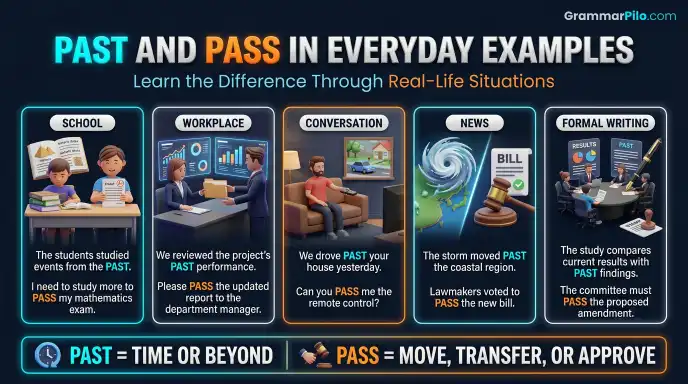
The following examples show how these words are used in school, work, conversation, and other everyday situations.
In School
Past: The students studied events from the past.
Pass: I need to study more to pass my mathematics exam.
Past: We walked past the science laboratory.
Pass: The teacher asked me to pass the worksheets to the class.
In Emails and Workplace Communication
Past: We reviewed the project’s past performance.
Pass: Please pass the updated report to the department manager.
Past: The deadline is already past.
Pass: The board voted to pass the proposal.
In Everyday Conversation
Past: We drove past your house yesterday.
Pass: Can you pass me the remote control?
Past: It is past my bedtime.
Pass: I hope the traffic will pass soon.
In the last example, pass means to go away or subside.
In News and Media
Past: The report examines the country’s economic past.
Pass: Lawmakers voted to pass the new bill.
Past: The storm moved past the coastal region.
Pass: The candidate must pass a background check before starting work.
In Formal Writing
Past: The study compares current results with past findings.
Pass: The committee must pass the proposed amendment before it takes effect.
Past: The building stands just past the main entrance.
Pass: The organization requires applicants to pass a screening process.
Pass vs. Past: A Quick Comparison Table
Use this table when you need to select the right word quickly.
| Intended meaning | Correct word | Example |
| An earlier time | Past | We learned from the past. |
| Beyond a location | Past | She walked past the gate. |
| Later than a particular time | Past | It is past noon. |
| Succeed in a test | Pass | He hopes to pass the exam. |
| Hand something over | Pass | Please pass the paper. |
| Move beyond something | Pass | Cars pass this road every minute. |
| Time goes by | Pass | The days pass quickly. |
| An action completed earlier | Passed | She passed her test yesterday. |
Google Trends and Modern Usage
Both words are widely used in contemporary English, but they appear in different grammatical contexts.
Past frequently appears in discussions about history, previous experiences, deadlines, time, and movement beyond a location. Common expressions include “in the past,” “past mistakes,” “past midnight,” and “walk past.”
Pass appears in discussions about examinations, transportation, sports, permission, legislation, and the movement of time. Common expressions include “pass an exam,” “pass the ball,” and “time passes.”
The form passed is especially important because it is the simple past tense of the verb pass. Writers should not substitute past for passed when a sentence needs that verb.
Easy Tricks to Remember
If you frequently mix up pass and past, these simple memory aids can help.
Trick 1: Past Means Before or Beyond
Think about history, previous experiences, or a point you have moved beyond.
Examples:
- The past year was challenging.
- We walked past the library.
Trick 2: Pass Means Do Something
Think of pass as an action.
Examples:
- Pass the salt.
- Pass the exam.
Trick 3: Use Passed for Completed Actions
If you are describing an action that happened earlier, passed is often the correct form.
Examples:
- She passed the exam last week.
- The car passed our house.
- Three hours passed before the meeting began.
Trick 4: Try Replacing the Word
If you can replace the word with “beyond” or “earlier time,” use past.
If you can replace it with “succeed,” “hand over,” or “move by,” use pass or passed, depending on the tense and sentence structure.
Frequently Asked Questions
1. What is the difference between past and pass?
Past refers to an earlier time or a position beyond something. Pass is a verb that can mean to move beyond, succeed in an exam, hand something over, or allow time to go by.
2. Is it past or pass an exam?
The correct expression is pass an exam. Use passed when referring to a completed result, as in “She passed the exam yesterday.”
3. Is it walk past or walk passed?
The correct expression is walk past when past means beyond a place or person. For example, “We walked past the store.”
4. Is it past midnight or pass midnight?
The normal expression is past midnight, meaning later than midnight. For example, “It is already past midnight.”
5. What is the difference between past and passed?
Past refers to an earlier time or a position beyond something. Passed is the past tense and past participle of pass. For example, “We walked past the shop” and “We passed the shop” are both correct.
6. Is pass a noun or a verb?
Pass can be both. As a verb, it can mean to succeed in an exam or hand something over. As a noun, it can mean a permit, ticket, or successful result.
7. Can past be used as a preposition?
Yes. In “She walked past the house,” past is a preposition indicating movement beyond the house.
8. Is past or pass correct in British English?
Both words are correct in British English, with the same basic meanings and spellings used in American English.
9. How do you use pass in a sentence?
Examples include “Please pass the salt,” “I hope to pass the test,” and “The hours pass quickly.”
10. How can I remember pass vs. past?
Remember that the past refers to an earlier time or something beyond a point, while pass describes an action such as succeeding, handing something over, or moving by.
Conclusion
The difference between past and pass becomes much easier once you understand how each word works in a sentence. Past usually refers to an earlier time, a previous experience, or a position beyond a particular point.
Pass is generally a verb that describes an action, such as moving beyond something, succeeding in an examination, handing an object to another person, or allowing time to go by.
For example, you walk past a store, pass an exam, and reflect on the past when thinking about earlier experiences. When describing an action that has already happened, you may need passed, as in “She passed the test.”
Both words are correct in American and British English, so the choice is based on meaning and grammar rather than regional spelling.
The easiest rule to remember is this: past means before or beyond, while pass means to do something. If you keep this distinction in mind and pay attention to the sentence structure, you can avoid common mistakes in school assignments, professional emails, and everyday conversations.
Explore More Articles

I’m Claire Morgan, the author behind Grammarpilo.com, where I write about English grammar, sentence structure, punctuation, and everyday language. My goal is to make grammar simple, clear, and practical, helping readers understand the rules and apply them with confidence in real-world writing.








1 thought on “Past or Pass: The Simple Trick That Makes the Difference Clear”