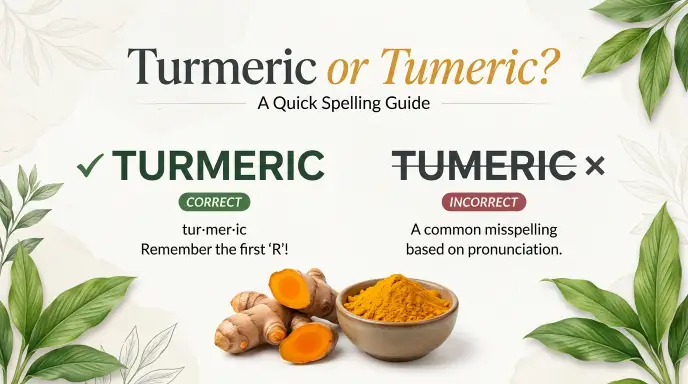
Turmeric is the correct spelling, while tumeric is a common misspelling. The word turmeric refers to a bright yellow orange spice made from the underground stem of the Curcuma longa plant.
You may see or hear tumeric because the first r in turmeric can be easy to miss when people pronounce the word.
The confusion is understandable. Unlike many English words, turmeric does not look exactly like it sounds.
When people say it quickly, the middle sound can become less noticeable, which can lead writers to spell it as tumeric.
If you searched for turmeric or tumeric, tumeric or turmeric, or Tumeric vs. turmeric, the answer is simple: use turmeric in standard English writing.
This guide explains the meaning, spelling, pronunciation, origin, common mistakes, and everyday uses of the word so you can confidently use it in recipes, health writing, shopping lists, menus, emails, and other forms of communication.
Turmeric or Tumeric: Quick Answer
Turmeric is the correct standard spelling. Tumeric is a common misspelling and should generally be avoided in formal and edited writing.
| Spelling | Status | Meaning |
| Turmeric | Correct | A yellow orange spice from the Curcuma longa plant |
| Tumeric | Incorrect spelling | Usually intended to mean turmeric |
The key point is easy to remember:
Correct: turmeric
Incorrect: tumeric
What Does Turmeric Mean?
Turmeric is a spice made from the rhizome of the Curcuma longa plant.
It belongs to the ginger family and is widely used in cooking, especially in South Asian, Southeast Asian, Middle Eastern, and other cuisines.
Turmeric has a strong yellow orange color. Ground turmeric is commonly used to add color, flavor, and earthy notes to dishes such as curries, rice dishes, soups, sauces, and spice blends.
The word can also refer to the plant itself or its dried root like rhizome.
Turmeric in a Sentence
Here are some natural examples:
- I added turmeric to the curry.
- This recipe calls for one teaspoon of turmeric.
- Turmeric gives the rice a bright yellow color.
- She bought fresh turmeric at the market.
- The recipe uses ginger, garlic, cumin, and turmeric.
In each example, turmeric is the standard spelling.
Why Do People Write Tumeric?
The spelling tumeric is common because the word can be difficult to hear clearly.
The standard spelling contains the sequence -rme-:
turmeric
Many people pronounce the word in a way that makes the middle r less noticeable. As a result, they may naturally write what they think they hear:
tumeric
This is similar to other English spelling mistakes where pronunciation does not clearly reveal every letter.
Another reason is familiarity. People often encounter the word in conversation before they see it written. If someone learns the word mainly through speech, tumeric can seem like a reasonable spelling.
However, standard dictionaries and edited English use turmeric.
The Origin of Turmeric
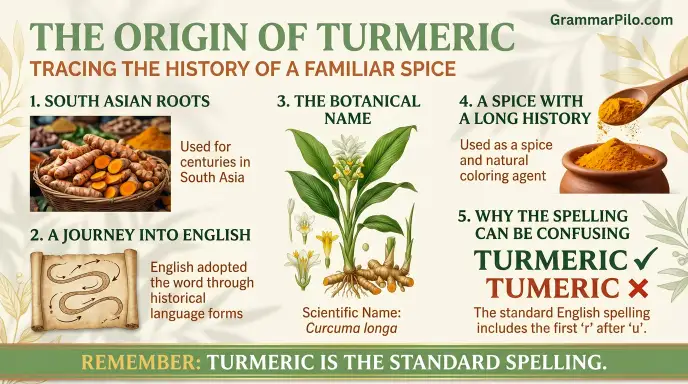
The word turmeric has a long history connected to South Asia and other regions where the plant has been cultivated and used for centuries.
English adopted the word through historical forms connected with Latin and Old French, ultimately tracing back to words associated with the plant in South Asian languages.
The scientific name of the plant is Curcuma longa.
Turmeric has been used as a culinary spice and coloring agent for a very long time. Its distinctive yellow-orange color has also made it important in traditional food preparation and cultural practices.
The history of the word helps explain why its spelling is not always obvious to modern English speakers. It is not a simple English word created from the way the spice looks or sounds.
British English vs. American English: Tumeric andTurmeric
There is no standard British American spelling difference between turmeric and tumeric.
Both American English and British English use:
turmeric
The misspelling tumeric is not an accepted alternative spelling simply because of regional English differences.
| Variety of English | Correct Spelling | Common Misspelling |
| American English | turmeric | tumeric |
| British English | turmeric | tumeric |
| Canadian English | turmeric | tumeric |
| Australian English | turmeric | tumeric |
| International English | turmeric | tumeric |
So, unlike words such as color/colour or center/centre, there is no standard regional choice between turmeric and tumeric.
Which Spelling Should You Use?
Use turmeric whenever you are writing the name of the spice or plant.
This applies to:
- School assignments
- Recipes
- Cookbooks
- Food blogs
- Restaurant menus
- Product descriptions
- Grocery lists
- Emails
- Articles
- Academic writing
- Business documents
- Social media posts
- Health and nutrition content
If you are writing for an American audience, use turmeric.
If you are writing for a British or international audience, use turmeric as well.
The important thing is to remember the r after the tu:
tur + mer + ic = turmeric
A useful memory trick is to think:
Turmeric has an R.
Common Mistakes With Tumeric and Turmeric
Mistake 1: Writing Tumeric
The most common error is simply leaving out the first r.
Incorrect: I added tumeric to the soup.
Correct: I added turmeric to the soup.
The missing r changes the spelling from the standard form to a misspelling.
Mistake 2: Assuming Tumeric Is a British Spelling
Some writers think tumeric might be the British version of turmeric.
It is not.
British English uses turmeric, just like American English.
Mistake 3: Trusting Pronunciation Alone
English spelling does not always match pronunciation perfectly.
If you hear someone say turmeric, the middle r may not sound strongly pronounced. That can make tumeric seem logical.
When writing, rely on the established spelling:
turmeric
Mistake 4: Confusing Turmeric With Ginger
Turmeric and ginger belong to the same plant family, but they are different plants.
Turmeric is associated with its strong yellow orange color, while ginger has a pale yellow interior and a different flavor profile.
Mistake 5: Using Tumeric in Formal Writing
A casual reader may understand tumeric, but that does not make it the preferred spelling.
For polished writing, always use turmeric.
Turmeric and Tumeric in Everyday Examples

The easiest way to remember the correct spelling is to see turmeric used in different situations.
Recipes
Add half a teaspoon of turmeric to the sauce.
The recipe combines turmeric with cumin and coriander.
Recipes frequently use the word when listing ingredients or describing cooking steps.
Emails
Could you please add turmeric to the grocery list?
I found a recipe that uses turmeric, ginger, and garlic.
In everyday emails, the standard spelling keeps your writing clear and polished.
Business Writing
The company sells organic turmeric powder.
The product contains turmeric extract as one of its ingredients.
Product descriptions should use the established spelling turmeric.
News and Articles
Turmeric is widely used as a culinary spice.
The article discusses the history and culinary uses of turmeric.
Social Media
Tonight’s curry gets its color from turmeric.
Fresh turmeric can add a bright color and earthy flavor to recipes.
Formal Writing
The study examined compounds found in turmeric.
Turmeric has been used as a food ingredient for centuries.
In every context, the spelling remains the same.
Turmeric vs. Tumeric: Quick Comparison Table
| Feature | Turmeric | Tumeric |
| Correct spelling | Yes | No |
| Standard dictionaries | Yes | Generally listed as a misspelling/variant reference |
| Refers to the spice | Yes | Intended meaning, but misspelled |
| Used in American English | Yes | No |
| Used in British English | Yes | No |
| Recommended for formal writing | Yes | No |
| Common online misspelling | Less common | Yes |
The difference is not one of meaning. It is primarily a spelling issue.
Turmeric or Tumeric: Google Trends & Modern Usage
Search behavior shows why this spelling question comes up so often. Turmeric is a widely used food and cooking term, while tumeric frequently appears as a spelling mistake because people omit the r when writing the word from memory.
The correct form is especially important in recipes, product pages, food articles, menus, and educational content.
Because search engines can often understand spelling mistakes and connect them with the intended word, someone searching for tumeric may still find information about turmeric. However, search recognition does not make tumeric the correct spelling.
For professional writing, the safest choice remains:
Turmeric
How to Remember the Spelling of Turmeric
If you regularly forget if the word contains an r, use this simple memory trick:
TURMERIC has R.
Break it into smaller parts:
TUR + MER + IC
Then compare:
TURMERIC ✓
TUMERIC ✗
You can also connect the word with Curcuma, the plant genus associated with turmeric. Seeing the correct spelling repeatedly in recipes and food writing will also make it easier to remember.
Turmeric and Its Pronunciation
Pronunciation can contribute to the spelling confusion.
Depending on accent and speech style, turmeric may be pronounced with the middle sounds reduced or less noticeable. This can make the written form seem longer than the spoken form.
That does not mean the r should be removed.
When you are unsure, remember:
The spelling is turmeric, even if the middle sound is not strongly heard.
This is an important English spelling lesson. Written English often preserves letters that are not especially prominent in everyday pronunciation.
Key Takeaways
- Turmeric is the correct spelling.
- Tumeric is a common misspelling.
- Turmeric is a spice made from the rhizome of Curcuma longa.
- American and British English both use turmeric.
- The spelling does not change based on region.
- The missing r is the main difference between the correct spelling and the common misspelling.
- Use turmeric in recipes, emails, schoolwork, articles, product descriptions, and formal writing.
- Remember the spelling as TUR + MER + IC.
Frequently Asked Questions
1. Is turmeric or tumeric correct?
Turmeric is correct. Tumeric is a common misspelling that leaves out the first r in the word. Use turmeric in standard English writing.
2. Is tumeric an acceptable spelling?
Tumeric is not the standard spelling of the spice. It is commonly used as a misspelling of turmeric. For formal, academic, professional, and edited writing, use turmeric.
3. Why do people spell turmeric as tumeric?
People often write tumeric because the middle r can be difficult to hear in natural pronunciation. When a word is learned mainly through speech, writers may spell it according to how it sounds.
4. Is turmeric spelled differently in British English?
No. Turmeric is the standard spelling in both British and American English. There is no standard British spelling tumeric.
5. How do you spell turmeric correctly?
The correct spelling is T-U-R-M-E-R-I-C.
A simple way to remember it is:
TUR + MER + IC = TURMERIC
6. What does turmeric mean?
Turmeric is a spice made from the rhizome of the Curcuma longa plant. It is known for its strong yellow orange color and is commonly used in cooking.
7. Is tumeric a different spice from turmeric?
No. In most cases, tumeric is simply a misspelling of turmeric, not the name of a separate spice.
8. Should I use turmeric in a formal document?
Yes. Turmeric is the correct form for formal documents, academic work, business writing, recipes, product descriptions, and other polished content.
9. Is turmeric a noun?
Yes. Turmeric is primarily used as a noun when referring to the spice or the plant. For example, “The recipe uses turmeric.”
10. What is the easiest way to remember turmeric spelling?
Remember that turmeric contains an R after tu:
TURMERIC ✓
TUMERIC ✗
That small memory trick can help you avoid the most common spelling mistake.
Conclusion
Turmeric is the correct spelling, while tumeric is a common misspelling. Although the two forms may appear in online searches, recipes, social media posts, and informal writing, they are not equal standard spellings.
The confusion usually comes from pronunciation. The middle r in turmeric may not be easy to hear, so some people naturally write tumeric. However, the standard spelling remains turmeric in both American and British English.
If you are writing a recipe, school assignment, food article, product description, email, or professional document, choose turmeric. You do not need a different spelling for American or British readers.
The easiest way to remember the word is TUR + MER + IC. Once you remember that turmeric has an R, the turmeric or tumeric question becomes much easier to answer.
Explore Here!

I’m Claire Morgan, the author behind Grammarpilo.com, where I write about English grammar, sentence structure, punctuation, and everyday language. My goal is to make grammar simple, clear, and practical, helping readers understand the rules and apply them with confidence in real-world writing.