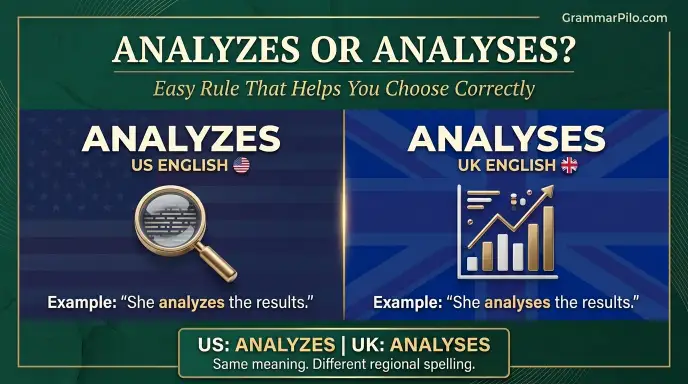
Analyzes and analyses are both correct English spellings, but their use depends on the sentence and the variety of English you are writing.
In American English, analyzes is the present tense verb form, while analyses is the plural of the noun analysis. In British English, analyses can be both a plural noun and a verb form.
This difference often confuses students, writers, editors, and people learning English. The words look almost identical, and both are linked to the word analysis.
However, choosing the right form is not only about spelling. You must also identify the part of speech and consider your audience.
For example, an American writer would normally write, “She analyzes the results.” A British writer would write, “She analyses the results.” Both sentences are correct in their respective varieties of English.
However, both American and British writers can use analyses as a plural noun. For example, “The two analyses produced similar results.”
In this guide, you will learn the difference between analyzes and analyses, understand American and British usage, explore common mistakes, and see practical examples from school, business, science, and everyday writing.
Analyzes or Analyses: Quick Answer
Use analyzes as a verb in American English, and use analyses as a verb in British English. Use analyses as the plural noun of analysis in both varieties.
Here is the quick comparison:
| Word | Part of speech | Usage | Example |
| Analyze | Verb | American English | I analyze the data. |
| Analyzes | Verb | American English | She analyzes the data. |
| Analyse | Verb | British English | I analyse the data. |
| Analyses | Verb | British English | She analyses the data. |
| Analysis | Noun, singular | American and British English | Her analysis is clear. |
| Analyses | Noun, plural | American and British English | Her analyses are clear. |
The easiest rule to remember
American English uses analyze and analyzes as verbs. British English uses analyse and analyses as verbs. Both use analysis for the singular noun and analyses for the plural noun.
Examples:
- American English: The teacher analyzes the results.
- British English: The teacher analyses the results.
- Both varieties: The teacher completed two analyses.
The sentence’s meaning and the variety of English determine which form you should use.
Definition and Meaning of Analyzes or Analyses
What Does Analyzes Mean?
Analyzes is the third person singular present tense form of the verb analyze in American English.
To analyze something means to examine it carefully, study its parts, or investigate information to understand it better.
Examples:
- She analyzes customer feedback.
- The scientist analyzes the samples.
- He analyzes every detail before making a decision.
- The software analyzes large amounts of data.
In these examples, analyzes describes an action performed by a person, group, or system.
The word is commonly used in science, education, business, technology, literature, and research.
American English verb forms:
- I analyze.
- You analyze.
- He analyzes.
- She analyzes.
- They analyze.
Notice that the verb takes -s when the subject is he, she, or it in the simple present tense.
What Does Analyses Mean?
Analyses has two main grammatical uses.
1. Analyses as a Plural Noun
In both American and British English, analyses is the plural form of analysis.
An analysis is a detailed examination of something. Two or more examinations are called analyses.
Examples:
- The researchers published three analyses.
- The financial analyses revealed several risks.
- Both analyses reached similar conclusions.
- We compared the results of the two analyses.
Here, analyses refers to multiple examinations or studies.
A useful spelling pattern is:
One analysis, two analyses.
2. Analyses as a Verb in British English
In British English, analyses is also the third person singular present tense form of analyse.
Examples:
- She analyses the evidence.
- The researcher analyses the results.
- He analyses the poem in class.
- The program analyses the information.
These sentences are correct in British English.
In standard American English, the same verb form is usually spelled analyzes.
Why Are These Words Confusing?
The main reason is that analyses can be a noun or a verb.
Compare these sentences:
Noun: The two analyses were accurate.
Verb in British English: She analyses the results.
Verb in American English: She analyzes the results.
The spelling alone does not tell you the full meaning. You must examine how the word works in the sentence.
The Origin of Analyses and Analyzes
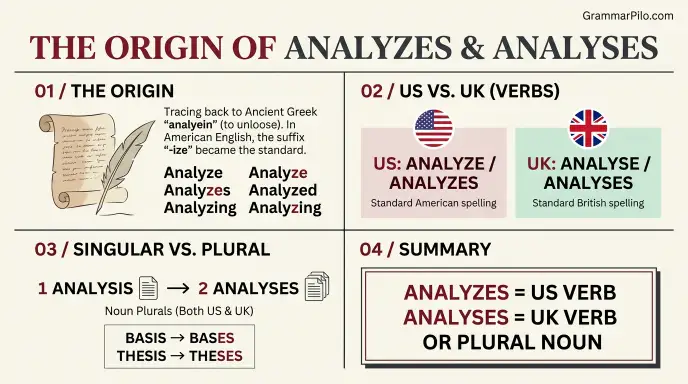
The Origin of Analyze
The word analyze comes through French from Greek roots associated with breaking something apart or loosening it into its parts. It developed into a word for examining something carefully to understand its structure, meaning, or operation.
American English generally uses the spelling analyze, with a z.
The verb has several related forms:
- Analyze
- Analyzes
- Analyzed
- Analyzing
Examples:
- I analyze the evidence.
- She analyzes the evidence.
- She analyzed the evidence yesterday.
- She is analyzing the evidence now.
These forms follow standard American English spelling.
The Origin of Analyse
Analyse is the British English spelling of the same verb.
British English commonly uses -ise in words where American English often uses -ize. This difference appears in several familiar word pairs.
| American English | British English |
| Analyze | Analyse |
| Organize | Organise |
| Realize | Realise |
| Recognize | Recognise |
British English also accepts some -ize spellings, particularly in styles that follow Oxford spelling conventions. However, analyse is the usual British form.
The British verb forms are:
- Analyse
- Analyses
- Analysed
- Analysing
Examples:
- I analyse the evidence.
- She analyses the evidence.
- She analysed the evidence yesterday.
- She is analysing the evidence now.
Why Does the Plural Noun Look Different?
The noun analysis comes from a different grammatical pattern. Its plural is not formed by simply adding -s.
Instead:
Singular: analysis
Plural: analyses
This pattern is similar to other English nouns borrowed from Greek.
For example:
- One basis, two bases.
- One crisis, two crises.
- One thesis, two theses.
- One analysis, two analyses.
Learning these patterns can help you avoid common spelling mistakes.
British English vs American English Spelling
The main difference between analyzes and analyses is the verb spelling used in American and British English.
| Sentence purpose | American English | British English |
| Base verb | Analyze | Analyse |
| Present tense with he, she, or it | Analyzes | Analyses |
| Past tense | Analyzed | Analysed |
| Present participle | Analyzing | Analysing |
| Singular noun | Analysis | Analysis |
| Plural noun | Analyses | Analyses |
American English Examples
American English uses analyzes as the third person singular verb form.
- The doctor analyzes the test results.
- She analyzes the company’s performance.
- The student analyzes the poem.
- The computer analyzes the information.
In standard American English, analyzes is the preferred spelling.
British English Examples
British English generally uses analyses as the third person singular verb form.
- The doctor analyses the test results.
- She analyses the company’s performance.
- The student analyses the poem.
- The computer analyses the information.
In standard British English, analyses is the preferred spelling.
What About International English?
International audiences may encounter both spellings in books, websites, reports, and academic papers.
Neither form is universally correct for every audience. The important point is to follow one spelling system consistently.
If you are writing for an American audience, use analyze and analyzes. If you are writing for a British audience, use analyse and analyses for the verb.
The plural noun analyses remains the same in both varieties.
Which Spelling Should You Use?
The right spelling depends on your audience and the grammatical role of the word.
Use Analyzes for American English Verbs
Choose analyzes when describing an action performed by one person, organization, or thing in American English.
Examples:
- She analyzes the survey responses.
- The company analyzes market trends.
- He analyzes the problem carefully.
- The application analyzes user behavior.
Use Analyses for British English Verbs
Choose analyses when writing in standard British English and describing an action.
Examples:
- She analyses the survey responses.
- The company analyses market trends.
- He analyses the problem carefully.
- The application analyses user behaviour.
The last example also uses the British spelling behaviour.
Use Analyses for Plural Nouns
In both American and British English, use analyses when talking about more than one analysis.
Examples:
- The two analyses support the conclusion.
- Several analyses were included in the report.
- The financial analyses identified possible risks.
A Simple Test
Ask yourself two questions:
Question 1: Is the word a verb or a noun?
If it means examining something, it is a verb. If it refers to one or more detailed examinations, it is a noun.
Question 2: Which variety of English am I using?
If you are using American English, write analyzes as a verb.
If you are using British English, write analyses as a verb.
And, if the word is a plural noun, use analyses in either variety.
Common Mistakes With Analyzes or Analyses
Mistake 1: Using Analyses as an American English Verb
Incorrect in standard American English: She analyses the data.
Correct: She analyzes the data.
The British spelling is analyses, but the standard American spelling is analyzes.
Mistake 2: Using Analyzes as a British English Verb
Incorrect in standard British English: The researcher analyzes the evidence.
Correct: The researcher analyses the evidence.
When following British spelling, use analyse and analyses.
Mistake 3: Writing Analysises
Incorrect: The report contains three analysises.
Correct: The report contains three analyses.
The plural of analysis is analyses, not analysises.
Mistake 4: Confusing Analysis With Analyses
Incorrect: The two analysis were different.
Correct: The two analyses were different.
Use analysis for one examination and analyses for two or more.
Mistake 5: Forgetting Subject Verb Agreement
Incorrect: She analyze the results.
Correct in American English: She analyzes the results.
Correct in British English: She analyses the results.
In the simple present tense, a singular third person subject such as he, she, or it normally takes the appropriate verb form ending in -s.
Mistake 6: Mixing American and British Spellings
A document may look inconsistent if it uses analyzes, organise, analyzed, and analysing without a clear style reason.
For a consistent American style, use:
- Analyze
- Analyzes
- Analyzed
- Analyzing
For a consistent British style, use:
- Analyse
- Analyses
- Analysed
- Analysing
Consistency makes writing easier to read and edit.
Analyzes and Analyses in Everyday Examples
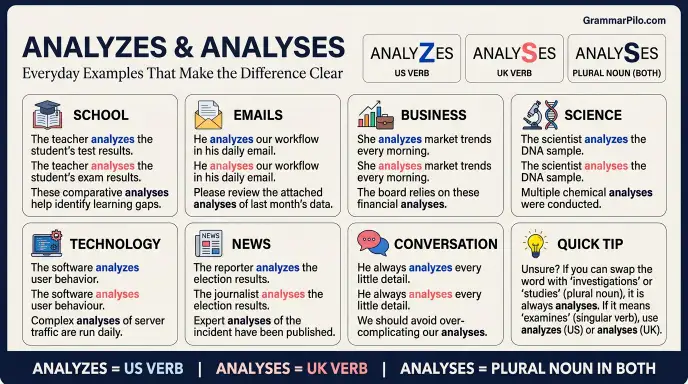
The following examples show how both forms work in different situations.
In School
American English: The student analyzes the poem before writing an essay.
British English: The student analyses the poem before writing an essay.
Plural noun: The teacher compares two literary analyses.
In Emails
American English: Our team analyzes the feedback every Friday.
British English: Our team analyses the feedback every Friday.
Plural noun: Please review the two analyses attached to this email.
In Business
American English: The company analyzes its sales figures each month.
British English: The company analyses its sales figures each month.
Plural noun: The financial analyses helped the managers compare the options.
In Science
American English: The laboratory analyzes each sample carefully.
British English: The laboratory analyses each sample carefully.
Plural noun: The scientists published several analyses of the collected samples.
In Technology
American English: The software analyzes website traffic.
British English: The software analyses website traffic.
Plural noun: The report includes three separate data analyses.
In News and Research
American English: The journalist analyzes the election results.
British English: The journalist analyses the election results.
Plural noun: The newspaper published two independent analyses of the event.
In Everyday Conversation
American English: He analyzes every little detail.
British English: He analyses every little detail.
Plural noun: Both analyses make sense to me.
These examples show that the meaning remains the same. The verb spelling changes according to the variety of English, while the plural noun remains unchanged.
Analyzes vs. Analyses: Google Trends and Usage Data
People searching for analyzes or analyses are often trying to solve two related problems: American versus British spelling and singular versus plural nouns.
Common related search phrases include:
- analyzes or analyses
- analyze or analyse
- analysis or analyses
- analyses meaning
- analyzes meaning
- analyses as a verb
- plural of analysis
- American spelling of analyzes
- British spelling of analyses
These searches reflect a practical writing question. A reader may know what the word means but still need help choosing the right form for a particular sentence.
Which Form Is Used More Often?
Usage depends on the type of writing and the audience.
- Analyzes is standard for the verb in American English.
- Analyses is standard for the verb in British English.
- Analyses is the plural noun in both varieties.
It would be misleading to declare one form universally more common or correct without specifying the country, grammatical use, and type of text.
Exact search popularity also changes over time. A current Google Trends comparison or a reliable language corpus would be needed to establish precise figures. The rules above are grammatical distinctions, not claims about live search volume.
How Writers Can Avoid Confusion
When choosing a spelling, identify the intended meaning first. Then check the audience and keep the spelling consistent throughout the document.
This approach works for school assignments, academic research, business reports, websites, and professional publications.
Analyses vs. Analyzes: Side-by-Side Comparison
| Feature | Analyzes | Analyses |
| Correct spelling | Yes | Yes |
| Verb in American English | Yes | Generally no |
| Verb in British English | Generally no | Yes |
| Plural noun in American English | No | Yes |
| Plural noun in British English | No | Yes |
| Base form | Analyze | Analyse for British verb usage |
| Singular noun | Analysis | Analysis |
| Example as a verb | She analyzes the report. | She analyses the report. |
| Example as a noun | The analyses were useful. | The analyses were useful. |
Remember: Analyzes is the usual American verb spelling. Analyses is the British verb spelling and the plural noun form in both American and British English.
FAQs About Analyses or Analyzes
1. Is it analyzes or analyses?
Both are correct, depending on the sentence. Analyzes is the standard American English verb form. Analyses is the standard British English verb form and the plural noun of analysis in both varieties.
2. Is analyses the plural of analysis?
Yes. The plural of analysis is analyses.
Example: The researcher completed one analysis and then compared it with two other analyses.
3. Is analyses a verb?
Yes. In British English, analyses is the third person singular present tense form of analyse.
Example: She analyses the results.
In American English, the same verb form is spelled analyzes.
4. Is analyzes correct in British English?
The spelling analyzes is not the usual British English form. British English generally uses analyse and analyses for the verb. However, some British publications follow Oxford spelling conventions, which accept -ize forms in many words. The spelling analyse remains the usual British choice.
5. How do you spell the plural of analysis?
Write analyses.
- Singular: One analysis
- Plural: Two analyses
Do not write analysises.
6. What is the difference between analysis and analyses?
Analysis is singular and refers to one detailed examination. Analyses is plural and refers to two or more examinations. The word analyses can also be a verb in British English.
7. How can I remember analyzes and analyses?
Remember the regional spelling rule:
- American English: Analyze, analyzes, analyzed, analyzing.
- British English: Analyse, analyses, analysed, analysing.
For the noun, use analysis for one and analyses for more than one in both varieties.
Conclusion: Analyzes or Analyses?
The difference between analyzes or analyses becomes simple once you identify the grammatical role of the word and the variety of English you are using.
In American English, analyzes is the correct third person singular verb form. For example, “She analyzes the results” is standard American spelling. In British English, the same sentence is usually written as “She analyses the results.”
However, analyses is also the plural form of the noun analysis in both American and British English. For example, “The two analyses produced similar findings” is correct in either variety.
The most useful rule is to remember that analysis is singular and analyses is plural. When using the verb, follow the spelling style of your audience: analyzes for standard American English and analyses for standard British English.
If you are writing a school assignment, business report, research paper, or website article, consistency is important.
Choose the appropriate spelling and use it throughout your work. With this simple distinction in mind, you can use analyzes and analyses confidently and avoid one of the most common English spelling and grammar confusions.
You Might Also Like

I’m Sloane Mercer, a U.S.-based English language writer focused on grammar, spelling, vocabulary, and everyday English usage. Through GrammarPilo, I provide clear and practical explanations to help readers choose the right words and communicate with confidence.








3 thoughts on “Analyzes or Analyses: Easy Rule That Helps You Choose Correctly”