Have you ever written peal or peel and paused because both spellings sound exactly alike? You are not alone. These two words are homophones, which means they have the same pronunciation but different meanings and spellings. The correct choice depends on the message you want to express.
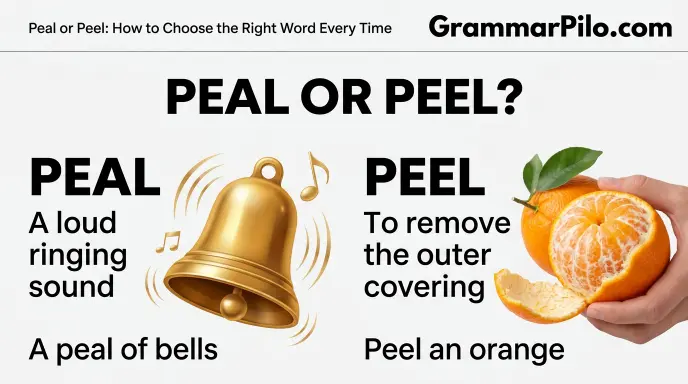
Peal usually refers to a loud, prolonged sound, especially the ringing of bells, a burst of laughter, or a roll of thunder.
Peel refers to removing the outer covering of something or to the covering itself, such as the skin of a banana or orange. It can also describe paint or skin that comes away from a surface.
Although the words sound identical, they appear in very different situations. You might hear a peal of bells but peel an apple.
Learning this simple distinction can help you avoid spelling mistakes in schoolwork, emails, articles, and everyday messages.
This guide explains the meaning, origin, pronunciation, and usage of peal and peel, with clear examples and practical tips to help you remember which spelling to use.
Peal or Peel: Quick Answer
Peal means a loud, prolonged sound, such as the ringing of bells, thunder, or laughter. Peel means to remove the outer skin or covering of something, or the covering itself.
Both words are pronounced the same way, but their meanings are different. Use peal for sounds and peel for skins, coverings, or removing them.
Both peal and peel are correct English words. Neither is a misspelling of the other. They simply have different meanings.
- Peal: A loud, long, or repeated sound, often made by bells, thunder, or laughter.
- Peel: The outer covering of fruit or vegetables, or the action of removing that covering.
Examples:
- A peal of bells rang across the village.
- Please peel the oranges before serving them.
- We heard a loud peal of thunder.
- The paint began to peel from the old door.
| Word | Main meaning | Example |
| Peal | A loud or prolonged sound | A peal of laughter filled the room. |
| Peel | An outer covering or the act of removing it | She peeled the apple. |
Easy memory tip: A peal is something you hear. A peel is something you remove or see on the outside of something.
What Does Peal Mean?
Peal is a noun and a verb connected with loud, ringing, or prolonged sounds. As a noun, it can describe the sound of bells, thunder, laughter, applause, or other loud noises. As a verb, peal means to ring out or sound loudly.
The word is especially common in expressions such as a peal of bells, a peal of thunder, and peals of laughter.
Peal as a Noun
As a noun, peal describes a loud sound or a series of sounds. It is often used with a phrase beginning with of.
Examples:
- A peal of bells announced the beginning of the ceremony.
- A sudden peal of thunder shook the windows.
- The children burst into peals of laughter.
- A peal of applause followed the performance.
The word can also refer to a set of bells or a particular sequence of bell ringing, especially in traditional bell-ringing contexts.
Peal as a Verb
As a verb, peal means to produce a loud, ringing sound.
Examples:
- The church bells pealed at noon.
- Laughter pealed through the crowded hall.
- The bells began to peal after the ceremony.
- Thunder pealed across the valley.
The verb is less common in casual conversation than expressions such as ring loudly or laugh loudly. However, it is useful in descriptive and literary writing.
What Is a Peal of Bells?
A peal of bells is a loud ringing sound produced by bells. The expression is often used when bells ring during celebrations, ceremonies, or religious events.
Example: A joyful peal of bells welcomed the newly married couple.
The phrase can describe the sound itself rather than simply the bells as physical objects.
What Does Peel Mean?
Peel can be a noun or a verb. As a noun, it refers to the outer skin or covering of fruit, vegetables, and some other things. As a verb, it means to remove that outer layer or to come away from a surface.
The word appears in everyday activities such as preparing food, removing stickers, and describing paint that is coming off a wall.
Peel as a Noun
As a noun, peel means the skin or outer covering of something, especially fruit or vegetables.
Examples:
- The orange peel had a fresh smell.
- Put the banana peel in the compost bin.
- Some people prefer to eat apples with the peel.
- The potato peel was left on the cutting board.
The word can also refer to a flat, shovel-like tool used by bakers to move bread or pizza into and out of an oven.
Peel as a Verb
As a verb, peel means to remove the skin, rind, or outer covering from something.
Examples:
- Please peel the carrots before cooking them.
- He peeled an orange for his younger sister.
- The chef showed us how to peel a mango.
- I need to peel the potatoes for dinner.
The verb can also describe a covering that comes off by itself.
Examples:
- The paint is beginning to peel.
- Her skin started to peel after a day in the sun.
- The wallpaper peeled away from the damp wall.
What Does Peel Off Mean?
The phrase peel off means to remove a covering or to become separated from a surface.
Examples:
- Peel off the label before washing the bottle.
- The sticker peeled off easily.
- The old paint began to peel off the door.
It can also have other informal meanings, such as leaving a road or moving away from a group, depending on the context.
The Origin and History of Peal and Peel
The words peal and peel have different histories. Their similar pronunciation is one reason writers sometimes confuse them, but their origins and meanings developed separately.
The Origin of Peal
The word peal appeared in Middle English around the fourteenth century. It originally referred especially to the ringing of bells.
Its history is generally connected with a shortened form of appeal. The idea was that church bells could call or summon people to a service. Over time, peal developed a broader meaning for loud, repeated, or prolonged sounds.
Today, a peal can describe bells, thunder, laughter, and other powerful sounds.
Example: A peal of laughter echoed through the building.
The Origin of Peel
The word peel, meaning to remove a covering, has a different history. It comes from older English and French forms connected with stripping or removing skin, hair, or an outer layer.
Its meaning gradually became associated with removing the skin or covering from fruit, vegetables, and other objects.
The noun peel developed to describe the outer layer that is removed.
Example: The lemon peel added a fresh flavor to the recipe.
Why Are Peal and Peel Confused?
The main reason is pronunciation. Both words are pronounced /piːl/, so they sound identical when spoken.
Their spellings differ by only one vowel:
- Peal contains ea.
- Peel contains ee.
Because pronunciation cannot help you distinguish them, you need to understand the meaning of the sentence.
British English vs. American English Spelling: Peal or Peel
There is no major British-versus-American spelling difference between peal and peel. Both spellings are used in British and American English, and their main meanings remain the same.
| English variety | Peal | Peel |
| American English | Loud sound or ringing of bells | Outer covering or act of removing it |
| British English | Loud sound or ringing of bells | Outer covering or act of removing it |
| Canadian English | Same standard spelling | Same standard spelling |
| Australian English | Same standard spelling | Same standard spelling |
| International English | Same standard spelling | Same standard spelling |
Which Spelling Should You Use?
Choose the word according to its meaning, not the country or variety of English you are using.
Use peal when describing:
- Bells ringing loudly
- Thunder making a loud sound
- A burst of laughter
- A loud or prolonged series of sounds
Use peel when describing:
- Removing fruit or vegetable skin
- The skin or rind of fruit
- Paint coming away from a surface
- Skin shedding after irritation or sun exposure
- A tool used to move food in an oven
Correct: The bells rang out in a joyful peal.
Correct: She used a knife to peel the apple.
Neither spelling is more American or more British. The difference is entirely about meaning.
Common Mistakes With Peal or Peel
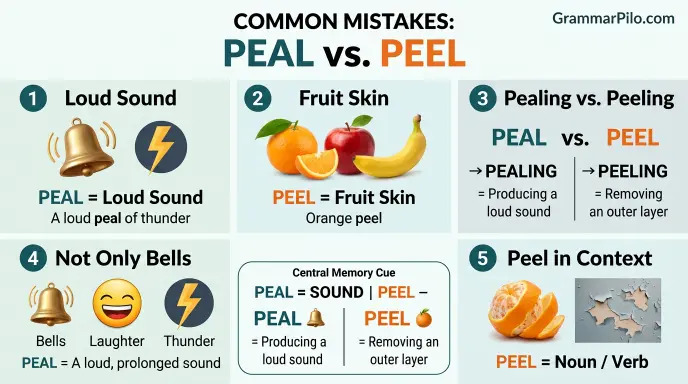
Mistake 1: Using Peel for a Loud Sound
Because peel and peal sound the same, writers may choose the wrong spelling when describing bells or laughter.
Incorrect: A loud peel of thunder woke us up.
Correct: A loud peal of thunder woke us up.
Use peal for a loud, prolonged sound.
Mistake 2: Using Peal for Fruit Skin
The word peal does not mean the skin of fruit.
Incorrect: She removed the orange peal.
Correct: She removed the orange peel.
Remember that peel is the outer covering of an orange, apple, banana, or similar item.
Mistake 3: Confusing Pealing and Peeling
Both words are correct, but they come from different verbs.
- Pealing comes from peal and refers to producing a loud sound.
- Peeling comes from peel and refers to removing or losing an outer layer.
Examples:
- The bells were pealing across the town.
- She was peeling potatoes in the kitchen.
Mistake 4: Assuming Peal Is Only Used for Bells
Although peal is strongly associated with bells, it can also describe other loud sounds.
Correct: A peal of laughter came from the classroom.
Correct: A peal of thunder rolled across the sky.
The word is not limited to church bells.
Mistake 5: Using Peel as an Adjective Without Understanding the Context
The word peel is usually a noun or verb. In a phrase such as orange peel, it functions as a noun modifying another noun.
Example: The orange peel was used to decorate the cake.
Do not confuse peel with peeling, which can describe something coming away from a surface.
Example: The wall has peeling paint.
Peal or Peel in Everyday Examples
Seeing both words in familiar situations makes their meanings easier to remember.
In Emails
Peal:
The church bells rang out with a joyful peal after the ceremony.
Peel:
Please peel the labels off the containers before returning them.
In News Writing
Peal:
A peal of thunder was heard across the region as the storm moved closer.
Peel:
The city has advised residents to remove the peel from certain produce before preparing it.
In Social Media Captions
Peal:
A beautiful peal of bells welcomed the weekend celebration.
Peel:
Fresh lemon peel makes this homemade cake extra special.
In Everyday Conversation
Peal:
- We heard a peal of laughter from the next room.
- The bells pealed just before sunset.
Peel:
- Can you peel this orange for me?
- The paint is starting to peel near the window.
In Formal Writing
Peal:
A peal of bells marked the opening of the public ceremony.
Peel:
The outer peel of the fruit was removed before the sample was prepared.
In Cooking and Recipes
Peel:
- Peel the potatoes and cut them into small pieces.
- Add a little lemon peel to the mixture.
- Remove the peel before slicing the fruit.
Peal is not normally used in cooking instructions unless the sentence refers to a sound.
Example: A peal of laughter came from the kitchen as the family prepared dinner.
Search and Modern Usage: Peal vs. Peel
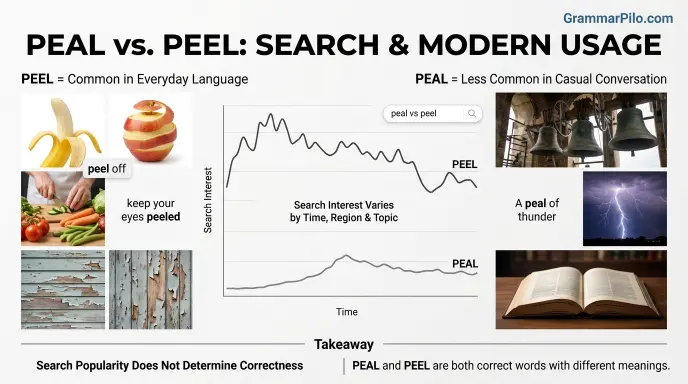
The words peal and peel appear in different contexts, so their search patterns may vary.
Peel is common in everyday language. People use it when discussing food preparation, fruit, vegetables, paint, skin, and household tasks. It also appears in phrases such as peel off and keep your eyes peeled.
Peal is less common in casual conversation. It is more likely to appear in descriptive writing, literature, news reports, and expressions involving bells, thunder, or laughter.
Search interest can vary by region, season, and topic. For example, searches for peel may be connected with recipes, while peal may appear in searches about bell ringing or word meanings.
A live Google Trends comparison can help you examine current search interest by location and time period. However, search popularity does not determine if a word is correct. Both peal and peel are established English words with separate meanings.
Peal vs. Peel: Quick Comparison
| Feature | Peal | Peel |
| Part of speech | Noun and verb | Noun and verb |
| Main meaning as a noun | A loud or prolonged sound | Outer skin or covering |
| Main meaning as a verb | To ring or sound loudly | To remove or come away from a covering |
| Pronunciation | /piːl/ | /piːl/ |
| Word type | Homophone | Homophone |
| Common expressions | Peal of bells, peal of thunder, peals of laughter | Orange peel, peel an apple, peel off |
| Present participle | Pealing | Peeling |
| Past tense | Pealed | Peeled |
| Example | The bells pealed at noon. | She peeled the mango. |
Pealing or Peeling: What Is the Difference?
The same spelling distinction continues in the -ing forms.
| Word | Meaning | Example |
| Pealing | Producing a loud sound | The bells were pealing. |
| Peeling | Removing or losing an outer layer | The paint was peeling. |
This is a useful distinction to remember because the extra vowel makes the two forms look more different.
Key Takeaways
- Peal and peel are both correct English words.
- They are homophones because they have the same pronunciation but different meanings.
- Peal refers to a loud, prolonged sound, especially bells, thunder, or laughter.
- Peel means the outer covering of something or the act of removing it.
- Use pealing for sounds and peeling for removing or losing a covering.
- Neither word is specifically British or American.
- Remember the simple rule: peal is heard; peel is removed.
Frequently Asked Questions
1. Is it peal or peel?
Both are correct words, but they have different meanings. Peal refers to a loud sound, while peel refers to an outer covering or the act of removing it.
2. What is the difference between peal and peel?
A peal is a loud or prolonged sound, such as ringing bells or laughter. A peel is the skin or outer layer of something, such as an orange, or the action of removing that layer.
3. Are peal and peel pronounced the same?
Yes. Both are pronounced /piːl/. They are homophones, so their pronunciation is identical even though their spelling and meaning differ.
4. Is it a peal of laughter or a peel of laughter?
The correct expression is a peal of laughter. It describes a loud burst or series of laughs.
Example: A peal of laughter came from the audience.
5. Is it orange peal or orange peel?
The correct spelling is orange peel. It refers to the outer skin of an orange.
Example: Add a little orange peel to the cake mixture.
6. What is the difference between pealing and peeling?
Pealing comes from peal and means producing a loud sound. Peeling comes from peel and means removing or losing an outer layer.
Examples:
- The bells were pealing.
- The paint was peeling.
7. Can peal be used as a verb?
Yes. Peal can be a verb meaning to ring or sound loudly.
Example: The bells pealed across the town.
8. Can peel be used as a noun and a verb?
Yes. As a noun, peel means an outer covering. As a verb, it means to remove that covering or to come away from a surface.
Examples:
- The banana peel was on the table.
- Please peel the banana.
9. Is peal or peel a British spelling?
Both are used in British English and American English. There is no regional spelling difference between them.
10. What is an easy way to remember peal and peel?
Remember that peal is connected with sounds you hear, such as bells and laughter. Peel is connected with a covering you remove, such as fruit skin.
Conclusion: Peal or Peel?
The difference between peal or peel becomes simple once you connect each spelling with its meaning. Peal refers to a loud or prolonged sound, such as the ringing of bells, a burst of laughter, or a roll of thunder. Peel refers to the outer covering of something or the action of removing it.
Both words are correct, and both sound the same. The spelling depends on the sentence, not on British or American English.
If you are describing a sound, choose peal. If you are talking about fruit skin, paint coming off, or removing an outer layer, choose peel.
Keep this short memory tip in mind: You hear a peal, but you peel a fruit. This simple connection can help you choose the correct word in conversations, messages, articles, and formal writing.
Read More Related Articles
- Hobby or Hobbie: Correct Spelling, Plural Form & Usage Explained
- Is It Congradulations or Congratulations? The Definitive Guide
- Opened or Openned: The Correct Spelling & Why One N Is Enough

I’m Claire Morgan, the author behind Grammarpilo.com, where I write about English grammar, sentence structure, punctuation, and everyday language. My goal is to make grammar simple, clear, and practical, helping readers understand the rules and apply them with confidence in real-world writing.