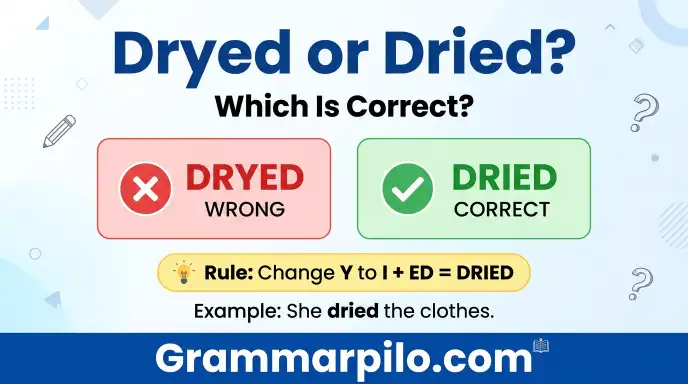
Dried is the correct word, and dryed is wrong in the English we use today. Many people still search for dryed or dried each day. They want to write the right word in a school task, a job email, a recipe, or a post online.
The mix up has a simple cause. Most action words take ed at the end with no change. We write walk and walked, and we write wash and washed. So the hand wants to do the same with dry.
It writes dry and adds ed. But dry does not follow that path. Dry ends with a letter that must change first. Words like try and cry change in the same way. We write tried and cried, not tryed or cryed.
This article clears the doubt step by step. You will learn the quick answer and the core rule, origin of the word and the old books link.
You will see the rule for British English and American English. Also you will see top mistakes, real life examples, search data, and clear answers to common questions.
Dryed or Dried Quick Answer
The Short Answer
Dried is the past form of the word dry. Use dried when you talk about a past action. Dried also works for a thing that is not wet now. Dryed has no place in new writing, school work, or office work.
The rule is short and easy. When a word ends with a consonant and the letter y, the y turns into i. Then we add ed. So dry turns into dried. In the same way, try turns into tried. Cry turns into cried, and copy turns into copied.
Quick Examples
Examples:
- She dried her hair after a bath.
- We dried the wet shoes in the sun.
- He dried the cup with a clean cloth.
Definition and Meaning of Dryed or Dried
A Clear Definition
Dried is the past tense and the past participle of the verb dry. In plain words, dried tells us that a wet thing lost its water. It also tells us the thing is not wet now.
The Simple Meaning
Think of a wet towel on a line. The sun hits the towel for one hour. Soon the towel has no water left in it. The towel is dried. The word dried shows the change from wet to dry.
The word dryed means the same thing in very old books only. In new books, web posts, and exams, dryed is marked as a wrong spelling.
Context and Usage
We use dried in the home, in food, and in daily work. Cooks use dried fruit, dried beans, and dried herbs. These foods had water in them in the past. People in dry lands talk about dried lakes and dried wells. A dried well has no water left in it at all.
Different Forms of Dry
The word dry has a small family of forms. The base form is dry. The third person form is dries. The ing form is drying. The past form is dried. Only the past form creates this doubt. That is why so many people compare dryed and dried side by side.
The Origin of Dryed or Dried
Where the Word Dry Came From
The word dry is very old. It comes from Old English, the English of more than one thousand years ago. The old form was close to dryge. The word meant a thing with no water in it. Its core sense is still the same today.
Why the Letter Y Changes to I
Long ago, English spelling rules took a firm shape. One key rule said this. When a short word ends with a consonant and y, the y turns into i before ed. This rule made words look clean and sound right.
It gave us dried, tried, cried, and fried. The sound of the word does not change. Only the last letters change on the page.
Why Dryed Shows Up in Old Books
In the past, spelling rules were not fixed for all books. Each writer wrote words in his own way. So you may find dryed in some very old books and old plays. That does not make dryed right today.
Books, schools, and tests now use one form only, and that form is dried. Some readers search dried or dryed just to check this old book link.
British English vs American English Spelling
The Main Rule
Here is good news for all writers. British English and American English agree on this word. Both spell the past form as dried. There is no split here at all. Dryed is wrong in London, and dryed is wrong in New York too.
Spelling Rules With Examples
Many English words do change across the sea. Colour changes to color, and realise changes to realize. But dried is not one of those words. The y to i rule works in the same way in both lands. Dried stays dried in all books, news, and tests.
Example from the UK: The paint dried fast in the warm room.
Example from the US: The paint dried fast in the warm room.
British and American Spelling Table
| Point | British English | American English |
| Past form of dry | dried | dried |
| Form to avoid | dryed | dryed |
| Word for food with no water | dried fruit | dried fruit |
| Used in schools and exams | dried | dried |
Which Spelling Should You Use?
Advice for Readers in the US
Use dried at all times if you write for a US crowd. Teachers, bosses, and editors in the US all want dried. A US exam will mark dryed as a wrong word.
Advice for Readers in the UK and Commonwealth
Use dried if you write for the UK, Canada, Australia, or India. The rule is the same in all these lands. No book in these lands asks for dryed in new work.
Advice for Global Readers
People who write for the whole world can relax. You need no split plan for dried and dryed. One form fits all lands. Always pick dried. It is safe for blogs, books, forms, and work mail. When you think of dryed vs. dried, the answer is the same for each land and each age group.
Common Mistakes with Dryed or Dried
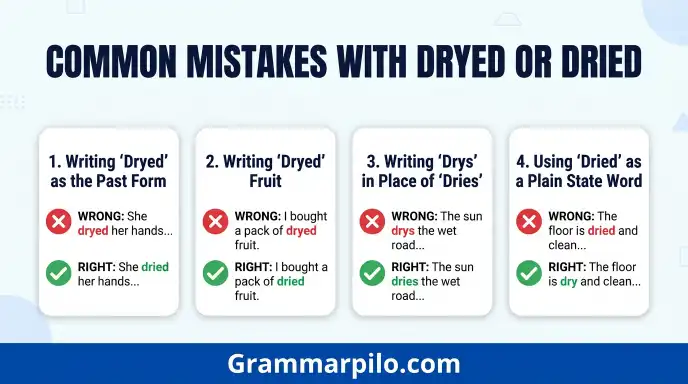
Mistake 1. Writing Dryed as the Past Form
This is the most common error of all. The hand writes dry and adds ed with no change. The y must turn into i first.
Wrong: She dryed her hands with a towel.
Right: She dried her hands with a towel.
Mistake 2. Writing Dryed Fruit
Food packs and menus show this error at times. The right words are dried fruit, dried mango, and dried herbs. Dryed is never right on a food pack.
Wrong: I bought a pack of dryed fruit.
Right: I bought a pack of dried fruit.
Mistake 3. Writing Drys in Place of Dries
Some writers keep the y in the third person form too. That is wrong. The y turns into i here as well.
Wrong: The sun drys the wet road fast.
Right: The sun dries the wet road fast.
Mistake 4. Using Dried as a Plain State Word
Dry tells the state of a thing. Dried tells a past act or a thing made dry. A fresh towel on a shelf is dry. It is not dried till a past act made it dry.
Wrong: The floor is dried and clean now.
Right: The floor is dry and clean now.
Dryed or Dried in Everyday Examples
In Emails
Work emails use dried in short and clear lines. The word shows that a task is done and a thing is ready.
Email example: I dried the wet forms and sent the full set to you.
Email example: The team dried all the test samples this morning.
In News
News reports use dried for land, farms, and water news. The word helps show a big change in a place.
News example: The lake dried in the hot summer and left dry mud.
News example: Farmers dried the grain in the sun before the rains came.
On Social Media
Posts and captions use dried in a light and fun way. People pair the word with rain, shoes, hair, and trips.
Social media example: My shoes dried at last after that big rain.
Social media example: Fresh bread and dried herbs for our small picnic today.
In Formal Writing
Reports and books use dried for facts and steps. The word fits well in science notes and work plans.
Formal example: The lab dried each sample for two full hours.
Formal example: The report said the soil dried fast in the dry season.
Google Trends and Usage Data for Dryed or Dried
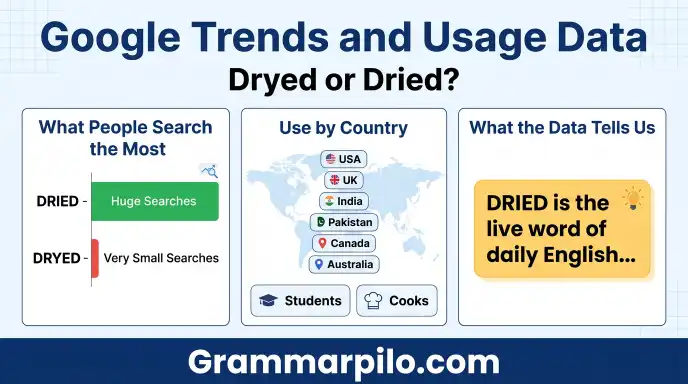
What People Search the Most
Search data shows a clear gap here. The word dried gets a huge number of searches. The word dryed gets a very small count. Most of those small dryed searches come from doubt. People type dried or dryed to ask which form is right. They do not use dryed as a real word in their own text.
Use by Country
People in the US and the UK search for dried the most. High counts also come from India, Pakistan, Canada, and Australia. Students form a big part of this group. Cooks form one more big part. Both groups need dried for tests, tasks, and recipes.
What the Data Tells Us
The data backs the rule with no doubt left. Dried is the live word of daily English. Dryed is a search term born of doubt only. Some users even flip the pair and type dried vs. dryed to test both ways.
The answer they find is the same each time. Writers in each land use dried in books, news, and web posts. Dryed has almost no real use in print today.
Dryed vs. Dried Side by Side
The Two Forms at a Glance
A side by side view ends the doubt fast. One form is fit for all new work. The other form lives only in old books and in wrong drafts. Some people also search the flip pair, dried vs. dryed, and reach the same end point.
| Word | Status Today | Meaning | Example |
| dryed | Not correct in modern English | An old book form of dried | Do not use it in new work |
| dried | Correct in all lands | Past form of dry, not wet now | She dried the wet cup |
FAQs on Dryed or Dried
1. Is dryed a correct word today?
No, dryed is not a correct word in the English of today. Use dried in school work, office work, books, and posts. Only very old books show dryed as a real form.
2. What is the past tense of dry?
The past tense of dry is dried. The y turns into i, and then ed joins the word. We use the same form for all past acts of dry.
3. Why is it dried and not dryed?
The rule of spelling gives the reply. When a word ends with a consonant and y, the y turns into i before ed. That is why we write dried, tried, and cried.
4. Is it dried fruit or dryed fruit?
It is dried fruit at all times. Fruit that lost its water is called dried fruit. You will see these words on packs, menus, and recipe books.
5. Do British and American English differ on this word?
No, both lands spell it the same way. British English uses dried, and American English uses dried too. This word has no split form at all.
6. What is the difference between dry and dried?
Dry names a state or a present act. Dried names a past act or a thing made dry on purpose. A dry towel is not wet. A dried towel was wet in the past.
7. Can I use dryed in a story set in the past?
You can use dryed in a very old style tale if you want an old book feel. For all normal work, use dried. Teachers and editors will treat dryed as an error in new text.
Conclusion
The case of dried or dryed is now clear and closed. Dried is the right past form of dry in all lands. It works in the US and the UK with no split at all.
Dryed is a common error of the hand, born when a writer adds ed with no change to the y. The fix is short and sweet. If a word ends with a consonant and y, turn the y into i and add ed.
Keep all the forms in mind as you write. Use dry for the state of a thing. Use dries for a third person act and drying for an act in flow. And use dried for a past act and for foods with no water left in them. Think of dried fruit on a shop shelf. Think of a towel that the sun made dry.
Search data, school books, and news text all point one way. Dried is the live form of daily English. Dryed lives only in old books and in test searches like dried and dryed. Write dried with full trust from this day on. Your lines will look clean, right, and pro to each reader who sees them.
Commonly Confused Spellings
- Bitting or Biting: The Easy to Miss Difference Explained in 2026
- Prioritise or Prioritize: The Correct Spelling for Your Audience
- Emphasise or Emphasize: Which Spelling Fits Your Audience?

I’m Claire Morgan, the author behind Grammarpilo.com, where I write about English grammar, sentence structure, punctuation, and everyday language. My goal is to make grammar simple, clear, and practical, helping readers understand the rules and apply them with confidence in real-world writing.






3 thoughts on “Dryed or Dried: Which Is Correct? 90% People Get This Wrong!”