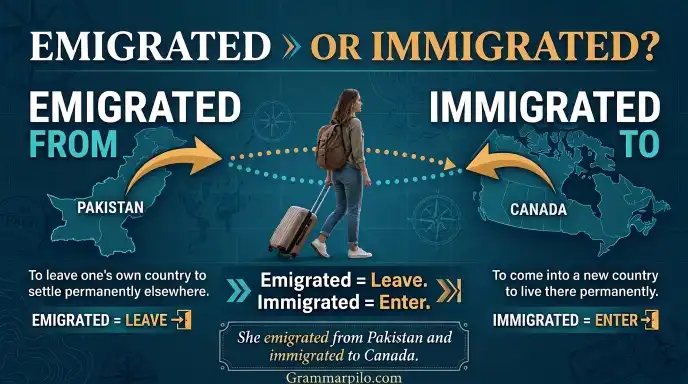
Emigrated and immigrated are both correct English words, but they describe migration from different perspectives. Emigrated means leaving one country to settle in another, while immigrated means entering a country to live there. The difference depends on the starting point and destination.
For example, if Maria leaves Pakistan and moves to Canada to establish a new home, she has emigrated from Pakistan and immigrated to Canada. Both words describe the same move, but each emphasizes a different side of the journey.
These words are easy to confuse because they refer to the same general process of moving between countries. The prefixes provide the essential clue.
The prefix e- in emigrate is associated with moving out, while im- in immigrate is associated with moving in.
Understanding the difference helps you write more accurately in school assignments, immigration documents, news reports, travel discussions, and everyday conversations.
This guide explains the definitions, origins, grammar rules, common mistakes, regional usage, and practical examples of emigrated and immigrated.
Quick Answer: Emigrated or Immigrated?
Use emigrated when someone leaves a country to settle elsewhere. Use immigrated when someone enters another country to live there.
- Emigrated from: She emigrated from Pakistan in 2022.
- Immigrated to: She immigrated to Canada in 2022.
- Both are correct: She emigrated from Pakistan and immigrated to Canada.
The main difference is perspective. Emigrated focuses on departure, while immigrated focuses on arrival.
What Does Emigrated Mean?
Emigrated is the past tense and past participle of the verb emigrate. It means that a person left their home country or country of residence to establish a life in another country.
The word emphasizes the place someone leaves rather than the country they enter.
Examples of Emigrated
- My grandparents emigrated from Italy in the 1960s.
- Several families emigrated from the region in search of better opportunities.
- He emigrated from Pakistan after accepting a permanent job abroad.
- The writer emigrated from Ireland and settled in the United States.
- They had emigrated before the new immigration policy was introduced.
In each example, the word highlights departure from a country.
How to Use Emigrated in a Sentence
The verb commonly appears with the preposition from because it identifies the place of departure.
Correct:
- She emigrated from India to pursue a career overseas.
- His family emigrated from Germany many years ago.
- Thousands of people emigrated from the country during that period.
You can also use emigrated without naming the starting country if the context already makes it clear.
Example: Her parents emigrated when she was a young child.
What Does Immigrated Mean?
Immigrated is the past tense and past participle of immigrate. It means that a person entered a country to establish residence there, usually for an extended period or permanently.
The word emphasizes the destination rather than the place someone left.
Examples of Immigrated
- My grandparents immigrated to Australia in the 1960s.
- She immigrated to Canada to join her family.
- He immigrated to the United States for work.
- Many people have immigrated to the city over the past decade.
- They immigrated to New Zealand and built a new life there.
Each sentence focuses on the country or place the person entered.
How to Use Immigrated in a Sentence
The verb commonly appears with the preposition to because it identifies the destination.
Correct: My aunt immigrated to the United Kingdom last year.
Correct: They immigrated to Canada with their children.
You may also see immigrated into in certain contexts, but immigrated to is a straightforward and widely used construction when naming a destination.
Emigrated vs. Immigrated: Key Differences
The easiest way to distinguish these verbs is to identify the direction of movement.
| Feature | Emigrated | Immigrated |
| Base verb | Emigrate | Immigrate |
| Main meaning | Left a country to live elsewhere | Entered a country to live there |
| Perspective | Departure | Arrival |
| Common preposition | From | To |
| Example | He emigrated from Brazil. | He immigrated to Spain. |
| Focus | Country of origin or departure | Destination country |
| Past participle | Emigrated | Immigrated |
The verbs do not describe two unrelated actions. They describe the same international move from opposite perspectives.
One Journey, Two Correct Words
Imagine that Daniel leaves Pakistan and settles in the United Kingdom.
- Daniel emigrated from Pakistan.
- Daniel immigrated to the United Kingdom.
- Daniel emigrated from Pakistan and immigrated to the United Kingdom.
All three sentences can be correct. The first emphasizes where he left, the second emphasizes where he arrived, and the third gives both sides of the journey.
The Origin and History of Immigrate and Emigrate
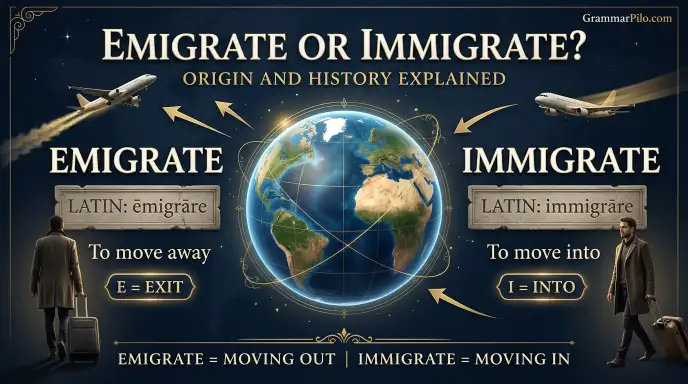
The words emigrate and immigrate share Latin roots and developed through forms used in European languages before becoming established in English.
Where Does Emigrate Come From?
Emigrate comes from Latin emigrare, meaning to move away or depart from a place. The prefix e- carries the sense of out or away, while the rest of the word relates to moving.
This historical meaning helps explain modern usage. When people emigrate, the focus is on leaving one country to establish residence somewhere else.
Where Does Immigrate Come From?
Immigrate comes from Latin immigrare, meaning to move into or enter a place. The prefix im- is a form of in- used before certain sounds and carries the idea of movement inward.
This explains why immigrate emphasizes entering a destination country.
Why Are the Words So Similar?
Both words describe international movement and share the same basic linguistic roots. Their prefixes distinguish the direction of the movement.
A simple memory aid is to connect E with Exit and I with Into.
- Emigrate: Exit the country.
- Immigrate: Enter another country.
This is a practical reminder of the difference, even though the words themselves have longer historical roots.
Emigrated or Immigrated in American and British English
There is no significant American versus British spelling difference between immigrated and emigrated. Both spellings are standard in American English, British English, Canadian English, Australian English, and other major varieties of English.
The distinction is based on meaning, not regional spelling:
| Context | Correct usage |
| American English | He emigrated from Mexico. |
| British English | She immigrated to Britain. |
| Canadian English | They emigrated from France. |
| Australian English | He immigrated to Australia. |
| International writing | She emigrated from Pakistan and immigrated to Canada. |
Which Word Should You Use?
Choose the word that matches the country you are describing.
If the sentence names the country a person left, emigrated from is usually appropriate. If it names the country a person entered to settle, immigrated to is usually appropriate.
For international audiences, including both the starting point and destination can make the sentence especially clear.
Common Mistakes When Using Emigrated or Immigrated
Even experienced writers sometimes confuse these words because both describe a move between countries. The following mistakes are easy to avoid.
1. Using Immigrated for the Country Someone Left
Incorrect for the intended meaning: She immigrated from Pakistan to Canada.
Clearer and standard: She emigrated from Pakistan to Canada.
The first sentence uses the departure focused verb with from. In standard usage, emigrated from is the better choice.
2. Using Emigrated for the Destination
Incorrect for the intended meaning: He emigrated to Australia in 2020.
Clearer and standard: He immigrated to Australia in 2020.
When focusing on entering Australia to settle, immigrated to is the appropriate expression.
3. Thinking the Words Are Interchangeable
The verbs are related, but they do not emphasize the same perspective. Replacing one with the other can change the meaning or make the sentence less precise.
Emigrated: They left France to settle elsewhere.
Immigrated: They entered France to settle there.
4. Confusing Immigration With Emigration
Immigration is the noun for entering a country to live there. Emigration is the noun for leaving a country to settle elsewhere.
Example: Immigration increased in the destination country, while emigration increased in the country people were leaving.
The exact interpretation depends on the country being discussed.
5. Assuming Migration Always Means International Movement
The broader word migration can describe movement from one region to another, including movement within a country. Emigration and immigration are generally used for movement across national borders in the sense of leaving or entering a country to establish residence.
Emigrated and Immigrated in Everyday Examples
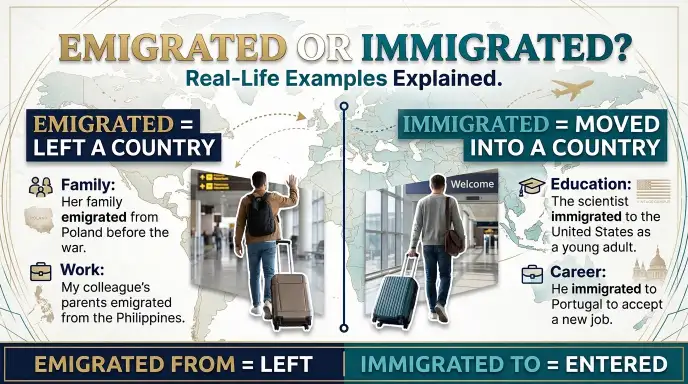
The following examples show how to use each word naturally in schoolwork, emails, conversation, news writing, and formal documents.
In School
Emigrated: The author’s family emigrated from Poland before the war.
Immigrated: The scientist immigrated to the United States as a young adult.
Both: Her parents emigrated from India and immigrated to Canada.
In Emails and Workplace Communication
Emigrated: My colleague’s parents emigrated from the Philippines several years ago.
Immigrated: Our new team member immigrated to the United Kingdom for work.
Both: He emigrated from Brazil and immigrated to Portugal to accept the position.
In Everyday Conversation
Emigrated: When did your family emigrate from Pakistan?
Immigrated: How long ago did you immigrate to Canada?
Both: My grandparents emigrated from Italy and immigrated to the United States in the 1950s.
In News Reports
Emigrated: The report examined why young professionals emigrated from the region.
Immigrated: The article described the experiences of families who immigrated to the country.
Both: Many people emigrated from the affected area, while others immigrated to neighboring countries.
In Formal Writing and Applications
Emigrated: The applicant’s parents emigrated from Sri Lanka in 1998.
Immigrated: The applicant immigrated to Australia in 2004.
Both: The record shows that the individual emigrated from one country and immigrated to another during the same year.
For official forms, always follow the wording used by the relevant government agency and provide accurate dates and locations.
Immigrate vs. Emigrate vs. Migrate
A third word, migrate, is also important because it has a broader meaning.
| Word | Meaning | Example |
| Emigrate | Leave a country to settle elsewhere | She emigrated from Japan. |
| Immigrate | Enter a country to settle there | She immigrated to Canada. |
| Migrate | Move from one place or region to another | The birds migrate south in winter. |
People, animals, and even data can migrate in different contexts. By contrast, emigrate and immigrate are most often used when discussing people moving between countries.
Quick reminder: Emigrate means move out, immigrate means move in, and migrate means move.
Google Trends and Modern Usage
Searches for immigrated or emigrated commonly reflect a desire to understand the direction of movement and choose the correct verb in a sentence.
The words also appear in news reports, historical accounts, demographic research, and official migration discussions.
No verified live Google Trends figures are included here, so exact search volumes or popularity percentages should not be assumed.
To investigate current search interest, compare the terms in Google Trends and select a relevant country and time period.
Dictionary entries and reputable government immigration resources can also help confirm definitions and context.
In contemporary writing, both verbs remain useful and widely understood. The distinction continues to matter because a sentence about leaving a country communicates a different perspective from a sentence about entering one.
For clear writing, name the departure country with emigrated from and the destination with immigrated to whenever that information is relevant.
A Simple Trick to Remember Emigrated or Immigrated
Use the first letter as a memory clue.
E = Exit. Emigrated means leaving a country.
I = Into. Immigrated means entering a country.
Imagine a person moving from Pakistan to Canada.
- They exited Pakistan, so they emigrated from Pakistan.
- They moved into Canada, so they immigrated to Canada.
You can also remember the common prepositions: emigrate from and immigrate to.
This simple method works for everyday writing, school assignments, travel discussions, and articles about international movement.
Frequently Asked Questions
1. What is the difference between emigrated and immigrated?
Emigrated means leaving a country to settle elsewhere, while immigrated means entering another country to live there. The difference is the perspective from which the move is described.
2. Is it emigrated from or immigrated from?
Use emigrated from when describing the country a person left.
Example: She emigrated from Pakistan in 2021.
Use immigrated to when describing the country the person entered.
3. Is it immigrated to or emigrated to?
Use immigrated to when emphasizing the destination country.
Example: He immigrated to Canada after accepting a job.
Emigrated to is sometimes encountered, but immigrated to is the clearer standard choice when the intended meaning is entering a country to settle.
4. Can someone emigrate and immigrate at the same time?
Yes. The two verbs describe opposite perspectives on the same international move.
Example: She emigrated from India and immigrated to Australia in the same year.
5. Is emigrated the same as migrated?
Not exactly. Migrated is broader and can describe movement between regions or countries. Emigrated specifically emphasizes leaving a country to settle elsewhere.
6. What is the noun form of emigrated?
The noun is emigration.
Example: Emigration from the region increased during the economic downturn.
7. What is the noun form of immigrated?
The noun is immigration.
Example: Immigration to the country increased over several years.
8. Are emigrated and immigrated spelled differently in British and American English?
No. Both words have the same standard spelling in American and British English. Their difference is meaning and perspective, not regional spelling.
9. Which word should I use when talking about my grandparents moving abroad?
Use emigrated to describe the country they left and immigrated to describe the country they entered.
Example: My grandparents emigrated from Pakistan and immigrated to the United Kingdom.
10. Is migration always permanent?
No. The word migration can describe different kinds of movement, and the intended duration depends on context. Emigrate and immigrate generally refer to moving to another country to establish residence, but the move is not necessarily permanent in every case.
Conclusion: Emigrated and Immigrated Have Different Perspectives
The difference between emigrated or immigrated becomes easy to understand once you focus on the direction of movement.
Emigrated describes leaving a country to settle elsewhere, while immigrated describes entering another country to live there. Both words are correct, and the best choice depends on the part of the journey you want to emphasize.
Remember the simple clues: E stands for exit, and I suggests moving into a place. Pair emigrated with from when naming the country someone left, and pair immigrated with to when naming the destination.
For example, a person who moves from Pakistan to Canada has emigrated from Pakistan and immigrated to Canada.
These words are not regional spelling variants. They are distinct verbs with related meanings, used in American, British, and international English.
By choosing the right word and including the relevant country, you can make your writing more accurate, natural, and easy to understand.
Continue Exploring English

I’m Sloane Mercer, a U.S.-based English language writer focused on grammar, spelling, vocabulary, and everyday English usage. Through GrammarPilo, I provide clear and practical explanations to help readers choose the right words and communicate with confidence.








2 thoughts on “Emigrated or Immigrated: Which Is Right? Find Out Now”