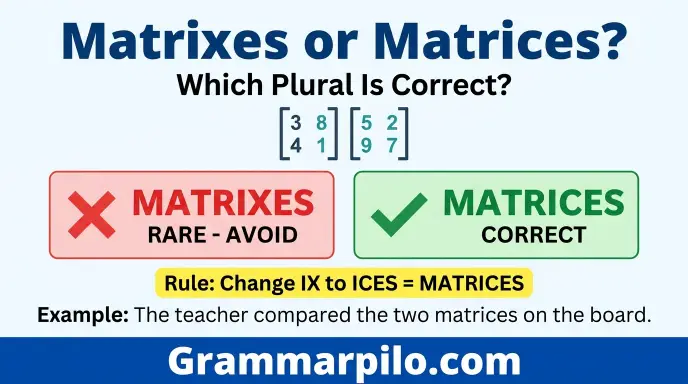
Matrices is the standard plural of matrix, and matrixes is a rare form that careful writers almost always avoid. A single grid of numbers on a page raises no problem at all.
Trouble starts the moment a second grid joins the first. Students, teachers, and coders all face the same pause before they write the plural. Regular English plurals end in s or es, so matrixes feels like the safe guess.
Latin, the source language of matrix, built its plural in a very different way. Searches move in both directions, from matrixes or matrices to matrices or matrixes, because sound alone cannot settle the spelling.
This guide settles it with a clear rule, the history behind that rule, and examples drawn from maths, science, work mail, and daily writing.
By the final section, the right plural will feel automatic rather than guessed. A short set of common traps, answered one by one, closes the gaps that a quick rule alone can leave behind.
Matrixes or Matrices Quick Answer
Short Answer
Matrices is the plural to use in maths, science, school work, and professional writing. Matrixes does appear in a few dictionaries as a rare variant, yet teachers, editors, and experts pass it over in practice.
Every search order tells the same story, through matrixes or matrices, matrices or matrixes, matrixes and matrices, matrices and matrixes, matrixes vs. matrices, and matrices vs. matrixes.
The Rule in One Line
Words borrowed from Latin that end in ix often change that ending to ices in the plural. Matrix follows the pattern exactly. One matrix stands alone, while two or more become matrices.
Say it: Matrices sounds like MAY tri seez, in three clear parts.
Examples in Action
Correct: The teacher compared the two matrices on the board.
Incorrect: The teacher compared the two matrixes on the board.
Correct: These matrices hold the sales data for each month.
Incorrect: These matrixes hold the sales data for each month.
Definition and Meaning of Matrixes or Matrices
Clear Definition
A matrix is a set of things arranged inside a structure that gives them order. In maths, that structure is a rectangle of numbers set in rows and columns. Outside maths, the same word names the material or setting inside which something grows, forms, or sits.
Simple Meaning
Think of a matrix as a frame that holds things in place. Numbers sit inside a maths matrix in neat rows. A fossil sits inside a rock matrix in the ground. Cells sit inside a soft matrix inside the body.
Many Jobs of One Word
Geology uses matrix for the rock that holds crystals or fossils. Biology uses the word for the material around cells in living tissue. Dentists and doctors meet it at the base of a nail, where new nail grows. Printers once used it for a mold that shaped metal letters.
Context and Usage
Context tells readers which sense you mean, and the plural stays matrices in every one of them. A sentence about eigenvalues points clearly to maths. A sentence about fossils points just as clearly to rock. Changing the field never changes the plural.
The Origin of Matrixes or Matrices
Latin Roots
Matrix comes from Latin, built on the word mater, meaning mother. Latin speakers used matrix for a mother animal, a parent plant, and a womb.
From those roots grew the wider sense of a source inside which something new takes shape. English took the word in during the 1500s and kept much of that meaning alive.
A Family of Similar Plurals
Index becomes indices in formal writing, and appendix becomes appendices. Vertex follows the same road to vertices. Each word arrived from Latin with its Latin plural packed inside it. Matrix belongs to that family, so matrices is not an odd exception at all.
Why Matrixes Exists at All
English loves its regular s and es endings, so writers naturally tried them on matrix. A few dictionaries recorded the result because real writers had used it. Recording a rare form, though, is not the same as recommending it.
Modern style guides, textbooks, and journals line up behind matrices with very rare exceptions.
British English vs American English Spelling
One Rule on Both Sides of the Ocean
British writers use matrices, and American writers use matrices. No regional split exists here for teachers to argue about. Exams in London and exams in New York mark the plural in exactly the same way.
Spelling Table
| Point | British English | American English |
| Standard plural | matrices | matrices |
| Rare variant | matrixes | matrixes |
| Maths and science | matrices | matrices |
| Formal writing | matrices | matrices |
Examples From Both Sides
British example: The journal printed the matrices in an appendix.
American example: The lab shared its matrices with the partner team.
Place changes nothing here, which makes this one of the easiest spelling choices in English.
Which Spelling Should You Use
For Readers in the US
Course books, research papers, and office reports across the US all run on matrices. Data teams use the word daily for tables of values in code and in sheets. A resume or a report carrying matrixes would stand out for the wrong reason.
For Readers in the UK and Commonwealth
Schools and journals in the UK, Canada, Australia, and beyond follow the same standard. Commonwealth science writing leans on Latin plurals in many fields, and this word fits that habit. Students gain marks by matching the form their textbooks already use.
For Global Readers
Matrices travels well because experts in every country share it. Conference papers and software guides read the same from Karachi to Toronto. A single shared form spares readers a needless pause.
Quick Field Guide
Maths and data work: Always write matrices.
Science and medicine: Always write matrices.
School and exam answers: Always write matrices.
Quoted titles and old books: Leave a rare matrixes exactly as printed.
Common Mistakes with Matrixes or Matrices
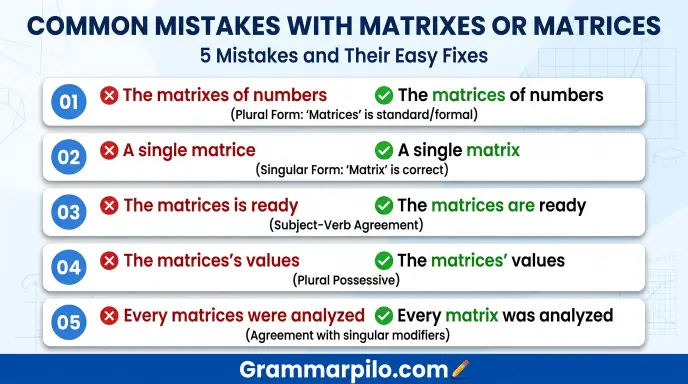
Mistake 1 Using Matrixes in Maths Writing
Textbooks never set the pattern this mistake copies. The error usually comes from trusting the regular English ending too far.
Wrong: We multiplied the matrixes to solve the system.
Right: We multiplied the matrices to solve the system.
Mistake 2 Writing Matricies
Adding ies at the end feels tidy, but no dictionary accepts that shape. The Latin ending is ices, with the c before it.
Wrong: The worksheet lists ten matricies to complete.
Right: The worksheet lists ten matrices to complete.
Mistake 3 Writing Matrixs
Dropping every ending rule at once gives matrixs, a form that fails in all settings. Even the rare variant keeps more letters than this slip does.
Wrong: Both matrixs contain the same values.
Right: Both matrices contain the same values.
Mistake 4 Using Matrix as Its Own Plural
One matrix is singular, and a crowd of them needs the plural form. Leaving the word unchanged makes the sentence read as unfinished.
Wrong: The two matrix are shown below.
Right: The two matrices are shown below.
Mistake 5 Mixing Both Forms in One Document
A page that opens with matrices and closes with matrixes looks edited by two different hands. Pick the standard form at the start and let it run to the end.
Wrong: The matrices were clean, but the matrixes in the appendix were not.
Right: The matrices were clean, and the matrices in the appendix matched them.
Matrixes or Matrices in Everyday Examples
In Emails
Email example: Please review the attached matrices before our data meeting on Thursday.
Office mail stays safe with the standard plural, since senior readers spot rare forms at once.
In News
News example: Researchers built matrices from thousands of scans to map how the disease spreads.
Science reporting copies the plural straight from the papers it covers, and those papers all use matrices.
In Social Media
Social media example: Finally learned how to multiply matrices and my maths exam suddenly feels less scary.
Students post the word often during exam season, and the standard form dominates those posts.
In Formal Writing
Formal example: The report compared rock matrices from six sites across the valley.
Geology reports show the plural at work far beyond maths class, with the same spelling throughout.
Matrixes or Matrices Google Trends and Usage Data
What People Search the Most
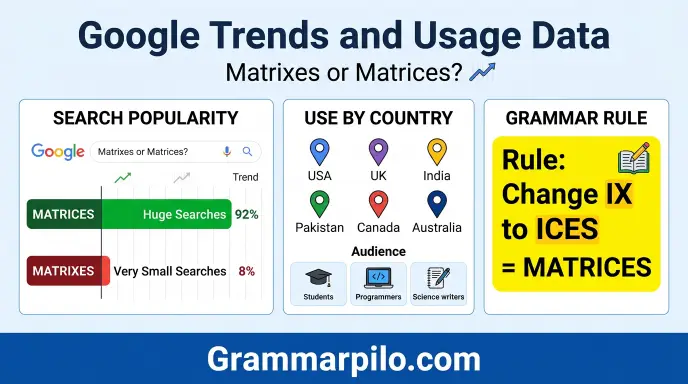
Search interest for matrices towers over interest for matrixes. Most searches for the rare form come from writers checking a plural before an exam, a paper, or a deadline. Spelling doubt, rather than real use, keeps the smaller term alive.
Use by Country
The US and the UK lead searches for this pair. India, Pakistan, Canada, and Australia follow with strong counts of their own. Students form the largest group, with programmers and science writers close behind them.
What the Data Tells Us
Published books, journals, and course pages print matrices as a matter of habit. Matrixes holds no real ground in maths or science publishing at all. Everyday usage has settled this contest so fully that the remaining searches are checks, not true doubt about expert practice.
Matrixes or Matrices Comparison Table
Side by Side View
| Form | Status | Best Use | Example |
| matrix | Singular | One grid or one setting | One matrix holds the data |
| matrices | Standard plural | Maths and science and formal writing | The matrices match in size |
| matrixes | Rare variant | Quoted old text and names only | The old book printed matrixes once |
| matricies | Always wrong | No correct use exists | Never use this form |
| matrixs | Always wrong | No correct use exists | Never use this form |
How to Read the Table
Row two is the only plural you need for your own writing. Rows four and five mark shapes to delete on sight during editing. Keep the rare variant in mind only so a line quoted from an old source does not confuse you.
Frequently Asked Questions
1. Which plural is correct, matrices or matrixes?
Matrices is correct for normal use in every field. Teachers, editors, and experts all treat it as the standard plural. Build your habit around that single form.
2. Is matrixes completely wrong?
A few dictionaries list matrixes as a rare variant, so calling it an invented word would go too far. Readers still see it as weak or dated in serious writing. Avoid it in anything you publish under your own name.
3. How do you say matrices in speech?
Say it: Matrices sounds like MAY tri seez.
Practice the sound once and the spelling often follows, since the ending you hear matches the ending you write.
4. Why does Latin change ix to ices?
Latin built many plurals by changing the stem of the word, not by adding a simple s. English kept those plurals for learned words like index and appendix. Matrix travelled into English with the same pattern already set.
5. Can matrixes serve for the setting or material sense of matrix?
Some older and general texts did use the rare form there, yet modern science writing uses matrices for rocks, tissues, and settings too. One form across all senses keeps your writing clean. Readers will never fault matrices in any of those settings.
6. What is the plural of matrix in maths?
Maths allows no real contest on this point. Textbooks, papers, and exam boards all print matrices. A student who writes matrixes in a maths answer risks losing a mark for spelling.
7. Which form should a student memorise for exams?
Memorise matrices and use it in every answer, essay, and report. That one choice covers maths, biology, geology, and general English papers. Rare variants earn no extra credit and can cost marks.
Conclusion
Key Points
Matrices carries the full weight of history, habit, and expert use behind it. Latin gave English the word matrix, and English kept the Latin plural that came with it.
Matrixes survives only at the edges, in older text, rare dictionary listings, and work that copies a name without change. Maths settles the matter most firmly of all, since no textbook, paper, or exam board treats the two forms as equals.
Science writing follows the same line for cells, tissues, rocks, and data. That shared habit is worth copying, because readers judge careful spelling as a sign of careful thinking.
Final Advice
Choose matrices every time you write in your own voice. Leave matrixes untouched only inside a quoted title, a brand name, or a passage you must copy exactly.
One form, used from the first line to the last, gives your page a calm and professional finish. The plural then stops being a puzzle and becomes a habit you no longer need to think about.
Learn the Correct Spelling
- Kindergartners or Kindergarteners: American English Spelling
- Dryed or Dried: Which Is Correct? 90% People Get This Wrong!
- Collectible or Collectable: The Spelling Difference Clearly Explained

I’m Sloane Mercer, a U.S.-based English language writer focused on grammar, spelling, vocabulary, and everyday English usage. Through GrammarPilo, I provide clear and practical explanations to help readers choose the right words and communicate with confidence.







2 thoughts on “Matrixes or Matrices: Why Only One Plural Belongs in Your Writing”