
Organize and organise are both correct spellings. The main difference is regional. Organize is the preferred spelling in American English, while organise is widely used in British English and other varieties of English.
However, British English also accepts organize, especially in styles that follow the Oxford spelling convention.
People search for organize or organise, organise or organize, and organize vs. organise because the two words have the same meaning but different spellings. Both mean to arrange things, plan an event, manage work, or put information in a clear order.
For example, an American writer might say, “I need to organize my desk.” A British writer might write, “I need to organise my desk.” Both sentences are correct.
Choosing the right spelling depends on your audience, your preferred English style, and any writing rules set by your school, workplace, or publisher.
Once you understand the difference, it becomes easy to use the right form in emails, essays, articles, business documents, and everyday messages.
Organize or Organise: Quick Answer
Organize is the standard American English spelling, while organise is a common British English spelling. Both words have the same meaning.
Examples:
- American English: I need to organize my room.
- British English: I need to organise my room.
- Both forms: We will organize the files before the meeting.
- Both forms: They will organise the files before the meeting.
The choice is mainly about regional spelling preferences, not meaning.
| Word | Common usage | Correct? |
| Organize | American English | Yes |
| Organise | British English | Yes |
| Organize | British English, including Oxford style | Yes |
| Organise | American English standard spelling | Not the usual choice |
When comparing organize or organise, organise or organize, organize and organise, organise and organize, organize vs. organise, and organise vs. organize, remember that both spellings are accepted. Use the form that matches your chosen style.
Definition and Meaning of Organize or Organise
The words organize and organise have the same meaning. They are verbs used to describe arranging things, planning activities, managing people, or putting information into a useful order.
What Does Organize Mean?
Organize means to arrange or plan something so that it works well or becomes easier to understand.
Examples:
- I organize my books by subject.
- She will organize the school event.
- We need to organize our daily tasks.
- The manager organizes the team’s work.
In each sentence, organize describes an action that creates order or helps people manage something.
What Does Organise Mean?
Organise has exactly the same meaning as organize. The difference is spelling, not definition.
Examples:
- I organise my books by subject.
- She will organise the school event.
- We need to organise our daily tasks.
- The manager organises the team’s work.
These sentences are correct in British English. The spelling organise is also common in Australia, New Zealand, and other places that often follow British spelling conventions.
What Are the Main Meanings of Organize and Organise?
The words can be used in several common ways.
1. To arrange things
You can organize clothes, files, books, or other items.
Example: “I organized my desk before starting work.”
2. To plan an event
You can organize a meeting, party, trip, or school activity.
Example: “They organised a birthday party for their friend.”
3. To manage work
You can organize your schedule, tasks, or team.
Example: “She organizes her work carefully.”
4. To arrange information
You can organize notes, data, or ideas into a clear order.
Example: “The student organized the notes before the exam.”
5. To bring people together
The word can describe arranging a group to work toward a shared goal.
Example: “Residents organized a local clean up.”
All these meanings apply to both organize and organise.
Is Organize a Verb or a Noun?
Organize and organise are verbs. Their related noun is organization or organisation.
Examples:
- Verb: We organize the files every Friday.
- Noun: The organization supports local families.
- British spelling: The organisation supports local families.
The same regional pattern applies to many related words, including organizing/organising, organized/organised, and organizer/organiser.
The Origin of Organize and Organise
The history of these words helps explain why English has two accepted spellings.
Where Does the Word Organize Come From?
The English word organize developed from French and Latin word forms connected with the idea of an organ or an organized structure. Its history is linked to arranging parts into a working whole.
Over time, the word gained a broader meaning. It came to describe arranging objects, planning activities, managing groups, and creating order in different areas of life.
For example, people organize their homes, businesses, events, and schedules. The word is useful because it describes both simple arrangements and complex planning.
Why Do Organize and Organise Have Different Spellings?
The difference comes from spelling conventions that developed in different English speaking regions. American English generally prefers ize, while British English commonly uses ise in many words of this type.
However, the rule is not as simple as saying that every British word must end in ise. The Oxford spelling convention also uses ize in words such as organize.
Both spellings have a long history, and neither form is a modern invention or a spelling error.
Is Organize an American Word?
No. Organize is not exclusive to American English. It is the usual American spelling, but it is also accepted in British English, particularly under Oxford style conventions.
Likewise, organise is not an incorrect form of the word. It is a standard spelling in British English and several other varieties.
The key lesson is that English spelling can vary by region while the meaning stays the same.
British English vs American English Spelling
The main difference between organize and organise is the ending. American English usually uses ize, while British English commonly uses ise, although British usage also accepts ize.
Organize vs Organise in American English
American English normally uses organize.
Examples:
- I organize my work every morning.
- She organizes the office supplies.
- They organized a community event.
- We are organizing a school trip.
American English also uses the related forms organized, organizing, organizer, and organization.
Organize vs Organise in British English
British English commonly uses organise.
Examples:
- I organise my work every morning.
- She organises the office supplies.
- They organised a community event.
- We are organising a school trip.
The related British forms include organised, organising, organiser, and organisation.
British publications that follow Oxford spelling may use organize, organized, and organizing instead.
Comparison Table of American and British Spelling
| Word form | American English | Common British English |
| Base verb | Organize | Organise |
| Third person verb | Organizes | Organises |
| Past tense | Organized | Organised |
| Present participle | Organizing | Organising |
| Person who organizes | Organizer | Organiser |
| Noun describing the group or system | Organization | Organisation |
The spellings in the table follow common regional preferences. British English publications using Oxford spelling may prefer the ize forms.
Does the Meaning Change Between Organize and Organise?
No. The meaning does not change.
“Please organize the meeting” and “Please organise the meeting” communicate the same request. The only difference is the spelling style.
This means you do not need to learn separate definitions for the two words. You only need to choose the spelling that suits your audience.
Which Spelling Should You Use?
The best spelling depends on your audience and the writing rules you need to follow.
For American Readers
Use organize when writing for an American audience.
Examples:
- Organize your notes before the test.
- We organized the files yesterday.
- She is organizing a meeting.
- The organization works with local schools.
These forms follow common American English spelling conventions.
For British Readers
Use organise if you are following the common British spelling style.
Examples:
- Organise your notes before the test.
- We organised the files yesterday.
- She is organising a meeting.
- The organisation works with local schools.
If your publisher or employer follows Oxford spelling, the ize forms may also be appropriate.
For Australian and New Zealand Readers
Australian and New Zealand English commonly use organise, organised, and organising.
Examples:
- I organise my schedule each week.
- They organised a local event.
- We are organising a school fundraiser.
Always check the style guide if you are writing for a particular newspaper, institution, or organization.
For International Readers
If your audience includes readers from different countries, either spelling can work. The most important thing is to be consistent.
For a general international article, you can choose American English with organize or British English with organise. Avoid switching between the two styles without a clear reason.
For Students and Professional Writers
Follow the spelling style required by your teacher, employer, or publisher.
Professional tip: If your document uses colour, favourite, and centre, you may be following British English conventions. In that case, organise may fit your style. If you use color, favorite, and center, organize is usually the better match.
Common Mistakes with Organize and Organise
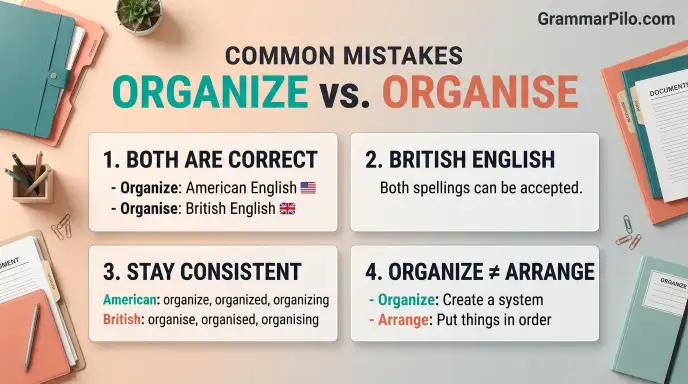
Although both spellings are correct, writers can still make mistakes by mixing styles or using related words incorrectly.
Mistake 1: Treating Organise as Always Wrong
Incorrect claim: “Organise is a spelling mistake.”
Correct explanation: Organise is a standard spelling in British English and other varieties that commonly use ise.
Example: “We need to organise the event.”
This sentence is correct in common British English.
Mistake 2: Treating Organize as Only American
Incorrect claim: “British writers must never use organize.”
Correct explanation: British English also accepts organize, especially in Oxford style writing.
Always follow the style guide that applies to your work.
Mistake 3: Mixing American and British Spellings
Inconsistent example: “We need to organize the files and organise the meeting.”
This mixes two spellings of the same verb within one sentence without a clear stylistic reason.
Consistent American English: “We need to organize the files and organize the meeting.”
Consistent British English: “We need to organise the files and organise the meeting.”
Mistake 4: Misspelling Related Forms
Writers sometimes change one form but forget the related words.
Common American forms:
- Organize
- Organized
- Organizing
- Organizer
- Organization
Common British forms:
- Organise
- Organised
- Organising
- Organiser
- Organisation
Choose a consistent set of spellings.
Mistake 5: Confusing Organize with Arrange
Organize and arrange have similar meanings, but they are not always interchangeable.
For example, you can arrange books on a shelf, while you might organize an entire library by subject.
Both words can be correct, but organize often suggests creating a system or managing several parts.
Organize or Organise in Everyday Examples
Both forms appear in emails, news articles, social media posts, schoolwork, and professional writing. The following examples show how to use them naturally.
In Emails
American English:
- I will organize the documents before the meeting.
- Could you organize the schedule for next week?
- We have organized the files by date.
British English:
- I will organise the documents before the meeting.
- Could you organise the schedule for next week?
- We have organised the files by date.
For a professional email, choose the spelling style used by your workplace and apply it consistently.
In News Articles
Examples:
- Local volunteers organize a clean up event every spring.
- The group organised a campaign to support families.
- The school will organize a public meeting next week.
- Residents are organising a community festival.
The spelling can vary by publication. News organizations generally follow their own style guides.
On Social Media
Examples:
- Time to organize my desk and clear my mind.
- We organised the best weekend trip!
- How do you organize your daily tasks?
- Friends are organizing a charity event.
For captions and posts, either form is fine as long as it matches the English style you prefer.
In Formal Writing
Examples:
- The report explains how to organize research data.
- The committee organised a review of the project.
- Businesses need to organize records carefully.
- The organization supports educational programs.
Formal writing benefits from consistent spelling, especially when documents are read by people in different countries.
In School Assignments
American English:
“My goal is to organize my notes every evening. This habit helps me prepare for exams and find important information quickly.”
British English:
“My goal is to organise my notes every evening. This habit helps me prepare for exams and find important information quickly.”
Both paragraphs are correct. The only difference is the spelling convention.
Organize vs Organise: Google Trends and Usage Data
People search for organize or organise, organise or organize, and organize vs. organise because they want to know which spelling is right for their audience.
Search interest can reveal common spelling questions, but it does not decide which spelling is correct.
Which Spelling Is More Popular?
Organize is the standard spelling in American English, while organise is widely used in British English and other regions that follow British spelling conventions.
Search frequency can vary by country, time period, and the type of content people are looking for. A higher search count for one spelling does not make the other incorrect.
Organize or Organise by Country
| Country or region | Common spelling |
| United States | Organize |
| United Kingdom | Organise, with organize also accepted |
| Australia | Organise |
| New Zealand | Organise |
| Canada | Both forms may appear, depending on style |
| International audiences | Either, used consistently |
These are general spelling conventions, not verified search volume rankings.
What Can Google Trends Tell You?
Google Trends can compare relative search interest for organize and organise across selected countries and time periods. It does not provide a simple count of every search made.
To make a fair comparison, use the same time range, region, and search settings for both terms. Review the results before making claims about which spelling is more popular in a particular country.
No verified live Trends figures are provided here, so exact percentages, rankings, or search volumes should not be assumed.
Why Do People Search for Organize vs Organise?
Common reasons include:
- Spelling checks: Writers want to choose the correct form.
- Regional differences: Readers want to understand American and British English.
- School assignments: Students need to follow a particular spelling style.
- Professional writing: Businesses want their documents to remain consistent.
- Content creation: Bloggers and editors want to match their target audience.
The key point is that both spellings are accepted. Your choice should reflect your audience and writing style.
Organize and Organise: Comparison Table of Keyword Variations
This table covers the main keyword variations and related forms.
| Keyword or phrase | Status | Explanation |
| Organize or organise | Correct comparison query | Both spellings are accepted. |
| Organise or organize | Correct comparison query | The same rule applies in reverse order. |
| Organize and organise | Correct phrase | Both forms can be discussed together. |
| Organise and organize | Correct phrase | Both spellings are valid. |
| Organize vs. organise | Correct comparison query | Compares regional spelling preferences. |
| Organise vs. organize | Correct comparison query | Same comparison, reversed order. |
| Organize | Standard American spelling | Used as a verb. |
| Organise | Common British spelling | Used as a verb. |
| Organized | Standard American form | Past tense or past participle. |
| Organised | Common British form | Past tense or past participle. |
| Organizing | Standard American form | Present participle. |
| Organising | Common British form | Present participle. |
| Organizer | Standard American noun | A person or tool that organizes. |
| Organiser | Common British noun | A person or tool that organises. |
| Organization | American spelling | A group or the act of organizing. |
| Organisation | Common British spelling | A group or the act of organising. |
Organize vs Organise: How to Remember the Difference
Use this simple memory trick:
- American English: Organize, organized, organizing.
- Common British English: Organise, organised, organising.
Think of the letter z in organize as a reminder of the spelling commonly used in the United States. Remember that British English also accepts organize in Oxford style spelling.
Frequently Asked Questions About Organize or Organise
1. Is organize or organise correct?
Both are correct. Organize is the standard American English spelling, while organise is common in British English and other varieties that follow British spelling conventions.
2. Is organise British or American English?
Organise is commonly used in British English, Australian English, and New Zealand English. American English normally uses organize.
3. Is organize accepted in British English?
Yes. British English accepts organize, particularly in Oxford style spelling. Many British publications, however, prefer organise.
4. Do organize and organise mean the same thing?
Yes. Both mean to arrange, plan, or manage something. The difference is spelling, not meaning.
5. Should I use organize or organise for an international audience?
Either can work. Choose one spelling style and use it consistently throughout your article, website, or document.
6. Is it organized or organised?
Both are correct. Organized is the standard American spelling, while organised is common in British English.
7. Is organization or organisation correct?
Both are correct. Organization is standard in American English and is also accepted in Oxford style British English. Organisation is common in British English.
Conclusion: Organize or Organise, Which Should You Choose?
The choice between organize or organise depends on the English spelling style you follow. Both words have the same meaning and are accepted forms of the verb. The difference is mainly regional, not grammatical.
In American English, organize is the standard form. Its related words include organized, organizing, organizer, and organization. In common British English, writers often use organise, organised, organising, organiser, and organisation. British English also accepts many ize forms, particularly under Oxford spelling conventions.
For school assignments, business emails, blog posts, and professional documents, follow the style guide required by your audience or publication. If there is no specific rule, choose American or British English and stay consistent.
Remember that neither organize nor organise is universally wrong. The best choice is the one that fits your readers and the spelling style of your writing.
The easiest rule to remember is this: Use organize for standard American English and organise for common British English. Both forms are correct when used consistently.
More Articles To Discover

I’m Claire Morgan, the author behind Grammarpilo.com, where I write about English grammar, sentence structure, punctuation, and everyday language. My goal is to make grammar simple, clear, and practical, helping readers understand the rules and apply them with confidence in real-world writing.








2 thoughts on “Organize or Organise: Which Spelling Is Correct in 2026?”