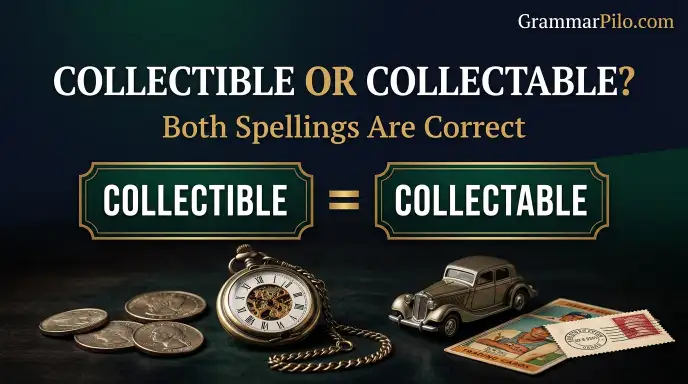
Collectible and collectable are both correct English spellings, and both describe something that people may collect or consider worth collecting.
The main difference is regional preference and common usage. Collectible is the more widely used spelling in American English, while collectable is also accepted in British English and other varieties of English.
These words often appear when people discuss coins, stamps, antiques, trading cards, toys, artwork, books, and other items that people save because of their rarity, historical importance, personal interest, or potential value.
If you are writing a product description, a blog post, an academic assignment, or an online listing, choosing the appropriate spelling can make your writing more consistent.
The confusion comes from the extra letter a in collectable. English has many words with alternative spellings, and not every variation follows exactly the same regional pattern. In this case, both forms are recognized, so one is not simply a misspelling of the other.
This guide explains the meaning, origin, regional usage, common mistakes, and practical examples of collectable and collectible. It also shows which spelling to choose for American, British, and international readers.
Quick Answer: Collectible or Collectable?
Both spellings are correct, but collectible is generally the preferred form in American English. Collectable is an accepted alternative, particularly in British English.
| Feature | Collectible | Collectable |
| Correct spelling | Yes | Yes |
| Meaning | Worthy of being collected | Worthy of being collected |
| American English | Preferred spelling | Accepted alternative, less common |
| British English | Used | Commonly accepted alternative |
| Meaningful difference | No major difference | No major difference |
| Best use | General and American English writing | British English or a consistent house style |
Example: The rare baseball card is a valuable collectible.
Example: The antique shop sells collectable coins and vintage toys.
Both sentences are correct. The choice usually depends on the style guide, regional audience, or spelling convention you are following.
Collectible and Collectable: Definition and Meaning
Both words describe something that can be collected, especially an object people value because of its rarity, appeal, history, or significance.
What Does Collectible Mean?
Collectible is an adjective meaning suitable or desirable for collecting. It can also be a noun referring to an item that people collect.
As an adjective, it describes an object that may interest collectors. As a noun, it identifies the object itself.
Examples of collectible as an adjective:
- The company released a collectible edition of its popular board game.
- This store specializes in collectible coins.
- The limited edition figure comes in collectible packaging.
- The museum displayed several collectible items from the twentieth century.
Examples of collectible as a noun:
- Vintage comic books are popular collectibles.
- She purchased a collectible at the antique market.
- The auction featured several rare collectibles.
- His collection includes sports memorabilia and other collectibles.
The word is especially common in American product descriptions, auction listings, hobby communities, and discussions about items that may gain value over time.
What Does Collectable Mean?
Collectable has the same basic meaning as collectible. It can function as an adjective or a noun, depending on how it appears in a sentence.
As an adjective, it describes something worth collecting. As a noun, it refers to an item collected by enthusiasts.
Examples of collectable as an adjective:
- The shop sells collectable stamps from different countries.
- The artist released a collectable series of miniature sculptures.
- Rare books can become highly collectable over time.
- The exhibition includes several collectable objects from the Victorian era.
Examples of collectable as a noun:
- The collector purchased three collectables at the fair.
- The auction featured unusual collectables from the 1950s.
- The store specializes in vintage collectables.
- Several collectables were displayed in glass cabinets.
Although the spelling differs, the meaning remains essentially the same.
Are Collectible and Collectable Interchangeable?
Yes. In ordinary usage, the two spellings are interchangeable because they express the same meaning.
However, it is sensible to follow one spelling consistently within a document. If your website uses American English, collectible is usually the natural choice. If you follow a British English style guide that prefers collectable, use that form throughout the relevant content.
The Origin and History of Collectible and Collectable
The two spellings developed from the same word family. Understanding their formation helps explain why both are accepted.
Where Does the Word Collectible Come From?
The word collectible is formed from collect and the suffix -ible. The verb collect came into English through French from Latin colligere, meaning to gather or bring together.
The suffix -ible is used to form adjectives that often express possibility or suitability. In collectible, it conveys the idea that an object is suitable or desirable to be collected.
The word later became especially useful in discussions of antiques, art, coins, stamps, toys, and other items that attract collectors.
Where Does the Word Collectable Come From?
The spelling collectable is formed from collect with the suffix -able. This suffix commonly creates adjectives meaning capable of being acted upon or suitable for a particular purpose.
For example, readable means easy or suitable to read, while washable means capable of being washed. By the same pattern, collectable means suitable for collecting.
Both suffixes can form words with similar meanings, which helps explain the coexistence of collectable and collectible.
Why Are There Two Spellings?
English spelling has developed through different historical influences, regional conventions, and patterns of word formation. Some words retain multiple accepted forms even when their meanings are identical.
In this case, both endings are recognized. The difference is mainly a matter of spelling preference and frequency rather than meaning.
Collectible vs. Collectable in British and American English
The most useful distinction is regional preference. American English generally favors collectible, while collectable is also established as an alternative, particularly in British English.
| Usage context | Collectible | Collectable |
| American English | Usually preferred | Accepted alternative |
| British English | Used and understood | Accepted and commonly encountered |
| Canadian English | Used | Also possible |
| Australian and New Zealand English | Used | Also possible |
| International websites | Widely recognizable | Recognizable |
| Product listings | Common, especially in US facing listings | Suitable when following a style that prefers it |
Regional preferences are not absolute rules. Individual publishers, retailers, museums, and collectors may use either spelling.
Collectible in American English
In American English, collectible is the usual choice in many dictionaries, commercial listings, hobby publications, and general writing.
Examples:
- The store sells collectible action figures.
- She collects collectible coins from different periods.
- The brand introduced a limited edition collectible.
- Rare baseball cards are popular collectibles in the United States.
If you are writing for an American audience, collectible is generally the safest default.
Collectable in British English
The spelling collectable is accepted in British English and appears in writing about antiques, art, coins, books, and other objects that attract collectors.
Examples:
- The shop offers collectable ceramics and vintage ornaments.
- The exhibition features collectable items from the early twentieth century.
- He purchased several collectable books at an auction.
- The market attracts people interested in rare collectables.
British writers can also encounter and use collectible. The choice should follow the publication’s spelling policy rather than an assumption that one form is incorrect.
Which Spelling Is Better for International Readers?
For an international audience, collectible is a strong default because it is widely recognized and particularly familiar in American English. However, collectable is also correct.
If your publication consistently follows British English, using collectable may better match its established style. The most important point is to avoid switching randomly between the two forms.
Which Spelling Should You Use?
The best choice depends on your audience and the style you want to maintain.
Use Collectible for American English
Choose collectible when writing for American readers, creating US product listings, or following an American English style guide.
Correct: She bought a rare collectible at the weekend market.
Correct: These collectible cards are popular among sports fans.
Use Collectable When Following a British English Preference
Choose collectable if your publication, organization, or preferred style guide uses that spelling.
Correct: The antique dealer specializes in collectable furniture.
Correct: Several collectables were sold at the charity auction.
Keep Your Spelling Consistent
Consistency makes a website or document look professionally edited. If a page begins with collectible, continue using that spelling unless you are quoting a source that uses collectable.
For example, an American English article should normally use collectible items, collectible toys, and collectibles throughout.
A British English article may instead use collectable items, collectable toys, and collectables if that is the chosen house style.
Consider Your Audience
If you are writing a product description for a US marketplace, collectible is usually the better option. If you are preparing content for a British publication, check its preferred dictionary or editorial guide.
Neither spelling changes the item’s actual value. Whether an object is rare, desirable, or financially valuable depends on the object and its market, not the spelling used to describe it.
Common Mistakes With Collectible and Collectable
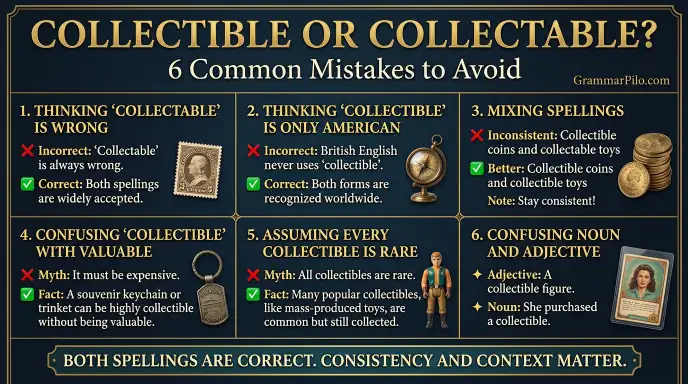
Although both spellings are accepted, writers can still make errors when choosing or using them.
Mistake 1: Assuming Collectable Is Always Wrong
Some writers believe that collectable is an incorrect spelling because they are more familiar with collectible.
Incorrect claim: Collectable is always a spelling mistake.
Correct explanation: Collectable is an accepted spelling with the same basic meaning as collectible.
Mistake 2: Assuming Collectible Is Only American
Although collectible is particularly common in American English, it is also used and understood in other English varieties.
Incorrect claim: British readers cannot use collectible.
Correct explanation: Both spellings are recognized, although regional and editorial preferences differ.
Mistake 3: Switching Between the Spellings Without a Reason
Using both forms in the same article may make the content look inconsistent.
Inconsistent: The shop sells collectible coins and collectable toys.
More consistent: The shop sells collectible coins and collectible toys.
The first sentence is understandable, but the second maintains a single spelling convention.
Mistake 4: Confusing Collectible With Valuable
A collectible item is something people collect or consider desirable for collecting. It is not necessarily expensive.
Example: A souvenir keychain may be a collectible even if it has little resale value.
Some collectibles become valuable because of rarity, demand, condition, or historical significance. Others remain inexpensive hobby items.
Mistake 5: Assuming Every Collectible Is Rare
An item can be collectible without being unique or scarce. Some products are deliberately manufactured in large quantities for collectors.
Example: The company released a collectible toy available in thousands of stores.
The adjective describes its intended appeal to collectors, not a guarantee of rarity.
Mistake 6: Confusing the Adjective With the Noun
Both words can be used as adjectives or nouns, so their grammatical role depends on the sentence.
Adjective: She purchased a collectible figure.
Noun: She purchased a collectible.
Both sentences are correct. In the first, the word describes a figure. In the second, it names the item itself.
Collectible and Collectable in Everyday Examples
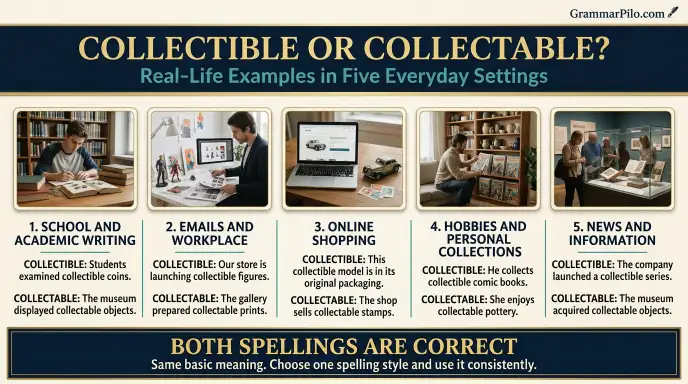
The following examples demonstrate how both spellings work in common situations.
In School and Academic Writing
Collectible: The students examined collectible coins as part of their history project.
Collectable: The museum displayed collectable objects from the Victorian period.
Collectible: Our class researched the history of collectible trading cards.
Collectable: The assignment discussed collectable books and their cultural importance.
Both forms are correct. Follow the spelling convention used by your school or publication.
In Emails and Workplace Communication
Collectible: Our store is launching a new range of collectible figures next month.
Collectable: The gallery is preparing a display of collectable prints.
Collectible: Please update the product page to include details about the collectible edition.
Collectable: The auction catalogue includes several collectable antiques.
In Online Shopping
Collectible: This collectible model comes in its original packaging.
Collectable: The shop specializes in collectable stamps and vintage postcards.
Collectible: The limited edition collectible is available while supplies last.
Collectable: Each collectable item is described in the online catalogue.
Retailers should use the spelling that matches their target market and editorial style.
In Hobbies and Personal Collections
Collectible: He has a large collection of collectible comic books.
Collectable: She enjoys searching for collectable pottery at antique fairs.
Collectible: The sports fan bought a collectible jersey signed by a famous player.
Collectable: Their display cabinet contains several collectable ornaments.
In News and Informational Writing
Collectible: The company announced a new collectible series for fans.
Collectable: The museum acquired several collectable objects for its exhibition.
Collectible: Collectible cards can attract interest from fans and hobbyists.
Collectable: Rare collectable books sometimes appear at specialist auctions.
These examples show that the spelling changes, but the basic meaning does not.
Collectable vs. Collectible: Side by Side Comparison
Use this reference table when you need to decide which spelling fits your writing.
| Comparison point | Collectible | Collectable |
| Correct spelling | Yes | Yes |
| Part of speech | Noun or adjective | Noun or adjective |
| Basic meaning | Suitable or desirable for collecting | Suitable or desirable for collecting |
| American preference | Usually preferred | Less common alternative |
| British usage | Accepted and used | Accepted, often preferred by some styles |
| Refers to rare items only | No | No |
| Guarantees financial value | No | No |
| Suitable for formal writing | Yes | Yes |
| Best editorial practice | Follow one spelling consistently | Follow one spelling consistently |
The simplest rule is to choose the spelling that matches your intended audience and apply it consistently.
Google Trends and Modern Usage
Both collectible and collectable appear in modern writing about antiques, coins, stamps, toys, trading cards, books, art, memorabilia, and limited edition merchandise.
The spelling collectible is widely used in American commercial content, while collectable is also established in British and other English language contexts.
Actual search interest can vary depending on the item being discussed and the country in which the search is performed.
Comparing Search Intent
People searching for these terms may want to:
- Find collectable or collectible products.
- Learn the correct spelling.
- Research antiques and vintage objects.
- Discover the value of coins, cards, toys, or memorabilia.
- Compare regional spelling preferences.
A search for collectible may reflect an interest in products or collections rather than a spelling question. Similarly, a search for collectable does not necessarily mean the person is unsure about spelling.
How to Check Current Search Interest
Google Trends can help compare the relative search interest for collectible and collectable over a selected period and in a selected region.
The results should be interpreted carefully because Google Trends reports normalized relative interest rather than a direct count of all searches. The comparison can also change depending on location, date range, and topic selection.
Exact current figures should be verified in Google Trends before publication. Without a live comparison, it would be misleading to claim a precise search volume difference between the two spellings.
Frequently Asked Questions
1. Is collectable or collectible correct?
Both spellings are correct. Collectible is generally preferred in American English, while collectable is an accepted alternative, particularly in British English.
2. What is the difference between collectible and collectable?
There is no major difference in meaning. Both words describe something that can be collected or is desirable to collectors. The main distinction is spelling preference and usage frequency.
3. Is collectable British English and collectible American English?
That is a useful general guideline, but it is not an absolute rule. Collectible is especially common in American English, and collectable is accepted in British English. Both forms can appear in different English speaking regions.
4. Should I write collectible items or collectable items?
Both phrases are correct. Use collectible items for a typical American English style. Use collectable items if your British English style guide or publication prefers that form.
5. Is collectible a noun or an adjective?
It can be either. In “a collectible toy,” it is an adjective describing the toy. In “the shop sells collectibles,” it is a noun referring to items people collect.
6. Does collectible mean valuable?
Not necessarily. A collectible is an item that people collect or consider desirable for collecting. Some collectibles are valuable, but others have little financial value.
7. What is the plural of collectible and collectable?
The plural forms are collectibles and collectables. Both are correct. Choose the form that matches the spelling convention used in the rest of your writing.
Conclusion: Choosing Between Collectible and Collectable
The words collectible and collectable have the same basic meaning. Both can describe an object that people collect because of its appeal, rarity, history, personal significance, or potential market value. The difference is primarily regional preference and spelling style, not definition.
For American English writing, collectible is generally the safest choice. The alternative collectable is also correct and may suit a British English publication or a style guide that prefers it. Readers will normally understand either form.
When writing articles, product descriptions, auction listings, or educational content, choose one spelling and use it consistently. Also remember that an item does not need to be rare or expensive to be considered collectible. The term describes its connection with collecting, not a guarantee of financial worth.
In short, you do not need to treat collectable as a misspelling of collectible. Both are accepted forms. For a general American English audience, use collectible; for other audiences, follow the preferred spelling of the publication or region.
Read More From GrammarPilo

I’m Claire Morgan, the author behind Grammarpilo.com, where I write about English grammar, sentence structure, punctuation, and everyday language. My goal is to make grammar simple, clear, and practical, helping readers understand the rules and apply them with confidence in real-world writing.





1 thought on “Collectible or Collectable: The Spelling Difference Clearly Explained”