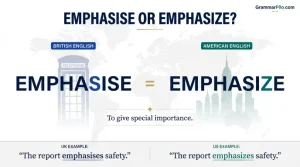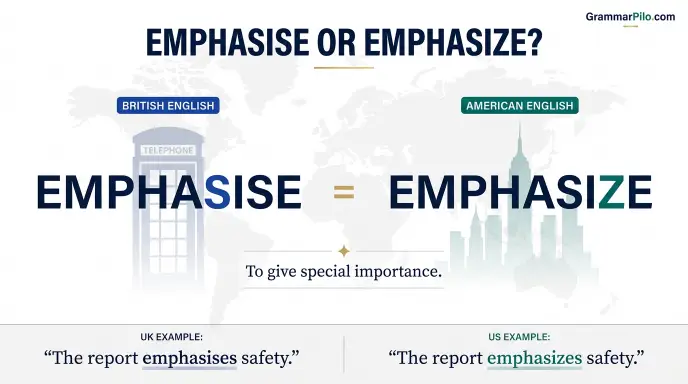
Emphasise and emphasize have the same meaning, but emphasize is the standard American English spelling, while emphasise is the standard British English spelling.
Both words mean to give special importance, attention, or prominence to something. For example, an American writer might say, “The teacher wants to emphasize the importance of regular practice,” while a British writer would typically write, “The teacher wants to emphasise the importance of regular practice.”
This spelling difference often confuses students, bloggers, editors, and professionals who write for international audiences. The good news is that neither spelling is inherently incorrect. The right choice depends primarily on the variety of English you are following and the consistency of your writing.
Both forms are used in education, business communication, academic papers, news articles, and everyday conversations. Their pronunciation and grammatical functions are essentially the same. The difference is the letter z in American English and s in British English.
In this guide, you will learn the meanings of emphasise and emphasize, understand their spelling differences, explore common mistakes, and see practical examples that will help you choose the appropriate form for your audience.
Quick Answer
Emphasize is the preferred spelling in American English, while emphasise is the preferred spelling in British English and many other varieties that follow British spelling conventions.
Both words mean to highlight, stress, or give special importance to an idea, fact, or detail. For example, American writers use “emphasize the benefits,” while British writers commonly use “emphasise the benefits.”
Emphasise vs. Emphasize at a Glance
The difference between emphasize and emphasise is a spelling variation rather than a difference in meaning.
| Feature | Emphasise | Emphasize |
| Preferred variety | British English | American English |
| Meaning | To give special importance | To give special importance |
| Word type | Verb | Verb |
| Pronunciation | Essentially the same | Essentially the same |
| Present tense | Emphasise | Emphasize |
| Past tense | Emphasised | Emphasized |
| Present participle | Emphasising | Emphasizing |
| Noun form | Emphasis | Emphasis |
| Example | The report emphasises safety. | The report emphasizes safety. |
Easy memory trick: British spelling commonly uses s in emphasise, while American spelling uses z in emphasize.
What Does Emphasise Mean?
Emphasise is a verb used mainly in British English and other English varieties that follow British spelling conventions. It means to highlight something, draw attention to it, or make it seem especially important.
Writers use emphasise when they want readers or listeners to focus on a particular idea, fact, quality, or message.
Emphasise as Giving Importance
When you emphasise something, you show that it deserves particular attention.
Examples include the following:
- The teacher emphasised the importance of reading every day.
- The manager wants to emphasise teamwork during the meeting.
- The article emphasises the need for accurate information.
- Our school emphasises respect and responsibility.
- The speaker emphasised the value of continuous learning.
In each sentence, emphasise highlights a particular point or quality.
Emphasise in Speaking
Emphasise can also describe the way someone stresses a word or phrase while speaking.
Examples include the following:
- She emphasised the word never to make her meaning clear.
- The presenter emphasised the final point during the discussion.
- He emphasised the importance of patience by speaking slowly.
- The teacher asked students to emphasise the key words when reading aloud.
In these examples, emphasis may be communicated through voice, timing, or pronunciation.
Emphasise in Writing
Writers can emphasise information through word choice, sentence structure, repetition, or formatting.
Examples include the following:
- The report emphasises three major findings.
- The author emphasised the risks in the opening paragraph.
- The editor asked me to emphasise the main recommendation.
- The conclusion emphasises the importance of further research.
The spelling emphasise is especially appropriate when preparing documents for a British audience or an organization that uses British English conventions.
What Does Emphasize Mean?
Emphasize is the standard American English spelling of the same verb. It means to give special importance to something, highlight a point, or make an idea more noticeable.
The meaning, pronunciation, and grammatical use are essentially the same as those of emphasise.
Emphasize as Highlighting an Idea
Use emphasize when you want to show that something is particularly important.
Examples include the following:
- The teacher emphasized the value of regular practice.
- The company emphasizes customer satisfaction.
- The report emphasized the need for stronger security.
- The coach emphasizes discipline and teamwork.
- The article emphasizes the benefits of clear communication.
These examples follow standard American spelling conventions.
Emphasize in Professional Communication
In business and workplace writing, emphasize helps writers identify priorities, explain expectations, and highlight important information.
Examples include the following:
- I want to emphasize the importance of meeting the deadline.
- The director emphasized the need for better coordination.
- Our presentation emphasizes the company’s main achievements.
- The policy emphasizes safety and accountability.
American organizations commonly use emphasize in reports, presentations, emails, and formal documents.
Emphasize in Academic Writing
Academic writers use emphasize when highlighting a conclusion, research finding, or central argument.
Examples include the following:
- The study emphasizes the relationship between sleep and learning.
- The researcher emphasized the limitations of the experiment.
- The paper emphasizes the need for additional evidence.
- The conclusion emphasizes the practical value of the findings.
If your academic institution follows American English, emphasize is generally the appropriate choice.
The Main Difference Between Emphasise and Emphasize
The main difference is regional spelling. Both words communicate the same idea, so the choice does not change the meaning of a sentence.
| Sentence | British English | American English |
| Present tense | Teachers emphasise practice. | Teachers emphasize practice. |
| Past tense | She emphasised the issue. | She emphasized the issue. |
| Present participle | They are emphasising safety. | They are emphasizing safety. |
| Future tense | We will emphasise quality. | We will emphasize quality. |
| Formal writing | The report emphasises the findings. | The report emphasizes the findings. |
Why Does the Spelling Change?
The difference reflects broader spelling conventions in English. American English often uses z in words where British English commonly uses s, including several verbs ending in -ise or -ize.
Examples of similar spelling differences include the following:
- Organise or organize
- Realise or realize
- Recognise or recognize
- Apologise or apologize
- Prioritise or prioritize
The pattern is common, but it is important to check the accepted spelling of each word because not every word follows the same regional pattern.
Does the Meaning Change?
No. Emphasise and emphasize have the same basic meaning. Neither spelling suggests a stronger or weaker level of importance.
For example, these sentences mean the same thing:
- The speaker emphasised the importance of honesty.
- The speaker emphasized the importance of honesty.
The only difference is the spelling convention used by the writer.
Emphasise or Emphasize in American and British English
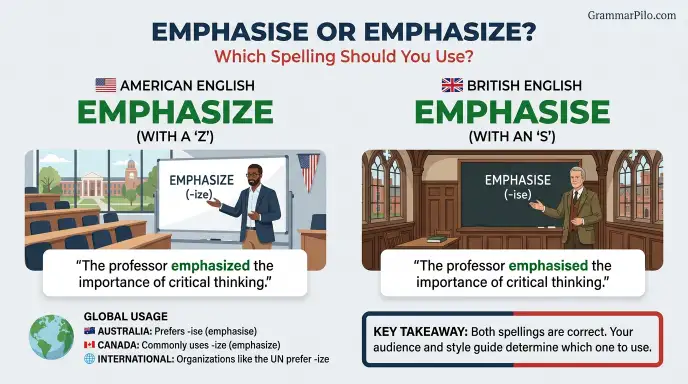
Choosing the correct spelling depends on your intended audience, publication style, or organization’s writing guidelines.
American English
In American English, emphasize is the standard spelling.
Examples include the following:
- The professor emphasized the importance of critical thinking.
- The report emphasizes the company’s achievements.
- We should emphasize the main benefits in the presentation.
- The manager emphasized the need for teamwork.
Use the z spelling when writing for most U.S. publications, businesses, schools, and American English websites.
British English
In British English, emphasise is a common and standard spelling.
Examples include the following:
- The professor emphasised the importance of critical thinking.
- The report emphasises the company’s achievements.
- We should emphasise the main benefits in the presentation.
- The manager emphasised the need for teamwork.
The s spelling is common in British publications and organizations that follow British spelling conventions.
What About Australia, Canada, and Other English-Speaking Regions?
Usage varies by country and style guide. British style emphasise is common in Australian English, while Canadian English often follows a mixture of British and American conventions. Some Canadian style guides and publications use emphasize.
If you are writing for an international audience, check the publication’s style guide. Consistency is more important than treating one spelling as universally correct.
Which Spelling Should You Use?
| Audience | Recommended spelling |
| United States | Emphasize |
| United Kingdom | Emphasise |
| Australia | Emphasise is commonly used |
| Canada | Check the relevant style guide |
| International audience | Follow the chosen publication style |
| GrammarPilo article for U.S. readers | Emphasize |
For a website targeting American readers, emphasize is generally the best default. If an article is specifically written for British readers, use emphasise and the related British forms consistently.
Common Mistakes When Using Emphasise or Emphasize
Although the spelling difference is simple, writers sometimes make mistakes when changing between English varieties or using related word forms.
Mistake 1: Treating One Spelling as Universally Incorrect
Incorrect claim: Emphasise is always wrong.
Correct explanation: Emphasise is standard in British English, while emphasize is standard in American English.
The spelling should match the variety of English used throughout the document.
Mistake 2: Mixing British and American Forms
Inconsistent: The report emphasises safety and emphasizes efficiency.
Better in American English: The report emphasizes safety and emphasizes efficiency.
Better in British English: The report emphasises safety and emphasises efficiency.
Writers should normally maintain one spelling convention throughout an article unless they are quoting a source or discussing regional differences.
Mistake 3: Using the Wrong Past Tense Form
American English: The teacher emphasized the key point.
British English: The teacher emphasised the key point.
The past-tense ending follows the spelling convention selected for the base verb.
Mistake 4: Confusing Emphasize With Emphasis
Incorrect: The report gives emphasize to safety.
Better: The report places emphasis on safety.
Also correct: The report emphasizes safety.
Emphasize is a verb, while emphasis is a noun. They are related, but they do not fit into exactly the same grammatical structures.
Mistake 5: Using Emphasize When a More Precise Verb Is Needed
Emphasize is useful, but some contexts call for a more specific word.
For example, instead of “The report emphasizes the error,” you might write “The report identifies the error” if the purpose is to point it out rather than stress its importance.
Other alternatives include highlight, stress, underline, and underscore. The best choice depends on the intended meaning.
Emphasise or Emphasize in Everyday Examples
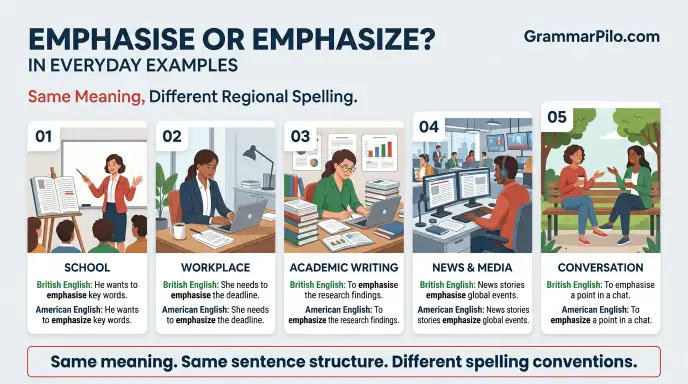
The following examples show how both spellings work in common situations. Each pair communicates the same meaning but follows a different regional spelling convention.
In School
British English: The teacher emphasised the importance of completing homework.
American English: The teacher emphasized the importance of completing homework.
British English: Our textbook emphasises grammar and vocabulary.
American English: Our textbook emphasizes grammar and vocabulary.
In Emails and Workplace Communication
British English: I would like to emphasise the importance of meeting the deadline.
American English: I would like to emphasize the importance of meeting the deadline.
British English: The manager emphasised the need for clear communication.
American English: The manager emphasized the need for clear communication.
In Academic Writing
British English: The research emphasises the relationship between exercise and well-being.
American English: The research emphasizes the relationship between exercise and well-being.
British English: The author emphasised the limitations of the study.
American English: The author emphasized the limitations of the study.
In News and Media
British English: The report emphasises the need for further investigation.
American English: The report emphasizes the need for further investigation.
British English: The spokesperson emphasised the government’s priorities.
American English: The spokesperson emphasized the government’s priorities.
In Everyday Conversation
British English: I want to emphasise one important point.
American English: I want to emphasize one important point.
British English: She emphasised that everyone should arrive on time.
American English: She emphasized that everyone should arrive on time.
These examples show that the meaning and sentence structure remain the same regardless of the spelling variation.
Emphasise vs. Emphasize: Word Forms Compared
The spelling difference continues in related verb forms. The noun emphasis and the adjective emphatic do not change in the same way.
| Word form | British English | American English |
| Base verb | Emphasise | Emphasize |
| Third-person singular | Emphasises | Emphasizes |
| Past tense | Emphasised | Emphasized |
| Past participle | Emphasised | Emphasized |
| Present participle | Emphasising | Emphasizing |
| Noun | Emphasis | Emphasis |
| Adjective | Emphatic | Emphatic |
Examples include the following:
- British: She emphasises the need for accuracy.
- American: She emphasizes the need for accuracy.
- British: They are emphasising the main benefits.
- American: They are emphasizing the main benefits.
- Both varieties: The emphasis is on accuracy.
Remember that the noun emphasis keeps the same spelling in both varieties of English.
Emphasize vs. Emphasise: Google Trends and Modern Usage
Emphasise and emphasize are established spelling variants used in British and American English. Their use often reflects the country, publication, school, or organization that a writer is addressing.
The spelling emphasize is appropriate for most American English content, while emphasise is common in British English and other contexts that follow British spelling conventions. Both forms appear in educational materials, academic writing, workplace communication, and online articles.
People may search for both spellings when checking grammar, editing documents, preparing assignments, or deciding which regional style to follow. The related words emphasis and emphasized may also appear in searches about word meaning and grammar.
Search interest can change according to region and time. No verified live Google Trends figures are included here, so exact search volumes or rankings should not be assumed.
To compare current interest, enter “emphasise” and “emphasize” into Google Trends and select the country and time period you want to investigate.
A Simple Trick to Remember Emphasise and Emphasize
The easiest way to remember the difference is to connect the spelling with your audience.
- Emphasise: Use the s spelling for British English.
- Emphasize: Use the z spelling for American English.
Try remembering these paired sentences.
British English: The teacher will emphasise the main idea.
American English: The teacher will emphasize the main idea.
Both sentences are correct. The only change is the letter used in the verb.
If you are writing for a particular publication, check its style guide before making a final decision. Once you choose a regional spelling convention, use it consistently in the base verb, past tense, and present participle.
Frequently Asked Questions
1. Is emphasize or emphasise correct?
Both spellings are correct. Emphasise is standard in British English, while emphasize is standard in American English. The two words have the same meaning.
2. What is the main difference between emphasize and emphasise?
The main difference is regional spelling. British English commonly uses emphasise, while American English uses emphasize. Both mean to give special importance or attention to something.
3. Is emphasize American or British English?
Emphasize is the standard American English spelling. It is also used by some publications outside the United States, including Canadian sources that follow -ize conventions.
4. Is emphasise British English?
Yes. Emphasise is a standard British English spelling. It is also common in Australian English and other contexts that follow British spelling conventions.
5. Is emphasise incorrect in American English?
It is not the preferred spelling in standard American English. American writers should generally use emphasize, particularly when following U.S. dictionaries, school standards, or publication style guides.
6. Do emphasise and emphasize have different meanings?
No. They have the same meaning, pronunciation, and grammatical function. Both mean to highlight, stress, or give importance to a point.
7. What is the past tense of emphasise or emphasize?
The British spelling is emphasised, and the American spelling is emphasized. For example, “The speaker emphasised the issue” is British English, while “The speaker emphasized the issue” is American English.
8. Is it emphasising or emphasizing?
Both forms are correct. Emphasising follows British spelling conventions, while emphasizing follows American spelling conventions.
9. Does Canada use emphasize or emphasise?
Canadian usage varies by publisher and style guide. Some Canadian sources use emphasize, while others may follow British-style emphasise. Follow the spelling convention required by your institution or publication.
10. Which spelling should I use on an American English website?
Use emphasize if your website follows American English. Keep related forms consistent by using emphasizes, emphasized, and emphasizing throughout the article.
Conclusion
Emphasise and emphasize are two correct spellings of the same English verb. Both mean to highlight an idea, stress an important point, or draw attention to a particular detail. The key difference is regional spelling rather than meaning or pronunciation.
Emphasise is the preferred spelling in British English and is also common in Australian English. Emphasize is the standard spelling in American English and is used by some other publications that follow -ize conventions. Canadian usage can vary, so checking the relevant style guide is a sensible approach.
The spelling distinction also affects related verb forms. British English uses emphasises, emphasised, and emphasising, while American English uses emphasizes, emphasized, and emphasizing. However, the noun emphasis is spelled the same way in both varieties.
For writers, students, editors, and website owners, the most important rule is consistency. Choose the spelling that matches your intended audience, then apply it throughout the document.
Remember the simple rule: emphasise for British English and emphasize for American English. With this distinction in mind, you can use both forms accurately and confidently.
Keep Exploring Word Comparisons
- Bitting or Biting: The Easy to Miss Difference Explained in 2026
- Prioritise or Prioritize: The Correct Spelling for Your Audience
- Frolic or Frolick: Small Spelling Mistake That Can Change Writing

I’m Claire Morgan, the author behind Grammarpilo.com, where I write about English grammar, sentence structure, punctuation, and everyday language. My goal is to make grammar simple, clear, and practical, helping readers understand the rules and apply them with confidence in real-world writing.