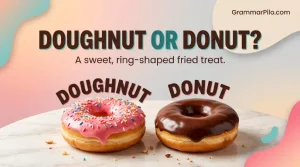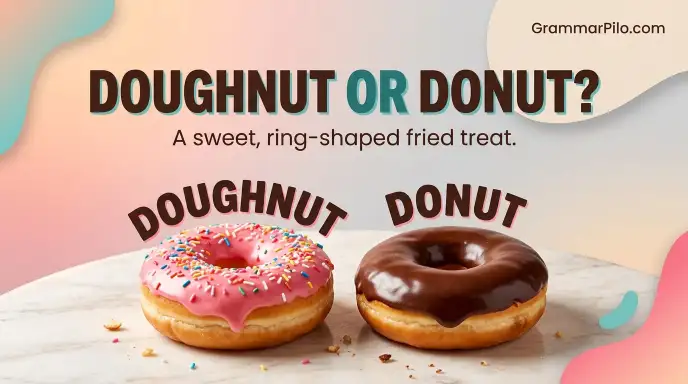
Both doughnut and donut are correct English spellings. Doughnut is the traditional and more widely used form in British English, while donut is especially common in American English.
Both words refer to the same sweet, usually ring shaped or filled pastry that is often fried and covered with sugar, icing, or other toppings.
People often search for doughnut or donut because they see both spellings on bakery menus, food packages, restaurant signs, and social media posts. One shop may advertise fresh doughnuts, while another sells glazed donuts.
This difference can make writers wonder if one spelling is incorrect or if the words describe different foods.
The good news is that you can use either spelling without changing the meaning. The choice usually depends on your audience, preferred writing style, or the spelling used by a particular brand.
In the United States, donut is especially familiar because of its widespread use in restaurant names and advertising. However, doughnut remains correct and is also used by many American writers and businesses.
This guide explains the meaning, history, regional differences, common mistakes, and everyday uses of doughnut and donut. You will also learn which spelling works best for British English, American English, and international writing.
Quick Answer: Doughnut or Donut?
Doughnut is the traditional spelling, while donut is a shorter alternative that is especially popular in American English. Both forms are correct and have the same meaning.
| Spelling | Common usage | Example |
| Doughnut | British English and traditional writing | I bought a chocolate doughnut. |
| Donut | Common in American English | I bought a chocolate donut. |
Easy rule to remember: Use doughnut if you prefer the traditional spelling or are following British English conventions. Use donut if you are writing for an American audience and prefer the shorter, familiar form.
Neither spelling is automatically wrong. Both describe the same type of food.
Definition and Meaning of Doughnut and Donut
The words doughnut and donut are nouns that refer to a sweet pastry commonly made from dough. It is usually fried, although baked versions are also available.
What Does Doughnut Mean?
Doughnut is the traditional spelling of the word. It describes a sweet pastry that may be shaped like a ring or filled with ingredients such as jam, cream, or custard.
Doughnuts come in many varieties, including:
- Glazed doughnuts: Covered with a sweet glaze.
- Chocolate doughnuts: Topped with chocolate icing or coating.
- Jelly doughnuts: Filled with jam or fruit jelly.
- Cream filled doughnuts: Filled with whipped cream or custard.
- Ring doughnuts: Shaped with a hole in the centre.
- Powdered doughnuts: Covered with powdered sugar.
The spelling doughnut is common in British English and is also used in the United States.
What Does Donut Mean?
Donut has the same meaning as doughnut. It is a shorter spelling that became especially popular in American English.
Examples include:
- I bought a glazed donut for breakfast.
- The bakery sells fresh donuts every morning.
- She ordered a box of chocolate donuts.
- We stopped for coffee and donuts on the way home.
The shorter spelling is common in menus, advertising, restaurant branding, and everyday American writing.
Are Doughnut and Donut Different Foods?
No. The two spellings do not describe different foods. A glazed doughnut and a glazed donut can be exactly the same pastry.
The difference lies in spelling and usage, not ingredients, shape, taste, or preparation.
The Origin and History of Doughnut and Donut
The history of these spellings helps explain why both forms remain in use today.
Where Does the Word Doughnut Come From?
The word doughnut combines dough, the mixture used to make bread and pastries, with nut. The exact historical reason for the second part of the word is not entirely certain.
One explanation links early doughnuts to small pieces of dough that resembled nuts in size or shape. Early versions of the food were not always shaped like the familiar ring we see today. Some were small pieces of fried dough, and others had fillings.
The spelling doughnut became established in English and remains the traditional form in many dictionaries and publications.
Where Does the Word Donut Come From?
Donut is a simplified spelling of doughnut. It became especially familiar in the United States, where shorter spellings often work well for signs, menus, advertising, and brand names.
The spelling is easy to read and quick to write. Its popularity grew through American food culture and commercial use.
Today, donut is widely recognized in American English, although doughnut has never disappeared from American writing.
Why Are There Two Spellings?
English often has alternative spellings that develop through everyday use, regional preferences, or simplified forms.
Examples include:
- Doughnut and donut: Traditional and shortened spellings.
- Though and tho: Standard and informal shortened forms.
- Through and thru: Standard and informal or commercial alternatives.
- Night and nite: Standard and informal alternative spellings.
These examples are not identical in formality or usage, but they show how spelling variations can become familiar over time.
For doughnut and donut, both forms are accepted. The best choice depends on your writing context and audience.
British English vs. American English Spelling
The main difference between doughnut and donut is regional preference. British English generally favours doughnut, while American English frequently uses donut.
| Feature | Doughnut | Donut |
| Spelling type | Traditional form | Shortened alternative |
| British English | Common | Recognized, but less traditional |
| American English | Also correct | Especially common |
| Meaning | Sweet pastry | Sweet pastry |
| Suitable for formal writing | Yes | Yes, depending on style |
| Common in advertising | Yes | Especially popular in the US |
Doughnut in British English
British English commonly uses doughnut in everyday writing, recipes, food descriptions, and bakery menus.
Examples include:
- The bakery makes fresh doughnuts every morning.
- Would you like a jam doughnut with your tea?
- The children decorated their doughnuts with colourful icing.
- We bought a box of doughnuts for the party.
The traditional spelling is a reliable choice for British readers.
Donut in American English
American English often uses donut, particularly in informal writing and commercial settings.
Examples include:
- I grabbed a donut before work.
- The shop sells coffee and fresh donuts.
- He ordered a dozen glazed donuts for the office.
- The kids decorated their donuts with sprinkles.
American writers also use doughnut, so the traditional spelling is not incorrect in the United States.
Which Spelling Is More Popular in the United States?
Both spellings are used in the United States, but donut is especially visible in restaurant names, advertising, and everyday commercial language.
The shorter form is familiar to many American readers because it appears on signs, packaging, and menus. However, dictionaries, recipes, and publications may use either spelling.
It is more accurate to describe donut as especially popular in American usage than to claim that doughnut is wrong or obsolete.
Which Spelling Should You Use?
Your audience and the purpose of your writing can help you decide between doughnut and donut.
Use Doughnut for Traditional or British English
Choose doughnut when you want the traditional spelling or are writing for a British audience.
This form works well in:
- British school assignments.
- Traditional recipes and cookbooks.
- Food articles written for British readers.
- Formal descriptions and general editorial writing.
- Publications that prefer traditional spelling.
Example: The bakery sells freshly baked doughnuts filled with raspberry jam.
Use Donut for American English
Choose donut when writing for an American audience, especially if the context is casual, commercial, or food related.
This form works well in:
- American restaurant menus.
- Bakery advertisements.
- Social media captions.
- Informal food blogs.
- Marketing materials aimed at American customers.
Example: Stop by our shop for fresh donuts and hot coffee.
What Should International Writers Use?
For an international audience, either spelling is understandable. Choose one form and use it consistently throughout your content.
If your article targets British readers, doughnut is a sensible default. If it targets American readers, donut may feel more familiar.
And if you are writing about a business with a specific name or spelling, preserve the brand’s official spelling. Brand names do not need to follow your preferred general writing style.
Common Mistakes When Using Doughnut or Donut
Although both spellings are correct, writers can still make mistakes when choosing between them.
Assuming Donut Is Incorrect
Some people believe donut is simply a misspelling of doughnut. This is not accurate. Donut is an established alternative spelling, especially in American English.
Correct: I bought a glazed donut.
Also correct: I bought a glazed doughnut.
Both sentences describe the same food.
Assuming Doughnut Is Outdated
The traditional spelling doughnut is still widely used. It appears in recipes, dictionaries, publications, and everyday writing in both British and American English.
Although donut is popular in the United States, this does not make doughnut old fashioned or incorrect.
Mixing Spellings Without a Reason
Using both spellings in the same article can make your writing look inconsistent.
For example, you might write “Our bakery sells fresh doughnuts” in one section and “Try our chocolate donuts” in another. This could be intentional if you are quoting a brand or discussing regional usage, but otherwise it is better to choose one form.
Better approach: Select a preferred spelling and apply it throughout your article, menu, or document.
Confusing Spelling With Food Type
Some writers think a doughnut must have a hole while a donut can be filled. This is incorrect.
Both spellings can describe ring shaped pastries and filled pastries. The shape and filling depend on the type of doughnut, not the spelling.
Forgetting the Plural Form
Both words form their plural by adding s.
- One doughnut, two doughnuts.
- One donut, two donuts.
Both plural forms are correct.
Everyday Examples of Doughnut and Donut
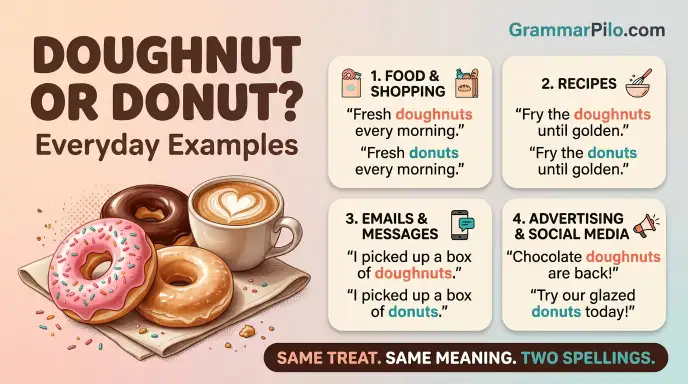
The following examples show how each spelling works in everyday situations.
Examples in Food and Shopping
Doughnut examples:
- I bought a cinnamon doughnut from the bakery.
- The shop sells fresh doughnuts every morning.
- She chose a cream filled doughnut for dessert.
- We ordered a dozen doughnuts for the celebration.
Donut examples:
- I bought a cinnamon donut from the bakery.
- The shop sells fresh donuts every morning.
- She chose a cream filled donut for dessert.
- We ordered a dozen donuts for the celebration.
The meaning remains the same in both sets of examples.
Examples in Recipes
A recipe may use either spelling in its title or instructions.
Doughnut recipe: Mix the ingredients, prepare the dough, and fry the doughnuts until golden.
Donut recipe: Mix the ingredients, prepare the dough, and fry the donuts until golden.
The spelling does not change the cooking process.
Examples in Emails and Messages
Both spellings are suitable for casual communication.
Using doughnut:
“Hi, I picked up a box of doughnuts for tomorrow’s meeting. Please let me know if you would like any.”
Using donut:
“Hi, I picked up a box of donuts for tomorrow’s meeting. Please let me know if you would like any.”
Choose the spelling that fits your usual writing style or your audience.
Examples in Advertising and Social Media
Businesses often choose the spelling that best fits their brand identity.
- Fresh doughnuts made every morning!
- Get your favourite donuts with a cup of coffee.
- Chocolate doughnuts are back on the menu.
- Try our new glazed donuts today.
Both spellings are clear and suitable for promotional writing.
Google Trends and Modern Usage: Donut and Doughnut
Doughnut and donut both appear in online searches related to food, recipes, bakeries, and spelling questions.
Why Do People Search for Doughnut or Donut?
People may see one spelling in a recipe and another on a shop sign. They often want to know if the words have different meanings or if one form is more correct.
Common searches include:
- doughnut or donut
- donut vs. doughnut
- doughnut vs. donut
- doughnuts or donuts
- how to spell doughnut
- how to spell donut
- doughnut meaning
These searches reflect both a spelling question and an interest in food related information.
What Does Modern Usage Suggest?
The shorter spelling donut is especially familiar in American commercial settings, including restaurant branding, menus, and advertising. The traditional spelling doughnut remains widely used in British English and in American writing.
Online usage can vary by location, publisher, business, and subject. Recipe websites may use either form, while a particular restaurant may use only the spelling in its official name.
Exact search interest changes over time. Without checking current Google Trends data, it would be misleading to provide specific search numbers or claim that one spelling is always more popular worldwide.
Practical takeaway: Choose the spelling that fits your readers and keep it consistent.
Doughnut vs. Donut: Comparison Table
This table summarises the main differences and similarities.
| Feature | Doughnut | Donut |
| Meaning | Sweet pastry | Sweet pastry |
| Spelling style | Traditional | Shortened alternative |
| Common regional association | British English | American English |
| Correct spelling | Yes | Yes |
| Plural form | Doughnuts | Donuts |
| Can be ring shaped | Yes | Yes |
| Can be filled | Yes | Yes |
| Used in recipes | Yes | Yes |
| Used in advertising | Yes | Yes |
Doughnut or Donut: Which Is Correct?
Both are correct. Doughnut is the traditional spelling, while donut is a popular alternative, especially in American English.
Donut or Doughnut: Is One More Formal?
Neither spelling is automatically more formal. Doughnut may be preferred in traditional or British English writing, while donut is common in American commercial and everyday usage.
Doughnuts or Donuts: Which Plural Is Correct?
Both doughnuts and donuts are correct plural forms. The choice depends on the spelling you use for the singular noun.
Doughnut and Donut: Do They Taste Different?
No. The spelling does not affect the ingredients, taste, shape, or preparation. A doughnut and a donut can be the same pastry.
Frequently Asked Questions
1. Is Doughnut or Donut Correct?
Both spellings are correct. Doughnut is the traditional form, and donut is a shortened alternative that is especially common in American English.
2. Is Donut American or British?
Donut is especially popular in American English. British English generally favours doughnut, although both forms are understood.
3. Is Doughnut the Original Spelling?
Doughnut is the traditional spelling, while donut developed as a shortened alternative. Both are now established forms of the word.
4. Do Doughnut and Donut Mean the Same Thing?
Yes. Both words describe the same type of sweet pastry. Neither spelling refers to a different recipe or shape.
5. Is Donut Acceptable in Formal Writing?
Yes, donut can be used in formal writing when it suits the publication’s spelling policy or the context. If a style guide prefers doughnut, follow that guidance.
6. Is It Doughnuts or Donuts?
Both plural forms are correct. Use doughnuts if you choose doughnut, and donuts if you choose donut.
7. Which Spelling Should I Use on My Website?
Choose the spelling that matches your target audience and brand style. Doughnut is a useful choice for British readers, while donut is especially familiar to American readers. Keep the spelling consistent across your website.
Conclusion: Doughnut or Donut Is a Matter of Spelling Preference
The difference between doughnut and donut is simple: both are correct spellings of the same sweet pastry.
Doughnut is the traditional form and is commonly preferred in British English. Donut is a shorter spelling that is especially popular in American English, particularly in restaurant names, menus, and advertising.
Neither word describes a different type of food. Both can refer to ring shaped pastries, filled pastries, glazed treats, and many other varieties. The choice is mainly about regional preference, writing style, and consistency.
If you are writing for a British audience or prefer the traditional spelling, use doughnut. If you are writing for American readers or creating casual food related content, donut is a familiar option. For international content, either form works as long as you use it consistently.
Once you understand this distinction, you can confidently use doughnut or donut in recipes, emails, menus, articles, and everyday conversations.
More Articles To Discover

I’m Sloane Mercer, a U.S.-based English language writer focused on grammar, spelling, vocabulary, and everyday English usage. Through GrammarPilo, I provide clear and practical explanations to help readers choose the right words and communicate with confidence.