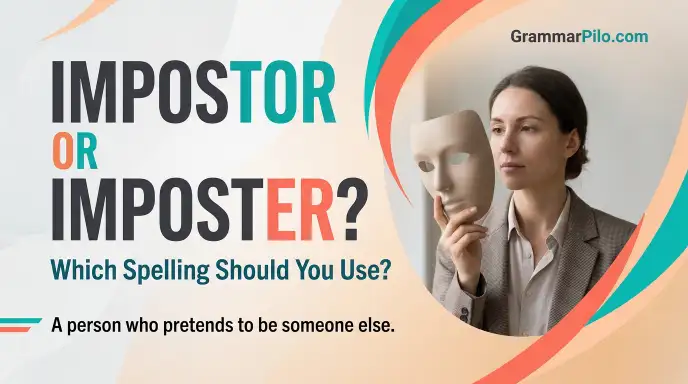
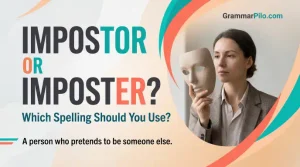
Both impostor and imposter are correct English spellings of the same word. They refer to a person who pretends to be someone else or falsely claims an identity, position, qualification, or status.
The main difference is spelling preference: impostor is the traditional form, while imposter is also widely accepted and used in modern English.
People often search for imposter or impostor because the two versions sound exactly alike and differ by only one letter.
You may encounter both spellings in books, news articles, online discussions, workplace conversations, and games involving deception or hidden identities. This can make it difficult to know which version to use in your own writing.
The good news is that you do not need to memorize two different meanings. If you write impostor or imposter, the word communicates the same basic idea.
Your choice can depend on your preferred dictionary, the style guide you follow, and the spelling used elsewhere in your document.
In this guide, you will learn the meanings, origins, spelling differences, American and British usage, common mistakes, and practical examples of imposter and impostor so you can use the word confidently.
Quick Answer: Impostor or Imposter?
Both spellings are correct. Impostor is the traditional spelling, while imposter is an accepted variant that is common in contemporary writing. Neither spelling changes the meaning or pronunciation.
| Feature | Impostor | Imposter |
| Correct spelling | Yes | Yes |
| Meaning | A person who deceives others about their identity or qualifications | The same |
| Pronunciation | im-POS-ter | im-POS-ter |
| Part of speech | Noun | Noun |
| Traditional status | Traditional spelling | Accepted variant |
| American English | Used | Used |
| British English | Used | Used |
| Example | The impostor claimed to be a doctor. | The imposter claimed to be a doctor. |
Easy rule: Choose impostor if you prefer the traditional spelling. Choose imposter if it matches your preferred dictionary or house style. Most importantly, remain consistent throughout your writing.
What Does Impostor Mean?
An impostor is a person who deliberately deceives others by pretending to be someone they are not or by falsely presenting their identity, qualifications, authority, or status.
The word is often used when someone attempts to gain trust, money, access, recognition, or another advantage through deception.
Definition of Impostor
As a noun, impostor describes a person who makes a false claim about who they are or what they are entitled to do.
For example, a person might pretend to be a police officer, use another person’s identity, or claim to hold a professional qualification they do not possess.
Examples include:
- The impostor pretended to be a bank employee.
- Investigators discovered that the man was an impostor.
- An impostor entered the building using a false identity.
- The company exposed an impostor who claimed to be a qualified engineer.
- The historical impostor fooled several people with a convincing story.
In each sentence, the word identifies someone who misrepresents their identity or status.
What Does Impostor Mean in Everyday English?
In everyday conversation, impostor can describe anyone who pretends to have an identity, role, or authority they do not genuinely possess.
The deception may be serious, such as identity fraud, or part of a fictional story involving disguise and secret identities.
For instance, a person impersonating a famous musician to obtain money could be called an impostor. In a mystery novel, a character who secretly takes another person’s place could also be described this way.
The word usually suggests deliberate deception rather than an innocent mistake.
What Is the Plural of Impostor?
The standard plural of impostor is impostors. The plural of imposter is imposters.
Examples:
- The impostors were discovered before they could leave.
- Several imposters attempted to enter the private event.
- The detective identified two impostors in the group.
- The investigators uncovered a network of imposters.
Both plural forms follow the spelling of their corresponding singular forms.
What Does Imposter Mean?
Imposter has the same meaning as impostor. It refers to someone who pretends to be another person or falsely claims a particular identity, qualification, or position.
The spelling with -er is not automatically incorrect. It is an established variant found in modern English writing.
Definition of Imposter
An imposter is someone who misleads others about who they are or what they can legitimately claim to be.
Examples include:
- The imposter claimed to be the owner’s representative.
- Everyone believed the imposter until the real employee arrived.
- The police questioned an imposter using stolen identification.
- The imposter pretended to have a medical degree.
- The novel follows a clever imposter who adopts another person’s identity.
These sentences could use impostor instead without changing their meaning.
Is Imposter a Real Word?
Yes. Imposter is an accepted spelling variant of impostor. It appears in contemporary English, including informal writing, published texts, and online discussions.
Some dictionaries list impostor as the main entry and imposter as a variant. Other references may give both spellings or indicate that one is more common in particular contexts.
That difference in dictionary presentation does not mean that imposter is universally wrong.
Why Do People Write Imposter?
English contains many words with alternative spellings, and spelling patterns can change over time. The ending -er is familiar in English, so imposter may look more natural to some writers.
Others prefer impostor because it is the traditional form or because their chosen dictionary recommends it.
The most practical approach is to follow one reliable reference or your organization’s writing guidelines rather than switching randomly between the two spellings.
The Origin and History of Impostor and Imposter
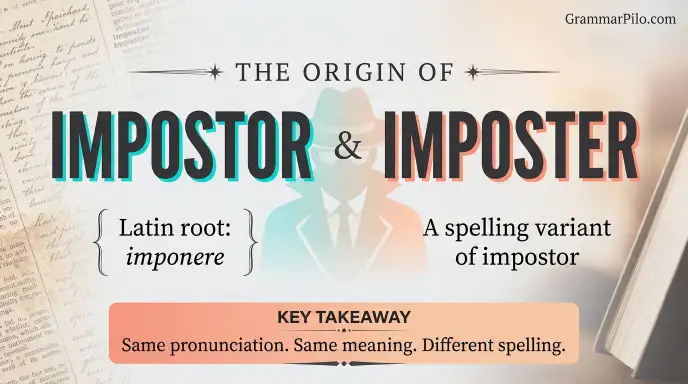
The history of the word explains why both spellings have the same meaning.
Where Does the Word Impostor Come From?
Impostor entered English through French and is ultimately connected to the Latin verb imponere, meaning to place upon or impose. The Latin root is also associated with the idea of imposing something on another person.
The related word imposture refers to the act or practice of deception through a false identity or claim. Both words are connected to the idea of making others accept something misleading.
Over time, impostor became established as a noun for a person who deceives others by pretending to be someone or something they are not.
How Did the Spelling Imposter Develop?
Imposter developed as a spelling variant of impostor. The two forms are pronounced alike and have the same meaning.
English spelling contains numerous words with competing forms. Some variants become associated with a particular region, period, or publication style, while others remain in use side by side.
In the case of impostor and imposter, both forms continue to appear in contemporary English. The existence of the variant does not create a separate definition.
Is There a Difference in Meaning Based on Origin?
No meaningful difference in modern definition comes from choosing one spelling over the other.
Both forms refer to a person who deceives others by falsely presenting an identity, role, or status. The distinction is orthographic, meaning it concerns how the word is written rather than what it means.
If you are discussing the history of the word, impostor is often the form used as the main dictionary headword. However, imposter remains an accepted variant.
Impostor vs. Imposter: British English and American English
Both spellings occur in American and British English. Unlike some regional spelling pairs, such as color and colour, impostor and imposter do not have a strict US versus UK division.
| Usage | American English | British English |
| Traditional spelling | Impostor | Impostor |
| Accepted variant | Imposter | Imposter |
| Meaning of impostor | A deceptive person claiming a false identity or status | Same |
| Meaning of imposter | Same as impostor | Same |
| Pronunciation | im-POS-ter | im-POS-ter |
| Main spelling rule | Follow your chosen dictionary or style guide | Follow your chosen dictionary or style guide |
Is Impostor American or British English?
Impostor is used in both American and British English. It is a traditional spelling that remains appropriate in formal and informal writing.
American and British writers may also use imposter. The spelling choice is not governed by a universal rule that assigns impostor to one country and imposter to the other.
Is Imposter More Common in American English?
Both forms appear in American writing, and the preferred spelling may depend on the publication, writer, or dictionary being followed.
It would be misleading to claim that one spelling is exclusively American or that the other belongs only to British English. Writers should consult the reference used by their intended audience if a specific house style is required.
Which Spelling Should You Use Internationally?
For international writing, impostor is a practical choice because it is the traditional form and is widely recognized. However, imposter is also acceptable.
If you are preparing an academic paper, professional report, website article, or book manuscript, use the spelling recommended by your preferred dictionary or publisher. If no specific preference exists, choose one form and use it consistently.
Impostor or Imposter: Which Spelling Should You Choose?
The choice is simple because both spellings refer to the same person or situation.
Use Impostor for a Traditional Spelling Preference
Choose impostor if you prefer the traditional form or your reference source lists it as the main spelling.
Examples:
- The impostor was exposed during the investigation.
- The detective suspected that the visitor was an impostor.
- A clever impostor convinced the villagers that he was a prince.
- The journalist uncovered the impostor’s false credentials.
This spelling is suitable for academic, professional, journalistic, and everyday writing.
Use Imposter When It Matches Your Preferred Style
Choose imposter if your dictionary, publisher, or editorial guidelines use that variant.
Examples:
- The imposter used a fake identity.
- The company discovered an imposter posing as a manager.
- The story features an imposter who deceives an entire community.
- The investigators tracked down the imposter.
Each sentence could use impostor without changing its meaning.
What If You Are Writing for a Website?
For website articles, product descriptions, educational content, and general publications, consistency is more important than switching between variants.
If your website already uses impostor, continue with that spelling in related articles. If your editorial style prefers imposter, use it consistently instead.
You can mention both spellings when explaining the difference, but use one preferred form throughout the rest of the article unless a quotation or official title requires otherwise.
Common Mistakes When Using Impostor and Imposter
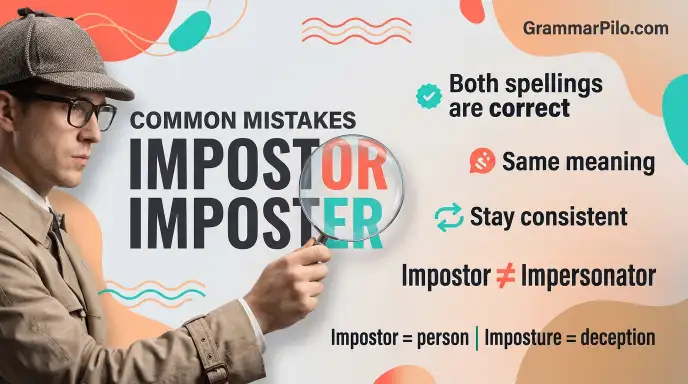
Because the two words differ by only one letter, spelling confusion is common. These are the main mistakes to avoid.
Mistake 1: Assuming Imposter Is Always Wrong
Some writers believe impostor is the only correct form. However, imposter is an accepted variant.
Better approach: Recognize both spellings and follow a consistent reference.
Mistake 2: Assuming the Words Have Different Meanings
There is no standard difference in meaning between imposter and impostor.
Better approach: Use either spelling for someone who pretends to have an identity, qualification, or status they do not possess.
Mistake 3: Changing Spellings in the Same Article
Using impostor in one paragraph and imposter in another without a reason can make writing look inconsistent.
Better approach: Select one form and maintain it throughout your document.
Mistake 4: Confusing an Impostor With an Impersonator
The words are related in meaning, but they are not always interchangeable.
An impostor falsely presents themselves as someone they are not or claims a status they do not have. An impersonator imitates another person’s appearance, voice, or behavior. An impersonator may deceive people, but impersonation can also be performed for entertainment.
Better approach: Use the word that best describes the person’s action.
Mistake 5: Confusing Impostor With Imposture
Impostor names the person who deceives others. Imposture names the deceptive act or practice.
For example, “The impostor was arrested” refers to the person, while “The imposture was exposed” refers to the deception.
Better approach: Check if you need a noun for the person or a noun for the act.
Everyday Examples of Impostor and Imposter
The following examples show how both spellings work in ordinary sentences.
Examples in:
Everyday Conversation
- I think that man is an impostor.
- The imposter claimed to know the business owner.
- The impostor was pretending to be a doctor.
- Nobody realized that the visitor was an imposter.
- The real employee arrived and exposed the impostor.
News and Professional Writing
- Investigators identified an impostor who had used false credentials.
- The company warned customers about an imposter posing as a customer service representative.
- Officials confirmed that the person was an impostor.
- The report described how the imposter gained access to confidential information.
- The organization issued a statement after discovering an impostor using its name.
Fiction and Storytelling
- The prince discovered that the guest was an impostor.
- In the mystery novel, an imposter takes the place of a wealthy businessman.
- The detective follows clues that reveal the impostor’s real identity.
- The villagers welcomed the stranger before learning that he was an imposter.
- The film follows a skilled impostor who creates an elaborate false identity.
Online Games
The word impostor is familiar in games and online discussions involving hidden identities, deception, or secret roles.
Examples include:
- The players voted out the impostor.
- We suspected that one member of the team was an imposter.
- The impostor tried to mislead the other players.
- The game becomes more difficult when the impostor gains everyone’s trust.
Both spellings can be used in these examples, although a game’s official text may use one particular form.
Impostor vs. Imposter: Key Differences at a Glance
| Question | Impostor | Imposter |
| Is it correct? | Yes | Yes |
| Is it a noun? | Yes | Yes |
| Does it describe a deceptive person? | Yes | Yes |
| Does it have a different pronunciation? | No | No |
| Does it have a different meaning? | No | No |
| Is it used in American English? | Yes | Yes |
| Is it used in British English? | Yes | Yes |
| Is one spelling traditional? | Yes, impostor | An accepted variant |
| Which should you use? | A good choice for traditional spelling | A good choice if preferred by your reference or style guide |
The distinction is about spelling preference rather than meaning, pronunciation, or grammatical function.
Imposter vs. Impostor: Google Trends and Modern Usage
People searching for imposter or impostor often want to know which spelling is correct, which form is preferred in published writing, or which spelling to use in a particular context.
Both versions appear in modern English, including discussions of deception, fictional characters, online games, and the psychological term impostor syndrome.
Why Do People Search for Impostor or Imposter?
Common reasons include:
- Checking the correct spelling before writing an article or report.
- Deciding which version to use in school or professional work.
- Searching for information about impostor syndrome.
- Discussing games and stories involving hidden identities.
- Editing a document for spelling consistency.
Because the two spellings sound identical, readers may not notice the difference until they see them written down.
Which Spelling Is More Popular?
The relative frequency of impostor and imposter can vary by source, country, publication type, and period. Traditional dictionaries often present impostor as the main entry, while imposter is also recognized as a variant.
Without checking a defined corpus or current search dataset, it would be misleading to provide exact percentages or claim that one spelling always dominates in every English speaking region.
How Can You Compare Their Search Interest?
Google Trends can show relative search interest for impostor and imposter in selected regions and periods. Dictionary entries and published text databases can also help explain how the two spellings are used.
However, search interest does not determine correctness. A word can receive more searches because people are uncertain about it, not because it is more appropriate in every context.
For practical writing, a reliable dictionary and a consistent editorial style are more useful than choosing a spelling solely because it receives more online searches.
Frequently Asked Questions
1. Is impostor or imposter correct?
Both are correct. Impostor is the traditional spelling, and imposter is an accepted variant. Both refer to a person who falsely claims an identity, position, or status.
2. What is the difference between impostor and imposter?
There is no standard difference in meaning or pronunciation. The distinction is spelling only. Your choice can depend on your preferred dictionary, publication, or style guide.
3. Is imposter a misspelling of impostor?
No. Imposter is an accepted spelling variant, not automatically an error. However, a particular publisher or teacher may require one preferred form for consistency.
4. Is impostor American or British English?
Impostor is used in both American and British English. Imposter is also used in both varieties, so the pair does not follow a strict US versus UK spelling rule.
5. What is the plural of impostor?
The plural of impostor is impostors. The plural of imposter is imposters. Both forms are grammatically correct.
6. How do you pronounce impostor and imposter?
Both are pronounced the same way, commonly represented as im-POS-ter. The spelling difference does not change the pronunciation.
7. Which spelling should I use in formal writing?
Impostor is a sensible choice if you prefer the traditional spelling. However, imposter is also acceptable. Follow the dictionary or editorial style guide required for your work.
8. What is the difference between an impostor and an impersonator?
An impostor falsely claims an identity, qualification, or status. An impersonator imitates another person’s appearance, voice, or behavior. An impersonator may perform for entertainment, while impostor usually emphasizes deception.
9. Is impostor syndrome spelled with an O or an E?
Both impostor syndrome and imposter syndrome appear in English. The traditional spelling is often written with an o, but the e variant is also used. Follow the preferred terminology of your reference or publication.
10. Can I use impostor and imposter in the same article?
You can mention both when explaining the spelling variation. However, for consistent writing, it is generally better to choose one as your preferred form and use it throughout the article.
Conclusion: Should You Write Impostor or Imposter?
When deciding between impostor or imposter, remember that both spellings are correct and carry the same meaning. Each refers to someone who pretends to be another person or falsely claims an identity, qualification, position, or status.
Impostor is the traditional spelling and is a practical choice for writers who prefer the established form. Imposter is an accepted variant that appears in modern English and can be used when it matches your preferred dictionary or editorial guidelines.
Neither spelling has a different pronunciation, and neither is restricted exclusively to American or British English. The most important thing is to use the word correctly and maintain consistency in your writing.
If you are unsure, choose impostor as your default, especially when no house style has been specified. If your dictionary or publisher prefers imposter, that form is also acceptable. Once you select your preferred spelling, use it consistently in articles, reports, school assignments, and professional documents.
More Words Worth Comparing

I’m Claire Morgan, the author behind Grammarpilo.com, where I write about English grammar, sentence structure, punctuation, and everyday language. My goal is to make grammar simple, clear, and practical, helping readers understand the rules and apply them with confidence in real-world writing.




1 thought on “Impostor or Imposter: The Spelling Difference Most People Miss”