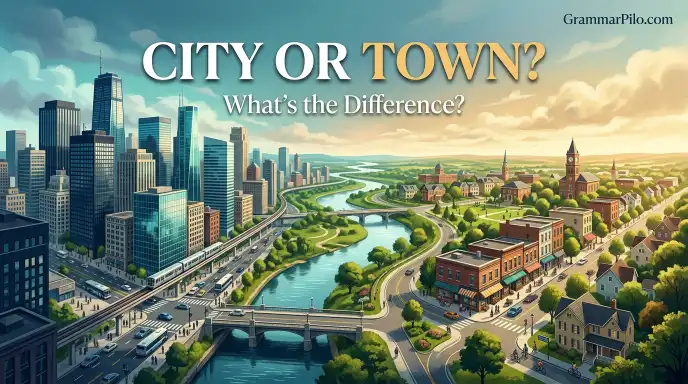
City and town are both words for places where people live, work, and build communities, but a city is often larger or has a more developed range of services than a town.
The exact difference depends on the country, local laws, population, and historical traditions. That is why the two terms can sometimes overlap.
If you are deciding between city or town, town or city, or city vs. town, town vs. city, the right word depends on the place you are describing. A busy urban area with major hospitals, universities, business districts, and extensive public transport may commonly be called a city.
A smaller community with a local shopping area, schools, homes, and a close knit atmosphere may be described as a town.
However, size alone does not always determine the official name. Some places called cities have relatively small populations, while some towns are larger than certain cities.
In countries such as the United States and the United Kingdom, the legal and historical meaning of these terms can differ.
This guide explains the meaning of city and town, their differences, regional usage, common mistakes, and everyday examples.
By the end, you will understand how to choose the most suitable word in conversation, school assignments, professional writing, and descriptions of places.
Quick Answer: City or Town?
Use city for a place commonly recognized as a city, particularly a major or officially designated urban area. Use town for a place commonly recognized as a town, often a smaller or more locally focused community. Always consider the place’s official designation and local usage.
| Feature | City | Town |
| General meaning | An urban settlement, often larger or more complex | A settlement that is often smaller or more locally focused |
| Population | May be large, but not always | Often smaller, but not always |
| Services | May have major hospitals, universities, transport networks, and business districts | May have local schools, shops, clinics, and community services |
| Atmosphere | Often associated with busy urban life | Often associated with a smaller community |
| Official status | May have a legal or administrative designation | May have a different legal or administrative designation |
| Usage | Depends on local conventions and official status | Depends on local conventions and official status |
Example: Karachi is widely described as a city, while a smaller settlement may be described as a town. The exact label for any particular place should follow its accepted name and official status.
The main point is that city and town are not interchangeable in every context, but there is no single worldwide population limit that separates them.
City and Town: Definition and Meaning
Understanding each word separately makes the difference easier to remember.
What Does City Mean?
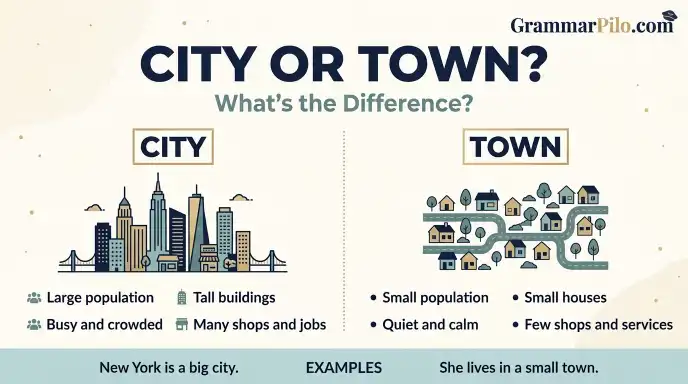
A city is a relatively large or important human settlement, often serving as a center for commerce, administration, education, healthcare, transport, or culture. In some countries, the term also has a specific legal meaning.
Cities commonly contain residential neighborhoods, offices, shops, schools, public institutions, and recreational spaces. Larger cities may also have airports, universities, specialist hospitals, extensive public transportation, and major commercial districts.
However, not every city has all these features. The word describes a type of settlement, not a guaranteed list of facilities.
Examples of city in sentences:
- Lahore is a major city in Pakistan.
- She moved to the city to study at a university.
- The city introduced new rules to improve public transportation.
- Our company has offices in several cities.
- The city center becomes especially busy during the morning commute.
In these examples, city refers either to a named urban settlement or to an urban area with its own services and activities.
What Does Town Mean?
A town is a settlement that is generally smaller than a city in many everyday contexts. It often serves as a local center for nearby residential areas, villages, and rural communities.
A town may have a main street, local businesses, schools, parks, places of worship, healthcare facilities, and a municipal administration. Some towns have thriving commercial areas, while others are quiet residential communities.
The word does not automatically mean that a place is rural, undeveloped, or lacking modern facilities. Many towns have substantial populations and important economic roles.
Examples of town in sentences:
- My grandparents live in a small town near the mountains.
- The town has a popular weekly market.
- We stopped in a coastal town during our road trip.
- The town council approved a new community park.
- Several new shops have opened in the town center.
Here, town describes a community that is commonly understood or officially designated as a town.
Is a Town Always Smaller Than a City?
No. A town is often smaller than a city in everyday descriptions, but this is not a universal rule.
Official definitions vary. A place may receive city status because of a legal decision, historical tradition, or administrative arrangement rather than simply because of its population. As a result, a town can sometimes have more residents than a city elsewhere.
Remember: Population is one clue, but official status and local convention can matter just as much.
The Origin and History of City and Town
The words city and town have different historical roots. Their development helps explain why they do not have exactly the same meaning today.
Where Does the Word City Come From?
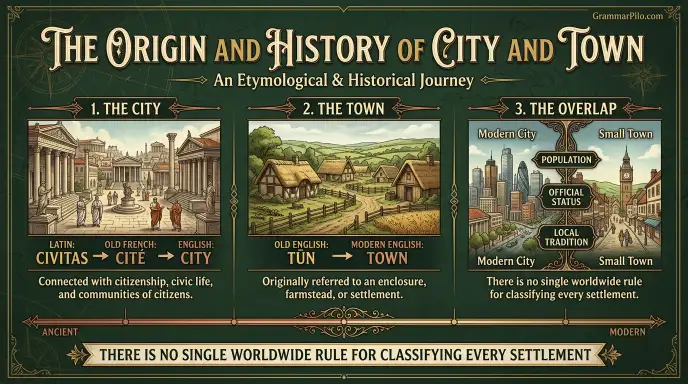
The English word city developed through Old French cite or cité, from Latin civitas. The Latin term was associated with citizenship, a community of citizens, or a civic body.
Over time, the English word came to refer to an urban settlement, particularly one of importance or recognized status. In modern English, it can describe a major population center or a place with an official city designation.
The historical connection with civic life remains relevant because cities often serve as centers for government, business, public institutions, and cultural activities.
Where Does the Word Town Come From?
The word town comes from Old English tūn, which originally referred to an enclosure, farmstead, or settlement. Its meaning developed over centuries to refer more broadly to an inhabited place or community.
Today, town often refers to a settlement smaller than a city, although this depends on regional usage and official definitions.
Why Do Their Modern Meanings Overlap?
The words developed under different historical and administrative systems. Countries established their own ways of classifying settlements, and those systems did not always use the same population limits or legal criteria.
Consequently, modern English speakers use town and city partly according to size and character, but also according to tradition and official designation.
This is why a universal rule such as “every place with more than a certain number of people is a city” would be inaccurate.
City vs. Town in American and British English
The words city and town are used in both American and British English. The spelling is the same, but their official and everyday meanings can vary.
| Feature | American English | British English |
| Spelling | City, town | City, town |
| Everyday distinction | A city is often understood as larger or more urban | A city is often understood as larger or officially distinguished |
| Official status | Depends on the state and local government system | City status has a specific historical and formal context |
| Population rule | No single population threshold applies everywhere | Population alone does not determine city status |
| Common phrase | Downtown, city limits, town hall | City centre, town centre, town hall |
| Main consideration | Local usage and administrative definitions | Local usage, history, and official designation |
City and Town in American English
In the United States, city and town can refer to different forms of local government, depending on the state. Their legal meanings are not consistent across the entire country.
In everyday conversation, people often use city for a large urban area and town for a smaller community. However, some local governments officially use the term town for places that have substantial populations.
Examples:
- She lives in a large city in Texas.
- We spent the weekend in a small town in Vermont.
- The city council approved the transportation project.
- The town has a historic main street and several family owned businesses.
The terms should be selected according to the actual place and the meaning intended, rather than a fixed national population rule.
City and Town in British English
In the United Kingdom, a place’s official city status has a distinct historical and formal basis. Population size alone does not automatically make a settlement a city.
A town may be populous and commercially important without having official city status. Conversely, a place with city status may have a smaller population than some towns.
British English also commonly uses town centre and city centre to describe the central shopping and business areas of towns and cities.
Examples:
- We took the train into the city centre.
- The town centre has several independent shops.
- The historic town attracts visitors throughout the year.
- The city is known for its university and cultural institutions.
What About Other English Speaking Countries?
Usage varies across Canada, Australia, New Zealand, Pakistan, India, and other English speaking regions. Local administrative systems, historical traditions, and common speech influence the distinction.
For example, a place may be called a city in everyday speech because it is a major urban center, while official records may use a more specific administrative designation.
Best practice: Follow the recognized name and official classification of the place you are writing about.
Which Word Should You Use: Town or City?
The best word depends on the location, the context, and the way the settlement is commonly identified.
Use City for a Recognized City
Choose city when the place is officially designated or commonly known as a city.
- Lahore is a major city with a large population and extensive commercial activity.
- The city has several universities and specialist hospitals.
- They moved to the city for better access to employment opportunities.
- The city government announced a new public transport plan.
In these examples, city describes an established urban area or its governing administration.
Use Town for a Recognized Town
Choose town when the settlement is officially or commonly identified as a town.
- The family lives in a quiet town near the coast.
- The town is known for its traditional market.
- A new library opened in the town last month.
- We visited a historic town during our holiday.
These sentences focus on communities identified as towns, regardless of if they have modern facilities.
Use the Official Name When Accuracy Matters
For reports, academic assignments, news articles, government documents, and travel guides, check the accepted classification of the specific location.
If a place has official city status, calling it a town may be misleading in a context where that status matters. The reverse can also be true.
Use the More Natural Word in Casual Conversation
In everyday conversation, speakers often use city to emphasize a busy urban environment and town to suggest a smaller community.
Example: “I grew up in a small town, but I live in a city now.”
This sentence creates a clear contrast in lifestyle and scale without suggesting that every town is small or every city is large.
Common Mistakes With City or Town
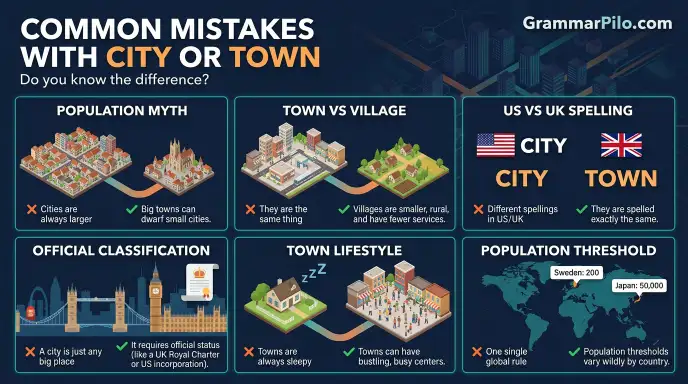
The words are familiar, but a few assumptions can lead to inaccurate writing.
Mistake 1: Assuming Every City Has a Larger Population
A city does not always have more residents than a town. Official status and historical conventions can influence the name.
Incorrect assumption: Every city must have a larger population than every town.
Better understanding: Cities are often larger in everyday usage, but there is no universal population rule.
Mistake 2: Treating Town as Another Word for Village
A town is not necessarily a village. In many contexts, a town is larger or serves a wider local area than a village, although the exact distinction varies by country.
Example: The town has several schools, shops, and a regional health center.
This description is possible even if the community does not have the scale of a major city.
Mistake 3: Assuming the Terms Have Different Spellings in the US and UK
Town and city are spelled the same way in American and British English. They are not a spelling pair like color and colour.
Correct: city, town
The difference lies in meaning, context, and local classification, not spelling.
Mistake 4: Using City and Town Interchangeably in Official Writing
If a place has an established official classification, replacing it with the other term can cause confusion.
Less precise: The town of London is a major urban center.
More precise: London is a city and the capital of the United Kingdom.
Always check the actual location before choosing a label in formal writing.
Mistake 5: Believing Every Town Is Quiet or Rural
Some towns are busy, commercially active, and densely populated. Others are small and peaceful. The word alone does not guarantee a particular lifestyle.
Example: The town has a crowded shopping district and heavy traffic during the afternoon.
The sentence is perfectly possible because towns can have busy commercial areas.
Mistake 6: Assuming There Is One Global Population Threshold
Different countries and administrative systems use different criteria. A fixed number cannot accurately distinguish every city from every town around the world.
Better approach: Consider official status, local usage, population, and the role of the settlement.
City and Town in Everyday Examples
These examples show how both words work in school assignments, emails, conversations, travel writing, and other everyday situations.
In School
City: The students researched the history of a major city.
Town: Our class visited a nearby town to learn about its local history.
City: The city has a large public library and several museums.
Town: The town holds a community festival every spring.
In Emails and Workplace Communication
City: Our company plans to open a new office in the city.
Town: The team will visit the town to meet local business owners.
City: Please confirm the city where the conference will take place.
Town: The report includes information about employment in the surrounding towns.
In Travel and Tourism
City: We spent three days exploring the city’s museums, restaurants, and historic buildings.
Town: We stayed in a coastal town known for its beautiful beaches.
City: The city attracts visitors from around the world.
Town: The town offers walking trails, small cafés, and a historic market square.
In News and Public Information
City: The city announced plans to improve public transportation.
Town: The town council approved a new community center.
City: Several neighborhoods in the city will receive improved street lighting.
Town: Residents of the town attended a public meeting about the new development.
In Everyday Conversation
City: “Do you prefer living in a city?”
Town: “I like living in a town because everything I need is nearby.”
City: “The city has more public transportation options.”
Town: “The town is smaller, but it has a strong community spirit.”
These examples show typical associations rather than strict rules. A particular town may have extensive transport options, and a particular city may have quiet neighborhoods.
Town vs. City: Side by Side Comparison
Use this table as a quick reference when choosing between the two words.
| Comparison point | City | Town |
| General definition | An urban settlement often associated with a larger or more complex urban role | A settlement often associated with a smaller or more local community |
| Population | Frequently larger, but not always | Frequently smaller, but not always |
| Services | May offer a broad range of regional services | Often provides local services for residents and nearby communities |
| Employment | May include major business districts and varied industries | May include local businesses, services, and other industries |
| Transport | May have extensive public transport | May have more limited transport, depending on location |
| Official classification | Can have a legally recognized status | Can have its own legal or administrative classification |
| Spelling | City | Town |
| American vs. British spelling | Same spelling | Same spelling |
The comparison describes common patterns, not universal requirements. Local laws and recognized place names take priority over assumptions about size or facilities.
Frequently Asked Questions
1. What is the main difference between a city and a town?
A city is often larger or serves as a more extensive urban center, while a town is often a smaller or more locally focused settlement. However, official status and local conventions can be more important than population alone.
2. Is a city bigger than a town?
Often, but not always. Some towns have larger populations than some cities because different countries and local governments use different classification systems.
3. Is a town considered a city?
Not automatically. A town may become a city if it meets the relevant legal or administrative requirements, but those requirements vary. In some places, city status is based on formal designation rather than population.
4. Are city and town the same in American and British English?
The words have broadly similar everyday meanings, but their official classifications can differ. In both varieties, city and town are spelled the same way.
5. What is the difference between a town and a village?
A town is generally a more substantial settlement than a village in many contexts and may serve a wider surrounding area. However, local definitions vary, and there is no single global rule that applies everywhere.
6. Should I write city or town in a formal document?
Use the location’s recognized official classification if it matters to the document. For general descriptions, choose the word that best reflects common local usage and the context.
7. Which is correct, city or town?
Both words are correct. The choice depends on the place you mean. Use city for a place recognized as a city and town for a place recognized as a town. Neither word is universally correct for every settlement.
Conclusion: Choosing Between City and Town
The difference between city and town is mainly about how a settlement is recognized, described, and organized. A city is often associated with a larger urban area, a wider range of services, and major commercial or cultural activity. A town is often associated with a smaller community that serves local residents and nearby areas.
These descriptions are useful starting points, but they are not absolute rules. Some towns are densely populated and economically important, while some cities have relatively small populations. The official classification of a place may depend on local law, history, or administrative decisions rather than size alone.
When choosing between city or town, consider the place you are describing and how it is commonly or officially identified. In casual writing, the more natural term is usually enough. In academic, professional, or factual writing, checking the official name can prevent confusion.
Remember that city and town are both correct English words, and neither is a regional spelling variant of the other. Use the term that accurately represents the specific settlement and the context of your sentence.
What to Read Next
- Agree or Disagree: The Easy Way to Choose the Right Word
- Lost or Found: Difference, Meaning & Examples (2026)
- Text or Die: What Does This Phrase Mean and How Is It Used?

I’m Sloane Mercer, a U.S.-based English language writer focused on grammar, spelling, vocabulary, and everyday English usage. Through GrammarPilo, I provide clear and practical explanations to help readers choose the right words and communicate with confidence.