
Both kindergartners and kindergarteners are correct English spellings for children who attend kindergarten, especially in American English.
The difference is mainly a matter of word formation and regional preference, not meaning. Kindergartners is a common and concise form in the United States, while kindergarteners is also widely understood and used.
These two words often confuse parents, teachers, students, and writers because they refer to the same group of young learners.
If you are writing a school newsletter, preparing classroom materials, creating an educational article, or describing a child’s first year of formal schooling, you may wonder which form sounds more natural.
The answer depends partly on your audience and the style you want to follow. In American English, both forms are acceptable, although kindergartners is a particularly familiar choice. The word kindergarteners retains the full word kindergarten before adding the ending -ers.
In this GrammarPilo guide, you will learn the meaning of both forms, understand how they are formed, compare their usage, and explore practical examples. You will also find spelling tips and answers to common questions so you can choose the right word confidently.
Quick Answer: Kindergartners or Kindergarteners?
Both kindergartners and kindergarteners are correct. They refer to children who attend kindergarten, the early educational stage that generally comes before first grade in the United States.
- Kindergartners: A common American English form that is shorter and widely used.
- Kindergarteners: Another accepted form that keeps the complete word kindergarten before adding -ers.
Examples:
- The kindergartners enjoyed their first field trip.
- The kindergarteners enjoyed their first field trip.
Both sentences are correct and communicate the same basic meaning.
If you are writing for an American audience and want a concise, natural-sounding choice, kindergartners is an excellent option. However, you do not need to treat kindergarteners as a spelling mistake.
Kindergartners vs. Kindergarteners: Definition and Meaning
The two forms describe the same group of children. Their difference lies in how the words are constructed.
What Does Kindergartners Mean?
Kindergartners is the plural form of kindergartner. A kindergartner is a child who attends kindergarten.
In the United States, kindergarten typically serves children around five years old, although the exact age depends on local enrollment rules, school cut-off dates, and individual circumstances.
The term is commonly used by parents, teachers, school administrators, and educational writers.
Examples of kindergartners in sentences:
- The kindergartners learned how to recognize basic shapes.
- Our school organized a reading event for the kindergartners.
- The teacher helped the kindergartners practice writing their names.
- Kindergartners often learn through stories, games, songs, and hands-on activities.
- The school prepared colorful activity sheets for its new kindergartners.
The word is especially useful when discussing kindergarten classes, classroom routines, early literacy, and children’s first experiences in school.
What Does Kindergarteners Mean?
Kindergarteners is the plural form of kindergartener. Like kindergartner, a kindergartener is a child who attends kindergarten.
This version preserves the full spelling of kindergarten and adds the ending -er to describe a person associated with that educational stage.
Examples of kindergarteners in sentences:
- The kindergarteners planted seeds in the school garden.
- Parents attended a meeting for incoming kindergarteners.
- The kindergarteners sang a song during the school assembly.
- The library introduced a special reading program for kindergarteners.
- Teachers prepared simple science activities for the kindergarteners.
The meaning remains the same as kindergartners. Choosing one form does not change the age, grade level, or educational status of the children being described.
Are Kindergartners and Kindergarteners Interchangeable?
Yes. In ordinary American English, the two terms are generally interchangeable.
For example, a school announcement could say, “Kindergartners will visit the library on Friday,” or “Kindergarteners will visit the library on Friday.”
Both versions are understandable and grammatically correct.
The most important consideration is consistency. If a school, publication, or educational organization follows a particular style, use its preferred form throughout the text.
The Origin and History of Kindergartners and Kindergarteners
Understanding the word kindergarten helps explain why both forms exist.
Where Does the Word Kindergarten Come From?
The word kindergarten comes from German. It combines Kinder, meaning “children,” with Garten, meaning “garden.”
German educator Friedrich Froebel introduced the kindergarten concept in the nineteenth century. He viewed early childhood education as a setting in which children could develop through guided play, activities, and social interaction.
The term eventually entered English and became widely associated with early childhood education.
As the word became established, English speakers formed nouns for people attending kindergarten. The forms kindergartner and kindergartener developed as alternatives, with the plural forms kindergartners and kindergarteners following naturally.
Why Are There Two Different Forms?
English frequently allows more than one way to form a word for a person associated with a place, activity, or stage of life.
In this case, kindergartner uses a shortened form of kindergarten before the ending -er. By contrast, kindergartener keeps the complete word and adds -er.
Both formations are understandable, and both have become established in American English.
This is not the same as a situation in which one spelling is correct and the other is a typo. Here, the two forms are accepted alternatives.
Kindergarteners or Kindergartners in American and British English
The words are most closely associated with American English because kindergarten is a familiar name for an early school stage in the United States.
| Context | Common or relevant term | Explanation |
| American English | Kindergartners | Common, concise form |
| American English | Kindergarteners | Also accepted |
| British English | Reception children | Common description for children in England’s Reception class |
| International English | Kindergarten children | Clear alternative when terminology varies |
| School-specific writing | The school’s preferred term | Follow local usage and house style |
Which Form Is More Common in American English?
Both kindergartners and kindergarteners are used in the United States. Kindergartners is a familiar and concise option in American school communications, but kindergarteners is also correct.
Writers may encounter either form in school websites, classroom resources, parenting articles, and educational publications.
There is no need to label kindergarteners incorrect simply because kindergartners is preferred by a particular writer or institution.
Do British Writers Use These Words?
The term kindergarten is understood in British English, but school terminology differs across the United Kingdom.
In England, for example, Reception is the usual name for the school year children enter before Year 1. Consequently, a British school may naturally refer to Reception children rather than kindergartners or kindergarteners.
Educational terminology varies between countries, so choose the expression that best matches your audience.
Which Form Should You Use?
Use kindergartners if you prefer a concise form commonly found in American English. Use kindergarteners if it matches your natural writing style or your organization’s preferred wording.
For international readers, kindergarten children can be especially clear when the precise school system is not familiar to everyone.
Whichever form you choose, maintain consistency within the same article or document.
Common Mistakes With Kindergartners and Kindergarteners
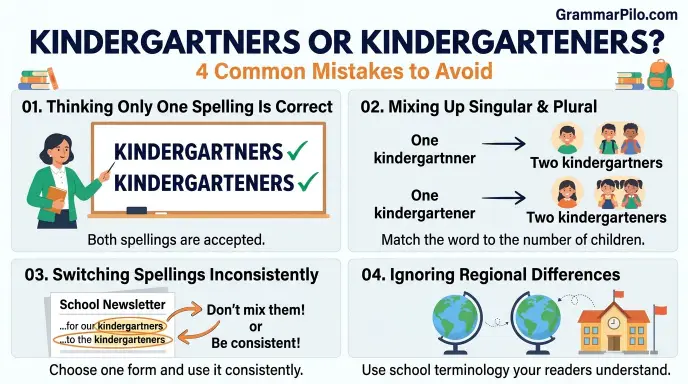
Although both spellings are correct, writers can still make mistakes when forming or using them.
Treating Kindergarteners as Incorrect
One common misconception is that only kindergartners is correct.
That is not accurate. Kindergarteners is an accepted alternative, and both forms refer to children who attend kindergarten.
Incorrect claim: Kindergarteners is always a misspelling.
Correct explanation: Both kindergartners and kindergarteners are accepted forms.
Confusing the Singular and Plural Forms
The singular forms refer to one child, while the plural forms refer to more than one.
| Singular | Plural |
| Kindergartner | Kindergartners |
| Kindergartener | Kindergarteners |
Examples:
- One kindergartner joined the activity.
- Five kindergartners joined the activity.
- One kindergartener joined the activity.
- Five kindergarteners joined the activity.
Remember to use the plural form when referring to a group.
Switching Between Forms Without a Reason
Using both forms in the same article is not necessarily grammatically wrong, but unnecessary switching can make the writing look inconsistent.
For example, a school newsletter might use kindergartners in one paragraph and kindergarteners in the next without any reason.
Choose the form that suits your audience and use it throughout the document.
Assuming Every Country Uses the Same School Terminology
The words kindergartner and kindergartener may be less natural in regions where kindergarten is organized differently or has another name.
If your readers are in England, Australia, or another country with a different school system, consider using the local educational term or briefly explaining what kindergarten means in your context.
Kindergarteners and Kindergartners in Everyday Examples
Both terms can be used naturally in school communication, parenting content, educational writing, and everyday conversation.
In School and Classroom Activities
Kindergartners:
- The kindergartners practiced counting from one to twenty.
- Our teacher read a picture book to the kindergartners.
- The kindergartners made paper flowers for the classroom.
- All kindergartners should bring their library books on Monday.
Kindergarteners:
- The kindergarteners practiced counting from one to twenty.
- Our teacher read a picture book to the kindergarteners.
- The kindergarteners made paper flowers for the classroom.
- All kindergarteners should bring their library books on Monday.
The meaning stays the same in each pair.
In Emails and School Newsletters
Kindergartners:
- Dear parents, our kindergartners will participate in a reading activity next week.
- Please send an extra change of clothes for your kindergartner.
- The school picnic is open to kindergartners and their families.
Kindergarteners:
- Dear parents, our kindergarteners will participate in a reading activity next week.
- Please send an extra change of clothes for your kindergartener.
- The school picnic is open to kindergarteners and their families.
Both forms work in school communications. Follow the school’s preferred terminology if one has been established.
In Parenting Articles and Educational Blogs
Kindergartners:
- Kindergartners benefit from activities that develop early literacy skills.
- Parents can encourage kindergartners to explore books at home.
- Many kindergartners enjoy learning through movement and play.
Kindergarteners:
- Kindergarteners benefit from activities that develop early literacy skills.
- Parents can encourage kindergarteners to explore books at home.
- Many kindergarteners enjoy learning through movement and play.
Both forms are appropriate for educational articles aimed at American readers.
In Everyday Conversation
- “My daughter is one of the kindergartners in that class.”
- “My daughter is one of the kindergarteners in that class.”
- “The kindergartners are preparing for their first school performance.”
- “The kindergarteners are preparing for their first school performance.”
The choice is mainly stylistic. Neither version changes the sentence’s meaning.
Kindergartners vs. Kindergarteners: Google Trends and Modern Usage
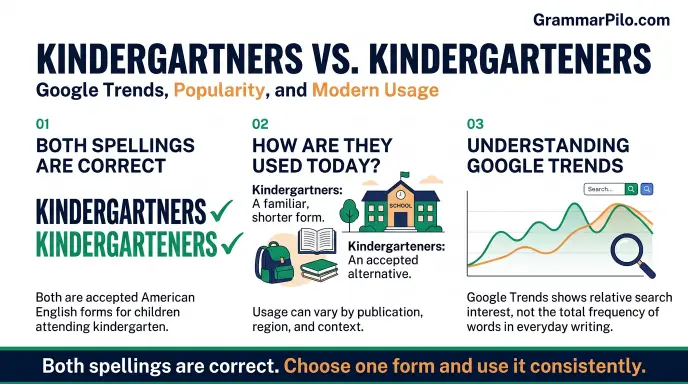
People search for kindergartners or kindergarteners, kindergarteners vs. kindergartners, and kindergartners vs. kindergarteners when they want to know which form is correct or more natural.
The confusion exists because the two words look slightly different but describe the same group of children. Unlike a spelling comparison involving a standard word and a misspelling, this comparison involves two accepted alternatives.
Which Form Is More Common?
Both forms appear in American English. The shorter kindergartners is a familiar choice in school and educational contexts, while kindergarteners remains an accepted alternative.
Exact usage frequency can vary by publication, region, and time period. Google Trends measures relative search interest rather than providing a complete count of how frequently a word appears in all writing.
Without checking live trend data or a defined language corpus, it would be misleading to claim an exact percentage or declare one form universally dominant.
For practical writing, choose the form that fits your audience and remain consistent.
Kindergartners vs. Kindergarteners: Quick Comparison Table
| Feature | Kindergartners | Kindergarteners |
| Correct spelling | Yes | Yes |
| Singular form | Kindergartner | Kindergartener |
| Meaning | Children attending kindergarten | Children attending kindergarten |
| American English | Common | Also accepted |
| British English context | May be understood; local terminology varies | May be understood; local terminology varies |
| Main difference | Shorter form | Retains the full word kindergarten |
| Suitable for school writing | Yes | Yes |
| Interchangeable in ordinary usage | Yes | Yes |
The central point is simple: both spellings are correct. The difference is in word formation and preference, not in the meaning.
Frequently Asked Questions About Kindergartners or Kindergarteners
1. Is It Kindergartners or Kindergarteners?
Both are correct. Kindergartners and kindergarteners refer to children who attend kindergarten. In American English, kindergartners is a familiar concise form, while kindergarteners is also accepted.
2. Is Kindergarteners a Real Word?
Yes. Kindergarteners is an established English word formed by adding -er to kindergarten and using the plural ending -s. It refers to children who attend kindergarten.
3. What Is the Singular of Kindergartners?
The singular is kindergartner. The singular form of kindergarteners is kindergartener. Both singular forms are accepted.
4. Which Form Is Better for American English?
Both are suitable for American English. Kindergartners is a concise, familiar choice, but kindergarteners is also correct. If your school or publication has a style preference, follow it.
5. Are Kindergartners and Kindergarteners the Same Age?
They generally refer to children enrolled in kindergarten, who are often around five years old in the United States. Exact ages vary according to school enrollment rules and individual circumstances.
6. Do British People Say Kindergartners?
The terms may be understood, but British school terminology varies. In England, children in the year before Year 1 usually attend Reception, so Reception children is often more natural in that context.
7. Can I Use Both Words in the Same Article?
You can, but it is usually better to choose one form and use it consistently. This creates a smoother reading experience and avoids making the wording seem unnecessarily inconsistent.
Conclusion: Both Kindergartners and Kindergarteners Are Correct
When comparing kindergartners or kindergarteners, you do not need to reject either form. Both are accepted English words that describe children who attend kindergarten. Kindergartners is a concise, familiar choice in American English, while kindergarteners retains the full word kindergarten before adding the ending -er.
The difference is mainly stylistic and structural. Neither word is inherently incorrect, and both can be used in classroom materials, school newsletters, parenting articles, educational blogs, and everyday conversation.
If you are writing for an American audience, choose whichever form sounds more natural to you or matches your publication’s style guide. For readers in other countries, consider local school terminology, since the names and organization of early education differ around the world.
Most importantly, use the chosen form consistently and make sure the surrounding text clearly communicates your meaning.
The simple rule to remember is this: kindergartners and kindergarteners are both correct, and either can describe children who attend kindergarten.
More Word Differences to Explore

I’m Claire Morgan, the author behind Grammarpilo.com, where I write about English grammar, sentence structure, punctuation, and everyday language. My goal is to make grammar simple, clear, and practical, helping readers understand the rules and apply them with confidence in real-world writing.






3 thoughts on “Kindergartners or Kindergarteners: American English Spelling”