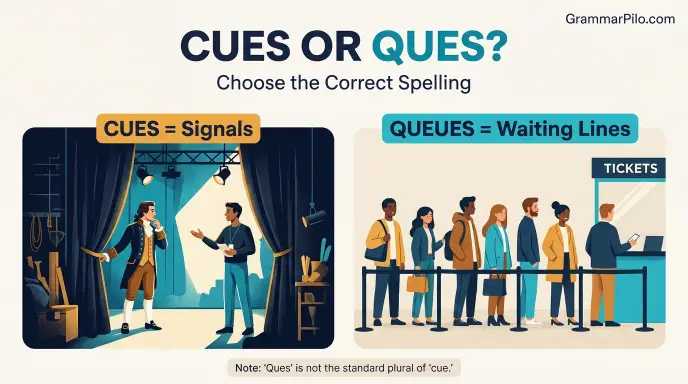
Cues and ques may look similar, but they do not have the same status in standard English. Cues is the correct plural of cue, a word that refers to a signal, hint, or prompt that tells someone when to act.
Ques is not the standard plural spelling of cue, although it can appear in specialized contexts, names, abbreviations, or as a borrowed word.
The confusion often happens because cue and queue sound exactly alike in many varieties of English. Someone who hears the word in conversation might write ques by mistake, especially when trying to describe signals in a performance, hints in a conversation, or prompts during a presentation.
Understanding ques or cues helps you avoid spelling errors in school assignments, workplace messages, creative writing, and everyday communication.
In this guide, you will learn what each form means, how to use cues correctly, why ques is usually a mistake in ordinary English, and how to distinguish cue, queue, and related words.
Quick Answer: Cues or Ques
Cues is the standard plural of cue. It means signals, hints, prompts, or instructions that help someone know what to do or when to do it.
Ques is generally incorrect when intended as the plural of cue. If you mean signals or hints, write cues. If you mean a line of people waiting, the correct word is queue, and its plural is queues.
Examples:
- The actor waited for his cues before speaking.
- The teacher gave students visual cues to help them understand the task.
- We joined the queue at the ticket counter.
The easiest way to remember the difference is that cues are signals, while queues are lines of people or things waiting their turn.
What Does Cues Mean?
The word cues is a plural noun formed from cue. It refers to signals or prompts that help a person understand when to speak, move, respond, or take action.
Definition of Cues
Cues (noun): Signals, hints, prompts, or indications that guide someone’s behavior or show that an action should happen.
A cue can be spoken, written, visual, physical, or environmental. For example, a stage actor may receive a cue from another performer, a teacher may use visual cues during a lesson, and a speaker may rely on notes as cues during a presentation.
Examples include:
- The actors remembered their cues for the final scene.
- Her expression gave me cues that something was wrong.
- The coach used hand signals as cues for the players.
- The presenter added notes to the slides as speaking cues.
- Children often use facial cues to understand other people’s emotions.
In each sentence, cues refers to information that helps someone interpret a situation or decide what to do.
Common Types of Cues
Cues appear in many areas of life, including entertainment, education, communication, sports, and psychology.
Performance cues: Signals that tell actors, musicians, or technicians when to begin an action.
Example: The lighting crew followed the director’s cues.
Visual cues: Images, gestures, colors, or other visible details that communicate information.
Example: The road signs provided visual cues for drivers.
Social cues: Signals in facial expressions, body language, tone of voice, or behavior that help people interpret social situations.
Example: He missed the social cues that suggested the conversation was ending.
Verbal cues: Spoken words or sounds that indicate what someone should do next.
Example: The instructor gave verbal cues during the exercise.
Memory cues: Prompts that help someone recall information.
Example: The first letter of each word served as a memory cue.
These examples show why cues is a useful word in both everyday and professional English.
What Does Ques Mean?
The spelling ques is not the standard plural of cue in modern English. If you want to describe signals, hints, or prompts, the correct spelling is cues.
Is Ques a Real English Word?
The letter combination ques can appear in particular contexts, such as proper names, abbreviations, or words borrowed from other languages.
For example, Spanish ques can occur as a shortened or colloquial form in certain contexts, while qué is the Spanish word commonly used for “what.” Such uses do not make ques the standard English plural of cue.
In ordinary English writing, the main issue is usually a spelling mistake caused by confusion with similar sounding words.
Incorrect: The speaker waited for his ques.
Correct: The speaker waited for his cues.
Incorrect: The director gave the actors their ques.
Correct: The director gave the actors their cues.
If the intended meaning is a line of waiting people, use queue instead.
Incorrect: We stood in the ques for tickets.
Correct: We stood in the queues for tickets.
Why Do People Write Ques?
There are several reasons people may confuse cues and ques.
- Sound alike words: Cue and queue are pronounced alike in many English accents.
- Unfamiliar spelling: The spelling of queue can seem unusual because several letters are not pronounced separately.
- Typing errors: People may type ques when writing quickly.
- Confusion about plurals: A writer may know that a word needs an s but choose the wrong spelling.
The best solution is to identify the intended meaning before choosing the word.
Cues vs. Ques: Main Differences
The difference between cues and ques is mainly about standard spelling and intended meaning.
| Feature | Cues | Ques |
| Standard English status | Correct plural of cue | Not the standard plural of cue |
| Meaning | Signals, hints, prompts | No standard meaning as the plural of cue |
| Singular form | Cue | Not applicable for this intended meaning |
| Common context | Acting, communication, education, sports | Specialized or nonstandard contexts |
| Example | The actor followed his cues. | Usually incorrect for signals |
| Recommended use | Use for signals or prompts | Avoid when you mean cues |
The distinction becomes clearer when you compare both spellings with queue, a separate word with a different meaning.
Cue, Cues, Queue, and Queues: What’s the Difference?
One reason people search for cues or ques is that several related looking words sound alike. Learning the four standard forms prevents common spelling errors.
Cue
Cue is a singular noun meaning a signal, hint, or prompt. It can also be used as a verb meaning to signal that something should begin.
Examples:
- The actor waited for his cue.
- The music was the cue for the dancers to enter.
- Please cue the video when I finish speaking.
Cues
Cues is the plural form of cue. Use it when referring to more than one signal or prompt.
Examples:
- The actors missed their cues.
- The teacher used several visual cues.
- Her body language gave us important cues.
Queue
Queue is a noun meaning a line of people or things waiting for their turn. It is also used as a verb, meaning to form a line or place something in a waiting list.
Examples:
- We waited in a queue outside the theater.
- The customers formed a queue at the entrance.
- I queued the song for later playback.
The word queue is especially common in British English. In American English, line is often used for a row of people waiting, although queue is also understood and used.
Queues
Queues is the plural of queue. It refers to multiple lines of people or things waiting.
Examples:
- Long queues formed outside the stadium.
- The website manages several customer support queues.
- Passengers waited in separate queues.
Comparison Table
| Word | Meaning | Example |
| Cue | One signal or prompt | That was my cue to leave. |
| Cues | More than one signal or prompt | The actors followed their cues. |
| Queue | One line of people or things waiting | There was a queue at the entrance. |
| Queues | Multiple waiting lines | The queues moved slowly. |
| Ques | Not the standard plural of cue | Use cues for signals. |
Memory trick: A cue tells you what to do. A queue is a line you wait in.
How to Use Cues in Everyday Examples

The word cues is useful in a wide range of situations. These examples show how it works naturally in sentences.
In School and Education
Teachers use cues to help students follow instructions, remember information, and understand lessons.
- The teacher used visual cues to explain the science experiment.
- Students looked for clues and cues in the reading passage.
- The instructor gave verbal cues during the pronunciation activity.
- Color coded notes provided cues for remembering important facts.
In these examples, cues refers to signals or prompts that support learning.
In Emails and Workplace Communication
Cues can help people coordinate tasks, deliver presentations, and understand professional interactions.
- Please add speaking cues to the presentation notes.
- The meeting agenda provided cues for each discussion topic.
- The manager picked up on cues that the client wanted more information.
- The production team followed the director’s cues during the live broadcast.
If you are writing professionally, cues is appropriate whenever you mean prompts or signals.
In Everyday Conversation
People often use cues when talking about behavior, communication, or reactions.
- I took her smile as one of the cues that she was happy.
- He did not notice the cues that the conversation was ending.
- The children followed the coach’s cues.
- Her tone gave me cues about how she felt.
These sentences demonstrate that cues can be verbal or nonverbal.
In Entertainment and Performance
The performing arts use cues to coordinate speech, movement, music, lighting, and other elements.
- The actor missed two cues during the rehearsal.
- The singer waited for the orchestra’s cues.
- The stage manager gave the lighting cues from backstage.
- The musicians watched the conductor for their cues.
Using ques in these sentences would be a spelling mistake if the intended meaning is signals.
In Technology and Gaming
The word cue can also refer to a prompt or signal in digital environments.
- The game displayed visual cues to help players find the exit.
- The video editor added cues for sound effects.
- The software uses notification cues to alert users.
- The player followed the on screen cues to complete the level.
In technical writing, the exact meaning depends on the system being described, but cues remains the standard plural when referring to prompts or signals.
Common Mistakes With Cues and Ques
Confusion between these spellings is often easy to correct once you recognize the intended meaning.
Mistake 1: Writing Ques Instead of Cues
Incorrect: The teacher gave us ques for the test.
Correct: The teacher gave us cues for the test.
Use cues when you mean signals, prompts, or hints.
Mistake 2: Confusing Cues With Queues
Incorrect: The customers stood in long cues outside the store.
Correct: The customers stood in long queues outside the store.
If you mean people waiting in a line, use queue or queues. In American English, line or lines may sound more natural in everyday speech.
Mistake 3: Using Cue When You Mean More Than One
Incorrect: The actors waited for their cue before the performance began.
This sentence can be correct if the actors share one cue. If they each have several signals to follow, the plural may be more accurate.
Correct: The actors waited for their cues before the performance began.
Choose the singular or plural based on the number of signals being described.
Mistake 4: Assuming Cues and Queues Have the Same Meaning
Although cue and queue sound alike, they have different meanings and spellings.
- A cue is a signal.
- A queue is a waiting line.
Their pronunciation does not make them interchangeable in writing.
Are Cues and Ques Different in American and British English?
The standard spelling cues is used in both American and British English when referring to signals or prompts. There is no American versus British spelling difference for this word.
The word queue is also correct in both varieties, but its everyday frequency differs by region.
| Meaning | American English | British English |
| A signal or prompt | Cue / cues | Cue / cues |
| A line of waiting people | Line / lines are very common; queue / queues are also used | Queue / queues are very common |
| Incorrect plural of cue | Ques | Ques |
| Correct plural of queue | Queues | Queues |
For example, an American might say, “We waited in line,” while a British speaker might say, “We waited in the queue.” Both are natural expressions in their respective contexts.
However, neither variety uses ques as the standard plural of cue.
Ques vs. Cues: Google Trends and Modern Usage
Interest in cues, ques, and queues may vary according to spelling questions, education, entertainment, and other search contexts. These terms are not interchangeable, so their search patterns may reflect different user intentions.
People searching for cues may want definitions, examples, or help understanding social and performance signals. Searches for queues may relate to waiting lines, computing systems, or British English vocabulary. Searches for ques may indicate uncertainty about spelling or a specialized meaning.
No verified live Google Trends figures are included in this article, so exact search volumes and popularity comparisons should not be assumed.
To investigate current interest, enter cues, ques, and queues into Google Trends, select a country and date range, and compare the results. Keep in mind that a search term can have more than one meaning, which may affect the results.
For standard writing, the practical guidance remains clear: use cues for signals and queues for waiting lines. Avoid ques when you mean the plural of cue.
How to Remember Cues or Ques
A simple memory trick can help you choose the right spelling.
Cues = signals. Think of an actor waiting for a cue to speak or a teacher giving cues to students.
Queues = lines. Imagine people standing in a line while waiting to buy tickets.
You can also remember these example pairs:
- The actor followed the cues.
- The audience waited in the queues.
- The coach gave the players cues.
- The passengers formed two queues.
If you are unsure, ask yourself what you want to describe. Is it a signal that guides an action? Use cue or cues. Is it a line of people or things waiting? Use queue or queues.
This distinction works in American and British English and helps prevent one of the most common sound alike spelling confusions.
Frequently Asked Questions
1. Is it cues or ques?
Cues is the correct standard spelling when you mean signals, hints, or prompts. Ques is not the standard plural of cue in ordinary English.
2. What does cues mean?
Cues is the plural of cue. It refers to signals, prompts, or indications that tell someone when to act or help them understand a situation.
Example: The actors waited for their cues.
3. Is ques ever correct?
The sequence ques can appear in specialized contexts, names, abbreviations, or other language related uses. However, it is not the standard English plural of cue. For signals or prompts, use cues.
4. What is the difference between cues and queues?
Cues are signals or prompts. Queues are lines of people or things waiting for their turn.
Example: The actor followed the cues before joining the queue outside.
5. Is cue singular or plural?
Cue is singular, and cues is plural.
Example: “The actor missed one cue” refers to one signal, while “The actor missed several cues” refers to multiple signals.
6. Are cues and queues pronounced the same?
In many varieties of English, cues and queues are pronounced the same, even though they have different meanings and spellings. This makes them homophones in those varieties.
7. Is cues used in both American and British English?
Yes. Cues is the standard plural of cue in both American and British English. The spelling does not change between the two varieties.
8. What is an example of cues in a sentence?
“The director gave the actors clear cues before the scene began.”
In this sentence, cues refers to signals that tell the actors when to perform their actions.
9. Why do people confuse ques and cues?
People may write ques because they are unsure how to spell the plural of cue or because they confuse cue with the similarly pronounced word queue. Remembering the meaning helps you select the correct spelling.
10. How can I remember cues vs. queues?
Remember that a cue is a signal, while a queue is a line. Use cues for prompts and queues for waiting lines.
Conclusion: Choose Cues for Signals and Queues for Lines
The difference between cues and ques comes down to standard spelling and meaning. Cues is the correct plural of cue, a word that refers to signals, hints, and prompts.
It is used in acting, education, workplace communication, sports, social interactions, and many other settings. The spelling ques is generally incorrect when used to mean more than one cue.
It is also important to distinguish cues from queues. Although these words sound alike in many English accents, they have different meanings. A cue helps someone know when to act, while a queue is a line of people or things waiting for their turn.
In American English, line is often more common in everyday conversation, whereas queue is especially common in British English.
For accurate writing, remember this rule: cues are signals, queues are waiting lines, and ques is not the standard plural of cue. Once you connect each word to its meaning, you can use the correct spelling confidently in schoolwork, emails, presentations, and everyday communication.
Avoid This Confusion

I’m Claire Morgan, the author behind Grammarpilo.com, where I write about English grammar, sentence structure, punctuation, and everyday language. My goal is to make grammar simple, clear, and practical, helping readers understand the rules and apply them with confidence in real-world writing.







2 thoughts on “Cues or Ques: Simple Spelling Guide That Clears Up Confusion”