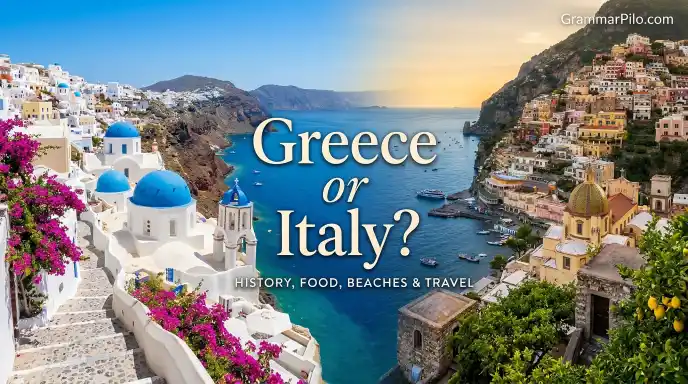
Greece and Italy are both beautiful Mediterranean countries, but Italy is famous for its Roman heritage, Renaissance art, world renowned cuisine, and diverse cities, while Greece is celebrated for its ancient Greek civilization, island landscapes, turquoise waters, and mythology.
Choosing Italy or Greece depends on the experience you want, your budget, the places you plan to visit, and the kind of holiday you enjoy.
Travelers often compare Greece vs. Italy because both countries offer sunny coastlines, historic landmarks, traditional villages, and unforgettable food. However, their cultures, landscapes, architectural styles, and travel experiences are different.
Italy may appeal more to visitors who want to explore historic cities, art museums, fashion, and regional food traditions.
Greece may be the better choice for travelers who dream of island hopping, ancient ruins, seaside villages, and relaxed coastal days.
In this guide, you will discover the key differences between Italy and Greece, including geography, history, culture, cuisine, beaches, costs, transportation, and popular attractions.
If you are planning your first Mediterranean vacation or simply researching these destinations, this comparison will help you decide which country fits your interests best.
Quick Answer: Greece or Italy?
Choose Italy for a varied mix of historic cities, Renaissance art, Roman landmarks, regional cuisine, fashion, and cultural attractions. Choose Greece for ancient temples, island hopping, spectacular coastal scenery, and a holiday that combines history with beach relaxation.
Both destinations offer outstanding experiences, so there is no universal winner.
| Category | Greece | Italy |
| Capital | Athens | Rome |
| Main language | Greek | Italian |
| Currency | Euro (€) | Euro (€) |
| Famous for | Ancient Greek history, islands, mythology, beaches | Roman history, Renaissance art, food, architecture |
| Popular destinations | Athens, Santorini, Mykonos, Crete | Rome, Venice, Florence, Milan, Amalfi Coast |
| Food highlights | Moussaka, souvlaki, Greek salad, feta | Pizza, pasta, risotto, gelato |
| Beach experience | Famous islands and clear Mediterranean waters | Coastal towns, sandy beaches, dramatic cliffs |
| Art and museums | Ancient sculpture, archaeology, classical sites | Renaissance masterpieces, Roman art, major museums |
| Ideal travel style | Island hopping, coastal relaxation, ancient history | City exploration, art, food, architecture, varied itineraries |
| Best for | Island scenery and relaxed seaside trips | Diverse cultural experiences and historic cities |
For a first trip focused on variety, Italy is an excellent option. For a trip centered on islands, swimming, and a slower Mediterranean atmosphere, Greece is especially appealing.
Where Are Greece and Italy Located?
Greece and Italy are both in southern Europe and are closely connected to the Mediterranean Sea. Their neighboring seas, coastlines, and historical trade routes have influenced their cultures for thousands of years.
Where Is Greece?
Greece is located in southeastern Europe, at the southern end of the Balkan Peninsula. It shares land borders with Albania, North Macedonia, Bulgaria, and Türkiye.
The country includes a mountainous mainland and a large number of islands spread across the Aegean and Ionian seas. Popular island groups include the Cyclades, Dodecanese, and Ionian Islands.
This geography gives Greece a distinctive travel experience. Visitors can explore Athens, visit ancient archaeological sites, and then travel to islands known for whitewashed villages, beaches, and coastal scenery.
Where Is Italy?
Italy is located in southern Europe and extends into the Mediterranean Sea in the shape of a boot. It shares land borders with France, Switzerland, Austria, and Slovenia. The independent countries of Vatican City and San Marino are also located within Italy’s territory or surrounded by it.
Italy includes the mainland peninsula, the major islands of Sicily and Sardinia, and numerous smaller islands. Its geography ranges from the Alps in the north to volcanic landscapes, rolling hills, beaches, and historic coastal settlements farther south.
Because Italy has such varied landscapes, a single trip can include alpine scenery, art filled cities, countryside vineyards, and Mediterranean beaches.
What Is the Main Geographical Difference?
Greece is especially associated with island travel and its scattered archipelagos. Italy offers a particularly broad range of landscapes across one long peninsula, with major cities and rural destinations connected by extensive transport networks.
Both countries have beautiful coastlines, but the best destination depends on if you prefer an island focused holiday or a trip that combines cities, countryside, and the sea.
Greece vs. Italy: History and Ancient Civilization
Greece and Italy have played major roles in European and world history. Their ancient civilizations influenced philosophy, government, architecture, literature, art, and religion.
The History of Greece
Ancient Greece is associated with the development of influential philosophical traditions, city states, dramatic literature, and early democratic institutions, particularly in Athens.
Landmarks such as the Acropolis of Athens and the ancient sanctuary at Delphi help visitors understand Greek religion, politics, and cultural life. Ancient Greek thinkers, including Socrates, Plato, and Aristotle, continue to influence philosophy and education.
Greek mythology is another important part of the country’s cultural legacy. Stories involving Zeus, Athena, Poseidon, and other deities remain familiar around the world.
Modern Greece also has a complex history involving the Byzantine Empire, centuries of Ottoman rule in parts of the region, and the establishment of the modern Greek state in the nineteenth century.
The History of Italy
Italy was the center of ancient Roman civilization, which shaped law, engineering, architecture, language, and political institutions across much of Europe and the Mediterranean.
Rome contains major remains of this history, including the Colosseum, Roman Forum, and Pantheon. Other areas of Italy preserve important evidence of ancient life, including Pompeii, which was buried by the eruption of Mount Vesuvius in AD 79.
Italy later became the birthplace of the Renaissance, a period of remarkable artistic, scientific, and intellectual activity. Florence is particularly associated with Renaissance art and architecture, while Rome and Venice also contain extraordinary cultural collections.
Italy’s history extends far beyond ancient Rome and the Renaissance. Its regional states, maritime republics, religious institutions, and eventual national unification all contributed to its modern identity.
Which Country Is Better for History Lovers?
Greece is an excellent choice for travelers fascinated by ancient Greek philosophy, mythology, temples, and archaeological sites.
Italy is particularly attractive to visitors who want to explore ancient Roman engineering, Renaissance painting, medieval cities, and historic churches.
Neither country has a monopoly on ancient history. Greece has Roman and Byzantine heritage, while Italy preserves Greek archaeological sites, especially in Sicily and southern Italy.
Greece or Italy: Culture and Lifestyle
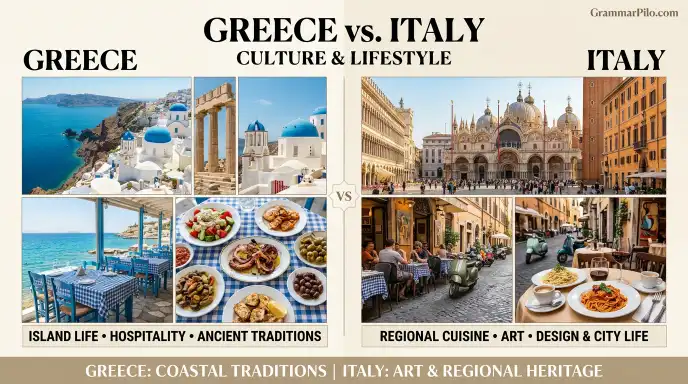
Although Greece and Italy share Mediterranean influences, their languages, traditions, social customs, and regional identities differ.
Greek Culture
Greek culture has strong connections to family, local communities, hospitality, food, music, religious traditions, and regional celebrations.
Meals are often social occasions, and visitors may encounter shared dishes, fresh seafood, olive oil, grilled meats, and seasonal vegetables. In many destinations, outdoor cafés and waterfront tavernas are important parts of everyday life.
Greek Orthodox Christianity has played a major role in the country’s cultural history. Churches, monasteries, religious festivals, and Easter celebrations remain important in many communities, although individual beliefs and practices vary.
Island life also differs from mainland life. A busy urban area such as Athens has a different pace and atmosphere from a small island village.
Italian Culture
Italian culture is strongly associated with regional food traditions, family life, fashion, design, art, and public social spaces.
Italy’s regional diversity is especially noticeable in its cuisine, architecture, dialects, festivals, and customs. The traditions of Sicily differ from those of Lombardy, Tuscany, or Veneto.
Cafés, piazzas, markets, and neighborhood restaurants play important roles in many communities. Visitors may also notice the country’s deep connections to craftsmanship, textiles, furniture design, and luxury fashion.
Catholicism has shaped much of Italy’s art and architecture, especially in Rome and other historic centers. Modern Italian society, like Greek society, includes people with different beliefs and lifestyles.
Italy vs. Greece: Cultural Atmosphere
Greece may feel especially appealing to travelers who want island villages, coastal dining, and a strong connection between landscapes and ancient traditions.
Italy may be more attractive to visitors interested in regional city life, artistic heritage, architecture, shopping, and food focused travel.
These are broad impressions rather than strict rules. Both countries offer lively cities, quiet villages, traditional festivals, and contemporary cultural scenes.
Greek Food vs. Italian Food
Food is one of the strongest reasons to visit either country. Greece and Italy use fresh ingredients and regional cooking traditions, but their signature dishes and flavor combinations are distinct.
Famous Greek Foods
Greek cuisine often features olive oil, vegetables, legumes, herbs, cheese, seafood, and grilled meat.
Popular dishes include:
- Moussaka: A baked dish commonly prepared with layers of eggplant, minced meat, and a creamy topping.
- Souvlaki: Grilled pieces of meat served on skewers or in a pita.
- Greek salad: A refreshing combination of tomatoes, cucumber, onion, olives, and feta cheese.
- Spanakopita: A savory pastry filled with spinach and cheese.
- Tzatziki: A yogurt based dip with cucumber, garlic, and herbs.
- Baklava: A sweet pastry made with layers of thin dough, nuts, and syrup or honey.
Greek cuisine is particularly appealing to travelers who enjoy grilled foods, seafood, salads, and bright, herbaceous flavors.
Famous Italian Foods
Italian cuisine varies greatly by region and often emphasizes pasta, bread, tomatoes, cheese, olive oil, seafood, meat, and seasonal produce.
Popular dishes include:
- Pizza: A baked flatbread topped with ingredients such as tomato, mozzarella, and basil.
- Pasta: Available in many shapes and regional preparations, from spaghetti to filled pasta.
- Risotto: A creamy rice dish associated especially with northern Italy.
- Lasagna: Layers of pasta with sauces, cheese, and other ingredients.
- Gelato: Italians tyle frozen dessert with a range of flavors.
- Tiramisu: A dessert commonly made with coffee soaked biscuits, mascarpone cream, and cocoa.
Italian cuisine is ideal for travelers who enjoy pasta, regional specialties, baked dishes, and a wide range of desserts.
Which Country Has Better Food?
There is no objective winner between Greek and Italian food. Greece may appeal more to people who love grilled seafood, fresh salads, yogurt based dishes, and Mediterranean herbs.
Italy may be especially satisfying for travelers who want to explore pasta, pizza, regional cheeses, and varied culinary traditions.
Food quality depends heavily on the restaurant, ingredients, season, and local specialties. Exploring regional dishes in either country is usually more rewarding than judging an entire national cuisine by one famous meal.
Greece vs. Italy: Beaches and Natural Beauty
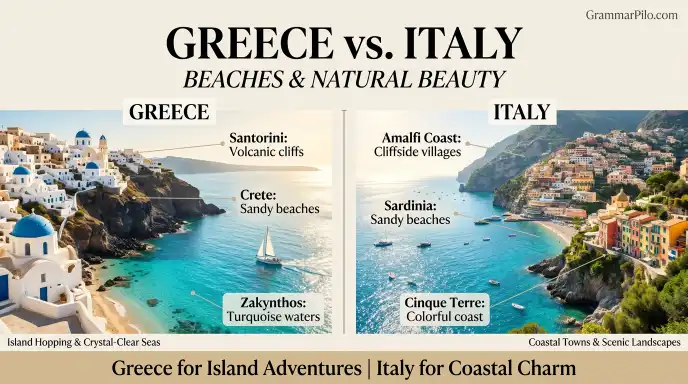
Both destinations offer spectacular Mediterranean scenery, but their coastlines have different visual character and travel patterns.
Beaches in Greece
Greece is famous for its islands, clear waters, rocky coves, sandy beaches, and whitewashed settlements.
Popular destinations include:
- Santorini: Known for dramatic volcanic cliffs, caldera views, and sunset scenery.
- Mykonos: Famous for beach clubs, nightlife, and stylish coastal settings.
- Crete: Offers long beaches, mountains, archaeological sites, and traditional villages.
- Corfu: Known for green landscapes, historic architecture, and beaches along the Ionian Sea.
- Zakynthos: Famous for striking coastal scenery and turquoise waters.
Greece is especially attractive for travelers who want to spend several days moving between islands or combining swimming with archaeological visits.
Beaches in Italy
Italy has a varied coastline with sandy beaches, rocky coves, fishing villages, and dramatic seaside towns.
Popular destinations include:
- Amalfi Coast: Known for cliffside villages, winding roads, and Mediterranean views.
- Sardinia: Offers beautiful beaches and clear water, including long stretches of pale sand.
- Sicily: Combines beaches with ancient Greek and Roman sites, historic towns, and volcanic landscapes.
- Cinque Terre: Famous for colorful villages perched above the Ligurian coast and scenic walking routes.
- Puglia: Offers coastal towns, beaches, and distinctive countryside architecture.
Italy is a strong choice for travelers who want beaches alongside historic towns, countryside excursions, or major cultural cities.
Greece or Italy for a Beach Holiday?
Greece is often the more obvious choice for an island hopping trip centered on swimming, boat excursions, and sunset views.
Italy may be better for travelers who want to combine seaside relaxation with regional cuisine, historic coastal towns, and excursions into cities or countryside areas.
The best beaches in both countries can be crowded during peak summer, so visiting in late spring or early autumn may provide a more comfortable experience, depending on the destination and weather.
Greece or Italy: Cost of Travel
The cost of visiting Greece or Italy depends on the season, destination, accommodation type, transportation, and dining preferences. Neither country is consistently cheaper in every situation.
Is Greece Cheaper Than Italy?
Greece can offer good value in some mainland destinations and less visited islands. However, well known islands such as Santorini and Mykonos can become expensive, particularly during the peak summer season.
Accommodation near popular beaches, private boat trips, and ferry travel between multiple islands can increase the total cost of a Greek holiday.
Travelers who choose less visited destinations, stay longer in one place, and eat at local restaurants may be able to manage their budgets more easily.
Is Italy More Expensive Than Greece?
Italy can be expensive in major tourist centers such as Venice, Florence, Milan, and parts of the Amalfi Coast. Prices may be particularly high during major events and busy summer periods.
However, Italy also offers more affordable experiences in smaller cities, rural areas, and less touristed regions. Regional trains, casual restaurants, and advance accommodation bookings can help control costs.
How to Compare the Total Budget
| Expense | Greece | Italy |
| Accommodation | Varies widely, with premium island prices | Varies widely, with premium city and coastal prices |
| Food | Local tavernas can offer good value | Casual trattorias and local eateries can offer good value |
| Transportation | Ferries and island transfers may add up | Trains, buses, and regional transport offer varied options |
| Activities | Boat trips and island excursions can be costly | Museums, guided tours, and popular attractions may add up |
| Seasonal pricing | Popular islands can be expensive in summer | Major cities and coastal destinations can be expensive in summer |
To compare Italy vs. Greece fairly, build an itinerary for the same number of days, similar accommodation, comparable meals, and similar activities.
A five day stay in Athens is not directly comparable with a five day trip that includes several Greek islands, just as Rome differs from an itinerary covering Venice, Florence, and the Amalfi Coast.
Transportation: Getting Around Greece and Italy
Transportation affects how much you can see and how relaxed your trip feels.
Traveling Around Greece
Athens has public transportation, including metro services, buses, and other urban connections. Mainland destinations can be reached by road, bus, and rail on selected routes.
Ferries are particularly important for travel between islands, although schedules and journey times vary by route and season. Some islands also have airports with domestic and international connections.
If you plan to visit several islands, consider ferry departure times, luggage, port transfers, and the possibility of weather related disruptions. Choosing islands within the same group can simplify your itinerary.
Traveling Around Italy
Italy has an extensive rail network linking many major cities and regional destinations. High speed trains connect places such as Rome, Florence, Milan, Naples, and Venice, making city to city travel convenient on many routes.
Buses and regional trains serve smaller towns, while rental cars can be useful in rural areas and some coastal regions. However, driving in historic city centers can be complicated by restricted traffic zones, narrow streets, and limited parking.
Italy’s transport options make it possible to combine several major cities without renting a car, though local planning is still necessary.
Which Country Is Easier to Explore?
Italy can be especially convenient for an itinerary focused on several major cities connected by rail.
Greece is highly rewarding for island travel, but moving between islands requires careful planning around ferry schedules or domestic flights.
For either country, avoid trying to fit too many destinations into a short holiday. Spending extra time in fewer places often creates a more enjoyable trip.
Best Places to Visit in Greece and Italy
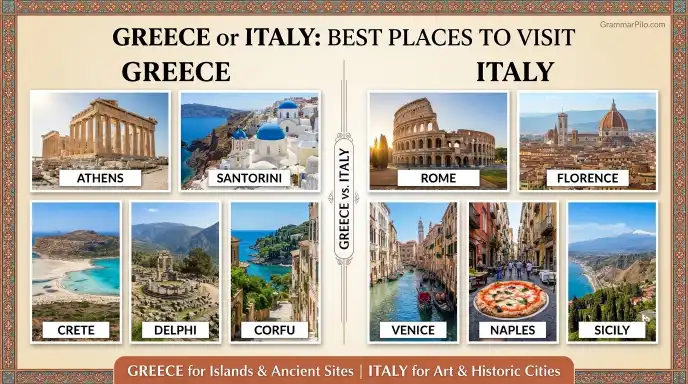
Your destination choices can make a bigger difference than the country itself. Both Greece and Italy offer major cities, quieter towns, historic sites, and scenic coastal destinations.
Best Places to Visit in Greece
Athens: Explore the Acropolis, ancient monuments, museums, markets, and modern Greek city life.
Santorini: Enjoy caldera viewpoints, volcanic landscapes, distinctive villages, and sunset scenery.
Crete: Visit archaeological sites, mountain villages, beaches, and traditional food destinations.
Delphi: Discover an important ancient sanctuary set among dramatic mountain scenery.
Corfu: Explore historic streets, green countryside, coastal villages, and beaches.
Best Places to Visit in Italy
Rome: Discover the Colosseum, Roman Forum, Vatican collections, historic squares, and traditional restaurants.
Florence: Explore Renaissance art, architecture, museums, and the historic center of Tuscany’s capital.
Venice: Experience canals, historic palaces, bridges, and distinctive lagoon scenery.
Naples: Sample local pizza, explore historic neighborhoods, and use the city as a base for nearby archaeological sites.
Sicily: Combine beaches, ancient Greek and Roman heritage, regional cuisine, and volcanic scenery.
Greece or Italy for a First Time Visitor?
If you want a first trip filled with major cities, famous museums, architecture, and varied regional experiences, Italy is a strong choice.
If your dream holiday includes ancient monuments, island scenery, boat trips, and time beside the sea, Greece may suit you better.
Both destinations can provide a memorable first visit. The key is to match the itinerary to your interests rather than attempting to see everything in one trip.
Best Time to Visit Greece or Italy
The ideal travel season depends on weather preferences, crowd levels, costs, and the activities you plan to enjoy.
Visiting Greece
Late spring and early autumn are often attractive times to visit Greece. These periods can offer warm conditions for sightseeing and outdoor activities, with fewer peak season crowds than the busiest summer weeks in many destinations.
Summer is popular for island holidays and swimming, but some locations can be very hot, crowded, and expensive. Island services and ferry schedules may be more frequent during the main travel season, though demand is also higher.
Winter is generally quieter, especially on smaller islands, where some tourist businesses may operate on reduced schedules.
Visiting Italy
Spring and autumn are also popular for Italy, particularly for city sightseeing, walking tours, and cultural attractions.
Summer is a busy period for major cities and coastal destinations. Heat can be intense in some areas, and accommodation prices often rise in high demand locations.
Winter can be a good time for museums, historic cities, seasonal events, and certain mountain destinations, although weather varies considerably from the Alps to Sicily.
Which Country Has Better Weather?
Neither Greece nor Italy has uniformly better weather. Both experience regional and seasonal differences.
Greece is often associated with sunny summer island holidays, while Italy offers a wider range of climates because of its north to south geography and mountain regions.
Check the forecast for your specific destinations and travel dates rather than relying on national averages alone.
Common Mistakes When Comparing Greece and Italy
Mistake 1: Assuming Greece Is Always Cheaper
Popular Greek islands can be expensive, especially in peak season. Travel between islands may also increase costs.
Better approach: Compare accommodation, transportation, meals, and activities for your actual itinerary.
Mistake 2: Assuming Italy Is Only About Rome
Italy includes major cities, rural regions, islands, mountain landscapes, and coastal areas. Rome is only one part of its cultural and geographic diversity.
Better approach: Consider destinations such as Florence, Puglia, Sicily, Sardinia, and smaller regional towns.
Mistake 3: Treating All Greek Islands as the Same
Greek islands differ in size, landscape, atmosphere, nightlife, and accessibility. Some are ideal for hiking and nature, while others are known for nightlife or luxury resorts.
Better approach: Research individual islands before choosing where to stay.
Mistake 4: Expecting Every Italian City to Be Easy to Explore by Car
Historic centers often have restricted traffic areas and limited parking. A rental car may be unnecessary or inconvenient for city focused trips.
Better approach: Consider trains and public transport for major cities, and rent a car only when it adds value to your route.
Mistake 5: Trying to Visit Too Many Places
Both countries offer so many attractions that an overly ambitious itinerary can become tiring and expensive.
Better approach: Choose a small number of destinations and allow time for local experiences, meals, and unexpected discoveries.
Frequently Asked Questions
1. Is Italy or Greece better for tourists?
Both are excellent tourist destinations. Italy is particularly strong for historic cities, art, architecture, food, and rail connected itineraries. Greece is especially appealing for island hopping, ancient Greek sites, coastal scenery, and beach holidays.
2. Is Greece cheaper than Italy?
It depends on the destinations, travel dates, and travel style. Some Greek destinations can be affordable, while popular islands may be expensive. Italy also has expensive tourist centers and more affordable regions. Compare complete itineraries rather than assuming one country is always cheaper.
3. Which country has better beaches, Greece or Italy?
Greece is famous for its islands, clear waters, and beach hopping opportunities. Italy has beautiful beaches too, including those in Sardinia, Sicily, Puglia, and along the Amalfi Coast. The best choice depends on the scenery and activities you prefer.
4. Is Greek food better than Italian food?
Neither cuisine is objectively better. Greek food often emphasizes grilled meats, seafood, vegetables, olive oil, and feta, while Italian cuisine is famous for pasta, pizza, risotto, cheese, and regional specialties. Personal taste is the deciding factor.
5. Which country has more ancient history?
Both have remarkable ancient heritage. Greece is central to the history of ancient Greek philosophy, city states, and mythology. Italy is particularly associated with ancient Rome. Their histories overlap, and both countries preserve archaeological sites from multiple civilizations.
6. Should I visit Greece or Italy for a honeymoon?
Greece can be ideal for couples who want island scenery, seaside hotels, boat trips, and romantic sunsets.
Italy may suit couples who prefer historic cities, countryside stays, art, and food focused experiences. Both can work beautifully for a honeymoon, depending on the preferred atmosphere and budget.
7. Can I visit Italy and Greece on the same trip?
Yes. Both use the euro, and they are connected through air travel and some ferry routes. However, travel time and connections depend on the departure and arrival points. For a short trip, focus on a few destinations instead of trying to cover both countries extensively.
8. Is Greece or Italy better for families?
Both countries offer family friendly destinations. Italy may be convenient for families who want city attractions, museums, historic sites, and rail travel.
Greece may be especially appealing to families seeking beaches, swimming, and relaxed island stays. Accommodation and transport choices are important in either country.
9. Which country is better for a summer vacation?
Greece is an excellent option for island focused summer holidays. Italy is a strong choice for travelers who want to combine cities, food, culture, and coastal destinations. Both can be hot and crowded during peak summer, so consider your tolerance for heat and your preferred pace.
10. Is Greece or Italy better for first time travelers to Europe?
Italy can be a convenient introduction for travelers who want to visit several famous cities by train. Greece can be a wonderful first destination for visitors interested in ancient history and island scenery. The better option depends on the activities and landscapes you most want to experience.
Conclusion: Should You Choose Greece or Italy?
Choosing Greece or Italy depends on the kind of Mediterranean experience you want. Greece stands out for its ancient Greek heritage, island landscapes, clear waters, mythology, and relaxed seaside destinations.
Italy offers an extraordinary combination of Roman history, Renaissance art, historic cities, regional cuisine, fashion, and varied natural scenery.
If you are most excited by island hopping, beach days, coastal villages, and ancient temples, Greece may be your ideal destination. If you want to explore famous museums, historic architecture, food traditions, and several major cities in one journey, Italy is an excellent choice.
Budget should also influence your decision, but neither country is automatically cheaper. Popular destinations in both can be expensive, especially during the busiest travel months. Comparing accommodation, transportation, meals, and activities will give you a more realistic picture.
Ultimately, Greece vs. Italy is not a contest with one universal winner. Both countries offer rich cultures, delicious food, memorable landscapes, and thousands of years of history.
Choose the destination that best matches your travel interests, allow enough time to enjoy it, and you will have a rewarding Mediterranean experience.
More Differences to Discover

I’m Claire Morgan, the author behind Grammarpilo.com, where I write about English grammar, sentence structure, punctuation, and everyday language. My goal is to make grammar simple, clear, and practical, helping readers understand the rules and apply them with confidence in real-world writing.







3 thoughts on “Greece or Italy: History, Food, Beaches, Culture & Travel Guide”