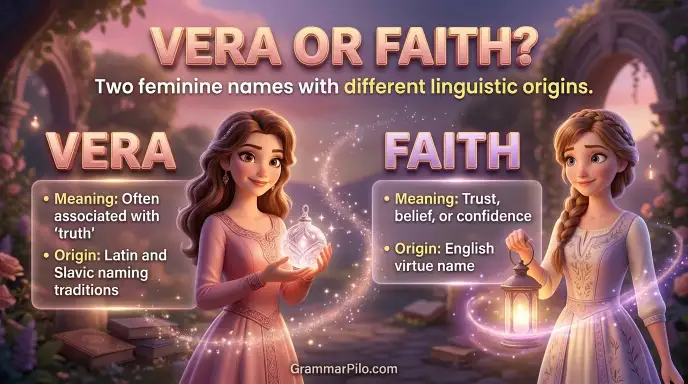
Choosing between Vera and Faith can be difficult if you want a name with a beautiful meaning, a timeless sound, and a meaningful cultural background. Both are feminine given names with positive associations, but they come from different linguistic roots and express different ideas.
Vera is commonly associated with truth in several Slavic languages, while Faith comes directly from the English word for trust, belief, and confidence, particularly in a religious context.
The choice between Vera or Faith often depends on personal taste, family traditions, cultural background, and the meaning you want a name to convey.
Vera has a classic, elegant quality and a history that stretches across several European cultures. Faith has a clear English meaning and is often chosen because it represents hope, trust, and spiritual conviction.
In this guide, you will learn the meanings, origins, pronunciation, popularity considerations, and everyday uses of Vera and Faith.
You will also discover how the names compare in American and British English, what makes each one distinctive, and how to decide which name best suits your preferences.
Quick Answer: Vera or Faith?
Vera and Faith are both established feminine given names, but they have different meanings and origins. Vera is associated with truth in Slavic naming traditions and is also connected with the Latin word verus, meaning true. Faith is an English virtue name meaning trust, belief, or confidence.
| Feature | Vera | Faith |
| Main meaning | Truth, associated with Slavic usage | Trust, belief, confidence |
| Linguistic background | Slavic traditions; also associated with Latin roots | English |
| Name type | Feminine given name | Feminine given name |
| Common pronunciation | VEER-uh or VAIR-uh, depending on language and region | FAYTH |
| General impression | Classic, refined, understated | Meaningful, sincere, faith inspired |
| Religious association | Also associated with Saint Vera in Christian traditions | Strong association with Christian faith and virtue naming |
| Common spelling | Vera | Faith |
Choose Vera if you prefer a traditional name associated with truth and a European cultural background. Choose Faith if you want a name whose meaning directly expresses belief, trust, or spiritual commitment.
What Does Vera Mean?
Vera is a feminine given name with a long history in Europe. Its best known meaning in Slavic naming traditions is “faith,” but the name is also commonly associated with the Latin word verus, meaning “true.”
This overlap is important when comparing Faith or Vera. Although the names have different linguistic histories, Vera can be associated with the same general idea of faith in some traditions.
The Meaning Behind Vera
In Russian and other Slavic naming traditions, Vera is associated with the word for faith. It is one of the traditional Christian virtue names linked with Faith, Hope, and Love, especially in Eastern Christian contexts.
The name is also frequently connected to Latin verus, meaning “true.” This association gives Vera an additional interpretation involving honesty, truthfulness, and authenticity.
Because names travel across languages and cultures, their meanings can vary depending on the tradition being discussed. Vera should not be assigned only one universal meaning without considering its cultural background.
What Kind of Name Is Vera?
Vera is generally used as a feminine first name. It has a short, balanced structure and is easy to spell in many languages that use the Latin alphabet.
The name can feel traditional without sounding overly elaborate. Its two syllables make it suitable for a wide range of surnames, and its long history gives it a familiar quality.
Vera may appeal to parents who want a name that feels elegant, simple, and culturally established. It can also suit readers looking for a character name that suggests intelligence, sincerity, or quiet confidence.
How Do You Pronounce Vera?
Vera has more than one established pronunciation.
- VEER-uh: Common in many English speaking settings.
- VAIR-uh: Also used by English speakers in some regions and families.
- Language specific pronunciations: Slavic and other languages may pronounce the name differently.
If you are choosing Vera as a baby name, it is worth deciding which pronunciation you prefer and checking how it sounds with the family surname.
What Does Faith Mean?
Faith is an English feminine given name derived directly from the noun faith. The word describes trust, confidence, belief, or reliance on someone or something. In religious contexts, it often refers to belief in God or commitment to spiritual teachings.
Unlike Vera, which has a name history involving different languages and interpretations, Faith communicates its central meaning immediately to most English speakers.
The Meaning Behind Faith
The word faith can describe confidence in another person, trust in a promise, or belief in something that cannot necessarily be proven through direct observation. It is especially significant in religious and philosophical discussions.
As a personal name, Faith is commonly associated with devotion, hope, loyalty, and inner strength. Its meaning may be especially important to families who value spiritual traditions or want a name that expresses a personal principle.
However, the name is not exclusively religious. A person named Faith does not necessarily belong to a particular religion or hold a particular set of beliefs. Names can carry symbolic meanings without defining someone’s identity.
What Kind of Name Is Faith?
Faith is a feminine given name known as a virtue name. Virtue names are based on qualities, values, or ideals, such as Grace, Hope, Charity, and Patience.
The name is short and direct, consisting of one syllable. It is easy to recognize in English and has a familiar spelling that rarely needs explanation.
Faith may appeal to parents who want a meaningful name with an unmistakable English definition. It is also a recognizable choice for fictional characters, public facing names, and symbolic writing.
How Do You Pronounce Faith?
Faith is pronounced FAYTH, with one syllable. The final sound is the unvoiced “th” found in words such as think and truth.
Its spelling is generally consistent across English speaking countries, although accents may affect the precise sound of the vowel.
The Origin and History of Vera and Faith
Vera and Faith have different linguistic histories, even though both can connect to ideas of belief and personal values.
Where Does the Name Vera Come From?
Vera has a particularly strong association with Slavic languages, where it is linked to the word meaning faith. It became established as a personal name through European and Christian naming traditions.
Vera is also associated with the Latin adjective verus, meaning true. This Latin connection is frequently mentioned in discussions of the name’s meaning and gives it an additional association with truth.
These explanations are related but should not be treated as identical origins. The meaning of Vera depends partly on the language and tradition in which it is used.
Over time, Vera became familiar in various European communities and in English speaking countries. Its concise form and traditional background helped it remain recognizable across generations.
Where Does the Name Faith Come From?
Faith developed from the English noun faith, which entered English through Old French feid or related forms and ultimately traces back to Latin fides, meaning trust, confidence, or belief.
The word has long been important in religious writing, philosophy, and everyday conversation. As a personal name, Faith belongs to the tradition of virtue names that express desirable qualities or spiritual ideals.
Virtue names became particularly prominent in English speaking religious communities, including some Protestant traditions. Faith, Hope, and Charity are well known examples of names based on religious and moral concepts.
Today, Faith is used in religious and nonreligious families alike. Its meaning remains clear, even when the person carrying the name does not associate it with a specific belief system.
How Are Their Histories Different?
Vera has a multilingual history and is associated with different meanings depending on its cultural context. Faith comes directly from an English word with a well established definition.
This distinction can matter when choosing between Faith and Vera. Vera may feel more international or culturally layered, while Faith may feel more direct and symbolic to English speakers.
Neither history makes one name better than the other. They simply offer different ways of expressing meaningful ideas through a personal name.
Vera vs. Faith: British English and American English
Vera and Faith are both used in British and American English. Their spellings do not change between the two varieties.
| Name | American English | British English | Spelling variation |
| Vera | Vera | Vera | No standard regional spelling change |
| Faith | Faith | Faith | No standard regional spelling change |
Is Vera an American or British Name?
Vera is not limited to either American or British English. It has European cultural associations and is used in many English speaking communities.
Pronunciation can vary between speakers in the United States and the United Kingdom. Individual families may also prefer different pronunciations, so regional tendencies should not be treated as absolute rules.
Is Faith an American or British Name?
Faith is also established in both countries. Because it comes from an English word, its spelling is familiar across English speaking regions.
The name’s popularity may vary by country and generation, but its spelling remains the same. There is no standard British spelling such as Fayth that replaces Faith in ordinary name usage.
Which Name Is More International?
Both names are recognizable internationally, but they have different strengths.
Vera appears in several language and cultural traditions, although pronunciation and associations may change. Faith is particularly transparent to people who understand English, but its meaning may be less immediately obvious to speakers of other languages.
If international pronunciation is important, consider the languages spoken by your family and community. Test the name with likely pronunciations rather than relying only on how it looks in writing.
Vera or Faith: Which Name Should You Choose?
The better choice depends on the meaning, sound, and cultural associations you prefer.
Choose Vera If You Want a Classic Name
Vera may be a good choice if you prefer a short, traditional name that feels refined and understated.
Consider Vera if you want:
- A name associated with truth or faith in particular traditions.
- A name with European and multilingual connections.
- A two syllable name with a gentle, balanced sound.
- A traditional name that does not directly resemble an everyday English virtue word.
- A name that can work well across different ages and stages of life.
Vera can also be a strong choice for a fictional character whose background, family history, or personality suits a classic name.
Choose Faith If You Want a Name With a Direct Meaning
Faith may be the better option if you want a name that communicates a specific value in English.
Consider Faith if you want:
- A name that directly means belief, trust, or confidence.
- A clear connection to religious or spiritual traditions.
- A familiar one syllable name.
- A virtue name with an established place in English naming customs.
- A name whose meaning is immediately understandable to most English speakers.
Faith can also work well for a fictional character whose name reflects a theme of hope, conviction, loyalty, or spiritual growth.
Which Name Sounds Better With a Surname?
The sound of a full name depends on syllable count, stress, rhythm, and the beginning and ending sounds of the surname.
Vera often creates a two syllable rhythm, while Faith creates a shorter, one syllable rhythm. Try saying each option aloud with the full surname.
For example, Vera may sound balanced with a short surname, while Faith may create a strong opening when paired with a longer surname. These are stylistic possibilities rather than fixed rules.
It can also help to write each name alongside middle name options and consider how the initials look.
Common Mistakes When Comparing Vera and Faith
Although Vera and Faith are both established names, several misunderstandings can arise when comparing them.
Mistake 1: Assuming Vera Always Means Truth
Vera is often connected with the Latin word verus, meaning true. However, in Slavic naming traditions, it is associated with faith.
Better approach: Explain the cultural or linguistic context when discussing the meaning of Vera.
Mistake 2: Assuming Vera and Faith Have Exactly the Same Origin
The names can share an association with faith, but that does not make their linguistic histories identical.
Better approach: Distinguish Vera’s Slavic and Latin associations from the English history of Faith.
Mistake 3: Treating Faith as Exclusively Religious
Faith has a strong religious meaning, but it also refers to trust and confidence in ordinary English.
Better approach: Consider both spiritual and everyday meanings.
Mistake 4: Assuming One Name Is Correct and the Other Is Not
Vera and Faith are both established given names. Neither is a misspelling of the other, and one does not serve as an alternative spelling of the other.
Better approach: Choose according to meaning, pronunciation, family preference, and cultural fit.
Mistake 5: Assuming Pronunciation Is Identical Everywhere
Vera has multiple accepted pronunciations, while Faith is generally more consistent in English.
Better approach: Ask the person or family how they pronounce Vera rather than assuming one version is universal.
Everyday Examples of Vera and Faith
Examples can make the difference between the names easier to understand.
Using Vera in Sentences
- Vera is my grandmother’s name.
- We chose Vera because we wanted a classic name with European roots.
- The character Vera is thoughtful, independent, and quietly determined.
- Vera’s name has associations with truth and faith in different naming traditions.
- I like how Vera sounds with our family surname.
Using Faith in Sentences
- Faith is my younger sister’s name.
- They chose Faith because its meaning reflects an important family value.
- The character Faith remains hopeful during difficult times.
- Faith can refer to trust in a person or belief in a religious teaching.
- Faith is a simple name with a strong meaning in English.
Vera or Faith in Creative Writing
Writers may choose Vera to give a character a traditional or culturally specific name. Faith can be useful when a character’s name is intended to reinforce themes of belief, trust, or conviction.
However, a character’s name should not replace character development. Someone named Faith can be doubtful or conflicted, just as someone named Vera can struggle with honesty. Names can create symbolism, but characters become believable through their choices and actions.
Vera or Faith for a Baby Name
Parents may consider family traditions, cultural background, pronunciation, and the meaning they want to associate with their child.
Vera offers a classic name with multiple cultural associations. Faith offers a direct English meaning and a familiar virtue name tradition.
It can be helpful to imagine each name on a young child, a teenager, and an adult. Both are short enough to remain practical throughout life, so the final decision may come down to sound and personal significance.
Faith vs. Vera: Google Trends and Modern Usage
People searching for Vera or Faith may be comparing the names for a baby, a fictional character, a family member, or general interest in name meanings.
The search phrase Vera or Faith does not necessarily indicate that one name is more popular than the other. People may search for the two names together because they are considering different meanings or comparing naming styles.
Why Do People Search for Vera or Faith?
Common reasons include:
- Looking for baby names with meaningful origins.
- Comparing classic names with virtue names.
- Exploring the meaning of Vera in different languages.
- Looking for names associated with truth, belief, or trust.
- Choosing a name for a fictional character or creative project.
Is Vera More Popular Than Faith?
Popularity depends on the country, year, and source of naming statistics. A reliable comparison requires data from a specific period and location.
For example, official birth name records may show how frequently Faith and Vera were given to babies in a particular country. Search interest alone does not establish how many children received either name.
Without checking a specific dataset, it would be misleading to claim that Faith or Vera is definitively more popular today.
How to Compare Their Popularity
If popularity matters to your decision, look at official baby name statistics for your country and compare the same years. You can also use Google Trends to explore relative search interest over a selected period.
Remember that Google Trends reports normalized search interest rather than total searches or the number of babies given a name. Its results can help identify patterns, but they should not be treated as a complete measure of name popularity.
Vera vs. Faith: Key Differences at a Glance
| Question | Vera | Faith |
| What does it mean? | Associated with truth and, in Slavic traditions, faith | Trust, belief, or confidence |
| Where does it come from? | Slavic naming traditions; also associated with Latin verus | English word with roots in French and Latin |
| How many syllables? | Usually two | One |
| Is it a virtue name? | Associated with faith in some naming traditions | Yes, a familiar English virtue name |
| Is it used in the US? | Yes | Yes |
| Is it used in the UK? | Yes | Yes |
| Does the spelling change by region? | No standard US/UK change | No standard US/UK change |
| Is it a valid first name? | Yes | Yes |
| Best suited to someone who prefers | A classic, international feeling name | A direct, meaningful English name |
The main difference is the way each name communicates meaning. Vera offers a cultural and linguistic history with more than one common association. Faith expresses its central idea directly through an English word.
Frequently Asked Questions
1. Is Vera or Faith the better name?
Neither name is universally better. Vera may appeal to people who prefer a classic name associated with truth and European naming traditions. Faith may appeal to people who want a name that directly expresses trust, belief, or spiritual conviction.
2. Does Vera mean Faith?
Vera is associated with faith in Slavic naming traditions. It is also commonly linked to the Latin word verus, meaning true. Its interpretation therefore depends on the cultural and linguistic context.
3. What does the name Faith mean?
Faith means trust, belief, or confidence. In religious contexts, it often refers to belief in God or commitment to spiritual teachings. As a given name, it is also associated with hope and devotion.
4. Is Vera a religious name?
Vera has connections with Christian naming traditions, particularly through its association with faith in Slavic contexts. However, it is also used as a personal name by people who do not choose it for religious reasons.
5. Is Faith a biblical name?
Faith is a prominent Christian virtue and a recurring concept in the Bible. It is best described as an English virtue name with strong Christian associations rather than a personal name originating as a biblical character’s name.
6. How do you pronounce Vera?
Vera is commonly pronounced VEER-uh or VAIR-uh in English. The preferred pronunciation can vary by region, language, and family.
7. Is Faith spelled differently in British English?
No. Faith is spelled the same way in standard British and American English. There is no standard regional spelling that replaces Faith.
8. Can Vera and Faith be used as middle names?
Yes. Both work as middle names. Vera can add a classic sound, while Faith can contribute a meaningful or spiritual association. The best option depends on how the complete name sounds and what it means to the family.
9. Which name is more traditional, Vera or Faith?
Both have established histories. Vera has long standing use across European naming traditions, while Faith belongs to the English tradition of virtue names. The impression of which is more traditional may depend on the country and generation.
10. Are Vera and Faith different spellings of the same name?
No. Vera and Faith are distinct names with different linguistic histories. They can share an association with faith in certain traditions, but neither is a spelling variant of the other.
Conclusion: Should You Choose Vera or Faith?
When comparing Vera or Faith, the best choice comes down to the meaning and style you want. Vera is a classic feminine name associated with truth through its Latin connection and with faith in Slavic naming traditions.
Its cultural background and understated sound make it appealing to people who want a name with a long history and international connections.
Faith is a direct English virtue name that expresses trust, belief, and confidence. Its meaning is easy for English speakers to understand, and it can carry personal, philosophical, or religious significance.
Neither name is a spelling mistake, and neither is automatically the better option. If you value a name with multiple cultural associations and a classic feel, Vera may be the right fit. If you prefer a name that clearly communicates a meaningful ideal, Faith may suit you better.
Before making a final choice, say both names aloud with the intended surname, consider their cultural context, and think about the meaning you would like the name to carry.
The strongest choice is the one that feels natural, meaningful, and right for your circumstances.
Discover More Differences

I’m Claire Morgan, the author behind Grammarpilo.com, where I write about English grammar, sentence structure, punctuation, and everyday language. My goal is to make grammar simple, clear, and practical, helping readers understand the rules and apply them with confidence in real-world writing.







1 thought on “Vera or Faith: Meaning, Origins & Quick Difference Between Them”