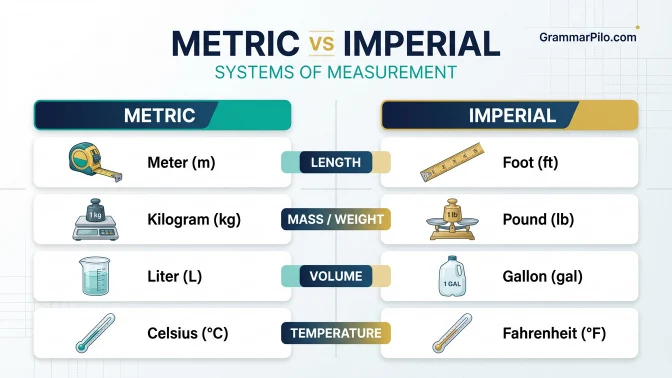
The metric and imperial systems are two major ways to measure length, weight, volume, and temperature. The metric system uses units such as meters, kilograms, and liters, while the imperial system uses inches, pounds, and gallons.
Both systems are still used around the world, but they differ in how measurements are organized and converted.
People often search for imperial or metric to understand the difference between these systems, convert measurements, or decide which one to use in everyday situations.
The metric system is widely used in science, education, medicine, and most countries. The imperial system remains common in the United States and appears in some everyday measurements in other countries.
Understanding metric vs. imperial measurements can make cooking, shopping, travel, schoolwork, and international communication much easier. This guide explains how each system works, compares their units, and shows when to use them.
Metric or Imperial: Quick Answer
The metric system is generally easier to learn, calculate, and convert because it follows multiples of 10. It is also the international standard in science, medicine, and most countries.
The imperial system is still useful in places where people use inches, feet, pounds, miles, and Fahrenheit in daily life. This is especially true in the United States.
Here is the basic difference:
- Metric system: Uses meters, kilometers, grams, kilograms, milliliters, liters, and Celsius.
- Imperial system: Uses inches, feet, yards, miles, ounces, pounds, pints, quarts, gallons, and Fahrenheit.
- Metric conversions: Usually move by factors of 10, 100, or 1,000.
- Imperial conversions: Use different factors, such as 12 inches in a foot and 5,280 feet in a mile.
Neither system is automatically better for every situation. The best choice depends on your location, profession, task, and the people who need to understand the measurements.
What Is the Metric System?
The metric system is a measurement system based on units that scale by powers of 10. It was developed in France during the late 18th century and later became the foundation of the modern International System of Units, commonly called SI.
Its organized structure makes calculations straightforward. For example, one kilometer equals 1,000 meters, and one kilogram equals 1,000 grams.
Common Metric Units
The metric system covers several types of measurements.
| Measurement | Metric Unit | Symbol |
| Length | Millimeter | mm |
| Length | Centimeter | cm |
| Length | Meter | m |
| Distance | Kilometer | km |
| Mass | Gram | g |
| Mass | Kilogram | kg |
| Volume | Milliliter | mL |
| Volume | Liter | L |
| Temperature | Celsius | °C |
How Metric Conversions Work
Metric conversions are usually simple because the units follow a decimal structure.
For example:
- 1 kilometer = 1,000 meters
- 1 meter = 100 centimeters
- 1 centimeter = 10 millimeters
- 1 kilogram = 1,000 grams
- 1 liter = 1,000 milliliters
To convert between these units, you move the decimal point or multiply or divide by the appropriate power of 10.
Example: A 2.5 kilometer walk equals 2,500 meters.
This consistent structure makes metric measurements especially convenient for mathematics, science, engineering, and international trade.
What Is the Imperial System?
The imperial system is a traditional measurement system that developed in Britain. It became standardized in the United Kingdom in 1824 and was historically used throughout the British Empire.
Its units include inches, feet, yards, miles, ounces, pounds, pints, quarts, and gallons. Unlike the metric system, its conversion factors are not consistently based on 10.
The United States uses a related system called United States customary units. Although many units have the same names as imperial units, some measurements differ.
Common Imperial Units
| Measurement | Imperial Unit | Symbol |
| Length | Inch | in |
| Length | Foot | ft |
| Length | Yard | yd |
| Distance | Mile | mi |
| Weight | Ounce | oz |
| Weight | Pound | lb |
| Volume | Imperial fluid ounce | fl oz |
| Volume | Imperial pint | pt |
| Volume | Imperial gallon | gal |
| Temperature | Fahrenheit | °F |
How Imperial Conversions Work
Imperial measurements use different conversion factors depending on the units involved.
For example:
- 12 inches = 1 foot
- 3 feet = 1 yard
- 1,760 yards = 1 mile
- 16 ounces = 1 pound
- 14 pounds = 1 stone
- 8 pints = 1 imperial gallon
These relationships can take more effort to memorize and calculate.
Example: A 6 foot person is 72 inches tall because one foot contains 12 inches.
The imperial system can feel natural to people who use it regularly. However, its varied conversion factors can make calculations less straightforward for beginners.
The Origin and History of Metric and Imperial Measurements
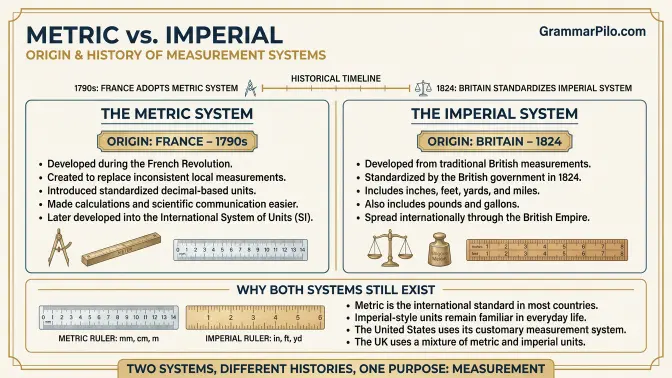
The imperial and metric systems developed in different places and for different reasons.
The History of the Metric System
Before the metric system, France used many local measurement units. These units varied from region to region, making trade and communication difficult.
During the French Revolution, leaders supported a standardized measurement system. The metric system was introduced in the 1790s to create a more consistent approach.
Its original design used decimal relationships. Over time, other countries adopted it because it simplified measurement, calculations, and scientific communication.
Today, the International System of Units provides the global foundation for modern metric measurements.
The History of the Imperial System
The imperial system grew from traditional British measurements. Many of its units had been used for centuries before the British government standardized them in 1824.
The system included familiar measurements such as inches, feet, yards, miles, pounds, and gallons.
As the British Empire expanded, these units spread to different parts of the world. Some countries later moved to metric measurements, while the United States continued using its own customary system.
Why Both Systems Still Exist
The metric system became the international standard for most technical and commercial purposes. However, measurement habits can be difficult to change.
People may continue using familiar units in daily life even when their country officially uses metric measurements.
For example, some people in the United Kingdom use miles for road distances and miles per hour for speed limits while using meters and centimeters for other measurements.
British English vs American English: Measurement Differences
Metric and imperial measurements are not simply British and American versions of the same system. The United Kingdom uses a mixture of metric and imperial units, while the United States mainly uses US customary units.
There are also important differences between British imperial units and American customary units.
Imperial vs US Customary Measurements
| Measurement | British Imperial | US Customary |
| 1 gallon | 4.546 liters | 3.785 liters |
| 1 pint | 568 mL | 473 mL |
| 1 fluid ounce | 28.4 mL | 29.6 mL |
| 1 mile | 1,760 yards | 1,760 yards |
| 1 pound | 16 ounces | 16 ounces |
The biggest everyday differences appear in volume measurements.
For example, a British imperial gallon holds more liquid than a US gallon. Therefore, a recipe or fuel measurement can produce confusion if you assume the units are identical.
Which System Does Each Country Use?
| Country | Common Measurement Practices |
| United States | US customary units in many everyday situations |
| United Kingdom | Metric and imperial units |
| Canada | Mostly metric, with some traditional imperial usage |
| Australia | Primarily metric |
| New Zealand | Primarily metric |
| India | Primarily metric |
| Pakistan | Primarily metric |
| Germany | Metric |
| France | Metric |
The exact units used can vary by industry, activity, and local convention.
For international communication, metric measurements are usually the safest starting point. However, use the units your audience expects when writing for a specific country.
Which Measurement System Should You Use?
Choosing metric or imperial depends on the situation. Both systems have practical uses, but metric is usually the more convenient option for international work and technical calculations.
Use Metric for Science and Education
Metric units are the standard choice in most scientific and educational settings.
Scientists use meters, kilograms, seconds, kelvin, and other SI units to share measurements consistently.
Students also benefit from the decimal structure because it makes calculations easier to follow.
Use Imperial or US Customary Units for US Audiences
If you are writing for readers in the United States, familiar units may make your content easier to understand.
For example:
- Use miles for road distances.
- Use feet and inches for height.
- Use pounds for body weight.
- Use Fahrenheit for everyday weather temperatures.
- Use cups, ounces, and gallons when appropriate for American recipes.
Use Metric for International Business
Metric units are generally more suitable for international product specifications, engineering documents, manufacturing, and scientific communication.
They reduce confusion when people from different countries need to compare measurements.
Use Both When Your Audience Is International
If your content targets readers in different countries, providing both units can improve clarity.
For example:
The table is 120 centimeters (about 47 inches) wide.
This approach allows readers to understand the measurement without performing a conversion themselves.
Common Mistakes When Using Metric and Imperial Measurements
Mixing measurement systems can create errors, especially in cooking, construction, travel, and technical work.
Mistake 1: Assuming US and UK Gallons Are Identical
Incorrect: A UK gallon and a US gallon contain the same amount of liquid.
Correct: A UK imperial gallon is approximately 4.546 liters, while a US gallon is approximately 3.785 liters.
Explanation: The two systems use different gallon definitions.
Memory tip: Always check the country before converting gallons.
Mistake 2: Confusing Weight and Mass
Incorrect: A kilogram and a pound are interchangeable units.
Correct: One kilogram is approximately 2.205 pounds.
Explanation: Kilograms and pounds are different units. They do not represent the same numerical amount.
Memory tip: Remember that 1 kg is a little more than 2 lb.
Mistake 3: Treating Inches and Centimeters as Equal
Incorrect: 10 inches equals 10 centimeters.
Correct: 10 inches equals 25.4 centimeters.
Explanation: Inches and centimeters belong to different measurement systems.
Memory tip: One inch is approximately 2.54 centimeters.
Mistake 4: Confusing Miles and Kilometers
Incorrect: 100 miles equals 100 kilometers.
Correct: 100 miles equals approximately 161 kilometers.
Explanation: A mile is longer than a kilometer.
Memory tip: One mile is about 1.6 kilometers.
Mistake 5: Mixing Fahrenheit and Celsius
Incorrect: 100°F equals 100°C.
Correct: 100°F is approximately 37.8°C.
Explanation: Fahrenheit and Celsius use different temperature scales.
Memory tip: Water freezes at 32°F or 0°C and boils at 212°F or 100°C under standard atmospheric pressure.
Everyday Examples of Metric and Imperial Measurements
Both systems appear in daily life. Knowing their common uses can help you understand measurements in different countries.
Cooking and Baking
Recipes may use grams and milliliters or cups, ounces, and fluid ounces.
For example:
- Metric: 250 grams of flour
- US customary: 1 cup of flour, depending on the recipe and ingredient
- Metric: 500 milliliters of milk
- US customary: About 2.1 US cups of milk
For baking, weighing ingredients in grams often provides more consistent results than measuring them by volume.
Travel and Road Signs
Road distances and speed limits depend on the country.
- United States: Miles and miles per hour
- United Kingdom: Miles and miles per hour for road travel
- Canada: Kilometers and kilometers per hour
- Australia: Kilometers and kilometers per hour
A traveler should check local road signs rather than assume the same units are used everywhere.
Health and Fitness
Medical and fitness information may use both systems.
Examples include:
- Body weight: Kilograms or pounds
- Height: Centimeters or feet and inches
- Running distance: Kilometers or miles
- Temperature: Celsius or Fahrenheit
Medical records and product labels may follow the conventions of the country where they are produced.
Shopping and Clothing
Clothing and product measurements can vary between markets.
For example, furniture dimensions may appear in centimeters in one country and inches in another. Online shoppers should check the measurement unit before ordering.
Weather Reports
Weather forecasts use Celsius in most countries and Fahrenheit in the United States.
For reference:
| Celsius | Fahrenheit |
| 0°C | 32°F |
| 10°C | 50°F |
| 20°C | 68°F |
| 25°C | 77°F |
| 30°C | 86°F |
| 37°C | 98.6°F |
| 100°C | 212°F |
These examples show why understanding both temperature scales is useful when traveling or reading international weather information.
Google Trends & Modern Usage
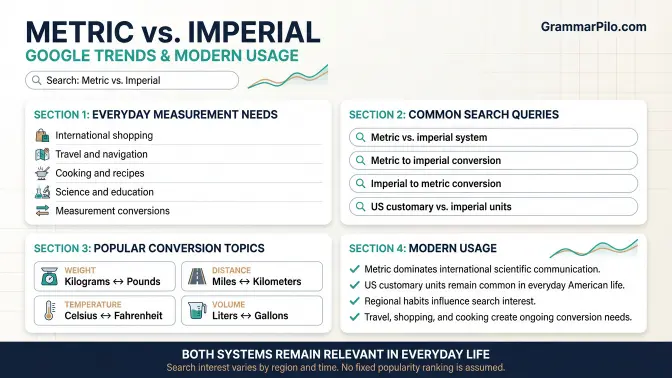
Interest in metric or imperial measurements often comes from practical needs. People search for these terms when converting measurements, comparing international products, reading recipes, studying science, or traveling.
Metric measurements dominate international scientific and technical communication. The United States continues to use customary units in many everyday settings, which keeps conversion questions relevant.
Common searches include:
- Metric vs. imperial system
- Metric to imperial conversion
- Imperial to metric conversion
- US customary vs. imperial units
- Kilograms to pounds
- Miles to kilometers
- Celsius to Fahrenheit
- Liters to gallons
Search interest can vary by region and season. For example, conversion questions may become more common when people travel, shop internationally, or follow recipes from another country.
No fixed popularity ranking or search volume figure should be assumed without checking current trend data.
The continued use of both systems means that measurement conversion remains a useful everyday skill.
Quick Comparison Table: Imperial vs. Metric
| Feature | Metric System | Imperial System |
| Main units | Meters, grams, liters | Feet, pounds, gallons |
| Conversion structure | Mostly powers of 10 | Different conversion factors |
| Main historical origin | France | Britain |
| Common use | Most countries | United States and some UK contexts |
| Scientific use | International standard | Limited everyday scientific use |
| Temperature | Celsius | Fahrenheit is common in the US |
| Ease of conversion | Generally easier | Often requires more steps |
| International communication | Widely recognized | May need conversion |
Important: The United States mainly uses US customary units, not the British imperial system. The two systems share many unit names but differ in certain definitions.
Key Takeaways
- The metric system uses meters, kilograms, liters, and Celsius.
- The imperial system uses inches, feet, pounds, gallons, and other traditional units.
- Metric conversions are generally easier because they follow a decimal structure.
- Most countries use metric measurements in everyday and technical settings.
- The United States mainly uses US customary units.
- British imperial and US customary gallons and pints are different.
- Using both systems can make international content easier to understand.
- Always check the measurement unit before converting recipes, product dimensions, or travel distances.
Frequently Asked Questions
1. Is metric or imperial better?
The metric system is generally easier to learn and convert because it follows a base 10 structure. It is also used internationally in science, education, and most countries. However, imperial and US customary units remain practical for people who use them daily.
2. Does the United States use metric or imperial?
The United States mainly uses US customary units in everyday life. These include inches, feet, miles, pounds, ounces, gallons, and Fahrenheit. The country also uses metric units in science, medicine, manufacturing, and many technical fields.
3. Is the UK metric or imperial?
The United Kingdom uses both systems. Road distances and speed limits commonly use miles and miles per hour. Many other measurements, including food labels and scientific measurements, use metric units.
4. Why is the metric system easier?
The metric system uses powers of 10, so converting between related units is usually straightforward. For example, one meter contains 100 centimeters, and one kilogram contains 1,000 grams. This structure makes calculations easier than many traditional imperial conversions.
5. What is the difference between imperial and US customary units?
Both systems share several unit names, but some measurements differ. The most familiar example is the gallon. A British imperial gallon is approximately 4.546 liters, while a US gallon is approximately 3.785 liters.
6. Which countries still use imperial measurements?
The United States uses US customary measurements in many everyday situations. The United Kingdom also retains some imperial units, particularly for road distances. Other countries may use traditional units in specific industries or informal settings.
7. Is 1 kilogram equal to 2 pounds?
No. One kilogram is approximately 2.205 pounds. For a quick estimate, you can multiply kilograms by 2.2 to get pounds.
8. How do you convert miles to kilometers?
Multiply the number of miles by approximately 1.609. For example, 10 miles equals about 16.09 kilometers. For quick mental calculations, multiplying by 1.6 gives a useful estimate.
9. Do scientists use metric or imperial?
Scientists generally use the International System of Units, which is based on metric measurements. It provides standardized units for experiments, research, calculations, and international scientific communication.
10. Should I use metric or imperial in international writing?
Metric is usually the best starting point for international writing because it is widely understood. However, adding an imperial equivalent can help readers in the United States and other audiences familiar with traditional units.
Conclusion: Metric or Imperial?
Metric and imperial measurements serve the same basic purpose, but they organize units differently. The metric system uses a decimal structure that makes conversions easier, while imperial measurements rely on traditional units with different conversion factors.
For most international, scientific, educational, and technical purposes, metric is the more practical choice. It is widely accepted and helps people communicate measurements across borders.
The imperial system remains useful in everyday life, especially in the United States and in certain UK contexts. If you regularly work with recipes, travel information, product dimensions, or international documents, learning both systems can save time and prevent mistakes.
The simplest rule is to use the system your audience understands. When writing for people in different countries, include both measurements whenever possible. That small step makes your information clearer and more useful.
Discover More Articles

I’m Claire Morgan, the author behind Grammarpilo.com, where I write about English grammar, sentence structure, punctuation, and everyday language. My goal is to make grammar simple, clear, and practical, helping readers understand the rules and apply them with confidence in real-world writing.