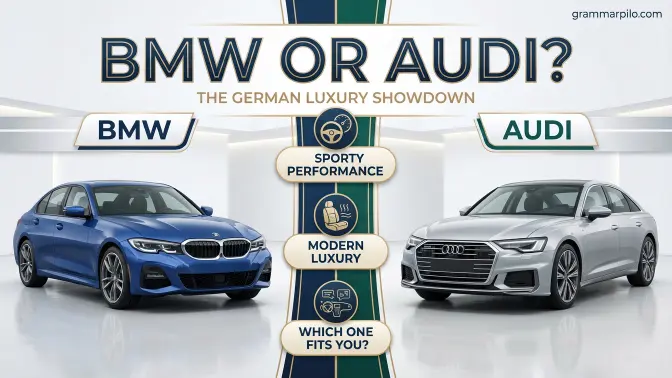
Choosing between BMW or Audi can be challenging because both brands are known for luxury, performance, advanced technology, and stylish vehicles.
BMW has built its reputation around sporty driving, powerful engines, and responsive handling. Audi is famous for sophisticated interiors, modern technology, elegant designs, and its Quattro all wheel drive system.
Both German automakers offer luxury sedans, SUVs, performance cars, and electric vehicles. However, their driving experiences and design philosophies are not exactly the same.
BMW often appeals to drivers who enjoy a more engaging connection with the road, while Audi attracts buyers who appreciate comfort, refined styling, and a modern cabin.
The right choice depends on your priorities. You may care most about acceleration, interior quality, fuel economy, maintenance costs, resale value, or everyday comfort.
This comparison explores BMW and Audi across these important areas to help you understand their strengths and differences before choosing your next luxury vehicle.
BMW vs. Audi: The Short Answer
BMW is generally the better choice for drivers who prioritize sporty handling, responsive performance, and an engaging driving experience. Audi is often a better fit for buyers who prefer elegant styling, comfortable interiors, modern technology, and available Quattro all wheel drive.
Both brands offer excellent luxury vehicles, but the best choice depends on the specific models you compare.
| Feature | BMW | Audi |
| Brand identity | Sporty luxury | Modern luxury |
| Driving experience | Performance focused | Refined and balanced |
| Interior design | Driver focused | Minimalist and technology focused |
| Exterior styling | Athletic and distinctive | Clean and sophisticated |
| All wheel drive | xDrive | Quattro |
| Performance models | BMW M | Audi RS |
| SUV lineup | X Series | Q Series |
| Electric vehicles | BMW i | Audi e tron models |
| Best for | Sporty driving | Comfort and modern design |
Quick recommendation: Choose BMW if driving excitement is your main priority. Consider Audi if you want a comfortable luxury car with modern styling and technology.
What Is BMW?
BMW stands for Bayerische Motoren Werke, which translates to Bavarian Motor Works. It is a German luxury automotive manufacturer known for producing premium cars, SUVs, motorcycles, and performance vehicles.
BMW has a long history of engineering vehicles that combine luxury with sporty driving characteristics. Its cars often emphasize responsive steering, powerful engines, balanced handling, and driver focused interiors.
The brand’s famous kidney grille and blue and white roundel make its vehicles easy to recognize.
Popular BMW Model Families
BMW offers several model families for different types of drivers.
- BMW 2 Series: Compact luxury cars with a sporty character.
- BMW 3 Series: A popular luxury sedan known for its balanced performance.
- BMW 5 Series: A larger luxury sedan with a focus on comfort and technology.
- BMW 7 Series: A flagship luxury sedan with premium features.
- BMW X1 and X3: Compact and midsize luxury SUVs.
- BMW X5 and X7: Larger luxury SUVs for families and buyers who want more space.
- BMW M Models: High performance vehicles developed for stronger acceleration and sharper driving dynamics.
BMW also offers electric vehicles under its i model family.
What Makes BMW Special?
BMW’s main appeal is its sporty approach to luxury.
Some of its commonly recognized strengths include:
- Responsive steering and handling.
- Powerful engine options.
- Sport oriented vehicle designs.
- Driver focused cabin layouts.
- Performance focused M models.
- A wide selection of luxury sedans and SUVs.
BMW is particularly attractive to people who want their daily vehicle to feel exciting to drive.
What Is Audi?
Audi is a German luxury automobile manufacturer headquartered in Ingolstadt, Germany. It is part of the Volkswagen Group and is known for combining premium design, advanced technology, refined interiors, and performance.
Audi vehicles often have clean exterior styling, carefully designed cabins, and modern digital displays. The brand also has a strong reputation for its Quattro all wheel drive technology.
Its four ring logo represents the historic Auto Union combination of four automobile manufacturers.
Popular Audi Model Families
Audi offers vehicles across several luxury categories.
- Audi A3: A compact luxury car.
- Audi A4: A well known luxury sedan name used in previous generations; its successor in many markets is the A5.
- Audi A5: A premium model family with sporty styling.
- Audi A6: A midsize luxury sedan.
- Audi A8: A flagship luxury sedan.
- Audi Q3 and Q5: Compact and midsize luxury SUVs.
- Audi Q7 and Q8: Larger luxury SUVs.
- Audi S and RS Models: Performance focused versions of selected Audi vehicles.
Audi also produces electric vehicles under its e tron naming and model families.
What Makes Audi Special?
Audi focuses on combining technology, comfort, and elegant design.
Its well known strengths include:
- Sophisticated interior styling.
- Modern infotainment systems.
- Quattro all wheel drive technology.
- Refined road manners.
- Distinctive exterior design.
- Performance options through S and RS models.
Audi can be especially appealing to buyers who want a luxury vehicle that feels modern, comfortable, and understated.
BMW vs. Audi: Performance and Driving Experience
Performance is one of the most important differences between BMW and Audi.
Both manufacturers offer powerful engines, responsive transmissions, and performance focused models. However, their vehicles can feel different behind the wheel.
BMW Performance
BMW has traditionally emphasized sporty driving characteristics.
Many BMW models are designed to provide responsive steering, controlled body movements, and strong acceleration. The brand also offers different engine configurations depending on the vehicle.
BMW’s M Performance and full M models take this approach further with more powerful engines, upgraded suspension systems, stronger brakes, and performance focused engineering.
Examples include:
- BMW M340i.
- BMW M3.
- BMW M5.
- BMW X3 M.
- BMW X5 M.
These vehicles are designed for drivers who want more excitement from their everyday journeys.
Audi Performance
Audi combines performance with a refined driving experience.
Its vehicles offer strong acceleration and controlled handling, while many models emphasize stability and comfort.
Audi’s S and RS families provide higher performance alternatives.
Examples include:
- Audi S3.
- Audi S5.
- Audi RS3.
- Audi RS5.
- Audi RS Q8.
Audi’s performance vehicles can deliver impressive acceleration while maintaining the brand’s modern and refined character.
Which Brand Performs Better?
BMW often has an advantage for drivers who prioritize steering feedback and sporty handling.
Audi can be an excellent choice if you want strong performance combined with stability, comfort, and available all wheel drive.
| Performance Factor | BMW | Audi |
| Driving character | Sporty and engaging | Refined and controlled |
| Steering feel | Often more driver focused | Often more comfort oriented |
| Acceleration | Strong across performance models | Strong across performance models |
| Performance lineup | M and M Performance | S and RS |
| Everyday driving | Sporty with comfort options | Balanced and refined |
Winner: BMW for a traditional sporty driving experience. Audi is a strong alternative for drivers who want performance with a refined feel.
BMW vs. Audi: Interior Quality and Comfort
A luxury car should offer more than a powerful engine. Interior materials, seating comfort, cabin noise, and technology all influence the ownership experience.
Audi and BMW both produce premium interiors, but their design approaches are different.
BMW Interior
BMW interiors generally place a strong emphasis on the driver.
The dashboard, steering wheel, displays, and controls are designed to create a connected driving environment.
Depending on the model and trim, you may find:
- Premium leather or alternative upholstery.
- Sport oriented seats.
- Digital instrument displays.
- Modern infotainment systems.
- Ambient interior lighting.
- Advanced climate controls.
- Premium audio options.
BMW cabins often combine sporty styling with practical comfort.
Audi Interior
Audi is widely recognized for its clean and modern interior design.
Its cabins often feature carefully arranged displays, refined materials, and a minimalist appearance.
Common features include:
- Digital cockpit displays.
- Large infotainment screens.
- Premium seating materials.
- Ambient lighting.
- Modern dashboard layouts.
- Advanced driver assistance features.
- Premium audio systems.
Audi interiors can feel especially appealing to buyers who prefer a clean, technology focused cabin.
Which Has the Better Interior?
Audi often stands out for its minimalist interior design and technology focused presentation.
BMW may appeal more to drivers who prefer a cockpit style layout and sport oriented seating.
The actual quality depends on the model, trim, production year, and optional equipment.
Winner: Audi for minimalist interior styling. BMW for a more driver focused cabin experience.
BMW vs. Audi: Exterior Design and Styling
Exterior styling is subjective, but both brands have recognizable design identities.
BMW generally uses bold styling elements and athletic proportions. Audi often follows a cleaner design approach with sharp lines and a sophisticated appearance.
BMW Exterior Design
BMW vehicles often feature:
- The recognizable kidney grille.
- Sculpted body panels.
- Sporty front and rear designs.
- Distinctive lighting.
- Athletic proportions.
- Performance inspired styling details.
Some BMW models have a particularly aggressive appearance, especially those from the M lineup.
Audi Exterior Design
Audi vehicles often feature:
- A wide single frame grille.
- Clean body lines.
- Distinctive LED lighting.
- Sharp exterior details.
- Modern wheel designs.
- Understated luxury styling.
Audi’s design language often emphasizes elegance rather than dramatic styling.
Which Looks Better?
BMW may appeal to people who like bold, sporty vehicles.
Audi may be a better fit for buyers who prefer clean, elegant, and modern designs.
Winner: There is no objective winner. BMW is often more athletic in appearance, while Audi tends to have a more understated design.
BMW vs. Audi: Technology and Features
Technology is an important part of modern luxury vehicles. Both manufacturers offer advanced infotainment systems, digital displays, driver assistance features, and connected services.
However, the available technology varies by model and production year.
BMW Technology
BMW uses its iDrive infotainment system.
Depending on the vehicle, features may include:
- Digital instrument displays.
- Touchscreen infotainment.
- Voice controls.
- Smartphone integration.
- Navigation.
- Wireless connectivity.
- Parking assistance.
- Driver assistance systems.
BMW’s newer vehicles offer updated versions of its infotainment platform with different screen layouts and digital functions.
Audi Technology
Audi uses its MMI infotainment system and, in selected models, its Virtual Cockpit digital instrument display.
Available features may include:
- Digital instrument displays.
- Touchscreen controls.
- Navigation systems.
- Smartphone connectivity.
- Voice commands.
- Parking assistance.
- Driver assistance technology.
- Connected vehicle services.
Audi has built a strong reputation for integrating digital displays and technology into its interior design.
Which Has Better Technology?
Both brands offer advanced technology, but their interfaces and feature availability differ.
Audi may appeal to buyers who like its digital cockpit and clean display layout. BMW may suit drivers who prefer its iDrive interface and driver focused controls.
Winner: A close comparison. Test the actual infotainment system in the model you plan to buy.
BMW vs. Audi: Fuel Economy and Efficiency
Fuel economy matters if you plan to use your luxury vehicle every day.
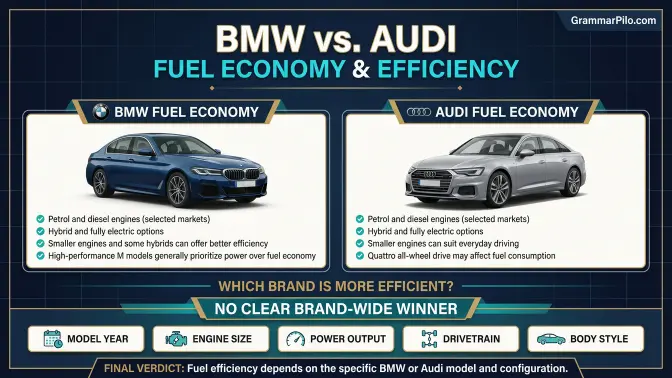
BMW and Audi offer different engine sizes, hybrid options, and electric vehicles. Their efficiency depends on the model, engine, drivetrain, driving conditions, and vehicle configuration.
BMW Fuel Economy
BMW offers a range of petrol, diesel in selected markets, hybrid, and fully electric powertrains.
Smaller engines and certain hybrid models can provide better fuel efficiency than high performance versions.
However, larger engines and M models generally prioritize performance rather than minimum fuel consumption.
Audi Fuel Economy
Audi also offers different petrol, diesel in selected markets, hybrid, and electric powertrains.
Its smaller engine models can be suitable for everyday driving, while larger performance vehicles use more fuel.
Quattro all wheel drive can also influence fuel consumption compared with some front wheel drive configurations.
Which Brand Is More Fuel Efficient?
There is no reliable brand wide winner.
A smaller BMW may use less fuel than a larger Audi, while a particular Audi may be more efficient than a comparable BMW.
Compare official fuel economy figures for vehicles with similar:
- Model years.
- Engine sizes.
- Power outputs.
- Drivetrains.
- Body styles.
Winner: Depends on the specific vehicle. Compare model level fuel economy rather than assuming one brand is always more efficient.
BMW vs. Audi: Reliability and Maintenance Costs
Reliability and maintenance costs are important when buying a luxury car.
Both BMW and Audi offer sophisticated engineering, but their vehicles can require expensive maintenance compared with many mainstream brands.
BMW Reliability and Maintenance
BMW maintenance costs can be influenced by engine design, electronic systems, suspension components, and vehicle age.
Common ownership expenses may include:
- Oil and filter changes.
- Brake servicing.
- Tire replacement.
- Cooling system repairs.
- Suspension maintenance.
- Electronic component repairs.
Regular maintenance and service records are important, especially when buying a used BMW.
Audi Reliability and Maintenance
Audi vehicles also use advanced mechanical and electronic systems.
Depending on the model, maintenance may involve:
- Oil and filter changes.
- Transmission servicing.
- Brake and tire replacement.
- Cooling system maintenance.
- Suspension repairs.
- Electronic system diagnostics.
- All wheel drive system servicing where applicable.
Some repairs can be expensive, particularly on older or high performance models.
Which Is More Reliable?
Neither BMW nor Audi is consistently more reliable across every model and year.
Reliability can vary significantly depending on the engine, transmission, maintenance history, previous ownership, and driving conditions.
Before buying a used vehicle, consider:
- Reviewing its service history.
- Checking for accident records.
- Arranging a professional inspection.
- Scanning for stored diagnostic trouble codes.
- Checking known problems for the exact engine and model year.
- Reviewing the cost and availability of replacement parts.
Winner: No universal winner. The specific model, engine, maintenance history, and condition matter more than the badge.
BMW vs. Audi: Resale Value and Depreciation
Luxury vehicles can lose value over time. Depreciation depends on demand, mileage, vehicle condition, model reputation, age, and local market conditions.
Audi and BMW both offer models that can attract strong interest in the used car market.
BMW Resale Value
BMW models with desirable engines, popular specifications, and complete service records may attract buyers in the used market.
Performance models can also have strong demand, although their resale value depends on condition, mileage, and ownership history.
Audi Resale Value
Audi vehicles can also retain value depending on the model and market.
Popular SUVs, well equipped sedans, and desirable performance versions may attract used car buyers.
However, maintenance history and repair costs can influence what buyers are willing to pay.
Which Brand Holds Its Value Better?
Neither brand always has better resale value.
Depreciation varies by country, vehicle category, model year, and market demand.
For a fair comparison, check used listings for the same model year, similar mileage, trim, and condition.
Winner: Depends on the model and local market. Compare actual resale prices instead of relying on brand reputation.
BMW vs. Audi: SUVs and Family Vehicles
Both manufacturers offer luxury SUVs designed for families, everyday commuting, and longer journeys.
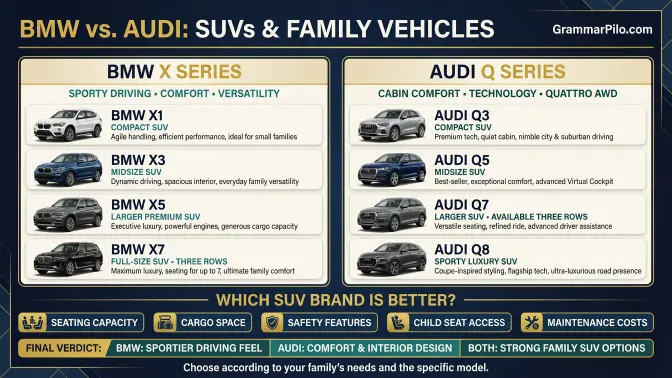
BMW uses the X Series naming system, while Audi uses the Q Series.
BMW SUVs
Popular BMW SUV options include:
- BMW X1: A compact luxury SUV.
- BMW X3: A versatile midsize SUV.
- BMW X5: A larger premium SUV.
- BMW X7: A full size luxury SUV with three row seating.
BMW SUVs generally combine comfort with a sporty driving character.
Audi SUVs
Popular Audi SUV options include:
- Audi Q3: A compact luxury SUV.
- Audi Q5: A popular midsize luxury SUV.
- Audi Q7: A larger SUV with available three row seating.
- Audi Q8: A larger luxury SUV with a sportier design emphasis.
Audi SUVs often combine comfortable cabins, modern technology, and available Quattro all wheel drive.
Which SUV Brand Is Better?
BMW may appeal to drivers who want an SUV with a sportier driving feel.
Audi may be attractive to families who prioritize interior design, comfort, and all weather traction options.
Compare seating capacity, cargo space, safety equipment, child seat access, and maintenance costs before deciding.
Winner: Both brands offer strong SUV choices. The specific model and family requirements should guide your decision.
BMW vs. Audi: Common Buying Mistakes
Buying a luxury vehicle without researching its exact model can lead to expensive surprises.
Avoid these common mistakes.
1. Choosing a Brand Instead of a Specific Model
BMW and Audi have different vehicles for different needs.
A BMW 3 Series and an Audi Q7 are not direct competitors because they belong to different vehicle categories.
Compare similar models, sizes, engines, and trims.
2. Assuming Every BMW Is Faster
BMW has a sporty reputation, but not every BMW is faster than every Audi.
Performance depends on the engine, transmission, weight, drivetrain, and model year.
Compare the actual specifications of the vehicles you are considering.
3. Ignoring Maintenance Costs
Luxury vehicles can require expensive replacement parts and specialist servicing.
Check expected maintenance costs before buying, particularly if you are considering an older used car.
4. Buying Without a Professional Inspection
A vehicle can look attractive while hiding mechanical or electronic problems.
Arrange an independent inspection and review the maintenance history before completing a used car purchase.
5. Comparing Different Model Years
A newer Audi may have different technology and safety features from an older BMW.
Compare vehicles from similar production years to make the evaluation fair.
6. Overlooking Insurance and Fuel Expenses
A luxury car’s purchase price is only one part of ownership.
Insurance, fuel, tires, servicing, registration, and repairs can significantly affect your budget.
BMW or Audi: Which One Should You Choose?
The best brand depends on what you expect from your vehicle.
Choose BMW If:
- You enjoy sporty driving.
- You want responsive steering and handling.
- You prefer athletic exterior styling.
- You are interested in performance focused M models.
- You want a luxury car that feels engaging on the road.
- You enjoy a driver focused interior.
Choose Audi If:
- You prefer elegant and understated styling.
- You value modern interior design.
- You want a comfortable daily driver.
- You are interested in Quattro all wheel drive.
- You like digital displays and technology focused cabins.
- You want a balance of luxury and performance.
Which Is Better for Different Needs?
| Your Priority | Recommended Starting Choice | Reason |
| Sporty driving | BMW | Performance focused character |
| Elegant styling | Audi | Clean and sophisticated design |
| Driver focused cabin | BMW | Cockpit style layout |
| Minimalist interior | Audi | Modern cabin design |
| Performance cars | Both | BMW M and Audi RS |
| Luxury SUVs | Both | X Series and Q Series |
| All wheel drive | Either | BMW xDrive and Audi Quattro |
| Daily commuting | Both | Model and comfort preferences |
| Family transportation | Both | Multiple SUV options |
| Lower ownership costs | Compare specific models | Maintenance varies |
Quick Comparison Table: Audi vs. BMW
| Comparison | BMW | Audi |
| Country | Germany | Germany |
| Brand character | Sporty luxury | Modern luxury |
| Driving experience | Engaging and athletic | Refined and balanced |
| Interior style | Driver focused | Minimalist and technology focused |
| Exterior design | Bold and sporty | Clean and sophisticated |
| All wheel drive | xDrive | Quattro |
| Performance division | BMW M | Audi RS |
| SUV lineup | X Series | Q Series |
| Electric vehicles | BMW i | e tron models |
| Maintenance | Model dependent | Model dependent |
| Reliability | Varies by model and year | Varies by model and year |
| Best for | Sporty driving | Comfort and modern design |
Key Takeaways
- BMW and Audi are both German luxury automobile manufacturers.
- BMW is widely associated with sporty handling and driver focused performance.
- Audi is known for elegant styling, modern interiors, and Quattro technology.
- BMW uses xDrive for its all wheel drive system.
- Audi uses Quattro for its all wheel drive technology.
- BMW M and Audi RS models offer high performance options.
- Both brands offer luxury sedans, SUVs, and electric vehicles.
- Maintenance costs and reliability depend heavily on the specific model and its history.
- Neither brand is always better in fuel economy or resale value.
- Comparing similar models is more useful than comparing the brands alone.
Frequently Asked Questions
1. Is BMW better than Audi?
BMW may be better for drivers who enjoy sporty handling, responsive steering, and performance focused vehicles. Audi may be a better fit for buyers who prefer elegant styling, comfortable interiors, and modern technology. Both are excellent luxury brands, but the right choice depends on your priorities.
2. Is Audi more luxurious than BMW?
Audi is often praised for its minimalist interiors and refined cabin design. BMW also offers premium materials, advanced technology, and comfortable seating. Luxury levels vary by model, trim, and optional equipment, so comparing specific vehicles is more useful than comparing the brands generally.
3. Which is faster, BMW or Audi?
Neither brand is always faster. BMW M models and Audi RS models offer high performance engines and impressive acceleration. The result depends on the specific vehicles, engine configurations, drivetrain, and model years being compared.
4. Is BMW more expensive to maintain than Audi?
Maintenance costs vary by model, engine, age, and location. Both brands can be expensive to maintain compared with mainstream vehicles. Parts availability, specialist labor rates, service history, and the condition of the vehicle can have a major effect on ownership costs.
5. Which is more reliable, Audi or BMW?
Neither brand has a universal reliability advantage across every model and year. Some models from either manufacturer may have better reliability records than others. Research the exact engine, transmission, model year, and known maintenance issues before purchasing.
6. Is BMW or Audi better for everyday driving?
Both can be excellent daily drivers. BMW may appeal to people who enjoy a sporty driving experience, while Audi may suit those who prefer a refined and comfortable feel. Seat comfort, road conditions, fuel economy, and vehicle size should also influence your decision.
7. Which brand has better all wheel drive, BMW or Audi?
BMW offers xDrive, while Audi offers Quattro. Both systems are designed to improve traction and stability in suitable conditions. Their performance depends on the vehicle’s drivetrain configuration, tires, road conditions, and system design. Neither is automatically better in every situation.
8. Which is better for families, BMW or Audi?
Both brands offer family friendly SUVs. BMW’s X3, X5, and X7 compete with Audi’s Q5, Q7, and Q8 in different categories. Compare passenger space, cargo capacity, child seat access, safety features, and ownership costs before selecting one.
9. Does BMW have better resale value than Audi?
Resale value depends on the vehicle, model year, mileage, condition, location, and demand. Some BMW models may retain value better in one market, while certain Audi models may perform better in another. Compare local used car listings for similar vehicles.
10. Which is better for performance, BMW M or Audi RS?
BMW M and Audi RS are both performance focused divisions. BMW M models are often associated with engaging handling and driver involvement, while Audi RS models combine strong performance with refined interiors and available Quattro traction. The better option depends on the specific cars being compared.
Conclusion: BMW or Audi?
BMW and Audi are both excellent choices in the luxury car market, but they appeal to slightly different types of drivers.
BMW is a strong option if you enjoy sporty handling, responsive performance, and an engaging driving experience. Audi is worth considering if you prefer elegant styling, modern interiors, comfort, and available Quattro all wheel drive.
Before making a decision, compare specific models with similar prices, production years, mileage, and equipment. Look beyond the badge and consider fuel economy, maintenance expenses, insurance, reliability records, and resale value.
If you enjoy driving and want a sportier feel, BMW may be the better match. If you prefer a refined cabin and understated luxury, Audi may be the right choice.
The final verdict: BMW is a strong choice for sporty luxury, while Audi is a compelling option for modern comfort and sophisticated design. The best car is the one that fits your driving habits and ownership budget.
Discover More Articles

I’m Claire Morgan, the author behind Grammarpilo.com, where I write about English grammar, sentence structure, punctuation, and everyday language. My goal is to make grammar simple, clear, and practical, helping readers understand the rules and apply them with confidence in real-world writing.







2 thoughts on “BMW or Audi: Which Luxury Car Brand Is Better?”