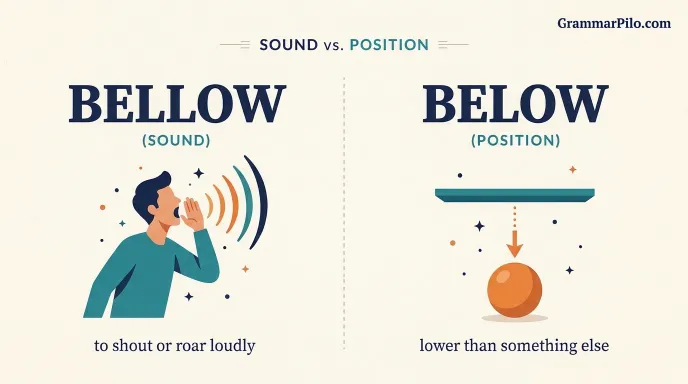
If you mean something that is lower than another thing, the correct word is below, not bellow. However, both bellow and below are correct English words with different meanings.
Below refers to a lower position, level, or amount, while bellow means to shout loudly or make a deep, powerful sound. These words are easy to confuse because they differ by only one letter, but using the wrong one can change the meaning of a sentence completely.
Understanding below and bellow is useful for students, writers, English learners, and anyone who wants to improve their spelling and everyday communication.
You might encounter below in instructions, emails, reports, and descriptions of physical locations. In contrast, bellow often appears in stories, conversations, and descriptions of loud voices or animal sounds.
In this guide, you will learn the meaning of each word, discover their origins, compare their usage in American and British English, and explore practical examples. You will also find common spelling mistakes, memory tricks, and answers to frequently asked questions about below vs. bellow.
Quick Answer
Below is the correct word when you mean under, beneath, or at a lower level. Bellow is the correct word when you mean to shout loudly or produce a deep, loud sound.
Examples:
- The temperature dropped below freezing.
- The teacher asked us to read the paragraph below.
- The angry man began to bellow across the room.
- The bull let out a loud bellow.
Remember this simple distinction: below describes position or level, while bellow describes a loud sound.
Neither spelling is universally wrong. The correct choice depends on what you want to communicate.
What Does Below Mean?
Below is a preposition or adverb that describes something located at a lower position, level, rank, or amount than something else. It can refer to physical location, measurements, standards, or information appearing later on a page.
Below as a Preposition
As a preposition, below connects a noun or noun phrase to something at a lower position or level.
Examples:
- The village lies below the mountain.
- Please sign your name below the dotted line.
- The temperature fell below zero overnight.
- Her score was below the class average.
- The apartment below ours is currently vacant.
In these examples, below indicates a lower physical position or a lower numerical level.
Below as an Adverb
Below can also function as an adverb when it describes a lower location without directly introducing a noun.
Examples:
- The instructions are listed below.
- The hikers stopped at the shelter below.
- The water flowed below.
- See the diagram below for more information.
This use is particularly common in websites, educational materials, forms, and written instructions.
Common Expressions With Below
The word below appears in many everyday expressions.
- Below average: Lower than the usual or expected level.
- Below zero: A temperature lower than zero.
- Below sea level: At a lower elevation than the surface of the sea.
- Listed below: Written or displayed farther down on a page.
- Below expectations: Not reaching the anticipated standard.
- Below the surface: Underneath the visible outer layer.
For example, a manager might write, “The results were below expectations,” to explain that a project did not achieve its intended performance.
What Does Bellow Mean?
Bellow is a verb meaning to shout in a loud, deep, powerful voice. It can also describe the loud sound made by certain animals. As a noun, It refers to a deep, loud shout or cry.
Unlike below, which usually describes position or level, it relates to sound and vocal expression.
Bellow as a Verb
When someone bellows, they speak or shout so loudly that their voice may sound angry, commanding, or forceful.
Examples:
- The coach began to bellow instructions from the sidelines.
- My father had to bellow over the noise of the machinery.
- The man bellowed in frustration.
- The captain bellowed orders to the crew.
- She heard someone bellow her name from across the street.
The word often suggests a louder and more forceful sound than ordinary speaking or shouting.
Bellow as a Noun
As a noun, bellow describes a loud, deep cry or shout.
Examples:
- A loud bellow came from the barn.
- His angry bellow startled everyone in the room.
- The bull released a powerful bellow.
- We heard a bellow of laughter from the next room.
The noun form is especially useful when describing animal noises, dramatic scenes, or unusually loud human voices.
Common Expressions With Bellow
Here are some common ways to use it in a sentence.
- Bellow with anger: Shout loudly because of anger.
- Bellow with laughter: Laugh in a very loud, booming way.
- Bellow an order: Give a command in a loud voice.
- A loud bellow: A deep, powerful shout or cry.
For example, “The sergeant bellowed an order” describes a forceful command, not a person standing beneath something.
The Origin and History of Bellow and Below
Although bellow and below look similar, they developed with different meanings and histories.
Where Does Below Come From?
The word below developed from Middle English forms associated with the idea of being lower down. Its history is linked to older expressions involving a lower position or location.
Over time, below became a common English word for describing physical placement, measurements, rank, and levels of achievement. It also became useful in written communication, where readers are often directed to information farther down a page.
Today, phrases such as “see below,” “below average,” and “below sea level” are familiar in everyday English.
Where Does Bellow Come From?
The word bellow has a long history in English and is associated with loud, deep vocal sounds. It developed as a word for the powerful cries of animals and later became widely used to describe loud human shouting.
Its sound related meaning remains central today. A person may bellow in anger, a crowd may bellow with excitement, or an animal may produce a deep bellow.
The difference in meaning is the most important point to remember. The history of below is associated with lower position, while bellow is associated with loud sound.
Bellow vs. Below in American and British English
Both bellow and below are standard spellings in American and British English. There is no regional spelling difference between these two words.
| Feature | Bellow | Below |
| Correct spelling | Yes | Yes |
| Main meaning | To shout loudly or make a deep sound | At a lower position or level |
| Part of speech | Verb and noun | Preposition and adverb |
| American English | Standard | Standard |
| British English | Standard | Standard |
| Typical context | Loud voices and animal sounds | Positions, measurements, and written instructions |
| Example | The man began to bellow. | The answer appears below. |
Is Bellow More Common in British or American English?
Both American and British speakers use it when describing loud shouting or deep sounds. The same is true of below when referring to a lower position or level.
The choice is determined by meaning, not nationality. An American writer and a British writer would both use “The information is below” and “The bull began to bellow.”
For international readers, learning the distinction between the words is more important than memorizing a regional preference.
When Should You Use Below Instead of Bellow?
Use below when you want to describe a lower place, amount, rank, or position. When describing a loud shout or deep sound use bellow.
Use Below for Locations
Choose below when something is under another object or situated at a lower level.
Examples:
- The parking garage is below the office building.
- The keys are on the shelf below the mirror.
- The hikers rested below the summit.
Use Below for Numbers and Measurements
Choose below when referring to a quantity that is lower than a particular value.
Examples:
- The temperature remained below 10 degrees.
- The employee’s performance fell below the required standard.
- The water level dropped below the marked line.
Use Below for Written Information
Use below when directing readers to material farther down a page or document.
Examples:
- The contact details are listed below.
- Read the explanation below before answering.
- The examples below demonstrate the rule.
Use Bellow for Loud Shouting
Choose it when a person speaks or shouts in a powerful, booming voice.
Examples:
- The angry customer began to bellow.
- The coach bellowed instructions to the players.
- He had to bellow to be heard above the music.
Use Bellow for Deep Animal Sounds
Use it when describing a deep, loud sound made by an animal.
Examples:
- The bull let out a bellow.
- We heard the animal bellow in the distance.
- A deep bellow echoed through the field.
Common Mistakes With Bellow and Below
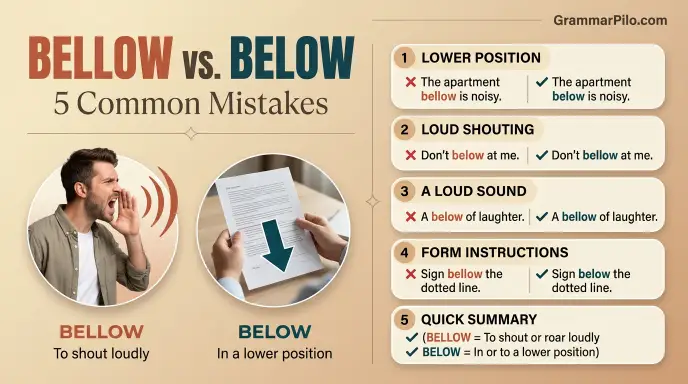
Because these words differ by only one letter, spelling mistakes are easy to make. The best way to avoid them is to check the meaning of the sentence.
Mistake 1: Writing Bellow When You Mean a Lower Position
Incorrect: The instructions are listed bellow.
Correct: The instructions are listed below.
Explanation: The sentence directs readers to information farther down the page. It does not describe a loud sound.
Mistake 2: Writing Below When You Mean Shouting
Incorrect: The angry man began to below at the driver.
Correct: The angry man began to bellow at the driver.
Explanation: The man is shouting loudly, so it is the appropriate verb.
Mistake 3: Confusing a Bellow With a Location
Incorrect: A loud below came from the barn.
Correct: A loud bellow came from the barn.
Explanation: The sentence describes a sound, making bellow the correct noun.
Mistake 4: Using Bellow in Instructions
Incorrect: Enter your email address bellow.
Correct: Enter your email address below.
Explanation: The instruction refers to a lower position on the form.
Mistake 5: Assuming One Word Is Always Incorrect
It is inaccurate to assume that bellow is always a misspelling of below, or that below is always a misspelling of bellow. Both words are legitimate English words. They simply have different meanings.
Always examine the context before deciding which spelling to use.
Below or Bellow: Everyday Examples
The following examples show how the words appear in common situations.
Examples of Below in Everyday English
- Please write your phone number below your name.
- The restaurant is located below the hotel.
- The temperature dropped below freezing last night.
- Her test score was below the required mark.
- The information you requested is provided below.
- The airplane flew below the clouds.
- The water level remained below the warning line.
- His income is below the national average.
- Read the paragraph below and answer the questions.
- The village is situated below the hills.
Examples of Bellow in Everyday English
- The coach began to bellow instructions during practice.
- The angry customer started to bellow at the cashier.
- We heard a bull bellow in the field.
- The captain bellowed an order across the deck.
- His bellow could be heard from the next room.
- The man had to bellow over the sound of the engine.
- The crowd bellowed with excitement.
- The animal released a deep bellow.
- She heard her brother bellow her name.
- The actor delivered the line with a dramatic bellow.
Using Both Words
These examples make the difference particularly clear.
- The man began to bellow while standing below the balcony.
- The bull’s bellow echoed from the valley below.
- The coach bellowed at the players standing below the stands.
- The sound came from below, followed by another loud bellow.
- The instructions below explain why the animal began to bellow.
In each sentence, below indicates a position, while bellow refers to a sound.
Google Trends and Modern Usage
People may search for “bellow or below,” “below or bellow,” and “bellow vs. below” because the words look similar and are easy to mistype. The difference can be particularly confusing for English learners, students, and writers who are unsure which spelling fits a sentence.
Why Do People Search for Bellow or Below?
Several situations can lead to this spelling question.
- Similar spelling: The words differ by just one letter.
- Pronunciation: Their sounds are similar enough to cause confusion for some speakers.
- Typing mistakes: A person may accidentally type bellow when intending to write below.
- Writing instructions: The word below appears frequently in forms, emails, websites, and educational content.
- Vocabulary learning: English learners may encounter bellow in stories or descriptions of loud sounds.
Which Word Is More Common?
Below is widely used in everyday communication because it describes locations, levels, measurements, and information appearing farther down a page. Bellow is more specialized and generally appears when a writer wants to describe loud shouting or a deep, booming sound.
This difference in everyday use does not make one spelling a substitute for the other. Each word serves a distinct purpose.
Google Trends can help compare search interest for the two terms over a selected period and region.
However, search interest changes over time, and the search terms may reflect spelling questions rather than the actual frequency of the words in published writing. Without a verified, date specific comparison, exact trend figures should not be assumed.
For practical writing, the most reliable approach is to choose the word that accurately communicates your intended meaning.
Bellow vs. Below: Key Differences at a Glance
| Comparison | Bellow | Below |
| Basic definition | To shout loudly or make a deep sound | At a lower position or level |
| Main idea | Sound | Position or level |
| Verb example | She began to bellow. | Not normally used as a verb |
| Noun example | We heard a bellow. | Not normally used as a noun |
| Preposition example | Not normally used as a preposition | The box is below the table. |
| Adverb example | Not normally used as an adverb | The details are shown below. |
| Common context | Shouting, animals, loud voices | Locations, measurements, instructions |
| Regional spelling | Same in US and UK English | Same in US and UK English |
Memory Tricks to Remember Below and Bellow
A simple memory trick can help you choose the right word without checking a dictionary every time.
Trick 1: Below Means Lower
Think of the phrase “look below.” Both refer to looking down or finding something at a lower position.
Example: Look below the heading for the answer.
Trick 2: Bellow Begins With B, Like a Booming Sound
Connect bellow with a booming voice. Both words begin with the letter B, and both can remind you of a loud sound.
Example: The angry man began to bellow.
Trick 3: Ask Yourself What the Sentence Describes
Before choosing a spelling, ask one simple question.
- Is the sentence describing a position, level, or amount? Use below.
- Is the sentence describing a loud shout or deep sound? Use bellow.
For example, “The temperature is below freezing” describes a level. “The bull began to bellow” describes a sound.
This quick test works in emails, school assignments, professional writing, and everyday conversations.
Frequently Asked Questions
1. Is It Bellow or Below?
Both words are correct, but they have different meanings. Below refers to a lower position or level, while bellow means to shout loudly or make a deep sound.
2. Is Bellow a Real Word?
Yes, it is a standard English word. It can function as a verb meaning to shout loudly or produce a deep sound, and as a noun meaning a loud, deep shout or cry.
3. What Does Below Mean?
Below means under something or at a lower position, level, rank, or amount. It can also direct readers to information farther down a page.
Example: The details are listed below.
4. What Is the Difference Between Bellow and Below?
The main difference is meaning. Bellow relates to loud sounds, while below relates to lower positions or levels.
Example: The man bellowed from the balcony above the street below.
5. Is Bellow or Below Correct in an Email?
Use below when directing someone to information, an attachment description, or instructions farther down the message. Use bellow only when describing a loud shout or deep sound.
Correct: Please see the details below.
6. Is Bellow or Below Correct in American English?
Both spellings are correct in American English. The appropriate choice depends on the sentence’s meaning, not on regional spelling conventions.
7. Is Bellow or Below Correct in British English?
Both words are also standard in British English. British writers use below for lower positions and bellow for loud shouting or deep sounds.
8. Can Bellow Be Used as a Noun?
Yes. As a noun, it refers to a loud, deep shout or cry.
9. How Can I Remember the Difference Between Bellow and Below?
Remember that below means lower down, while bellow sounds like a booming voice. If the sentence describes a location or measurement, choose below. If it describes a loud sound, choose bellow.
10. Is “See Bellow” Correct?
Usually, no. If you are directing readers to information farther down a page, write “see below.” The phrase “see bellow” would only make sense in an unusual context involving a loud sound or a specific reference to a bellow.
Conclusion
The difference between bellow or below becomes easy to understand once you focus on meaning. Below describes something at a lower position, level, rank, or amount.
It is the word you need when referring to information farther down a page, a temperature under a certain point, or an object beneath another object. Bellow, on the other hand, describes a loud, deep shout or sound and can be used as both a verb and a noun.
Both words are correct in American and British English, so you do not need to memorize separate regional spellings. Instead, pay attention to the context of your sentence.
If you are describing a location or measurement, choose below. If you are describing someone shouting loudly or an animal making a deep cry, choose bellow.
Remember the simple trick: below means lower, and bellow means a booming sound. With this distinction in mind, you can avoid common spelling mistakes and use both words accurately in schoolwork, emails, articles, and everyday communication.
You May Also Like

I’m Sloane Mercer, a U.S.-based English language writer focused on grammar, spelling, vocabulary, and everyday English usage. Through GrammarPilo, I provide clear and practical explanations to help readers choose the right words and communicate with confidence.







1 thought on “Bellow or Below: A Quick Guide to Meaning & Examples”