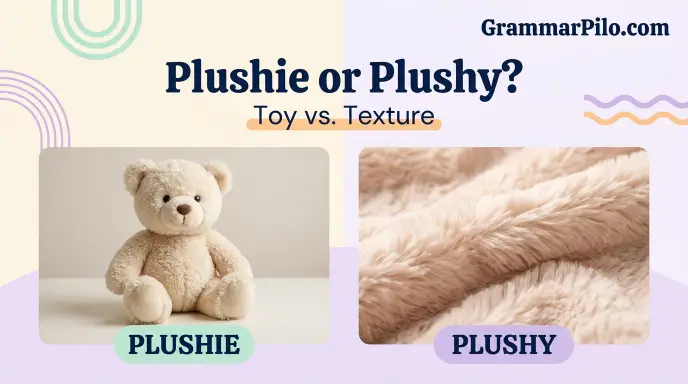
Plushie and plushy are both correct English words, but they usually serve different purposes. Plushie is a noun that refers to a soft stuffed toy, often shaped like an animal, character, or cute object.
Plushy is an adjective that describes something soft, plush, or luxurious, although it is less common than the related adjective plush. The best choice depends on what you want to say.People often search for plushie or plushy because the words look and sound similar.
Both are associated with softness, stuffed toys, and comfortable materials, so it is easy to confuse them when writing product descriptions, social media posts, shopping searches, or everyday messages. However, using the correct form makes your meaning clearer.
In this guide, you will learn the meaning, origin, pronunciation, and grammatical differences between plushy and plushie.
You will also discover how these words are used in American and British English, see practical examples, explore common spelling mistakes, and learn which version is appropriate when talking about stuffed animals, collectible toys, soft furnishings, and luxurious textures.
Quick Answer: Plushie or Plushy?
Use plushie when referring to a soft stuffed toy. Use plushy when describing something that feels soft, padded, or luxurious, although plush is generally the more common adjective.
| Feature | Plushie | Plushy |
| Main use | Noun | Adjective |
| Meaning | A soft stuffed toy | Soft, plush, or luxurious in texture |
| Example | I bought a cat plushie. | The blanket feels plushy. |
| Refers to a toy? | Yes, commonly | Not usually by itself |
| Describes texture? | Not its usual grammatical role | Yes |
| Common in online toy communities? | Very common | Less common for the toy itself |
| American English | Used | Used |
| British English | Used | Used |
The easiest way to remember the difference is that a plushie is usually the toy itself, while plushy describes a quality or texture.
What Does Plushie Mean?
The word plushie is an informal noun for a soft stuffed toy. Plushies are often made from fabric with a soft surface and filled with polyester fiber, cotton, or other stuffing materials. They can represent animals, fictional characters, food items, fantasy creatures, or simple shapes.
Plushies are popular with children, collectors, fans of games and animation, and people who enjoy decorative or comforting objects.
What Is a Plushie?
A plushie is a toy made to feel soft and cuddly. It may resemble a teddy bear, cat, dog, rabbit, cartoon character, or other recognizable figure.
For example, someone might purchase a plushie of a favorite character, place a small plushie on a desk, or collect plushies from a particular series.
The word is especially common in online shopping, toy collecting, fandom communities, and social media. It often carries a friendly, affectionate tone.
Examples include:
- I bought a tiny frog plushie at the gift shop.
- Her favorite plushie sits beside her pillow.
- The store sells plushies based on popular video game characters.
- He gave his little sister a soft teddy bear plushie.
- My collection includes animal plushies from different countries.
In these sentences, plushie names a physical object, so it functions as a noun.
What Is the Plural of Plushie?
The standard plural of plushie is plushies.
Examples:
- The children lined up their plushies on the bed.
- She collects miniature plushies.
- The shop has new plushies in several colors.
The spelling changes from the final -ie to -ies, following a familiar English plural pattern.
Is Plushie an Informal Word?
Yes, plushie is generally informal and conversational. It is widely understood in modern English, particularly in discussions of stuffed toys and collectibles.
In a formal product catalog, a seller might use plush toy, stuffed animal, or soft toy. In casual conversation, plushie is often more natural and expressive.
The best term depends on the audience and context. For example, a toy manufacturer may label a product a “plush character toy,” while a collector may simply call it a plushie.
What Does Plushy Mean?
Plushy is an adjective meaning soft, plush, or luxurious in texture. It is related to the word plush, which commonly describes a soft fabric or something that feels thick, comfortable, and rich.
Although plushy is a valid word, it is less common than plush in many everyday contexts.
How Is Plushy Used?
Plushy describes a quality rather than normally naming a toy.
For example:
- The cushion has a plushy texture.
- She chose a plushy blanket for the sofa.
- The fabric feels warm and plushy.
- The chair has a soft, plushy surface.
- The rug looked plushy under the living room lights.
In these examples, plushy modifies a noun or follows a linking verb to describe how something feels or looks.
Is Plushy the Same as Plush?
The words are closely related, but plush is generally the more established and common adjective.
Compare these sentences:
- The sofa has plush cushions.
- The sofa has plushy cushions.
Both sentences communicate softness and comfort. However, plush cushions sounds more conventional in many contexts, particularly in product descriptions, interior design writing, and polished prose.
Plushy can sound more informal, playful, or descriptive. It may be useful when emphasizing a soft, cuddly texture.
Can Plushy Describe a Stuffed Toy?
Yes. Plushy can describe a stuffed toy’s texture, but it does not usually replace the noun plushie.
For example:
- Correct: The plushie is soft and plushy.
- Correct: She bought a plushy stuffed animal.
- Less natural if you mean the toy itself: She bought a plushy.
In the last example, the reader may understand what you mean from context, but plushie or plush toy is clearer.
The Origin and History of Plushie and Plushy
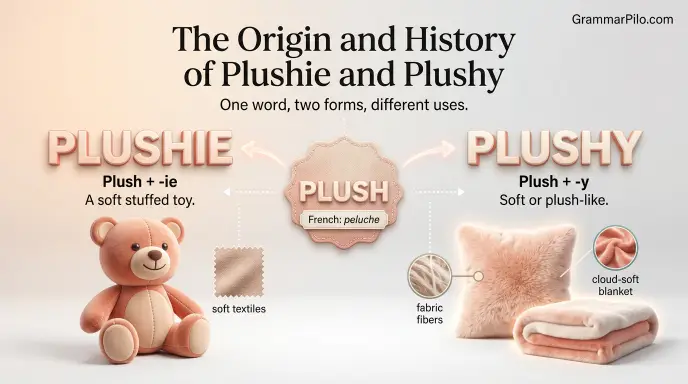
Understanding the relationship between these words helps explain why their spellings are similar.
Where Does the Word Plush Come From?
The English word plush is associated with a soft fabric that has a raised pile. Its history is linked to French peluche, a word for a soft, pile fabric, and ultimately to earlier European language forms associated with textile materials.
Over time, plush developed broader uses. It came to describe not only a type of fabric but also things that feel soft, rich, comfortable, or luxurious.
For example, English speakers may talk about plush upholstery, plush hotel rooms, plush carpets, or plush seating.
Where Does Plushie Come From?
Plushie developed as an informal name for a soft stuffed toy, using plush with the familiar noun forming ending -ie.
English speakers often use endings such as -ie or -y to create friendly, informal words. Similar patterns appear in words such as doggie and teddy.
In modern use, plushie is especially familiar in toy collecting, online shopping, fan communities, and conversations about character merchandise.
Where Does Plushy Come From?
Plushy is formed from plush with the adjective forming ending -y. English commonly uses this ending to describe a quality or characteristic.
For example, cloudy describes something covered with clouds, while silky describes something that resembles silk in texture. In a similar way, plushy describes something with a plush like softness.
The distinction is therefore partly grammatical. Plushie usually names a toy, while plushy describes a quality.
Plushy vs. Plushie: British English and American English
Plushie and plushy are understood in both American and British English. There is no major standard regional spelling difference between the two words.
| Usage | American English | British English |
| A soft stuffed toy | Plushie, plush toy, stuffed animal | Plushie, soft toy, stuffed animal |
| Describing a soft texture | Plush, plushy | Plush, plushy |
| Common informal toy term | Plushie | Plushie |
| Common product description adjective | Plush | Plush |
| Standard plural of plushie | Plushies | Plushies |
Is Plushie American or British English?
Plushie is used in both varieties. It is particularly familiar in internet culture and collectible toy communities, where people use the same spelling regardless of their country.
In British English, soft toy is also a common everyday expression for a stuffed toy. In American English, stuffed animal is widely used, particularly for toys shaped like animals.
These alternatives do not make plushie incorrect in either variety.
Is Plushy More Common in American or British English?
Plushy can appear in both varieties, but it is generally less common than plush as a descriptive adjective. The choice is more about style and context than a strict national spelling rule.
A British writer might describe a plushy cushion, just as an American writer might describe a plushy blanket. In more formal product descriptions, both may prefer plush.
Which Spelling Should You Use Internationally?
For an international audience, use plushie when naming the toy and plush when describing its texture in a standard product description.
For example, “a soft plushie” is easy to understand, while “a plush blanket” sounds natural in many English speaking markets.
If you prefer the more playful tone of plushy, it is appropriate in casual writing when the intended meaning is clear.
Plushie or Plushy: Which One Should You Use?
The best word depends on the role it plays in your sentence.
Use Plushie When You Mean a Stuffed Toy
Choose plushie when referring to the object itself.
Examples:
- I ordered a panda plushie.
- The plushie arrived in a small box.
- She keeps her favorite plushie on the bed.
- They released a limited edition character plushie.
- The children exchanged plushies at the party.
In each example, the word refers to a thing that someone can buy, own, give, collect, or display.
Use Plushy When You Mean Soft or Cuddly
Choose plushy when describing texture, appearance, or comfort.
Examples:
- The blanket feels plushy.
- He rested against the plushy cushions.
- The toy has a plushy surface.
- I prefer plushy fabric for decorative pillows.
- The chair looked especially plushy and inviting.
Although plushy works in these sentences, plush may sound more natural in formal or commercial writing.
Use Plush When You Want the Most Conventional Adjective
If your goal is clear, standard product writing, plush is often the best adjective.
Compare:
- A plush toy
- A plush blanket
- Plush upholstery
- A plush hotel room
These expressions are widely established. Plushy is also possible in descriptive contexts, but it may sound more playful or informal.
Common Mistakes When Using Plushie and Plushy
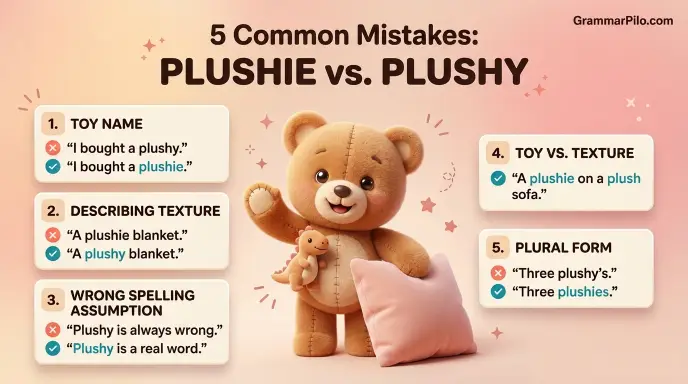
Because the words look similar, writers sometimes use them interchangeably. The following mistakes are easy to avoid.
Mistake 1: Calling Every Stuffed Toy Plushy
A writer might say, “I bought a plushy yesterday,” when they mean a stuffed toy.
This may be understood in a conversation, but plushie is usually the clearer noun.
Better choice: I bought a plushie yesterday.
Mistake 2: Using Plushie as an Adjective in Every Context
Plushie is primarily a noun. In expressions such as “a plushie blanket,” readers may interpret the phrase as a blanket related to a toy rather than a blanket with a soft texture.
Better choice: A plush blanket or a plushy blanket.
Mistake 3: Assuming Plushy Is a Misspelling
Plushy is a legitimate English word. It is not automatically incorrect simply because plush is more common.
Better choice: Use plushy when its informal descriptive tone suits the sentence.
Mistake 4: Confusing Plushie With Plush
A plushie is a toy, while plush can describe fabric, furniture, accommodation, and other things that feel luxurious.
Better choice: The child hugged a plushie while sitting on a plush sofa.
Mistake 5: Writing the Plural as Plushy’s
The plural of plushie is plushies, without an apostrophe.
Better choice: She bought three plushies.
An apostrophe is used for possession or certain contractions, not to form an ordinary plural.
Everyday Examples of Plushie and Plushy
These examples show how the two words appear in daily communication, online shopping, and creative writing.
Examples in:
Everyday Conversation
- My little brother sleeps with his favorite plushie.
- This plushie looks just like my cat.
- I want a plushy pillow for my reading chair.
- The plush blanket feels warmer than the thin cotton one.
- She gave me a tiny plushie as a birthday gift.
Online Shopping
- This plushie comes in three different sizes.
- The store has collectible plushies based on popular characters.
- The plush toy is made with soft fabric and polyester filling.
- The blanket has a plushy surface that feels comfortable against the skin.
- The product listing describes the cushion as plush and supportive.
Media Posts
- “My new plushie finally arrived!”
- “Look at this adorable little frog plushie.”
- “I need a plushy blanket for movie night.”
- “My shelf is officially full of plushies.”
- “This fabric looks so plush.”
In social media posts, plushie is especially common because it names the collectible item directly. Plushy works when the writer wants to describe a texture or feeling.
Formal Writing
- The manufacturer introduced a new line of plush toys.
- The collector displayed several character plushies.
- The cushion features plush fabric and a supportive filling.
- The product’s plush surface is designed for comfort.
- The retailer sells soft toys in several shapes and sizes.
For formal product descriptions, plush toy or soft toy may be preferable when writing for readers who are unfamiliar with the informal term plushie.
Google Trends and Modern Usage
People searching for plushie or plushy may be looking for stuffed toys, collectible merchandise, spelling guidance, or descriptions of soft fabrics.
The words appear in related contexts, but their search intent is not always the same.
Why Do People Search for Plushy or Plushie?
Common reasons include:
- Looking for the correct word for a stuffed toy.
- Shopping for plush toys or character merchandise.
- Searching for collectible plushies.
- Writing product descriptions for soft toys.
- Checking if plushy is an acceptable English word.
- Comparing the words’ meanings and grammatical roles.
The popularity of plushie in online communities is connected to the growth of collectible toys, character merchandise, and social media discussions about cute objects.
Which Word Is More Common?
In everyday discussions about stuffed toys, plushie is a familiar informal noun. For describing soft materials and luxurious surroundings, plush is generally more common than plushy.
Exact search interest changes over time and depends on the country, topic, and period being examined. Without a specific, verified dataset, it would be misleading to provide exact search volumes or claim that one spelling has a particular percentage advantage.
How Can You Compare Their Search Interest?
Google Trends can be used to compare search interest for plushie, plushy, and related terms over a selected period and in a particular region.
However, search interest is not the same as total search volume or proof that a word is grammatically correct. The most useful comparison considers both the intended meaning and the context in which each word appears.
Plushie vs. Plushy: Key Differences at a Glance
| Question | Plushie | Plushy |
| Is it a real English word? | Yes | Yes |
| What part of speech is it usually? | Noun | Adjective |
| What does it mean? | A soft stuffed toy | Soft, plush, or luxurious |
| Example | I bought a rabbit plushie. | The blanket feels plushy. |
| Can it refer to a toy? | Yes, directly | It can describe the toy’s texture |
| Can it describe a blanket? | Not normally | Yes |
| Is it common in toy communities? | Yes | Less common for naming the toy |
| Is it used in US English? | Yes | Yes |
| Is it used in UK English? | Yes | Yes |
| What is its plural? | Plushies | Depends on the noun being described; plushy can also have other uses |
The most important difference is grammatical. Plushie usually names an object, while plushy describes a characteristic.
Frequently Asked Questions
1. Is plushie or plushy correct?
Both are correct words, but they have different common uses. Plushie is a noun for a soft stuffed toy. Plushy is an adjective describing something soft or plush in texture.
2. Is a plushie the same as a stuffed animal?
A plushie is a type of stuffed toy, but it does not have to represent an animal. Plushies can be shaped like fictional characters, food, fantasy creatures, or other objects. The term stuffed animal usually refers to a toy shaped like an animal.
3. Is plushy a real word?
Yes. Plushy is an English adjective meaning soft, plush, or luxurious in texture. It is less common than plush in many everyday contexts, but it is not inherently a spelling error.
4. What is the plural of plushie?
The plural is plushies. For example, “She collects plushies from her favorite game.”
5. Is plushie American or British English?
Plushie is used in both American and British English. British speakers may also say soft toy, while American speakers often use stuffed animal.
6. Is plushy better than plush?
Not usually in standard descriptive writing. Plush is the more established adjective and is often the best choice for product descriptions, furniture, fabrics, and accommodation. Plushy can work when a more informal or playful tone is appropriate.
7. Can I say “plushy toy”?
Yes. Plushy can describe a toy that feels soft and cuddly. However, plush toy is more conventional, and plushie is common when naming the toy informally.
8. Why do people use the word plushie?
People use plushie because it is a friendly, informal word for a soft stuffed toy. It is especially common among collectors, fans of fictional characters, and people discussing toys online.
9. Is plushies spelled with an apostrophe?
No. Plushies is the ordinary plural form of plushie. An apostrophe is unnecessary unless you are showing possession, as in “the plushie’s ribbon.”
10. Should I use plushie or plushy in a product description?
Use plushie when naming the toy and plush or plushy when describing texture. For example, “This plushie has a soft, plush surface” is clear, while “This plush blanket feels plushy” is also understandable.
Conclusion: Should You Use Plushie or Plushy?
When deciding between plushie or plushy, focus on what you want the word to communicate. Plushie is the usual choice when you mean a soft stuffed toy, if it is a teddy bear, an animal, a collectible character, or a cute decorative object.
Its informal tone makes it especially popular in online communities, toy stores, and everyday conversation.
Plushy is an adjective used to describe softness, padding, or a plush like texture. It can describe a blanket, cushion, toy, or other soft object. However, plush is generally the more conventional adjective in formal writing and product descriptions.
The distinction is straightforward once you identify the role of the word in your sentence. If you are naming the toy, use plushie. If you are describing how something feels, plushy can work, although plush may sound more natural.
Both words are valid, and neither is a universal replacement for the other. Using the right form will make your writing clearer, more natural, and better suited to your intended audience.
More Differences to Discover

I’m Claire Morgan, the author behind Grammarpilo.com, where I write about English grammar, sentence structure, punctuation, and everyday language. My goal is to make grammar simple, clear, and practical, helping readers understand the rules and apply them with confidence in real-world writing.






2 thoughts on “Plushie or Plushy: Correct Spelling & When Should You Use Each?”