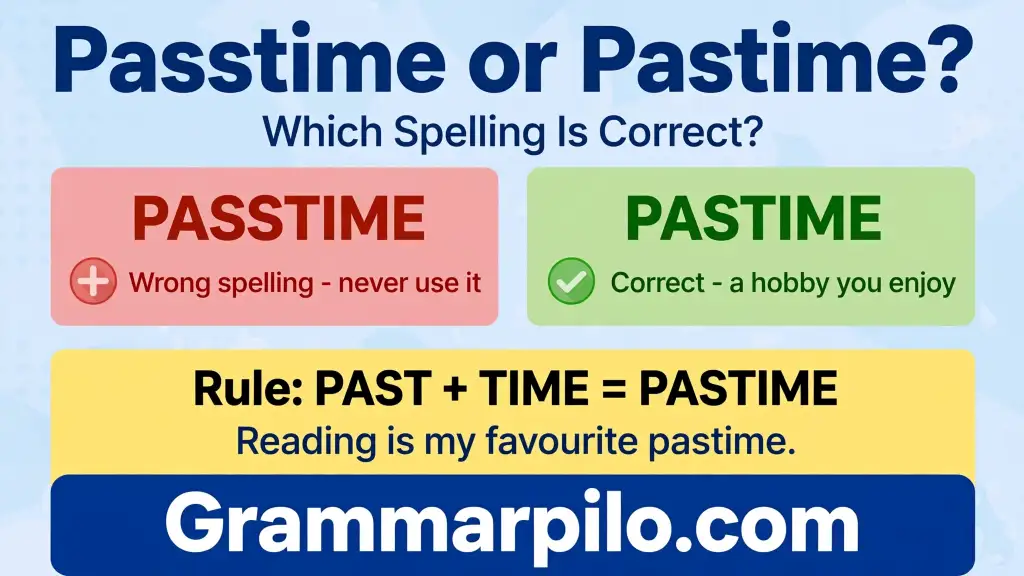
Pastime is the correct spelling. Passtime is a common misspelling. The word pastime means an activity that someone enjoys doing in their free time, such as reading, gardening, painting, or playing a game.
People search for passtime or pastime, pastime or passtime, and pastime vs. passtime because both forms look reasonable.
The word pass has a double s, so it may seem natural to write passtime. However, standard English uses only one s at the end of pastime’s first part. The correct word is pastime, with one s between pa and time.
This spelling difference matters in school assignments, emails, blog posts, social media captions, and professional documents.
Using the right spelling helps your writing look clear and polished. The good news is that the correct form is easy to learn once you understand its meaning and remember how it is written.
In this guide, you will learn the definition of pastime, its history, British and American spelling rules, common mistakes, and examples of natural usage. You will also find practical tips for choosing the correct spelling every time.
Passtime or Pastime: Quick Answer
Pastime is correct, and passtime is incorrect in standard English.
Use pastime when you describe an activity that you enjoy during your free time.
Examples:
- Reading is my favorite pastime.
- Gardening is a relaxing pastime for many people.
- Playing chess is an enjoyable pastime.
- Her favorite pastime is taking photographs.
Remember this simple rule: Write pastime with one s before time.
| Word | Correct or incorrect? | Meaning |
| Pastime | Correct | An activity enjoyed in free time |
| Passtime | Incorrect | A common misspelling of pastime |
When comparing passtime vs. pastime, always choose pastime in standard writing. The same rule applies to pastime vs. passtime, passtime and pastime, and pastime and passtime.
Definition and Meaning of Passtime or Pastime
The words pastime and passtime may look similar, but only pastime is accepted as the standard spelling. Understanding the meaning of the correct word makes it easier to use it in everyday English.
What Does Pastime Mean?
A pastime is an activity that a person enjoys doing during their free time. It is often something people do for fun, relaxation, or personal interest.
Simple definition: A pastime is something you enjoy doing when you are not busy with work or other duties.
Examples include reading books, listening to music, cooking, swimming, drawing, and playing sports.
Consider these sentences:
- My favorite pastime is reading mystery novels.
- Fishing is a popular pastime in our town.
- She enjoys knitting as a quiet pastime.
- Watching movies is a common pastime among friends.
In each sentence, pastime describes an activity that brings enjoyment or helps someone relax.
What Is the Simple Meaning of Pastime?
The simplest meaning of pastime is a hobby or a fun way to spend free time.
The words pastime and hobby have similar meanings, but they are not always used in exactly the same way.
A hobby is often an activity that someone enjoys regularly and may work to improve. A pastime can be any enjoyable way to spend time, even if the person does it only occasionally.
For example:
- Collecting stamps is his favorite hobby.
- Solving crossword puzzles is her favorite pastime.
- Playing cards is a popular pastime at family gatherings.
These examples show that both words describe enjoyable activities, although pastime can have a broader meaning.
Is Pastime a Noun or a Verb?
Pastime is a noun. It names an activity or something people do for enjoyment.
Correct usage: Painting is a relaxing pastime.
Incorrect usage: I pastime every evening.
The second sentence is incorrect because pastime is not normally used as a verb. Instead, write, “I paint every evening as a pastime,” or “I spend my evenings painting.”
What Does Passtime Mean?
Passtime is generally a misspelling of pastime. It does not have a separate, widely accepted meaning in standard English.
People may type passtime because they connect it with the verb pass, as in “pass the time.” That connection makes the spelling seem logical, but it does not make passtime correct.
Compare these examples:
- Correct: Walking is a pleasant pastime.
- Incorrect: Walking is a pleasant passtime.
- Correct: Walking helps me pass the time.
- Incorrect: Walking helps me passtime.
The key difference is that pastime is a noun, while pass the time is a verb phrase.
The Origin of Pastime and Passtime
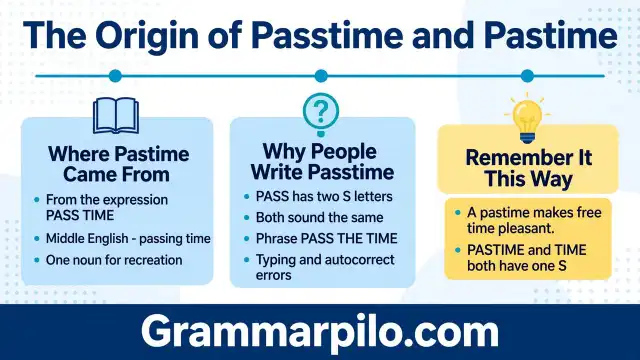
The history of pastime helps explain why its correct spelling differs from the common misspelling passtime.
Where Does the Word Pastime Come From?
The English word pastime developed from the expression pass time. It entered English through Middle English, with historical forms related to passing or spending time.
The word combines the idea of passing time with an activity that makes that time enjoyable. Over the years, it became a single noun used to describe recreation, amusement, or a favorite activity.
For example, reading can help someone pass the time while traveling. When reading is an activity that person enjoys, it can also be called a pastime.
The connection between pass time and pastime is useful for understanding the meaning. However, the two forms serve different grammatical purposes.
Why Do People Write Passtime Instead of Pastime?
There are several reasons people confuse the two spellings.
1. The influence of the word pass
The verb pass contains two s letters. People may carry that spelling into passtime because the words seem related.
2. The sound of the word
In normal speech, the difference between pastime and passtime is not easy to notice. Both spellings may appear similar when spoken aloud, so learners often rely on what they think the word should look like.
3. The phrase pass the time
People know the expression “pass the time.” They may assume that combining the two words should produce passtime. Standard English, however, uses the established noun pastime.
4. Typing and spelling errors
Fast typing, unfamiliarity with the word, and autocorrect mistakes can all lead to the wrong spelling appearing in online posts or documents.
How Can Word History Help You Remember the Correct Spelling?
Think of pastime as a word that names an enjoyable activity, rather than as a direct combination of the complete words pass and time.
A simple memory trick is to remember this sentence:
“A pastime makes free time pleasant.”
Both pastime and time contain the same single s before the word’s final part. Once you learn this spelling, you can recognize the error more easily.
British English vs American English Spelling
British and American English sometimes use different spellings, such as colour and color or organise and organize. However, pastime is spelled the same way in both varieties of English.
There is no standard British spelling passtime and no standard American spelling passtime.
Is Pastime British or American English?
Pastime is accepted in British English, American English, Canadian English, Australian English, and other major varieties of English.
The spelling does not change based on the country or the audience. Writers should use pastime regardless of the regional spelling style they follow.
Examples in American English:
- Hiking is a popular pastime in the United States.
- My favorite pastime is playing basketball.
Examples in British English:
- Gardening is a popular pastime in Britain.
- My favourite pastime is playing cricket.
Notice that pastime remains unchanged. The word favorite changes to favourite in the second American and British examples, but the spelling of pastime does not.
Pastime vs Passtime Spelling Comparison Table
| Feature | Pastime | Passtime |
| Standard spelling | Yes | No |
| Accepted in American English | Yes | No |
| Accepted in British English | Yes | No |
| Accepted in formal writing | Yes | No |
| Meaning | An enjoyable free time activity | Usually a spelling error |
| Example | Reading is my pastime. | Reading is my passtime. |
The table makes the difference clear. When writing for an international audience, choose pastime.
Does the Spelling Change in Other English Speaking Countries?
No. Writers in Canada, Australia, New Zealand, Ireland, and other English speaking regions also use pastime.
Regional preferences may affect words such as favourite, colour, centre, and travelling. They do not affect the standard spelling of pastime.
This means that you do not need separate spelling rules for this word. Learning the correct form once is enough for schoolwork, business writing, online content, and everyday communication.
Which Spelling Should You Use?
The choice between pastime or passtime is simple because only one spelling is standard. Your audience may influence other spelling choices, but it does not change this rule.
For American Readers
If you are writing for an American audience, use pastime.
Examples:
- Basketball is a popular pastime in the United States.
- My favorite pastime is cooking new recipes.
- Reading before bed is a relaxing pastime.
American English uses favorite rather than favourite, but pastime remains the same.
For British and Commonwealth Readers
For readers in the United Kingdom, Australia, New Zealand, Canada, and other Commonwealth countries, use pastime.
Examples:
- Cricket is a popular pastime in many communities.
- Her favourite pastime is gardening.
- Walking in the countryside is an enjoyable pastime.
The word remains pastime even when the surrounding text follows British spelling conventions.
For International Readers and English Learners
If your writing is intended for an international audience, pastime is the safest and correct choice.
English learners can remember it as a noun for a hobby or another enjoyable activity. Using the correct spelling helps readers understand the sentence without being distracted by an error.
For example, instead of writing “My favorite passtime is drawing,” write “My favorite pastime is drawing.”
For School, Work, and Formal Writing
Always use pastime in essays, reports, applications, emails, articles, and presentations.
Although a reader may understand passtime, the misspelling can make your writing appear less carefully edited. Correct spelling is especially important in professional work, where clarity and attention to detail matter.
Professional tip: If you use a spelling checker, add a final manual review. Not every writing tool catches every error, especially when a misspelled word resembles a familiar expression.
Common Mistakes with Passtime and Pastime
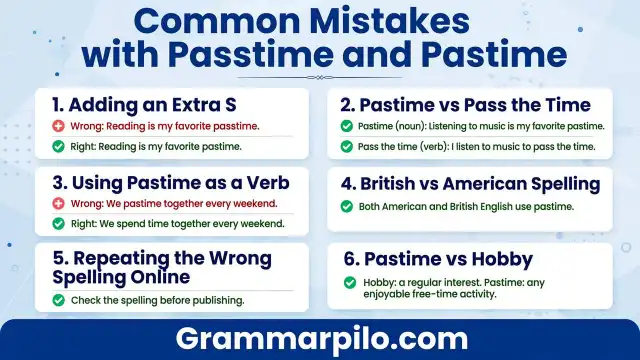
Many spelling mistakes happen because people rely on how a word sounds or how they think it should be formed. The confusion between pastime and passtime is a good example.
Mistake 1: Adding an Extra S
Incorrect: Reading is my favorite passtime.
Correct: Reading is my favorite pastime.
The word pastime contains one s before time. Adding another s creates a nonstandard spelling.
Mistake 2: Confusing Pastime with Pass the Time
These expressions are related in meaning, but they work differently in a sentence.
Correct: Listening to music is my favorite pastime.
Correct: I listen to music to pass the time.
The first sentence uses pastime as a noun. The second uses pass the time as a verb phrase.
Do not write “I listen to music to passtime.” That construction is not standard English.
Mistake 3: Using Pastime as a Verb
Because pastime names an activity, some learners may try to use it as an action word.
Incorrect: We pastime together every weekend.
Correct: We spend time together every weekend.
Correct: Spending time together is our favorite pastime.
Choose a suitable verb when describing an action. Use pastime when naming the enjoyable activity.
Mistake 4: Assuming British and American Spelling Differ
Some English words have regional spelling differences, but pastime is not one of them.
Incorrect assumption: Americans write pastime, but British writers use passtime.
Correct explanation: Both American and British English use pastime.
Do not change this word to match a regional writing style.
Mistake 5: Repeating the Wrong Spelling in Online Content
A misspelling can spread when it appears in social media captions, blog headings, comments, or copied text.
For example, a writer might use passtime in a title and repeat it throughout an article. This makes the mistake more noticeable.
The solution is simple. Check the spelling before publishing and use the correct form consistently.
Mistake 6: Confusing Pastime with Hobby
A pastime and a hobby can describe the same activity, but their meanings are not perfectly identical.
For example, a person may enjoy watching birds during a walk without treating it as a regular hobby. It can still be a pastime.
A hobby often suggests a regular personal interest, while a pastime can be any enjoyable way to spend free time.
Passtime or Pastime in Everyday Examples
The word pastime is useful in many types of writing. It can describe a personal interest, a popular leisure activity, or something people do to relax.
In Emails
In emails, pastime can help you describe your interests or start a friendly conversation.
Examples:
- My favorite pastime is reading historical novels.
- I enjoy gardening as a weekend pastime.
- Could you share your favorite pastime with the group?
- Photography has become a relaxing pastime for me.
For a professional email, you might write:
“Outside work, my favorite pastime is hiking. It helps me relax and enjoy the outdoors.”
Avoid passtime in professional messages. Although readers may understand your meaning, the correct spelling creates a better impression.
In News Articles
News writers often use pastime when describing activities that are popular in a community or country.
Examples:
- Cycling has become a popular pastime among local residents.
- The article explores how gardening became a favorite pastime for many families.
- Chess remains a well known pastime in schools and community clubs.
- Fishing is an important pastime in several coastal towns.
In news writing, pastime can describe a cultural trend or a recreational activity. The word does not need to refer to a person’s main hobby.
On Social Media
Social media users often discuss hobbies, interests, and relaxing activities. Pastime works well in captions and posts about these subjects.
Examples:
- Reading and coffee make the perfect weekend pastime.
- My favorite pastime is exploring new places.
- What is your favorite pastime on a rainy day?
- Painting is more than a pastime for me. It is a way to express myself.
A simple caption could be:
“Finding joy in the little things. Reading remains my favorite pastime.”
For hashtags, you can use terms such as #Pastime, #Hobbies, and #FreeTime. Use the correct spelling in the caption and any text that accompanies the post.
In Formal Writing
In essays, reports, and academic assignments, pastime can describe recreation and leisure.
Examples:
- Reading is a valuable pastime that can support vocabulary development.
- Outdoor activities are a common pastime among people of different ages.
- The study examined the role of leisure activities in everyday life.
- Gardening serves as both a relaxing pastime and a practical skill.
For a formal tone, explain the activity clearly and avoid using the word too often in the same paragraph.
In Everyday Conversation
You can also use pastime when talking to friends, family, or classmates.
Examples:
- What is your favorite pastime?
- Is playing video games your main pastime?
- My grandfather’s favorite pastime is growing vegetables.
- We need a fun pastime for the weekend.
In casual speech, people may use hobby more often. However, pastime remains natural and correct.
In School Assignments
Students may need to describe their interests in essays or short paragraphs.
Example paragraph:
“My favorite pastime is drawing. I enjoy drawing animals, trees, and buildings in my free time. It helps me relax and improve my skills. Sometimes, I share my drawings with my friends. Drawing is a simple pastime, but it brings me a lot of joy.”
This paragraph shows how pastime can be used naturally without complicated vocabulary.
Passtime vs Pastime: Google Trends and Usage Data
People search for passtime or pastime, pastime or passtime, and pastime vs. passtime because they want to confirm the correct spelling before using the word.
Search interest can help explain the questions people ask, but it is important to separate search behavior from spelling rules.
Which Spelling Is More Popular?
Pastime is the standard English spelling. Passtime is a common misspelling that may appear in search queries, informal posts, and unedited online content.
For that reason, the two forms should not be treated as equally correct just because people search for both.
A person who types passtime into a search engine may be looking for the correct word. The search itself does not mean that the spelling is accepted.
Passtime or Pastime by Country
The correct spelling remains pastime in the United States, United Kingdom, Canada, Australia, and other English speaking regions.
| Country or region | Correct spelling | Common reason for confusion |
| United States | Pastime | Connection with “pass the time” |
| United Kingdom | Pastime | Extra s added by mistake |
| Canada | Pastime | Similar looking word forms |
| Australia | Pastime | Uncertainty about word formation |
| International English | Pastime | English spelling and vocabulary learning |
These examples explain the spelling rule, not measured search rankings for each country.
What Do Google Trends Results Tell Us?
Google Trends can help compare interest in search terms such as pastime and passtime. However, Trends reports relative search interest rather than the total number of searches.
A reliable comparison should use the same time period, region, and search category for both terms. The results should then be checked before making claims about which country searches for each spelling most often.
No verified live Trends figures are included here, so exact percentages, rankings, or search volumes should not be assumed.
Why Do People Search for Passtime vs Pastime?
Several reasons explain this search behavior:
- Spelling checks: People want to confirm the correct form before publishing or submitting writing.
- English learning: Students want to understand why pastime has one s.
- Writing corrections: Writers may notice the two forms in different places and want to check them.
- Meaning questions: Some users want to know the difference between pastime, hobby, and pass the time.
- Professional editing: Bloggers, teachers, and editors want to avoid spelling errors in public content.
The main lesson is clear. Search interest can show what confuses people, but standard English spelling determines which form to use.
Pastime vs. Passtime: Comparison Table of Word Variations
The following table compares common keyword variations and related expressions. It shows which forms are correct and how to use them naturally.
| Keyword or expression | Status | Example or explanation |
| Passtime or pastime | Comparison query | Use pastime. |
| Pastime or passtime | Comparison query | Pastime is correct. |
| Passtime and pastime | Both terms mentioned | Use pastime in the sentence. |
| Pastime and passtime | Both terms mentioned | The second spelling is nonstandard. |
| Passtime vs. pastime | Comparison query | The correct spelling is pastime. |
| Pastime vs. passtime | Comparison query | Choose pastime. |
| Pastime | Correct noun | Reading is my pastime. |
| Passtime | Common misspelling | Avoid it in standard writing. |
| Pass the time | Correct verb phrase | Games help us pass the time. |
| Past times | Correct phrase in some contexts | Past times were different. |
| Past time | Not the usual spelling of this noun | Write pastime as one word. |
| Hobby | Related noun | Gardening is my hobby. |
| Leisure activity | Related expression | Swimming is a leisure activity. |
Past Time vs Pastimes: Is There a Difference?
Pastime and past times are not interchangeable.
Pastime means an enjoyable activity. Past times refers to times in the past, although the exact phrase is less common than expressions such as earlier times or bygone days.
Examples:
- Pastime: Chess is a popular pastime.
- Past times: Stories about past times can teach us about history.
The space between the words changes their meaning, so choose the expression that fits your sentence.
Frequently Asked Questions About Passtime or Pastime
1. Is it passtime or pastime?
Pastime is correct. It means an activity that someone enjoys during free time. Passtime is a common misspelling and should be avoided in standard English.
2. Why is pastime spelled with one s?
The standard spelling is an established form of the English noun pastime, which developed from the idea of passing time. Although pass has two s letters, the noun is spelled pastime, not passtime.
3. Is pastime correct in American English?
Yes. American English uses pastime. For example, “Playing basketball is my favorite pastime” is correct American English.
4. Is pastime correct in British English?
Yes. British English also uses pastime. For example, “Gardening is my favourite pastime” is correct British English. The spelling of pastime stays the same in both varieties.
5. What does pastime mean in simple words?
A pastime is something you enjoy doing in your free time. Reading, cooking, playing sports, gardening, and listening to music can all be pastimes.
6. Is pastime the same as hobby?
The meanings are similar, but there is a small difference. A hobby is usually an activity someone enjoys regularly as a personal interest. A pastime can be any enjoyable activity that helps someone spend free time.
For example, collecting coins may be a hobby, while watching a movie on a quiet evening can be a pastime.
7. How can I remember the correct spelling of pastime?
Remember this sentence: “A pastime makes free time pleasant.” Write pastime with one s before time. If you see passtime in a sentence, check it and correct it to pastime.
Conclusion: Passtime or Pastime, Which One Is Correct?
When choosing between passtime or pastime, always use pastime. It is the correct spelling in American English, British English, and other major varieties of English. The spelling passtime is a common error, not an accepted alternative.
A pastime is an activity that you enjoy during your free time. Reading, gardening, painting, playing sports, and listening to music are all examples. You can use the word in everyday conversations, emails, school assignments, social media captions, news articles, and professional documents.
Remember that pastime and pass the time have related meanings but different grammatical uses. You might say, “Reading is my favorite pastime,” or “I read to pass the time.” Both sentences are correct, but the words cannot be used interchangeably.
The spelling does not change between British and American English, so there is no need to memorize separate regional forms. If you are writing for an international audience, pastime is the right choice.
The easiest rule to remember is this: pastime has one s before time. Keep this simple spelling rule in mind, and you can avoid the mistake in future writing.
Other Spelling & Vocabulary Guides
- Grimey or Grimy and the One Correct Spelling You Must Use
- Carrer or Career: The Correct Spelling & Easy Way to Remember
- Clutz or Klutz: The Correct Spelling and Meaning Explained

I’m Sloane Mercer, a U.S.-based English language writer focused on grammar, spelling, vocabulary, and everyday English usage. Through GrammarPilo, I provide clear and practical explanations to help readers choose the right words and communicate with confidence.




1 thought on “Passtime or Pastime: How to Remember Correct Spelling in 2026?”