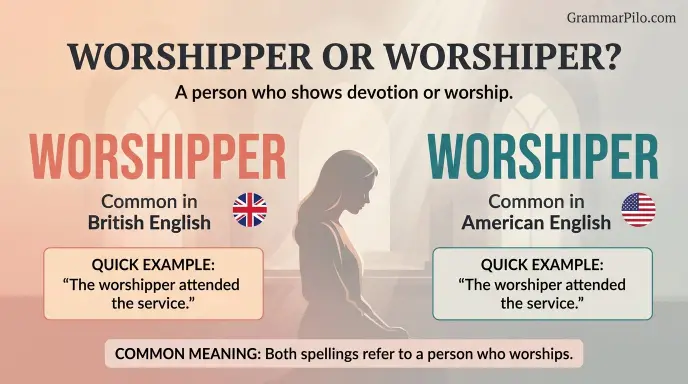
Both worshipper and worshiper are correct English spellings, but the preferred form depends on the variety of English you are using.
Worshipper, with a double p, is commonly preferred in British English, while worshiper, with a single p, is an accepted spelling in American English. Both words describe a person who worships a god, deity, or other object of religious devotion.
The difference can be confusing because the two words have the same pronunciation and meaning.
If you are writing a school assignment, preparing a religious article, publishing website content, or creating educational material, choosing the appropriate spelling helps keep your writing consistent with your intended audience.
In this guide, you will learn the meaning of worshipper and worshiper, explore their origins, compare British and American spelling conventions, and see practical examples of both forms.
You will also discover which spelling to use in formal writing and how to avoid common mistakes when choosing between these similar words.
Worshipper or Worshiper: Quick Answer
Worshipper is commonly used in British English, while worshiper is an accepted and established spelling in American English. Both words refer to someone who worships.
- Worshipper: The preferred form in British English and many publications that follow British spelling conventions.
- Worshiper: A common American English spelling, although worshipper is also used in American publications.
- Meaning: A person who expresses reverence, devotion, or religious honour toward a deity or sacred figure.
Examples:
- British English: The worshipper entered the temple quietly.
- American English: The worshiper entered the temple quietly.
- British English: Every worshipper participated in the ceremony.
- American English: Every worshiper participated in the ceremony.
The meaning remains the same in both versions. The difference lies in spelling preference, and actual usage can vary by dictionary, publisher, and religious organisation.
What Does Worshipper Mean?
A worshipper is a person who worships a deity, religious figure, or sacred object. The word is also sometimes used more broadly for someone who shows deep admiration or devotion toward a person or thing.
Worshipper as a Noun
The word worshipper is a noun formed from the verb worship. It commonly describes someone who takes part in religious practices, prayers, ceremonies, or acts of devotion.
Examples:
- The worshipper bowed his head during the prayer.
- Worshippers gathered at the mosque before sunrise.
- Each worshipper received a programme for the ceremony.
- The temple welcomed worshippers from nearby villages.
In these sentences, worshipper refers to a person or a group of people engaged in worship.
Worshipper in Religious and General Contexts
The word is most often associated with religion, but it can sometimes be used figuratively to describe intense admiration.
Examples:
- The worshipper lit a candle at the shrine.
- The church welcomed every worshipper to the service.
- She was a devoted worshipper of the ancient goddess.
- He was a worshipper of classical music and its great composers.
The figurative use is less common than the religious meaning. In everyday writing, the surrounding sentence usually makes the intended meaning clear.
What Does Worshiper Mean?
Worshiper has the same meaning as worshipper. It describes a person who worships or expresses reverence and devotion. The single p spelling is particularly associated with American English.
Worshiper as a Noun
A worshiper may attend religious services, pray, participate in a ceremony, or show devotion to a deity.
Examples:
- The worshiper prayed silently inside the church.
- Worshipers gathered to celebrate the religious festival.
- Every worshiper was invited to join the service.
- The worshiper placed flowers near the sacred image.
These examples use the American spelling, but the meaning is identical to that of worshipper.
Worshiper in Modern Writing
The single p spelling appears in American publications, educational material, and religious writing. However, American English does not universally reject the double p form. Many American dictionaries and publications also recognise worshipper.
Examples:
- The worshiper attended the weekly service.
- Worshipers filled the hall during the ceremony.
- A worshiper offered a prayer for peace.
- The guide explained the customs followed by each worshiper.
The best spelling for a particular article depends on the publication’s preferred style rather than a strict rule that makes the alternative incorrect.
The Origin and History of Worshipper and Worshiper
Understanding how these words developed helps explain why English uses two spellings for the same noun.
Where Does the Word Worship Come From?
The word worship developed from Old English weorþscipe, a term connected with worth, honour, respect, and the state of being worthy. Over time, its meaning became strongly associated with reverence toward God or a deity and with acts of religious devotion.
The word gradually developed into the familiar modern verb worship, meaning to show reverence or devotion, and the noun worship, referring to the act or practice itself.
How Did Worshipper Develop?
The word worshipper is formed by adding the agent suffix -er to the verb worship. This suffix commonly identifies a person who performs an action, as in teacher, writer, and builder.
In English spelling, a final consonant is often doubled before a suffix beginning with a vowel when the word follows certain stress and syllable patterns. The spelling worshipper follows this pattern by doubling the final p before -er.
Why Is Worshiper Also Used?
English spelling conventions are not entirely uniform. American English has adopted several spellings that use fewer doubled consonants in certain words, and worshiper is an established example.
However, this is not a universal rule that every American word must use a single consonant. American English also retains many double consonant forms. As a result, both worshiper and worshipper appear in American usage.
The important point is that these spellings developed as accepted variants. Neither spelling changes the meaning of the word.
British English vs. American English Spelling
The distinction between worshipper and worshiper is commonly explained through regional spelling preferences, although real world usage is not completely divided by national borders.
| Feature | British English | American English |
| Common spelling | Worshipper | Worshiper |
| Alternative form | Worshiper is understood | Worshipper is also accepted |
| Word type | Noun | Noun |
| Meaning | A person who worships | A person who worships |
| Pronunciation | Essentially the same | Essentially the same |
| Plural form | Worshippers | Worshipers |
| Example | The worshipper joined the service. | The worshiper joined the service. |
Worshipper in British English
British English commonly favours worshipper, with a double p. This spelling is suitable for British educational writing, news articles, religious publications, and other material that follows British conventions.
Examples:
- Worshippers gathered outside the cathedral.
- The worshipper offered a prayer.
- Local worshippers attended the festival.
- The building provides space for worshippers.
Worshiper in American English
American English commonly uses worshiper, with a single p. It is an established form in American writing and may be preferred by publishers that follow American spelling conventions.
Examples:
- Worshipers gathered outside the church.
- The worshiper offered a prayer.
- Local worshipers attended the festival.
- The building provides space for worshipers.
Because both spellings occur in American English, it is wise to consult the relevant dictionary or editorial guide if your publication requires a specific form.
Which Spelling Should You Use?
The right choice depends on your audience, the style guide you follow, and the spelling conventions used elsewhere in your writing.
For American Readers
Use worshiper if you want to follow the common American spelling preference. This form is suitable for many American educational materials, news articles, and general interest publications.
Example: The worshiper attended the ceremony with family members.
If your publisher or organisation prefers worshipper, however, follow that instruction instead.
For British Readers
Use worshipper when following standard British English conventions. This is a natural choice for British publications, school assignments, and religious material written for a UK audience.
Example: The worshipper attended the ceremony with family members.
For Canadian Readers
Canadian English combines British and American spelling influences. The double p form worshipper is a reasonable choice when following a British oriented Canadian style guide, but individual publications may differ.
Check your institution’s or publisher’s preferred dictionary when consistency matters.
For Australian and New Zealand Readers
Australian and New Zealand English commonly follow British spelling conventions, making worshipper a suitable choice in many contexts. Still, publishers and organisations can set their own editorial preferences.
For International and Online Writing
For an international audience, select one spelling and use it consistently. If your website follows British English, worshipper is a practical default. If it follows American English, worshiper may fit better.
Consistency across your articles is more important than treating one accepted spelling as universally correct.
Common Mistakes When Using Worshipper or Worshiper
Although the difference is small, writers sometimes make mistakes when choosing between these forms.
Assuming Worshipper Is Always Correct
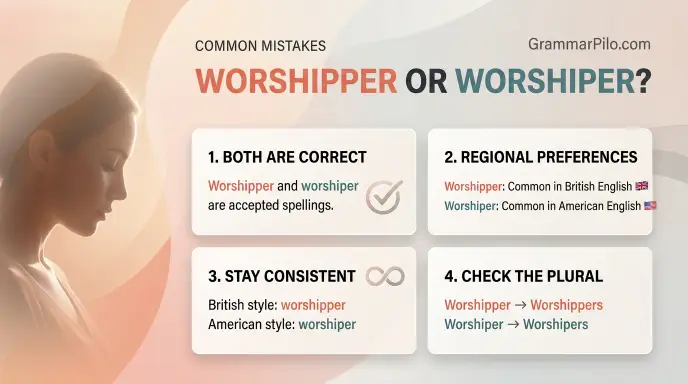
The double p spelling is common in British English, but worshiper is also a recognised spelling. Using the single p form in American English is not automatically a mistake.
Assuming Worshiper Is Always American and Worshipper Is Always British
These are useful general preferences, not absolute rules. Both spellings appear in American writing, and publishers may choose a form based on their preferred dictionary or house style.
Mixing Spellings in the Same Article
Using worshipper in one paragraph and worshiper in another without a reason can make an article look inconsistent.
Inconsistent example:
The worshipper entered the building, and another worshiper followed.
Consistent British style example:
The worshipper entered the building, and another worshipper followed.
Consistent American style example:
The worshiper entered the building, and another worshiper followed.
Confusing the Singular and Plural Forms
The plural form is created by adding -s to the chosen spelling.
- Singular: worshipper or worshiper
- British style plural: worshippers
- American style plural: worshipers
Remember to maintain the same spelling convention in both singular and plural forms.
Everyday Examples of Worshipper and Worshiper
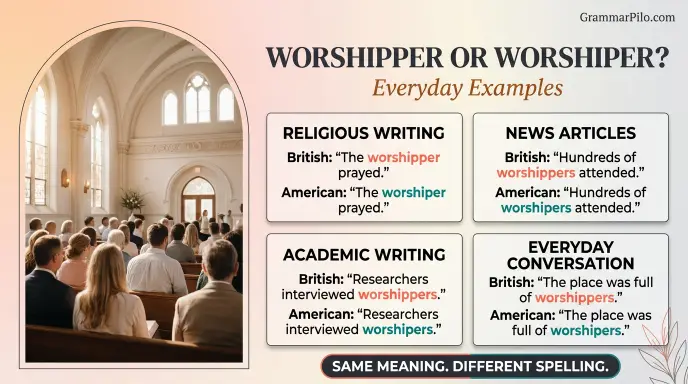
The following examples show how both spellings can be used in religious writing, formal communication, news reporting, and everyday sentences.
In Religious Writing
British style spelling:
- The worshipper prayed before the ceremony began.
- Worshippers gathered at the place of worship.
- Every worshipper was welcomed into the congregation.
American style spelling:
- The worshiper prayed before the ceremony began.
- Worshipers gathered at the place of worship.
- Every worshiper was welcomed into the congregation.
In News Articles
British style spelling:
- Hundreds of worshippers attended the annual celebration.
- The building can accommodate thousands of worshippers.
- Local worshippers described the event as meaningful.
American style spelling:
- Hundreds of worshipers attended the annual celebration.
- The building can accommodate thousands of worshipers.
- Local worshipers described the event as meaningful.
In Academic Writing
British style spelling:
- The study examined the experiences of religious worshippers.
- Researchers interviewed worshippers from several communities.
- The article discusses the role of worshippers in public ceremonies.
American style spelling:
- The study examined the experiences of religious worshipers.
- Researchers interviewed worshipers from several communities.
- The article discusses the role of worshipers in public ceremonies.
In Everyday Conversation
British-style spelling:
- The worshipper arrived early for the service.
- The place was full of worshippers.
- Each worshipper followed the established customs.
American style spelling:
- The worshiper arrived early for the service.
- The place was full of worshipers.
- Each worshiper followed the established customs.
These examples show that the words work in the same grammatical contexts, regardless of the spelling chosen.
Worshipper or Worshiper: Comparison Table
Use this quick reference when deciding which form belongs in your writing.
| Word or phrase | Usage guidance |
| Worshipper or worshiper | Both are correct; regional and editorial preferences differ |
| Worshiper or worshipper | Same meaning, with the spelling order reversed |
| Worshipper vs. worshiper | Compares the common British preferred and American preferred forms |
| Worshiper vs. worshipper | The same comparison in reverse order |
| Worshipper and worshiper | Two accepted spellings of the same noun |
| Worshiper and worshipper | The same two variants in reverse order |
| Worshippers or worshipers | Both are correct plural forms |
| Worshippers vs. worshipers | Choose according to your spelling convention |
The phrases worshipper or worshiper, worshiper or worshipper, worshipper and worshiper, worshiper and worshipper, worshipper vs. worshiper, and worshiper vs. worshipper all refer to the same spelling variation.
Google Trends and Modern Usage
Why Do People Search for Worshipper or Worshiper?
People search for worshipper or worshiper because the words look almost identical, yet dictionaries and publications may display different forms.
Students, writers, religious educators, and editors may want to confirm the spelling before using it in an assignment or published article.
The difference can be especially confusing for people learning English because the final p is doubled in one form but not the other.
Modern Usage in Online Content
Both spellings remain in use. British oriented publications commonly prefer worshipper, while many American publications use worshiper.
However, the double p spelling also appears in American sources, so the distinction should be treated as a general preference rather than an absolute division.
Online articles, dictionaries, religious websites, and academic publications may follow different editorial standards. When exact consistency is important, consult the style guide used by your organisation.
How to Choose a Consistent Spelling
Start by deciding which variety of English your article will follow. Use worshipper if you are following British English conventions or worshiper if your chosen American style guide recommends it.
Avoid claiming that one form is becoming more popular unless you have reliable, current data to support that conclusion.
Search interest and published usage are different measures, and neither should be inferred from spelling preference alone.
Key Takeaways
- Worshipper is commonly preferred in British English.
- Worshiper is commonly used in American English.
- Both spellings refer to a person who worships.
- Both forms are recognised, and worshipper also appears in American writing.
- The plural forms are worshippers and worshipers.
- Neither spelling changes the word’s pronunciation or meaning.
- Follow your publisher’s style guide when one is provided.
- Consistent spelling helps make your writing look polished and professional.
Frequently Asked Questions
1. Is worshipper or worshiper correct?
Both are correct. Worshipper is commonly preferred in British English, while worshiper is a common American English spelling. The two forms have the same meaning.
2. Is worshipper British or American?
Worshipper is particularly associated with British English, but it is also used in American English. It should not be treated as incorrect simply because the audience is American.
3. Is worshiper American or British?
Worshiper is commonly associated with American English. It is an established spelling, although some American publishers and dictionaries also use worshipper.
4. What is the difference between worshipper and worshiper?
The difference is spelling, not meaning. Both words describe a person who worships or expresses religious devotion. The double p form is common in British English, while the single p form is common in American English.
5. What is the plural of worshipper?
The plural of worshipper is worshippers. For example, “Worshippers gathered at the temple before sunrise.”
6. What is the plural of worshiper?
The plural of worshiper is worshipers. For example, “Worshipers gathered at the church before the service.”
7. Should I use worshipper or worshiper in academic writing?
Follow the spelling conventions required by your institution or publisher. British oriented academic writing commonly uses worshipper, while American oriented writing may use worshiper. Check the relevant style guide if the distinction matters.
8. Is worshipper spelled with two Ps?
Yes. Worshipper contains two consecutive p letters before the ending -er. The alternative spelling, worshiper, contains only one p.
9. Can I use worshipper and worshiper in the same article?
It is best to choose one spelling and use it consistently. Both forms are accepted, but switching between them without a clear reason can distract readers and make an article appear poorly edited.
10. Which spelling should I use for an international audience?
Choose the form that matches the main spelling convention of your publication. Worshipper is a practical choice for British oriented international content, while worshiper may suit content following American conventions. Consistency is the key.
Conclusion
The difference between worshipper and worshiper is a matter of spelling preference rather than meaning.
Both words describe someone who worships or shows reverence toward a deity, sacred figure, or object of devotion. The double p form, worshipper, is commonly preferred in British English, while the single p form, worshiper, is widely used in American English.
Neither form should automatically be labelled wrong. The spelling you choose should reflect your audience, the dictionary you follow, and any editorial rules that apply to your writing.
British oriented publications often prefer worshipper, whereas many American publications use worshiper. Both forms are understood by English speakers.
For the clearest and most professional result, decide on a spelling convention before you begin writing and use it consistently throughout your article, essay, or website.
Apply the same choice to plural forms, too: worshippers or worshipers. With this simple approach, you can confidently use worshipper or worshiper in the right context.
You May Also Like

I’m Sloane Mercer, a U.S.-based English language writer focused on grammar, spelling, vocabulary, and everyday English usage. Through GrammarPilo, I provide clear and practical explanations to help readers choose the right words and communicate with confidence.