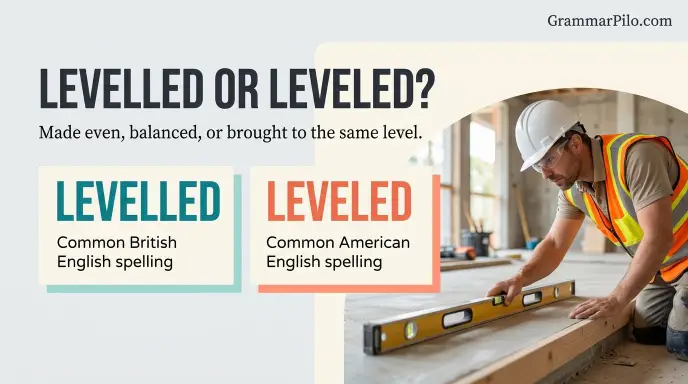
Levelled and leveled are both correct spellings. The difference depends on the type of English you use. Levelled is the common spelling in British English, while leveled is the standard spelling in American English.
Both are past tense and past-participle forms of the verb level, which means to make something flat, even, or equal.
People search for levelled or leveled, leveled or levelled, and levelled vs. leveled because the words look almost identical. The only difference is the extra letter l in levelled. This small change can be confusing, especially for students, bloggers, editors, and people writing for an international audience.
For example, an American writer might say, “The workers leveled the ground before building the house.” A British writer would commonly write, “The workers levelled the ground before building the house.” Both sentences are correct.
Understanding the spelling rule helps you choose the right form in emails, school assignments, business documents, articles, and everyday writing.
This guide explains the meaning, origin, regional differences, common mistakes, and practical examples of levelled and leveled.
Levelled or Leveled: Quick Answer
Use leveled in American English and levelled in British English. Both spellings are correct and have the same meaning.
Examples:
- American English: The workers leveled the ground.
- British English: The workers levelled the ground.
- American English: She leveled the shelf.
- British English: She levelled the shelf.
The spelling difference follows a common regional pattern. American English often keeps one final l when adding endings to certain verbs, while British English often doubles the final l.
| Word | Common usage | Correct? |
| Leveled | American English | Yes |
| Levelled | British English | Yes |
| Leveled | British English | Also accepted in some styles |
| Levelled | American English | Not the usual American spelling |
When comparing levelled or leveled, leveled or levelled, levelled and leveled, leveled and levelled, levelled vs. leveled, and leveled vs. levelled, remember that the meaning stays the same. The choice depends on your spelling style.
Definition and Meaning of Levelled or Leveled
The words levelled and leveled are forms of the verb level. They describe making something flat, even, balanced, or equal. They can also refer to bringing something down or directing something toward a target.
What Does Leveled Mean?
Leveled is the American English past tense and past participle of level.
Examples:
- The workers leveled the ground.
- She leveled the picture frame.
- The company leveled the pay differences between the two roles.
- He leveled the box before placing it on the shelf.
In these sentences, leveled describes an action that happened in the past or an action that has been completed.
What Does Levelled Mean?
Levelled has the same meaning as leveled, but it is the common British English spelling.
Examples:
- The workers levelled the ground.
- She levelled the picture frame.
- The company levelled the pay differences between the two roles.
- He levelled the box before placing it on the shelf.
The word may refer to making a surface even, adjusting an object, or making differences smaller.
What Are the Different Meanings of Level?
The verb level has several uses.
1. To make a surface flat
Example: The workers levelled the soil before planting grass.
2. To make things equal
Example: The new policy levelled the differences in pay.
3. To aim something at a target
Example: The character levelled a tool toward the door.
4. To destroy or knock something down
Example: The storm levelled several old buildings.
Both levelled and leveled can express these meanings. Only the spelling changes between the common regional forms.
Is Levelled or Leveled a Verb?
Yes. Both are verb forms. They are the past tense and past participle of level.
Examples:
- Past tense: The team leveled the surface. (American English)
- Past tense: The team levelled the surface. (British English)
- Past participle: The ground has been leveled. (American English)
- Past participle: The ground has been levelled. (British English)
The base verb is level in both varieties.
The Origin of Levelled and Leveled
The history of these words helps explain why the spelling changes between American and British English.
Where Does the Word Level Come From?
The English word level entered the language through French, with roots connected to the idea of raising, lifting, or bringing something to a flat position. Over time, it developed meanings related to flat surfaces, equal heights, balance, and degrees of measurement.
Today, level can describe a flat floor, a person’s skill level, the amount of water in a container, or the act of making something even.
The verb form follows the same basic meaning. When something is levelled or leveled, it has been made flat, even, or equal in some way.
Why Does British English Use Levelled?
British English commonly doubles the final l in words such as level when adding endings that begin with a vowel. This produces forms such as levelled, levelling, and leveller.
Examples:
- Level → Levelled
- Level → Levelling
- Level → Leveller
This pattern also appears in other British spellings, such as travelled and cancelled.
Why Does American English Use Leveled?
American English commonly uses a different rule for certain verbs ending in an unstressed vowel followed by l. In these cases, the final l often stays single when an ending is added.
Examples:
- Level → Leveled
- Level → Leveling
- Level → Leveler
This pattern also appears in common American spellings such as traveled and canceled.
The difference is a spelling convention, not a change in meaning or pronunciation.
British English vs American English Spelling
British and American English often differ in how they double a final l before adding an ending. The words levelled and leveled are a clear example of this difference.
Levelled vs Leveled in British English
In common British English, use levelled for the past tense and past participle. The present participle is usually levelling.
Examples:
- The builder levelled the ground.
- She is levelling the surface.
- The team has levelled the playing field.
- The workers used a leveller to check the floor.
These spellings follow the usual British convention of doubling the final l.
Levelled vs Leveled in American English
In American English, use leveled for the past tense and past participle. The present participle is leveling.
Examples:
- The builder leveled the ground.
- She is leveling the surface.
- The team has leveled the playing field.
- The workers used a leveler to check the floor.
American English generally keeps one l in these forms.
Comparison Table of British and American Spellings
| Word form | American English | Common British English |
| Base verb | Level | Level |
| Past tense | Leveled | Levelled |
| Past participle | Leveled | Levelled |
| Present participle | Leveling | Levelling |
| Person or tool that levels | Leveler | Leveller |
| Example phrase | Leveled the ground | Levelled the ground |
These are the common regional spellings. Some British publications may follow other style conventions, so check the requirements of your publisher or organization.
Does the Meaning Change Between Levelled and Leveled?
No. Both words mean the same thing. The difference is only in spelling.
For example, “The workers leveled the field” and “The workers levelled the field” describe the same action. One follows American spelling, and the other follows common British spelling.
Which Spelling Should You Use?
Your choice should depend on the audience you are writing for and the spelling rules you need to follow.
For American Readers
Use leveled, leveling, and leveler when writing in standard American English.
Examples:
- The workers leveled the driveway.
- She is leveling the floor.
- The contractor used a leveler.
These forms are common in American newspapers, websites, school assignments, and business writing.
For British Readers
Use levelled, levelling, and leveller when following common British English conventions.
Examples:
- The workers levelled the driveway.
- She is levelling the floor.
- The contractor used a leveller.
These spellings are also common in Australian and New Zealand English.
For Australian and New Zealand Readers
Australian and New Zealand English generally follow the British pattern.
Examples:
- The workers levelled the ground.
- The team is levelling the surface.
- The builder checked the floor with a leveller.
If you are writing for a specific publication, use its preferred spelling style.
For International Readers
Either spelling can be understood by an international audience. The most important thing is to choose one variety of English and use it consistently.
For example, if your article uses colour, favourite, and travelling, the British spelling levelled may fit better. If it uses color, favorite, and traveling, leveled is usually the better choice.
For Students and Professional Writers
Follow the style guide provided by your school, employer, or publisher. If no style guide is available, choose either American or British English and remain consistent.
Professional tip: Do not change only one word in a document. If you use leveled, check related forms such as leveling and leveler as well.
Common Mistakes with Levelled and Leveled
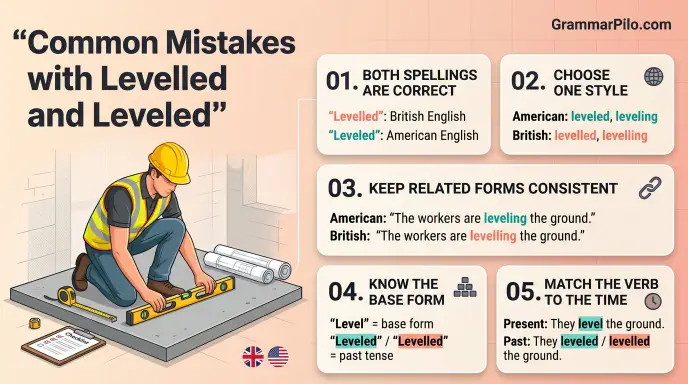
Although both forms are correct, writers can make mistakes by mixing spelling styles or applying the wrong ending.
Mistake 1: Treating Levelled as Always Incorrect
Incorrect claim: “Levelled is a spelling mistake.”
Correct explanation: Levelled is the common British English spelling.
Example: The workers levelled the ground before construction.
This sentence is correct in British English.
Mistake 2: Treating Leveled as Always Incorrect
Incorrect claim: “Leveled is not proper English.”
Correct explanation: Leveled is the standard American English spelling.
Example: The workers leveled the ground before construction.
This sentence is correct in American English.
Mistake 3: Mixing British and American Spellings
Inconsistent example: The workers levelled the ground and then started leveling the floor.
This sentence mixes British and American spellings.
Consistent American English: The workers leveled the ground and then started leveling the floor.
Consistent British English: The workers levelled the ground and then started levelling the floor.
Mistake 4: Forgetting the Present Participle
Writers may correctly use leveled but then write levelling in an American English document.
American English: The workers are leveling the ground.
British English: The workers are levelling the ground.
Check all related forms when editing a document.
Mistake 5: Confusing Levelled with Level
Level is the base form, while levelled and leveled describe a completed action.
Examples:
- Present: They level the ground every year.
- American past tense: They leveled the ground yesterday.
- British past tense: They levelled the ground yesterday.
Use the form that matches the time and grammar of your sentence.
Levelled or Leveled in Everyday Examples
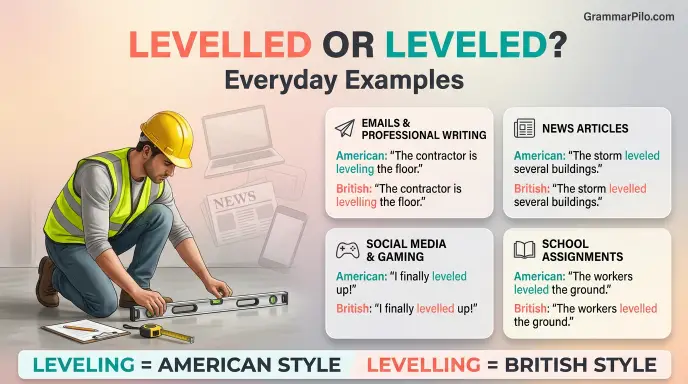
Both spellings appear in daily communication, construction, news reports, schoolwork, and professional writing.
In Emails
American English examples:
- The team leveled the surface before the installation.
- We have leveled the shelves.
- The contractor is leveling the floor.
British English examples:
- The team levelled the surface before the installation.
- We have levelled the shelves.
- The contractor is levelling the floor.
For business emails, follow the spelling style used by your company or client.
In News Articles
Examples:
- The storm leveled several buildings in the region. (American English)
- The storm levelled several buildings in the region. (British English)
- Workers have leveled the damaged road. (American English)
- Workers have levelled the damaged road. (British English)
News publications generally follow a consistent editorial style, so either spelling may appear depending on the publication.
On Social Media
Examples:
- Finally leveled the garden before planting. (American English)
- Finally levelled the garden before planting. (British English)
- The new update leveled the playing field. (American English)
- The new update levelled the playing field. (British English)
The word can also appear in gaming discussions, where leveled up often refers to increasing a character’s level.
In Formal Writing
Examples:
- The contractor leveled the surface to meet the project requirements. (American English)
- The contractor levelled the surface to meet the project requirements. (British English)
- The study examined how the policy leveled differences between groups. (American English)
- The study examined how the policy levelled differences between groups. (British English)
In formal documents, use the spelling that matches the rest of the text.
In School Assignments
American English:
“The workers leveled the ground before building the house. They checked the surface to make sure it was even.”
British English:
“The workers levelled the ground before building the house. They checked the surface to make sure it was even.”
Both examples are correct. The spelling changes, but the meaning remains the same.
Levelled vs Leveled: Google Trends and Usage Data
People search for levelled or leveled, leveled or levelled, and levelled vs. leveled because they want to confirm the correct spelling for their audience.
Search interest can help explain common spelling questions, but it does not decide which form is correct.
Which Spelling Is More Popular?
Leveled is the standard American spelling, while levelled is common in British English and other varieties that follow British spelling conventions.
Search interest can vary by country, time period, and subject. For example, a search about construction may use the word differently from a search about a video game.
A higher number of searches for one spelling does not make the other form incorrect.
Levelled or Leveled by Country
| Country or region | Common spelling |
| United States | Leveled |
| United Kingdom | Levelled |
| Australia | Levelled |
| New Zealand | Levelled |
| Canada | Both forms may appear, depending on style |
| International audiences | Either, used consistently |
These are general spelling conventions, not measured search-volume rankings.
What Can Google Trends Tell You?
Google Trends can compare relative search interest for levelled and leveled across countries and time periods. It reports relative interest rather than exact search counts.
A useful comparison should use the same time range, region, and search settings for both spellings. The results should then be checked before making claims about which country searches for one form more often.
No verified live Trends figures are included here, so exact search volumes, percentages, or country rankings should not be assumed.
Why Do People Search for Levelled vs Leveled?
Common reasons include:
- Spelling checks: Writers want to avoid errors.
- Regional differences: Readers want to understand British and American spelling.
- School assignments: Students need to follow a particular spelling style.
- Professional writing: Businesses want consistent documents.
- Gaming and everyday usage: Users may encounter both spellings online.
The main takeaway is that both forms are correct in their appropriate regional styles.
Levelled and Leveled: Comparison Table of Keyword Variations
This table compares the main keyword variations and related forms.
| Keyword or phrase | Status | Explanation |
| Levelled or leveled | Correct comparison query | Both spellings are accepted. |
| Leveled or levelled | Correct comparison query | Same comparison in reverse order. |
| Levelled and leveled | Correct phrase | Both forms can be discussed together. |
| Leveled and levelled | Correct phrase | Both spellings are valid. |
| Levelled vs. leveled | Correct comparison query | Compares regional spelling preferences. |
| Leveled vs. levelled | Correct comparison query | Same comparison in reverse order. |
| Leveled | Standard American spelling | Past tense or past participle. |
| Levelled | Common British spelling | Past tense or past participle. |
| Leveling | Standard American form | Present participle. |
| Levelling | Common British form | Present participle. |
| Leveler | Standard American form | Person or tool that levels. |
| Leveller | Common British form | Person or tool that levels. |
| Level | Correct base verb | The workers level the ground. |
| Leveled up | Common American form | Increased a level, often in a game. |
| Levelled up | Common British form | Increased a level, often in a game. |
How to Remember the Difference
Use this simple rule:
- American English: Level, leveled, leveling.
- Common British English: Level, levelled, levelling.
Think of the double l in levelled as a common British spelling pattern. Remember that the meaning stays the same in both forms.
Frequently Asked Questions About Levelled or Leveled
1. Is it levelled or leveled?
Both are correct. Leveled is the standard American English spelling, while levelled is the common British English spelling.
2. Is levelled British or American English?
Levelled is commonly used in British English, Australian English, and New Zealand English. American English normally uses leveled.
3. Is leveled correct in British English?
The spelling leveled may appear in British English, but levelled is the usual British form. Follow the style guide required by your publication.
4. Do levelled and leveled mean the same thing?
Yes. Both are past tense and past-participle forms of level. They can mean making a surface flat, making things equal, or bringing something down.
5. Is it leveling or levelling?
Both are correct. Leveling is standard in American English, while levelling is common in British English.
6. Is it leveled up or levelled up?
Both forms are correct. American English commonly uses leveled up, while British English commonly uses levelled up. The phrase often appears in gaming when a character gains a level.
7. How can I remember levelled vs leveled?
Remember that American English usually uses one l in leveled, while British English commonly doubles it in levelled. Keep the same spelling pattern in related forms such as leveling and levelling.
Conclusion: Levelled or Leveled, Which Should You Choose?
The choice between levelled or leveled depends on the English spelling style you follow. Both words are correct and have the same meaning. The main difference is the extra l in the common British spelling.
In American English, use leveled, leveling, and leveler. In common British English, use levelled, levelling, and leveller. These forms describe making something flat, even, balanced, or equal. They may also appear in phrases such as leveled up or levelled up.
For school assignments, business emails, articles, and professional documents, follow the spelling rules required by your audience or publication. If there is no specific style guide, choose either American or British English and remain consistent throughout your writing.
Remember that neither levelled nor leveled is universally wrong. The right choice is the one that matches your chosen spelling convention.
The easiest rule to remember is this: Use leveled for standard American English and levelled for common British English. Both forms are correct when used consistently.
You May Also Like Related Article

I’m Claire Morgan, the author behind Grammarpilo.com, where I write about English grammar, sentence structure, punctuation, and everyday language. My goal is to make grammar simple, clear, and practical, helping readers understand the rules and apply them with confidence in real-world writing.